👻 HAUNTED PLACE · EXP. Nº0482
ACTIVE
Villa Fraccaroli
Villa Fraccaroli is a location reputed to be haunted in Veneto, IT. Its reputation comes from reported apparitions, unexplained phenomena and eyewitness accounts gathered over time.
Where is Villa Fraccaroli?
- Location
- Veneto, IT
- Type
- House / mansion
- Coordinates
- 45.756, 11.43
- Testimonies
- 0
- Last updated
LOCATION
Why is Villa Fraccaroli said to be haunted?
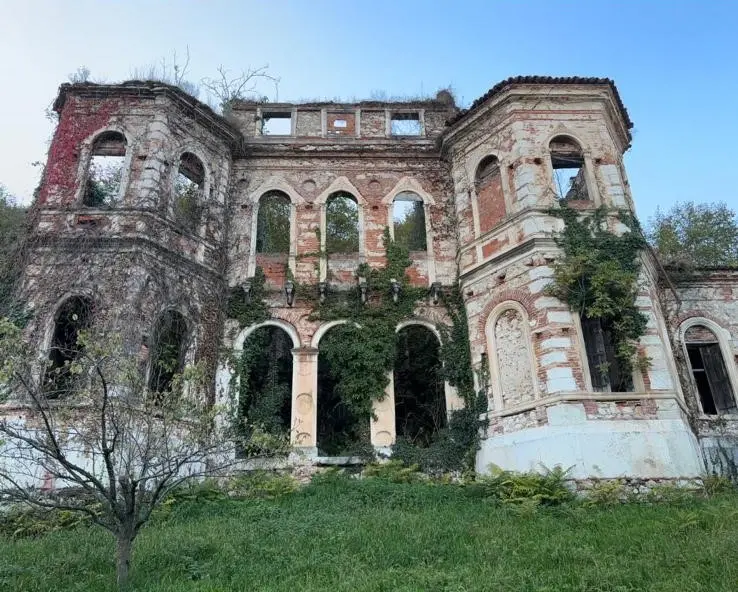
Villa Fraccaroli, at Piovene Rocchette north of Vicenza, is known in its own town only by its nickname: the Castle of Spirits. Ask for it by its catalogue name and you get shrugs — a local historian wrote as much in 2016, and a reporter proved it by accident in 2022, when it took a barman to point her at the Villa degli Spiriti down the road. Begun in 1853 to a design by the Vicentine architect Antonio Caregaro Negrin for Paolina Carlotta Fraccaroli, it never got past roof level: a notarial deed of January 1909 already calls the main building uninhabitable and long abandoned because unfinished. The war did the rest. After May 1916 the front reached the Astico valley, the town's factories were bombed and its people evacuated twice. The story attached to the ruin says a girl was killed by a beam being hoisted to close the roof, and that her ghost is still there. The local historian who rebuilt the whole chronology from cadastral maps and notarial deeds found no accident, no death and no black magic in any of them. The oldest datable printed version of the legend is from May 2014, and it ends by denying itself.
What is the history of Villa Fraccaroli?
Villa Fraccaroli is not a villa, and it never was one. It is the shell of a palazzino begun in 1853 at Piovene Rocchette, at the mouth of the Astico valley in the Venetian Pre-Alps, and never finished. The Istituto Regionale per le Ville Venete does not catalogue it on its own but as part of a single complex — "Villa Verlato, Fraccaroli, Ballarin, Filippi Chiappin, Chiappin", record VI 399 of 2005 — whose older buildings are dated to the 16th and 17th centuries and whose palazzo is dated to the 19th. The record, in its own wording, protects the complex under Italy's heritage law 1089/1939, gives the palazzo's condition as "pessimo", and its access as "non visitabile". Villa Fraccaroli is, in short, a catalogue name. In the town the building has a different one.
When the local historian Renzo Priante published his account of it in January 2016, he opened with a thought experiment: a stranger who stops in Piovene and asks for Villa Fraccaroli will get blank faces and shrugs, while the same stranger who adds "the one they also call the palace of the spirits" will have several hands pointing at once. Six years later a reporter for the Vicenza daily VicenzaPiu, Maria Cristina Strocchi, ran that experiment for real without knowing it: she asked residents for Villa Fraccaroli, nobody recognised the name, and it took a barman to tell her that the Villa degli Spiriti was a little further down the road. Two independent tests, six years apart, of the same modest fact — the nickname is the only name the building has locally.
The palazzino belongs to the history of the Verlato family, whose 16th-century villa stands immediately beside it. The Verlato heiress Lucia married a Fraccaroli; their daughter Paolina Carlotta Fraccaroli inherited the property on 10 March 1853 and married Francesco Dalla Negra, a landowner of Arzignano, in the same year. (The sources disagree on her father's given name — the English Wikipedia article calls him Alessandro, an Italian blog post of 2014 calls him Innocenzo, and the archival chronology names neither — so this file does not name him.) The architect was Antonio Caregaro Negrin, born in Vicenza on 13 June 1821 and dead there on 26 December 1898, who had restored the stage of Palladio's Teatro Olimpico in 1847 and been made an Olympic Academician for it. Franco Barbieri's entry on him in the Dizionario Biografico degli Italiani (vol. 20, 1977) lists "il palazzino Fraccaroli (1853) a Piovene" among his works: the plainest scholarly confirmation there is of both the date and the attribution.
The building is documented from the year it was begun, and documented as unfinished. The manuscripts of the local chronicler Bressan record it as "Palazzino Fracaroli (non ancora compiuto) di stile lombardo, costruito nel 1853, su disegno dell'arch. Antonio Negrin" — already, in 1853, not yet completed. Two years later the Vicentine novelist Jacopo Cabianca praised in print the "fantastico palazzino di Madama Fraccaroli – Dalla Negra a Piovene", admiring how Negrin had married the elegance of the facades to a comfortable distribution inside. He was praising a design, not a household. The reason it stopped is banal and dated: on 14 April 1853, a month after inheriting, Paolina Carlotta gave birth to a son, Scipione Dalla Negra, at Arzignano — some 26 km away in a straight line, and where her husband's land was. Construction reached roof level and the ground floor was made habitable; the piano nobile was left rough. No wedding was ever celebrated there and no child was ever born there.
What follows is a chain of sales, and for a ruin the paperwork is unusually exact. On 18 July 1870 the whole property went to Lucia Franceschi, widow Ballarin, and her son Giacomo; on 10 May 1875 Giacomo inherited it; on 6 May 1891 it passed to Francesco Ballarin and his brothers. Then, on 28 January 1909, deed number 1262 before Domenico Maddalena, notary at Schio, transferred it to the Filippi family — and the deed gives its reason for the price in a line worth quoting: "Si dichiara che nella valutazione del prezzo fu tenuto conto della condizione d'inabitabilita del fabbricato principale, da tanto tempo abbandonato perche non compiuto". The price took account of the uninhabitable condition of the main building, long abandoned because unfinished. Five years before the war, the palazzino was already a ruin on paper. The last recorded heirs are of 1955 and 1956.
Then the war came, and it came to the door. After the Austro-Hungarian Strafexpedition of May 1916 the Astico valley became front line, and Monte Summano, on whose lower slopes the town sits, was dug through with tunnels and trenches. Piovene's industry — the Rossi works, later Lanerossi, and the Summano-Zanella brewery — was bombarded and destroyed, and the population was evacuated; the Italian Wikipedia article on the comune dates the two evacuations to July 1916 and November 1917, and Priante's own history of the town's industry gives 1916 without a month. Bernardetta Ricatti Tavone, the standard authority on Caregaro Negrin, wrote in 1980 that everything built "fu gravemente danneggiata durante la prima guerra mondiale, poiche l'edificio fu adibito ad usi militari" — gravely damaged during the First World War, because the building had been put to military use. Local accounts add that the left wing was destroyed and never rebuilt.
Here the file has to be honest about a gap rather than close it. The cadastral maps of 1934 and of 1964 still draw the 19th-century block complete with its south wing, and Priante, who reproduces them, warns both that the cadastre has always drawn this building differently from how it actually stands and that the collapse of the wing is a supposition rather than a record. No source I could reach dates the damage to a day, or to a raid. The English Wikipedia infobox gives 1917; it cites nothing for that year, and this file does not repeat it.
The ghost, finally, belongs to a far shorter history than the building. The earliest dated version I could fix in print is of 24 May 2014, on the Italian blog Pensiero spensierato, where a writer signing as Ladyghost tells it in full — a girl killed by one of the heavy beams being hoisted to close the roof, struck on the head — and then, in the same post, denies it flatly. On 28 January 2018 VicenzaToday published the story and, to its credit, named its source at the foot of the page: the Facebook page "Veneto Segreto". Its paragraph on the war is word for word Priante's. On 6 January 2021 AltoVicentinOnline reported the ruin "becoming a star on the web" after posts on the Facebook pages "Luoghi abbandonati" and "Sei di Piovene se" drew thousands of likes, and quoted the circulating description at length — with a new turn: the roof is missing because the girl's ghost destroys whatever is built. VicenzaPiu retold it in September 2022. On 15 November 2024 an English Wikipedia article on the villa was started through the article wizard, four days after the photograph on this page had been uploaded to Wikimedia Commons; the two accounts involved have names that both begin with LIUC. Every link in that chain is more than a century younger than the ruin it explains.
Timeline: the documented record of Villa Fraccaroli
- 10 March 1853 Paolina Carlotta Fraccaroli inherits the Piovene property and marries Francesco Dalla Negra, a landowner of Arzignano, in the same year. The date comes from the cadastral and notarial chronology of the 1997 Sala-Cavedon thesis.
- 1853 The manuscripts of the local chronicler Bressan record the building for the first time, and already as unfinished: "Palazzino Fracaroli (non ancora compiuto) di stile lombardo, costruito nel 1853, su disegno dell'arch. Antonio Negrin".
- 14 April 1853 A month after inheriting, Paolina Carlotta gives birth to a son, Scipione Dalla Negra, at Arzignano, about 26 km away, where her husband's land was. The building work stops around this point and never resumes.
- 1855 The Vicentine novelist Jacopo Cabianca praises in print the "fantastico palazzino di Madama Fraccaroli – Dalla Negra a Piovene". It is the earliest published notice of the building I could locate.
- 18 July 1870 The whole property is sold to Lucia Franceschi, widow Ballarin, and her son Giacomo. It will change hands again in 1875 and 1891 without anyone finishing the palazzino.
- 28 January 1909 Deed no. 1262 before Domenico Maddalena, notary at Schio, transfers the property to the Filippi family, stating that the price allowed for the main building being uninhabitable and "long abandoned because unfinished". Five years before the war.
- 1916 After the Strafexpedition of May 1916 the front reaches the Astico valley. Piovene's factories are bombarded and destroyed and the population evacuated; the Summano-Zanella brewery is hit the same year.
- November 1917 Second evacuation of Piovene, according to the Italian Wikipedia article on the comune, which dates the two displacements to July 1916 and November 1917. No source I could reach dates the damage to the palazzino to a particular day or action.
- 1934 A new cadastral map still draws Palazzo Fraccaroli complete with its south wing, as does the map of 1964. Priante warns that the cadastre has always depicted this building differently from how it really stands.
- 1977 Franco Barbieri's entry on Antonio Caregaro Negrin in the Dizionario Biografico degli Italiani (vol. 20) lists "il palazzino Fraccaroli (1853) a Piovene" among the architect's works, confirming date and attribution in a scholarly reference work.
- 1980 Bernardetta Ricatti Tavone's monograph on Caregaro Negrin states that the built part was gravely damaged in the First World War because the building had been put to military use. The passage is quoted by Priante.
- 1996-97 academic year Marcella Sala and Luca Cavedon defend at the IUAV in Venice a thesis on recovering the ruin of Palazzo Fraccaroli and Villa Verlato. Its chronology of cadastral and notarial records is the documentary backbone of the case.
- 2005 The Istituto Regionale per le Ville Venete catalogues the complex as record VI 399: buildings of the 16th-17th centuries plus a 19th-century palazzo by Caregaro Negrin, protected under law 1089/1939, palazzo in "pessimo" condition, "non visitabile".
- 24 May 2014 Earliest dated printed version of the legend I could fix: on the blog Pensiero spensierato, a writer signing as Ladyghost tells of a girl killed by a beam being hoisted to close the roof — and in the same post denies there is any ghost, curse or satanic rite.
- 30 January 2016 Renzo Priante publishes on Accogliamo le Idee the archival account of the building, with the thesis chronology, the deeds and the plans. It contains the nickname and no ghost: no accident, no death and no black magic appear anywhere in it.
- 28 January 2018 VicenzaToday prints the ghost story and names its source at the foot of the page: the Facebook page "Veneto Segreto". Its paragraph on the First World War is word for word Priante's from 2016.
- 6 January 2021 AltoVicentinOnline reports the ruin going viral on the Facebook pages "Luoghi abbandonati" and "Sei di Piovene se", and records a new turn: the roof is missing because the girl's ghost destroys whatever is built. The same article explains the night noises by the ruin's lack of roof and windows.
- 3 September 2022 Maria Cristina Strocchi reports in VicenzaPiu that she asked residents of Piovene for Villa Fraccaroli, nobody knew the name, and it took a barman to mention the Villa degli Spiriti — an unwitting repetition of Priante's 2016 test.
- 15 November 2024 An English Wikipedia article on the villa is started through the article wizard, four days after the photograph used on this page was uploaded to Wikimedia Commons (11 November 2024) by an account with a similar name. Several of its claims about the Fondo Ambiente Italiano do not survive checking against the FAI's own page.
Is there a rational explanation for Villa Fraccaroli?
The most detailed account of this building available to anyone — Renzo Priante's, built on cadastral maps, notarial deeds and a 1997 degree thesis from the IUAV in Venice by Marcella Sala and Luca Cavedon — contains no accident at all. Searched for the words the legend needs, it gives trave (beam) 0, morte 0, incidente 0, fantasma 0, magia 0 and caduta 0. The control, run over the same text on terms it certainly does use: 1853 appears 5 times, guerra 6, 1909 twice, and spiriti 7 — every one of the seven as the nickname, never as an event. A source that records the day of a sale in 1870 and the number of a deed in 1909 is a source that records dated happenings. It records no dead child.
The ruin explains the story better than the story explains the ruin. There is no roof and there are no windows, and a small wood grows in the rooms. Two readers left the detail in the comments under Martina Polelli's 2018 post: Renzo Priante wrote that it is a ruin, a palace never finished since 1853, which "for a period had a roof and was partly inhabited"; a reader signing as Roberto added that there are no floors inside and no plaster on the walls. AltoVicentinOnline drew the obvious conclusion itself in 2021: people who hear odd noises at night are not making them up, "given that the villa is right up against the inhabited area and has neither windows nor roof". The grotesque figures beneath the stone corbels over the three arches of the street front, which the legend reads as talismans commissioned to keep spirits away, are described by every local source as what they are — buttresses — and by Ricatti Tavone as supports drawn from the medieval zoomorphic repertoire that Negrin liked. They are visible in the photograph on this page, and so is everything else the sceptical reading needs: open sky through the upper windows, ivy in the arcade, no roof.
The legend is also etiological, which is the tell. In its 2021 form the ghost exists in order to explain why the roof was never closed — the girl destroys whatever is built. The documented explanation is duller and far better attested: an heiress who inherited on 10 March 1853, married that year, gave birth 26 km away on 14 April, and did not come back.
Two claims that circulate need correcting here rather than in a footnote. The Fondo Ambiente Italiano has not recognised this building, has not placed it on any restoration list and has not fenced it: its FAI page is an entry in "I Luoghi del Cuore", a public nomination-and-vote census, with nominations recorded in the 2010, 2016, 2018, 2020 and 2022 rounds, no description written for it and no intervention on record. The gate is real, but the local post that first mentions it, in 2018, calls it simply a gate added afterwards and attributes it to nobody.
And there is no ticket office. Nobody here sells this story: the property is private, shut, and not on any tour.
Can you visit Villa Fraccaroli?
Piovene Rocchette lies about 25 km north-north-west of Vicenza in a straight line, measured from the pin of this file to the coordinates Wikipedia gives for Vicenza (45.55 N, 11.55 E). The palazzino is on Via Libertà, at the northern end of the town. Renzo Priante describes the approach on foot down Via Libertà towards Santorso, where the road narrows: a long high wall, a breach through which a meadow can be seen, and at the far end of it, almost under the mountain, a ruin of high walls with two polygonal turrets. Martina Polelli's blog Love Velo d'Astico places it on the right on the way down towards Santorso, and notes that it can be glimpsed from Via Trento at the level of Via Filzi. The pin, 45.7564 N 11.4298 E, taken from the infobox of the English Wikipedia article, is about 46 m from Via Libertà in the OpenStreetMap data of 31 May 2026.
The sources give three addresses. The catalogue record VI 399 (2005) of the Istituto Regionale per le Ville Venete gives Via Libertà 150 for the whole complex, which it registers under the name Villa Verlato, Fraccaroli, Ballarin, Filippi Chiappin, Chiappin, with cadastral sheet 5, parcels 591, 592, 593 and 960. Love Velo d'Astico and the English Wikipedia infobox give Via della Libertà 219. The FAI's I Luoghi del Cuore census gives Via Sant'Eurosia 61, and lists the building in its campaigns of 2010, 2016, 2018, 2020 and 2022.
The same IRVV record describes the complex as private property, protected under Law 1089 of 1939, and marks it "Visitabile: NO". It rates the main building and its rustic wing, both of the sixteenth to seventeenth centuries, as in good condition, and the unfinished nineteenth-century palazzo by Antonio Caregaro Negrin as "pessimo". Love Velo d'Astico wrote in 2018 that the property is closed by a gate added later, a deterrent for those who went round the rooms at night. AltoVicentinOnline reported in January 2021 that until a few years before many young people from the Vicenza area had dared each other to sleep at night inside the ruined walls, and pointed out that the villa has neither windows nor roof.
The documentation is largely online. The IRVV record can be read at culturaveneto.it, and Franco Barbieri's entry on Caregaro Negrin in volume 20 (1977) of the Dizionario Biografico degli Italiani is on the Treccani website. Priante's article of 30 January 2016 reproduces the chronology from the degree thesis of the architects Marcella Sala and Luca Cavedon, written at the IUAV in Venice in the academic year 1996-97 under Patrizia Paganuzzi, which he calls the most complete source on the two villas.
Sources consulted
- Renzo Priante, «Villa Fraccaroli» — Accogliamo le Idee (cultura e società, Piovene Rocchette), 2016 web
- Istituto Regionale per le Ville Venete / Regione del Veneto, «Villa Verlato, Fraccaroli, Ballarin, Filippi Chiappin, Chiappin — scheda VI 399 del Catalogo delle Ville Venete» — Catalogo delle Ville Venete (culturaveneto.it), 2005 archive
- Franco Barbieri, «CAREGARO NEGRIN, Antonio» — Dizionario Biografico degli Italiani, vol. 20, Istituto della Enciclopedia Italiana, 1977 academic
- Redazione, «Piovene Rocchette, Villa Fraccaroli: il mistero della bimba fantasma» — VicenzaToday (capture of 7 May 2018 in the Wayback Machine; the live page returns 403/502), 2018 newspaper archive
- Maria Cristina Strocchi, «Veneto misterioso: Villa Fraccaroli, la "leggenda" della casa degli Spiriti a Piovene Rocchette in provincia di Vicenza» — VicenzaPiù / vipiu.it (capture of 3 September 2022 in the Wayback Machine; the live page returns 403), 2022 newspaper archive
- Redazione (firmado A.B.), «Piovene. La leggenda della bimba morta e Villa Fraccaroli spopolano nel web. Video e fotogallery» — AltoVicentinOnline, 2021 newspaper archive
- Ladyghost, «Villa Fraccaroli: il castello stregato degli spiriti» — Pensiero spensierato (blog), 2014 web
- Martina Polelli, «Villa Fraccaroli, il Castello degli Spiriti di Piovene» — Love Velo d'Astico (blog local), 2018 web
- FAI — Fondo per l'Ambiente Italiano, «PALAZZINO FRACCAROLI (CASA DEGLI SPIRITI) — ficha del censo I Luoghi del Cuore» — fondoambiente.it, 2026 web
- Renzo Priante, «Un secolo e mezzo di storia industriale e operaia» — Accogliamo le Idee (cultura e società, Piovene Rocchette), 2014 web
- Wikipedia in italiano, «Piovene Rocchette (sección sobre la Primera Guerra Mundial)» — it.wikipedia.org, 2026 web
- English Wikipedia (artículo creado en 2024), «Villa Fraccaroli» — en.wikipedia.org, 2026 web
Reviewed by V. Serrano on 2026-09-07 · How we verify our content
📎 Source: Wikipedia (CC BY-SA)
💬 Field testimonies (0)
No testimonies yet. Add the first.
Add your testimony
🔒 Log in to add a testimony