👻 HAUNTED PLACE · EXP. Nº9474
ACTIVE
Bermuda Triangle
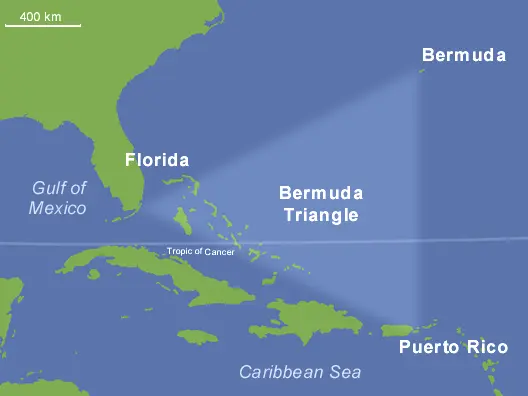
Loosely bounded by Miami, Bermuda and Puerto Rico, the Bermuda Triangle got its nickname in a February 1964 Argosy article by Vincent Gaddis, though the idea predates him: an Associated Press wire story in 1950 and a Fate article in 1952 already described the area as a place of disappearances.
Where is Bermuda Triangle?
- Location
- Unknown
- Type
- Other
- Coordinates
- 25.0, -71.0
- Last updated
LOCATION
Why is Bermuda Triangle said to be haunted?
The case that launched the legend was Flight 19: five US Navy Avenger bombers vanished during a training exercise on 5 December 1945, along with the flying boat sent to look for them. Writers through the 1960s and 70s piled on further losses, from the freighter USS Cyclops in 1918 to the tanker SS Marine Sulphur Queen in 1963, attributing them to everything from methane to aliens. In 1975 Larry Kusche went through the cases one by one against the original files and found that many had happened far outside the area, in documented storms, or had not happened at all. NOAA holds today that there is no evidence ships and planes disappear there any more often than anywhere else in heavily travelled ocean.
What is the history of Bermuda Triangle?
Most legends have no birthday. This one does, and it can be traced almost month by month through a stack of American magazines.
The chain begins on 16 September 1950 with an Associated Press feature by E. V. W. Jones, Sea's Puzzles Still Baffle Men in Pushbutton Age, carried by newspapers including the Miami Herald in the days that followed. Two years later George X. Sand expanded on it in Fate as Sea Mystery at Our Back Door (October 1952). In April 1962 the American Legion Magazine ran The Mystery of the Lost Patrol by Allan W. Eckert, an account of five Navy aircraft lost in 1945 which, in Larry Kusche's later judgement, "included fictionalized, dramatized messages that would be attributed to Flight 19 by many of the later" writers. Those invented radio calls are still quoted today as if they were transcripts.
The name itself arrived in February 1964, on page 29 of Argosy, a men's pulp adventure magazine. The article was The Deadly Bermuda Triangle, by Vincent H. Gaddis, and its definition was really a drawing instruction: "Draw a line from Florida to Bermuda, another from Bermuda to Puerto Rico, and a third line back to Florida through the Bahamas. Within this roughly triangular area, known as the 'Bermuda Triangle,' most of the total vanishments have occurred." Gaddis widened it in the next breath — others, he wrote, had happened in adjacent areas north and east in the Atlantic, south in the Caribbean and west in the Gulf of Mexico — without saying how far those adjacent areas ran; and he asserted that the losses "total far beyond the laws of chance" without saying what the laws of chance were.
From there it compounded. Ivan T. Sanderson folded the Triangle into a global scheme of "Vile Vortices" in Argosy in August 1968. Richard Winer published The Devil's Triangle with Bantam in 1974 and made a television documentary. And on 29 September 1974 Doubleday published The Bermuda Triangle by Charles Berlitz with J. Manson Valentine — the book that fixed the legend in the mass market. Kirkus Reviews called it spellbinding while noting, drily, that Berlitz's speculations about lost civilisations and UFOs read as more plausible than his earlier chapters on the actual missing ships.
Underneath all of it sits one genuine disaster, and it is worth telling from the record rather than from the magazines.
On the afternoon of 5 December 1945, five TBM Avenger torpedo bombers took off from Naval Air Station Fort Lauderdale at about 14:10 to fly Navigation Problem No. 1: 091 degrees for 56 miles to Hens and Chickens Shoals, about half an hour of low-level bombing practice, another 67 miles on 091, then 346 degrees for 73 miles and 241 degrees for 120 miles home. The instructor was Lieutenant Charles Carroll Taylor, USNR, a combat veteran of USS Hancock with 2,509.3 flying hours, 606 of them in the Avenger. The four other pilots — one Navy, three Marines — had roughly 300 hours each, about 60 in type. It was Taylor's first time leading this particular syllabus flight; he had arrived from NAS Miami only a fortnight earlier.
Two details from the pre-flight belong in any honest account. All five aircraft were missing their 24-hour clocks, a commonly pilfered item, which was not treated as a reason to cancel because every pilot was supposed to carry a wristwatch. And Taylor turned up late for the briefing and asked the duty officer to find another instructor, giving no reason. No relief was available and the request was refused.
Trouble began around 15:40. Lieutenant Robert F. Cox, the senior flight instructor, airborne over the field as FT-74, heard a voice asking a trainee for a compass reading, then the trainee replying: "I don't know where we are. We must have got lost after that last turn." When Cox made contact, Taylor told him: "Both my compasses are out and I am trying to find Fort Lauderdale, Fla. I am over land but it's broken. I am sure I'm in the Keys but I don't know how far down and I don't know how to get to Fort Lauderdale." He was not in the Keys. He was somewhere over the northern Bahamas, in the opposite direction.
What follows in the board's transcript is a slow, unbearable divergence. Taylor was told to fly 270 degrees, west, toward the sun — the standing instruction for any lost aircraft out of Fort Lauderdale. Believing he was south of Florida, he refused, because west would have taken him into the Gulf of Mexico. Asked to move to the search-and-rescue frequency, he answered: "I cannot switch frequencies. I must keep my planes intact." At least two students were heard saying "Dammit, if we could just fly west we would get home; head west, dammit." Around 17:50 six direction-finding stations placed him in a 100-mile circle near 29 degrees north, 79 degrees west, well north of the Bahamas — and, as Rear Admiral Samuel J. Cox put it in 2021, no one thought to broadcast that fix in the blind for the flight to hear. The last garbled call was a plan: "when the first plane drops below ten gallons, we all go down together."
The rescue aircraft was a second catastrophe, and a better-documented one. Training 49, a PBM-5 Mariner under Lieutenant (j.g.) Walter G. Jeffrey, made a routine call at 19:30 after leaving NAS Banana River. At 19:50 the tanker SS Gaines Mills reported "leaping flames 100 feet high and burning for ten minutes", then sailed through a pool of oil finding no one; the escort carrier USS Solomons had the aircraft on radar and watched it vanish at that exact place and time. Mariners were nicknamed "flying gas tanks", and the board's questioning dwelt at length on fuel vapour and smoking rules.
Five days of searching over more than 250,000 square miles of the Atlantic and the Gulf produced nothing at all: fourteen men lost on the Avengers, thirteen on the Mariner, twenty-seven in total.
Timeline: the documented record of Bermuda Triangle
- March 1918 The collier USS Cyclops disappears between Barbados and Baltimore with 10,800 tons of manganese ore. Records obtained from Germany after the First World War later rule out U-boats and mines: none were in the area.
- 5 December 1945 Five TBM Avengers of Flight 19 are lost on a navigation exercise out of NAS Fort Lauderdale, along with the PBM Mariner Training 49 sent to look for them. Twenty-seven men die and nothing is ever found.
- 30 January 1948 The airliner Star Tiger is lost approaching Bermuda. The British Ministry of Civil Aviation calls it the most baffling problem ever presented for investigation, yet its own report lists recurring unrepaired defects and headwinds that regularly beat the forecast.
- 16 September 1950 Associated Press releases Sea's Puzzles Still Baffle Men in Pushbutton Age, by E. V. W. Jones. Gaddis himself would later list it as the first text to describe the region as a place of mysterious disappearances.
- October 1952 George X. Sand expands the idea in Fate magazine under the title Sea Mystery at Our Back Door.
- April 1962 The American Legion Magazine publishes The Mystery of the Lost Patrol by Allan W. Eckert. Kusche identifies it as the source of the dramatised radio messages that later writers would quote as authentic transcripts of Flight 19.
- February 1963 The tanker Marine Sulphur Queen is lost with 39 men. A US Coast Guard Marine Board of Investigation records force 6 to 11 winds nearby, molten sulphur agitated by the sea and tank venting that failed to clear the gases.
- February 1964 Vincent H. Gaddis publishes The Deadly Bermuda Triangle on page 29 of Argosy and gives the area its name, defining it as three lines drawn between Florida, Bermuda and Puerto Rico — then immediately extending it to "adjacent areas" he never bounds.
- 1965 The Argosy article becomes chapter 13, The Triangle of Death, of Gaddis's book Invisible Horizons (Chilton, Philadelphia), which carries the name from the newsstand into libraries.
- August 1968 Ivan T. Sanderson absorbs the Triangle into a worldwide grid of "Vile Vortices" in Argosy, the point at which the story stops being about one stretch of the Atlantic.
- June 1973 Naval Aviation News publishes Lost Patrol by Michael McDonell, which prints the popular version of Flight 19 as folklore and then rebuilds the flight from the Board of Investigation record.
- June 1974 The Military Sealift Command magazine Sealift runs Exorcizing the Devil's Triangle, which calls most of the supernatural explanations "a voluminous mass of sheer hokum" and notes that USS Scorpion, often credited to the Triangle, sank near the Azores.
- 29 September 1974 Doubleday publishes The Bermuda Triangle, by Charles Berlitz with J. Manson Valentine, the book that carries the legend into the mass market.
- October 1975 Lawrence David Kusche publishes The Bermuda Triangle Mystery—Solved, a case-by-case audit built on original records, and concludes that the legend is "a manufactured mystery" born of careless research.
- 4 January 2010 NOAA's National Ocean Service posts its standing statement: no official map delineates the Triangle, the US Board on Geographic Names does not recognise it, and there is no evidence of a higher rate of disappearances there than anywhere else.
- November 2015 Forty years on, Kusche returns to the case in the Skeptical Inquirer, admits he had hoped the mysteries were real because the first hardcover would have been a bestseller, and calls the Triangle one of the most widespread frauds ever perpetrated.
- January 2021 Rear Admiral Samuel J. Cox, director of Naval History and Heritage Command, restates the Navy's position: the cause was never determined, nobody transmitted the radio fix to the lost flight, and it "most certainly wasn't due to aliens or the Bermuda Triangle".
Is there a rational explanation for Bermuda Triangle?
The Navy did not wait for outside sceptics. In June 1973 Naval Aviation News published Lost Patrol by Michael McDonell, which set out "the popular version" of Flight 19 — the confused voices, the strange-looking ocean, the white water — and then, having quoted it as folklore, reconstructed the flight from the Board of Investigation record. In June 1974 the Military Sealift Command magazine Sealift ran Exorcizing the Devil's Triangle, blunter still: most of the supernatural explanations, it concluded, "amount to a voluminous mass of sheer hokum, extrapolated to the nth degree". One awkward consequence is that the dramatised dialogue whose earliest known source is Eckert's 1962 piece still turns up on official pages, including the Naval History and Heritage Command's own popular summary of the loss.
The systematic demolition came in 1975, from an unlikely quarter. Lawrence David Kusche was a reference librarian at Arizona State University's Hayden Library and a commercial pilot and flight instructor with several thousand hours. Students kept asking him for sources on the Triangle and there were none, so he began compiling a bibliography with a colleague, Deborah Blouin. He then did what no previous writer had done: he went to the originals — New York Times and London Times indexes on microfilm, Lloyd's casualty records, Coast Guard and Navy files, and the official Board of Investigation into five missing TBM airplanes and one PBM airplane. He is candid about his motive. "Early on," he wrote in 2015, "I hoped to find that the mysteries were true, because I knew the first hardcover book on the market would be a huge bestseller."
What he found instead, case by case, was that the mystery was largely an artefact of copying: "The Legend of the Bermuda Triangle is a manufactured mystery. It began because of careless research and was elaborated upon and perpetuated by writers who either purposely or unknowingly made use of misconceptions, faulty reasoning, and sensationalism."
Two failure modes recur. The first is geography. The German bark Freya, found dismasted and abandoned in 1902 and listed for decades as a Triangle victim, appears in Lloyd's Register's wreck return for 1900-1904 as lost near Mazatlán — in the Pacific, on the wrong side of Mexico. The submarine USS Scorpion was found by USNS Mizar about 400 miles south-west of the Azores, a fact the Navy's own Sealift article points out with some impatience. The Japanese freighter Raifuku Maru is usually said to have radioed "It's like a dagger! Come quick" across a calm sea in April 1925; the contemporary account Kusche reproduces has her sending "Now very danger. Come quick", listing thirty degrees in mountainous seas at 41 degrees 43 minutes north, 61 degrees 39 minutes west — some 400 miles from Boston and 700 miles north of Bermuda, outside anybody's triangle.
The second is weather that the storytellers left out. The Marine Sulphur Queen, lost with 39 men in February 1963, was investigated by a US Coast Guard Marine Board of Investigation whose findings Kusche quotes at length: the SS Texaco California, some 40 miles away, reported winds of Beaufort force 6 to 11 and decks awash, and the board judged that the molten sulphur cargo had been agitated by the heavy sea while the tank venting failed to clear the gases. For the airliner Star Tiger, lost near Bermuda in January 1948, the British Ministry of Civil Aviation did report that "no more baffling problem has ever been presented for investigation" — but the same report, from which Kusche reproduces long extracts, records recurring defects that maintenance checks had failed to eliminate and a route where headwinds routinely exceeded the forecast, on which Tudors had already been forced to divert to Gander.
And sometimes there is nothing underneath at all. For the Ellen Austin and her doomed prize crew of 1881, Kusche searched the New York Times index, the London Times index, Lloyd's, the public library in St John's, and read The Newfoundlander page by page for 1881 and half of 1882. Nothing. His summary of the pattern is that in several cases important details, and in others entire incidents, are fictional.
The magnetic arguments fare no better. Project Magnet, routinely described as a secret Navy survey of the Triangle, was a worldwide airborne geomagnetic survey; its director, Henry P. Stockard, told Sealift: "We have passed over the area hundreds of times and never noticed any unusual magnetic disturbances." As for the agonic line, along which magnetic north and true north coincide, NOAA does note that a compass there can point to true north — but as Kusche, a flight instructor, observes, that makes the navigator's correction zero, which simplifies the arithmetic rather than sabotaging it.
The official position is unambiguous and has not moved. NOAA's National Ocean Service states that "the U.S. Navy and U.S. Coast Guard contend that there are no supernatural explanations for disasters at sea", that no official maps delineate the Triangle's boundaries, that the US Board on Geographic Names neither recognises it nor keeps a file on it, and that "there is no evidence that mysterious disappearances occur with any greater frequency in the Bermuda Triangle than in any other large, well-traveled area of the ocean".
None of which makes Flight 19 explained. The board of inquiry wrote that "we are not able to even make a good guess as to what happened", while the accident cards filed at the time put the cause down as poor navigation and the outcome as lost through fuel exhaustion. The board also concluded that "the leader of the flight became so hopelessly confused as to have suffered something akin to mental aberration" — a verdict Taylor's mother fought until the Board for the Correction of Naval Records found "an injustice" in his file and replaced it with "the cause of the accident remains unknown". Kusche, who interviewed ninety-two people who had known Taylor, found that Captain William O. Burch, the air station's commanding officer, had told the family he believed Taylor had confused the cays of the northern Bahamas with the Florida Keys. Twenty-seven men are still out there. The honest word for that is unexplained, not inexplicable.
Can you visit Bermuda Triangle?
The Bermuda Triangle has no edges that can be stood on. NOAA's National Ocean Service states that "no official maps exist that delineate the boundaries of the Bermuda Triangle" and that the U.S. Board on Geographic Names does not recognise it as an official name.
The place where the story started can be visited. The Naval Air Station Fort Lauderdale Museum occupies the Link Trainer Building, Building 8 of the wartime air station that Flight 19 flew from, at 4000 West Perimeter Road, Fort Lauderdale, Florida 33315, on the south-west corner of Fort Lauderdale-Hollywood International Airport. The building held six to eight Link Trainer flight simulators and is the last structure surviving from a base of more than 200 buildings. It was added to the National Register of Historic Places on 20 May 1998 under reference 98000454, and it was moved to its present site at the turn of the millennium, after a federal transportation grant paid for a crew to cut the 300-ton building from its foundation and roll it there on steel beams. Two torpedoes stand in front of the door, and the car park is on the south side of the building.
Checked on 22 September 2026, the museum opens on Saturdays and Sundays from 11:00 to 15:00, closed on major holidays, with the last tour at 14:30. Admission, tours and parking are free; the museum calls its tours "pay-what-you-wish" and suggests a donation of $5 a head for parties of more than five, with members free. The building is wheelchair accessible. The telephone number is 954-359-4400. The Flight 19 holdings include letters, photographs, artefacts, books and video, and a Flight 19 memorial stands in the museum's butterfly garden.
The hazards NOAA does list for the region are ordinary ones. The majority of Atlantic tropical storms and hurricanes pass through the area; the Gulf Stream "can cause rapid, sometimes violent, changes in weather"; and the large number of islands in the Caribbean Sea creates shallows that are treacherous to navigation. The Navy's 1974 account of the region quotes a retired Coast Guard captain, Roy Hutchins, on what happens when the Gulf Stream — surging north at four knots on its axis — meets strong north-easterly winds: "The waves break and you get a vertical wall of water from 30 to 40 feet high coming down on you. Unless a boat can take complete submergence in a large, breaking sea, she cannot live." The same article records that the Coast Guard answered around 8,000 distress calls in the area in a single year, roughly 23 a day, and that the commonest cause was small boats running out of fuel.
Sources consulted
- National Ocean Service, «What is the Bermuda Triangle?» — NOAA, U.S. Department of Commerce, 2010 web
- Naval History and Heritage Command, «The Loss of Flight 19» — history.navy.mil, 2024 web
- Michael McDonell, «Lost Patrol» — Naval Aviation News, June 1973, 8-16 (NHHC Online Reading Room), 1973 archive
- U.S. Navy / Naval Air Advanced Training Command, «Loss of Flight 19: Official Accident Reports (NAVAIR 339C accident cards)» — NHHC Online Reading Room, 1945 report
- Samuel J. Cox, Director, Naval History and Heritage Command, «H-057-4: The Disappearance of Flight 19 and Training 49, 5 December 1945» — H-Gram 057, 2021 report
- Military Sealift Command, «Exorcizing the Devil's Triangle» — Sealift, no. 6 (June 1974), 11-15 (NHHC Online Reading Room), 1974 archive
- Lawrence David Kusche, «The Bermuda Triangle Mystery—Solved» — Harper & Row; Warner Books paperback, first printing October 1975, 1975 book
- Larry Kusche, «The Bermuda Triangle Mystery Delusion: Looking Back after Forty Years» — Skeptical Inquirer, vol. 39, no. 6 (November/December 2015), 2015 newspaper archive
- Kirkus Reviews, «Review of Charles Berlitz, The Bermuda Triangle (Doubleday, 29 September 1974)» — Kirkus Reviews, 1 September 1974, 1974 newspaper archive
- Naval Air Station Fort Lauderdale Museum, «Directions, hours and the Flight 19 collection» — nasflmuseum.com, 2026 web
Reviewed by V. Serrano on 2026-07-31 · How we verify our content
💬 Field testimonies (0)
No testimonies yet. Add the first.
Add your testimony
🔒 Log in to add a testimony