👻 HAUNTED PLACE · EXP. Nº9475
ACTIVE
SS Marine Sulphur Queen
On 2 February 1963 the SS Marine Sulphur Queen, a wartime T2 tanker rebuilt three years earlier to carry 15,260 tons of molten sulphur, sailed from Beaumont, Texas, for Norfolk, Virginia.
Where is SS Marine Sulphur Queen?
- Location
- United States
- Type
- Ship
- Coordinates
- 25.75, -86.0
- Last updated
LOCATION
Why is SS Marine Sulphur Queen said to be haunted?
At 01:25 on 4 February a crewman used the radio to place a buy order for wheat with his broker in Tampa, as Newsweek reported a month later; the ship was then somewhere near 25 45' N, 86 00' W, in the Gulf of Mexico, and nothing was ever heard from her again. All thirty-nine men aboard were lost. A search covering 348,400 square miles found nothing, and a second search off Key West brought up nine kinds of floating gear and no wreckage. The Coast Guard's inquiry found a ship whose conversion had cut down her keel and removed nine watertight bulkheads, whose logs recorded twelve fires or uses of the steam smothering system between August 1961 and December 1962, and whose last crack had been hammered shut by the chief engineer on the day she sailed. It offered four possible causes, refused to rank them, and stated that the exact cause could not be determined. A federal court went further in 1972: the ship was unseaworthy, and "no one knows how the ship was lost". The Bermuda Triangle got her anyway.
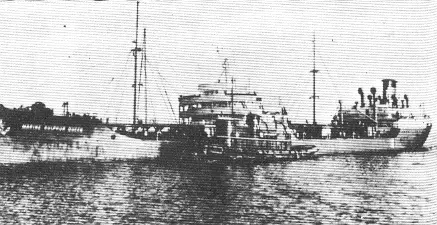
What is the history of SS Marine Sulphur Queen?
She was nineteen years old and she was an experiment. Built at the Sun Shipbuilding and Dry Dock Company of Chester, Pennsylvania, in 1944 as the SS Esso New Haven, she was one of the mass-produced T2-SE-A1 turbo-electric tankers of the war programme: 504 feet long by 68.2 in the beam, 7,240 gross tons, a Westinghouse turbo-electric drive of 7,240 shaft horsepower, official number 245295. In the latter part of 1960 the Bethlehem Steel Company shipyard at Baltimore rebuilt her insides to carry molten sulphur, a cargo that until then no self-propelled ship had carried exclusively, and she was renamed Marine Sulphur Queen. She belonged to the Marine Sulphur Transport Corporation and was run under bareboat charter by Marine Transport Lines, Inc., both at 11 Broadway, New York.
What the conversion did to her is the whole of this story, and it is set out in the Coast Guard's own findings. To make room for one continuous independent tank 306 feet long, 30 feet 6 inches wide and 33 feet high — internally divided into four sulphur tanks — the yard removed every transverse bulkhead in the way of the original centre tanks. Nine watertight bulkheads amidships were replaced by one watertight bulkhead at frame 59, two partial diaphragm bulkheads and six bolted top connections, and the Board found flatly that "the replacement members did not possess the strength of the original watertight bulkheads." To seat the tank, the centre vertical keel between frames 46½ and 72½ was cut down from 7 feet 6 inches to a constant 3 feet 4 inches, and the centreline deck girder from 5 feet 1 inch to 2 feet 8 inches. The tank sat in a void with about three and a half feet under it, two feet at the sides and three feet over the top, and it moved: it was bolted through slotted holes so it could grow lengthwise when heated, and one expert put the extra tensile stress on the hull at about 2,000 psi. Crewmen heard the tank expanding as loud noises throughout the ship.
She began carrying molten sulphur in January 1961 and she leaked, burned and cracked from almost the first voyage. On 8 April 1961 a major spill at Carteret, New Jersey, drove sulphur down onto the insulation of No. 1 tank and into the void below; about 4,500 square feet of insulation had to be replaced. A second spill followed on 28 December 1961 at No. 3 pump house. In late 1961 a crack about 12 inches long opened in the steel of the starboard sump at the after end of No. 4 tank; it was veed out, welded and doubled in February 1962, and a second crack developed in the same area afterwards. From the late summer of 1962 until the day she sailed for the last time, molten sulphur leaked from the insulation at the after end of No. 4 tank on every loaded voyage, and the crew had to shovel the solidified sulphur out of the bilges each time to stop it plugging the suctions. When she left Beaumont on 2 February 1963 there were an estimated 20 to 70 tons of set sulphur lying in her bottom. That second crack had not been repaired: the Board records that it "was peened over by the Chief Engineer in Beaumont while loading cargo for the voyage commencing on 2 February 1963 and found tight." The real repair was booked for the March 1963 yard period.
The fires are in her own logs. Deck and engine room smooth logs record fires or the use of the steam smothering system on 24 August 1961, 7 and 8 October 1961, 15 February 1962, 16 and 20 October 1962, 3 November 1962 and on 22, 26, 27, 28 and 29 December 1962; all but the first were in the void spaces, in insulation soaked with sulphur. They were pie-shaped, seldom more than a few square feet, usually not put out by steam, and in almost every case the master or a crewman went down into the void with a fresh-air mask and doused them with fresh water. Previous crew members testified that they felt little or no alarm about them, and that the general alarm was never sounded. She had also grounded twice at Tampa on 13 October 1961, ridden out hurricane Carla on 7-9 September 1961 (after which an 18-inch fracture was found in shell plate strake F at web frame 61) and hurricane Ella in October 1962, and her log for 4 March 1962 notes that heavy seas and deep swells were "noted to put racking stress on the vessel."
Her last cargo, 15,260 tons of molten sulphur at 273-276°F, went aboard between 1915 on 1 February and 0600 on 2 February 1963. She left the Beaumont dock at 1330 CST and dropped her pilot at the Sabine Bar Sea Buoy about 1900, bound for Norfolk with an ETA of noon on 7 February. At 0125 EST on 4 February RCA Radio took a personal message from a crew member. Newsweek, reporting a month later, named him: able seaman Willie Manuel, putting in a buy order for 5,000 bushels of May wheat with his broker in Tampa. That is the last thing anyone ever heard from the Marine Sulphur Queen. Her estimated position was 25°45' N, 86°00' W, reckoned from a speed of advance of 14.5 knots — some 183 nautical miles west-north-west of the Dry Tortugas, in the Gulf of Mexico. At noon the day before, the SS Texaco California, about 38 miles away, had logged northerly winds of force 6 to 11 and her decks awash.
RCA called her at 1123 on 4 February and got nothing. She was not reported overdue until 2100 EST on 7 February, and the Board later found that the operating company had explained away the missing 48-hour and 24-hour arrival messages as bad weather and then waited several hours past her ETA before telephoning: "as a result of this delay, very valuable time was lost in instituting the search for the vessel and/or possible survivors." The search began at 0800 on 8 February and ran to 13 February: 83 sorties, 499.6 flight hours, 348,400 square miles, and 42 ships that might have seen her all checked out with negative results. Nothing was found.
Then, on 20 February, a U.S. Navy torpedo retriever boat working about 12 miles south-west of Key West picked a fog horn and a life jacket out of the water, both stencilled with her name. A second search followed, and the Navy hunted for the hulk from 20 February to 13 March with six vessels and 523 hours on scene. Everything ever recovered from her fits in one sentence of the report: 8 life jackets, 5 life rings, 2 name boards, 1 shirt, 1 piece of an oar, 1 storm oil can, 1 gasoline can, 1 cone buoy and 1 fog horn. Experts from the Bureau of Standards, the Coast Guard and the Bureau of Fisheries examined it at Washington; two life jackets and the shirt tied to one of them had been worn by people; the tears in the jackets indicated attack by predatory fish; the FBI found no laundry marks on the shirt and no trace of sulphur on anything; and nothing showed any sign of fire or explosion. The search was called off at 1740 on 14 March 1963.
There is one loose end. On or before 29 April 1963 a note in a whisky bottle turned up on a spoil island in Laguna Madre, near Corpus Christi. It was written in ballpoint on a piece of manila paper, unsigned, and spoke of an explosion and two men hurt; it carried a rough map of the Gulf, the Florida Straits and Cuba with a circled X marked "SHIP". A federal questioned-documents examiner compared it with crew signatures and a letter one man had written to his sister and concluded it was the hand of a particular member of the crew. The Board still ruled it out, on two grounds: the Director of the Coast and Geodetic Survey said the bottle could not have drifted to Corpus Christi from anywhere east of 85° W without days of strong south-easterly wind, and on 3 and 4 February the wind was northerly; and writing the note, bottling it, taping it and dropping it would have taken time in which a distress message could have been sent instead.
Thirty-nine men went down with her, and their names are not a secret. The master was James V. Fanning of Beaumont; the chief mate George E. Watson of Galveston; the radio officer George E. Sloat of Baltimore; the chief engineer Leon B. Clauser of Beaumont. Others were Adam Martin Jr. of Austin, Willie T. Manuel of Ville Platte, Louisiana — the wheat speculator — Jesse I. Vicera, the pumpman, born in Naval, Leyte, in the Philippines and living in Linden, New Jersey, and Aaron Heard, wiper, of Norfolk, Virginia. The wrongful-death case that ran for the next decade is captioned, in the Second Circuit, with the name of Ida Ruth Heard.
Timeline: the documented record of SS Marine Sulphur Queen
- 1944 The Sun Shipbuilding and Dry Dock Company of Chester, Pennsylvania, delivers the T2-SE-A1 tanker SS Esso New Haven, official number 245295: 504 feet by 68.2, 7,240 gross tons, Westinghouse turbo-electric drive.
- Latter part of 1960 The Bethlehem Steel yard at Baltimore converts her to carry molten sulphur and she is renamed Marine Sulphur Queen. Every transverse bulkhead in way of the centre tanks is removed for a 306-foot independent tank; the centre vertical keel is cut down from 7 ft 6 in to 3 ft 4 in. The Coast Guard approved the plans conditionally on 13 May 1960 and the American Bureau of Shipping on 21 June 1960.
- 18 January 1961 The Coast Guard certificates her at Baltimore for the carriage of "Grade E liquids at elevated temperatures". She begins commercial service as the first self-propelled ship built to carry molten sulphur in bulk.
- October–December 1962 Fires in the sulphur-soaked insulation of the void spaces become frequent: the logs record them on 16 and 20 October, 3 November and on 22, 26, 27, 28 and 29 December. Crew members later testify that during a voyage in late December fires burned almost continuously at the after end of No. 4 tank and that the general alarm was never sounded.
- 16 January 1963 The Coast Guard begins her biennial inspection for certification at Beaumont while she loads. She passes; eleven of eighteen ring buoys are replaced. The cargo tanks, the void spaces around them and the wing tanks are not inspected, because a drydocking was already booked for March.
- 2 February 1963 Loading of 15,260 tons of molten sulphur ends at 06:00. Before sailing, the chief engineer peens over an unrepaired crack at the after end of No. 4 tank and finds it tight. She leaves the Beaumont dock at 13:30 CST and drops her pilot at the Sabine Bar Sea Buoy about 19:00, bound for Norfolk.
- 4 February 1963, 01:25 EST RCA Radio receives a personal message from a crew member — according to Newsweek a month later, able seaman Willie Manuel putting in a buy order for 5,000 bushels of May wheat with his Tampa broker. It is the last word from the ship. Estimated position 25°45' N, 86°00' W. RCA's calls at 11:23 go unanswered.
- 7 February 1963, 21:00 EST The operating company reports her overdue to the Fifth Coast Guard District, hours after her expected arrival. The Board's conclusion 27 blames the delay: "very valuable time was lost in instituting the search for the vessel and/or possible survivors."
- 8–13 February 1963 Coast Guard, Navy, Marine Corps and Air Force aircraft fly 83 sorties and 499.6 hours over 348,400 square miles along the trackline from Beaumont through the Straits of Florida to Norfolk. Forty-two ships that might have sighted her are traced and questioned. Nothing is found and the search is discontinued.
- 20 February 1963 A U.S. Navy torpedo retriever boat about 12 miles south-west of Key West picks up a fog horn and a life jacket stencilled with the ship's name. A second search follows; in all, 8 life jackets, 5 life rings, 2 name boards, a shirt, a piece of an oar, a storm oil can, a gasoline can, a cone buoy and a fog horn are recovered. None of it shows any trace of fire, explosion or sulphur.
- 4 March 1963 Newsweek publishes "Sulphur Queen's End", naming the wheat order as the last message and quoting second mate David Fike, who was on vacation and missed the voyage: "I keep coming back to that question. Why was there no radio message? Ships just don't go down that fast." The piece also reports a four-mile oil slick around the debris and calls her a 524-foot ship — two figures that entered the story here and not in the investigation.
- 29 April 1963 A note in a whisky bottle is reported found on a spoil island in Laguna Madre near Corpus Christi, speaking of an explosion and two men hurt and carrying a map with a circled X marked "SHIP". A federal questioned-documents examiner attributes the handwriting to a named member of the crew; the Board nevertheless rejects it, because the Coast and Geodetic Survey holds that the bottle could not have drifted there from east of 85° W in a northerly wind.
- 23 August 1963 The Marine Board of Investigation signs its findings and sends them to the Commandant. It concludes that the exact cause cannot be ascertained, declines to rank the possible causes, and states that it is possible the casualty "originated with a complete longitudinal fracture of its hull girder".
- February 1964 Vincent H. Gaddis coins the phrase "Bermuda Triangle" in Argosy and opens the article with the Marine Sulphur Queen — six months after the Board reported. He calls her a 254-foot vessel, dates the search wrongly, places the debris fourteen miles south-east of Key West and writes that "nothing more has been found".
- 17 March 1964 Admiral E. J. Roland, Commandant of the Coast Guard, approves the record and adds a fifth possible cause the Board had not considered: an explosion of hydrogen sulphide and carbon disulphide in the void spaces. He accepts the ban on repeating this conversion, orders more frequent inspection of molten sulphur carriers, and rejects the Board's proposal for fire hose stations in the voids.
- 25 April 1972 The United States Court of Appeals for the Second Circuit affirms that the ship was unseaworthy, denies the owners exoneration and limitation of liability, denies punitive damages and dismisses the claims against the shipbuilder. It quotes the trial court verbatim: "no one knows how the ship was lost."
- 1974 Charles Berlitz's The Bermuda Triangle makes her a "425-foot freighter" lost in good weather that "vanished without message, clues, or debris", and turns the seaman's wheat order into the brokerage house that supposedly first missed the ship and triggered the search. Every one of those statements is contradicted by the Coast Guard record.
- 1975 Lawrence David Kusche devotes chapter 39 of The Bermuda Triangle Mystery—Solved to the ship, prints the Board's findings at length and observes that the conversion removed the bulkheads that would have kept a damaged ship afloat long enough to send a distress call. He also records that on the tenth anniversary of the loss the first wrongful-death claim was settled, with court approval of $115,000 to the widow of an ordinary seaman.
- 27 January 2001 Divers of the Association of Underwater Explorers, funded by the BBC, dive an unidentified wreck 140 miles off Fort Myers at 423 feet to see whether it is the Marine Sulphur Queen. The hull lies on its side; the measured beam comes out at 48 feet against the Queen's registered 68.2, and the identification is left open. The site is named "Deep 423".
Is there a rational explanation for SS Marine Sulphur Queen?
This is one of the best-documented ship losses of its decade, and almost everything the public knows about it comes from three magazine pieces that were written without reading the file.
The record contradicts both the mystery version and the tidy engineering version. The Coast Guard did not solve this. The Commandant's action of 17 March 1964 states that "in the absence of survivors or physical remains of the ship, the exact cause of the loss of the MARINE SULPHUR QUEEN cannot be determined," and the Board wrote that the possible causes "remain only possibilities and the available evidence precludes the assignment of any order of probability to these causes." It offered four — an explosion in the cargo tanks; a complete failure of the hull girder breaking her in two; capsizing in synchronous rolling; a steam explosion from the void space filling with water — and the Commandant added a fifth of his own, an explosion of hydrogen sulphide and carbon disulphide in the void spaces, where the history of fires showed a source of ignition existed. The Board did lean, in conclusion 19, towards "a complete longitudinal fracture of its hull girder," and it noted ten known cases of complete fracture in T-2 tankers; the Commandant's action that closes the file still leaves the cause undetermined.
There is a second, legal record, and it goes further. Litigation began within weeks and lasted a decade. The district court for the Southern District of New York held in 1970 that the Queen left Beaumont unseaworthy in several respects and "not reasonably suitable for her intended service": bulkheads spaced more than 100 feet apart in violation of the American Bureau of Shipping rule adopted by the Coast Guard, transverse strength destroyed by the conversion, no provision for transverse and vertical thermal expansion, a centreline concentration of cargo that made her roll faster, void spaces coated in corrosive and potentially explosive sulphur, no way to warn the crew of the gases, ineffective vents, and a cargo of 15,315 long tons that overflowed the tanks into the expansion trunks. The Second Circuit affirmed on 25 April 1972, and quoted the trial court's own words: "no one knows how the ship was lost." It also dismissed the claims against the shipbuilder, Bethlehem Steel, and refused punitive damages. With the cause unknown, liability turned on the burden of proof: under the rule of The Pennsylvania (1874), an owner in breach of a safety rule must show that the breach could not have caused the loss, and the appeal court observed that "in light of the fact that no one knows what caused the loss, it is impossible for MTL to bear its burden". On the weather they were blunt — some 24 ships reported conditions from the same area that day and sailed through without incident.
Now the mystery literature, checked line by line against the file. Vincent H. Gaddis coined the phrase "Bermuda Triangle" in Argosy in February 1964, and the Marine Sulphur Queen is the first case in the article — she opens it. Gaddis wrote that she "sailed into the unknown", that she was a "254-foot vessel", that she was overdue on 6 February, that the search was abandoned on 14 February, that on the 19th a Navy boat found a life jacket "fourteen miles southeast of Key West", and that "nothing more has been found." The report says 504 feet, overdue reported on the 7th, search discontinued on the 13th, the pick-up on the 20th about twelve miles south-west of Key West, and nine categories of material recovered over the following three weeks. Two of those details were already in Newsweek of 4 March 1963: the radio message on the night of the 3rd and the wrong compass point, "14 miles southeast of Key West". Newsweek gave the length as 524 feet, the same three digits as Gaddis's 254. The overdue date of the 6th and the end of the search on the 14th are in neither Newsweek nor the Board's report. Gaddis's article went to press months after the Board had signed its findings on 23 August 1963.
Charles Berlitz repeated and worsened it in The Bermuda Triangle (1974). His ship is a "425-foot freighter"; "the weather was good"; she "vanished without message, clues, or debris"; the search was "launched by the Coast Guard on February 6" and "discontinued on February 15"; the Navy found "a life jacket... fifteen miles out at sea, south of Key West", and the second hunt "found only another life jacket"; and the Marine Board "offered neither solution nor theory concerning this disaster." Against the file: 504 feet; a converted T2 tanker; force 6 to 11 and decks awash on a ship 38 miles away; nine categories of debris; the search began on 8 February and ended on the 13th; a fog horn and a life jacket in the first pick-up, about twelve miles south-west; and four causes plus a fifth. Berlitz's most quoted flourish is that the ship "was first missed not by its owners but by a brokerage house" whose confirmation cable went unanswered, and that this triggered the search. The underlying detail is real and better than his use of it: the last transmission was Willie Manuel's wheat order. But the message was sent from the ship to RCA Radio at 01:25 on 4 February; the ship was reported overdue by her own operating company, late, on 7 February; and the Board's conclusion 27 is a formal reproach to that company for the delay. Berlitz took a documented fact, reversed its direction, and deleted the seaman's name.
The librarian Lawrence David Kusche went through it in The Bermuda Triangle Mystery—Solved (1975) and put it plainly: "The Legend of the Bermuda Triangle has it that the Coast Guard failed to find an explanation for the loss of the Marine Sulphur Queen. In reality, the Board of Investigation listed four possible causes and the Commandant added a fifth." His own contribution is the point most often missed — that the conversion removed the very bulkheads that let a damaged ship stay up long enough to send an SOS, so the silence needs no mystery to explain it. One caution about Kusche, who is right about almost everything here: he writes that "of the five suggested causes of the disaster, the Coast Guard felt that an explosion was the least likely to have occurred." The Coast Guard said no such thing; it declined to rank them. Kusche is reading conclusion 10, which says an explosion alone would probably not have destroyed the ship. It is a small step past the document, and it is the kind of step that becomes a fact three books later.
On geography there is nothing to argue about. The last known position, 25°45' N, 86°00' W, is in the Gulf of Mexico, about 240 nautical miles west of Key West and 183 west-north-west of the Dry Tortugas — outside the Florida–Bermuda–Puerto Rico triangle that Gaddis himself drew in the same article in which he made her its first victim. The debris was recovered on the far side of the Keys, which is where the Gulf Stream would carry it. Finally, the length, which has circulated in five versions for sixty years: the Coast Guard's registry length is 504 feet. Newsweek said 524, TIME said 523, Berlitz said 425 and Gaddis said 254. The 523-524 figures are close to the overall length of the T2-SE-A1 class; the number in the record is 504.
Can you visit SS Marine Sulphur Queen?
The ship was never found, so there is no wreck site. The Marine Board of Investigation gives her position at 01:25 EST on 4 February 1963, the time of the last message received from her, as 25°45' N, 86°00' W, "based on an estimated speed of advance of 14.5 knots", so the figure is an estimate. That point lies in open water in the eastern Gulf of Mexico, about 240 nautical miles (445 km) west-north-west of Key West and 183 nautical miles (338 km) west-north-west of Fort Jefferson in the Dry Tortugas, which is itself some 110 km (69 miles) west of Key West.
According to the Board, the U.S. Navy searched the bottom for the hulk from 20 February to 13 March 1963, "from the shoals to the 100 fathom curve between Key West and 24°35'N, 83°30'W", using six Navy vessels for 523 hours on the scene and 17 aircraft sorties, with a computed 80 per cent probability of detecting the hulk; it did not find it. On 27 January 2001 divers of the Association of Underwater Explorers, invited by the charter captain Jeff Hunter and funded by the BBC, dived an unidentified wreck some 140 miles offshore of Fort Myers; the daughter of one of the lost crew was aboard. Mike Rodriguez's report describes a heavily encrusted ship lying on her side with a long mast over the sand, the sand at 420 feet on the sounder and at 423 on his own gauge, and the shallowest point of the hull at about 360 feet. He measured the beam with a knotted line and made it 48 feet, "significantly shorter than the 60 feet expected on the MSQ", and wrote that he could not say whether the measurement "confirms or denies the identity of the wreck". The team named the site "Deep 423" after its depth.
Three of the main documents can be read free of charge. The Board's report, with the Commandant's Action of 17 March 1964, survives as a 44-page scanned PDF in the Internet Archive's copy of the Coast Guard website. The Second Circuit's opinion, In the Matter of the Vessel Marine Sulphur Queen, 460 F.2d 89, argued on 26 January 1972 and decided on 25 April 1972, is on law.resource.org. The memorial pages of Debbie Corwin, daughter of the pumpman Jesse I. Vicera, survive in Wayback Machine captures of 2008; they carry the crew list with home towns and ratings, the Newsweek report of 4 March 1963 and a column by the historian W. T. Block from The Beaumont Enterprise of 13 September 2000.
Block's column places the Texas Gulf Sulphur Company's sulphur docks on the Neches River at Beaumont, where the ship loaded, and the Board records her as bound for Norfolk, Virginia. Corwin's crew page says that a church door at St. Mary's Catholic Church in Port Arthur, Texas, "has a ship on it remembering the crew"; the source for that is the memorial page. Block counted five of the dead from Port Arthur or Groves, while the crew list on Corwin's site gives six: five from Port Arthur and Leroy Courville from Groves.
Sources consulted
- U.S. Coast Guard, Marine Board of Investigation; Commandant E. J. Roland, «Marine Board of Investigation: SS MARINE SULPHUR QUEEN; disappearance of at sea on or about 4 February 1963 — findings of fact, conclusions and recommendations (23 August 1963), with the Commandant's Action of 17 March 1964 (MVI-3, 5943/Marine Sulphur Queen a-8 Bd), 44 pp.» — Treasury Department, United States Coast Guard, Washington D.C., 1964 report
- United States Court of Appeals for the Second Circuit (Anderson, Circuit Judge), «In the Matter of the Vessel Marine Sulphur Queen. Marine Sulphur Transport Corporation, as Owner, and Marine Transport Lines, Inc., as Demise Charterer, Bethlehem Steel Corporation, impleaded; United States Fire Insurance Co.; Ida Ruth Heard et al., Death Claimants — 460 F.2d 89, Nos. 457-460, argued 26 January 1972, decided 25 April 1972» — Federal Reporter, second series, vol. 460, p. 89, 1972 report
- Vincent H. Gaddis, «The Deadly Bermuda Triangle (pp. 28-29, 116-118) — the article that coined the term, opening with the Marine Sulphur Queen» — Argosy, 1964 newspaper archive
- Newsweek staff, «Tragedies: Sulphur Queen's End, pp. 29-30 (text transcribed on the memorial site of Debbie Corwin from a copy supplied by Luren E. Dickinson, Director of Libraries, Reading Public Library)» — Newsweek, 4 March 1963, 1963 newspaper archive
- Charles Berlitz, with the collaboration of J. Manson Valentine, «The Bermuda Triangle — the Marine Sulphur Queen passages ("a 425-foot freighter", "the weather was good", the brokerage house story) and the summary list of disappearances» — Doubleday, New York, 1974 book
- Lawrence David Kusche, «The Bermuda Triangle Mystery—Solved, chapter 39: February 1963, Marine Sulphur Queen (pp. 205-216)» — Harper & Row / Warner Books, 1975 book
- Debbie Corwin, daughter of pumpman Jesse I. Vicera, «SS Marine Sulphur Queen: crew list, news transcriptions, Coast Guard summary and litigation pages ("Debbie's Point of View", online from 31 December 1998; archived)» — home.pacbell.net/corwind, via the Internet Archive Wayback Machine, 2004 web
- Mike Rodriguez, «Dive Report: Deep 423 (Marine Sulphur Queen?), Saturday 27 January 2001 — Association of Underwater Explorers expedition funded by the BBC; measured beam 48 ft, identification inconclusive» — mikey.net dive reports, via the Internet Archive Wayback Machine, 2001 web
- TIME staff, «Investigations: The Queen with the Weak Back (contemporary account of the Beaumont board of inquiry; calls her "a 523-ft. converted tanker")» — TIME, 8 March 1963, 1963 newspaper archive
Reviewed by V. Serrano on 2026-08-18 · How we verify our content
💬 Field testimonies (0)
No testimonies yet. Add the first.
Add your testimony
🔒 Log in to add a testimony