👻 HAUNTED PLACE · EXP. Nº9474
ACTIVE
Davelis Cave
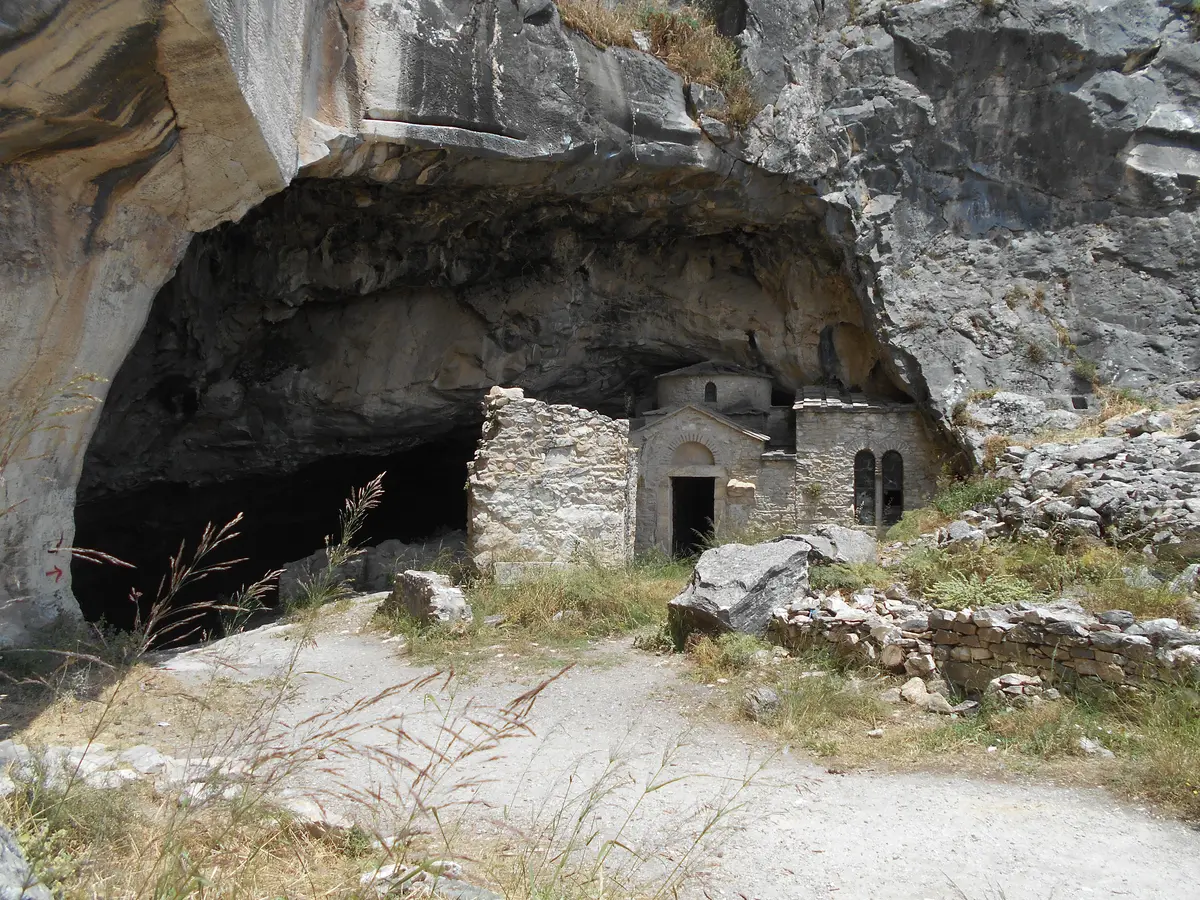
Davelis Cave opens at the foot of a vertical marble face on the south-west slope of Mount Penteli, north-east of Athens.
Where is Davelis Cave?
- Location
- Attica, Greece
- Type
- Cave / sinkhole
- Coordinates
- 38.071, 23.877
- Last updated
LOCATION
Why is Davelis Cave said to be haunted?
The pit around it is the Spilia quarry, catalogued as Quarry 55, and a 2025 isotope study ties it to the Parthenon: it supplied structural marble, column drums and lintels, while the sculpture came from higher workings. Set into the cave mouth is a double Byzantine church whose dome still carried the year 1233/1234 and a haloed portrait of Michael Choniates, metropolitan of Athens. Almost none of that survives in the stories told about the place. The cave is famous instead as the lair of the brigand Christos Davelis, killed in 1856, although the municipality of Penteli notes that some doubt he ever knew the cave existed, and as the centre of a Greek conspiracy legend born in 1977, when the Ministry of National Defence began secret works inside it, cut tunnels through the rock and cracked the thirteenth-century frescoes that conservators had cleaned five years earlier. The tunnels the legend calls modern were described by a British traveller in 1819.
What is the history of Davelis Cave?
The mountain came first; the cave is a by-product of it.
Pentelic marble built classical Athens, and the pits that produced it have been surveyed and numbered. The one that matters here is the lowest of the large ancient quarries on the south-west slope, known as Spilia — "the cave" — and catalogued as Quarry Π55. Manolis Korres, for years the architect in charge of the Parthenon restoration, argued that this quarry supplied the marble of the Parthenon. A 2025 stable-isotope study by Scott Pike, built on 610 samples from 83 quarry pits, refined that rather than overturned it: the sculpture of the west pediment came from the higher Aspra Marmara workings, while the Spilia Divali quarry "appears to have been one of the quarries selected to supply the larger elements of the structure, such as column drums and lintels". The cavern itself was opened up by that quarrying. The rock faces still carry the marks of chisels and wedges, part of the ancient paved road down which the blocks were dragged on sledges also survives, and a street at the foot of the quarries still bears the name Lithagogias, "stone-carrying".
Christian use of the cave is old and documented. Crosses, angels, eagles and inscriptions cut into the rock attest worship from the late Roman or early Byzantine period. At the mouth of the cave a double chapel was built in two phases between the tenth and twelfth centuries: a south chapel hollowed back into the cave wall, and a north chapel of masonry with a small dome, used extensively for burials. Doula Mouriki, who published the frescoes in 1973–74, found the date in the dome — ,ϚΨΜΒ, that is 6742 from the creation of the world, 1233/1234 — and noted that the first letter "has been destroyed only recently". Reaching that reading took three attempts: Georgios Ladas had read the inscription as 1782; Anastasios Orlandos corrected it to 1233/1234 in 1951; Nikolaos Moutsopoulos later proposed 1274. On a wall of the south chapel stands a haloed figure inscribed Ο ΑΘΗΝΩΝ ΜΙΧΑΗΛ — Michael Choniates, metropolitan of Athens between 1182 and 1204, who died around 1222 and was never canonised. Mouriki reads the halo as evidence of a local cult of the humanist bishop, and links these painters to the church of Saint Peter at Kalyvia Kouvara, where the same portrait appears.
The monks who lived here gave the cave its older name, the Cave of the Amomoi — "the blameless". The dedication to Saint Spyridon, Georgios Soteriou observed in 1927, comes only from later traditions of the monks of Penteli Monastery; Mouriki suspects the south chapel was originally dedicated to Saints Peter and Paul.
Christos Natsios, called Davelis, was born around 1832 and was killed on 12 July 1856 in the Zemeno pass between Distomo and Arachova. His band did work north-eastern Attica, around Marathon, in the winter of 1855–56. Nothing places him in this cave. The travellers who described it before him — Richard Chandler in 1776, Edward Dodwell in 1819 — call it simply the quarry of Pentele, and so do Soteriou in 1927 and Ladas in 1952. The earliest publication I have been able to date that puts the brigand's name in its title is Moutsopoulos's article of 1960.
In 1972 a conservator of the Greek Archaeological Service, S. Baltoyannis, cleaned the frescoes at the expense of the Hellenic Society. Five years later the Ministry of National Defence was inside the cave with heavy machinery and explosives.
Timeline: the documented record of Davelis Cave
- 447 BCE Work begins on the Parthenon. Isotope analysis of its blocks matches the Spilia Divali quarry (Π55), the pit that surrounds this cave, for large structural elements such as column drums and lintels; the sculpture of the west pediment came from higher quarries at Aspra Marmara.
- 1233/1234 The dome of the north chapel is painted with the Pantokrator, the Virgin, two archangels, eight prophets and two evangelists, and inscribed with the year 6742 from the creation of the world. Anastasios Orlandos established the reading in 1951, correcting Georgios Ladas, who had read 1782.
- 1776 Richard Chandler publishes his account of the Society of Dilettanti tour: the lower quarry has “within the mouth, some ruined chapels, the walls painted with portraits of saints”, a hermit's cell on the cliff face and a deep well inside the mountain. He does not name any brigand.
- 1819 Edward Dodwell publishes his description of the cavern, with “broken arches and subterraneous passages, cut through the marble rock, receiving from without a dim and mysterious light”, and ivy nearly closing the entrance.
- 12 July 1856 Christos Natsios, known as Davelis, is killed in the Zemeno pass between Distomo and Arachova. His band had worked north-eastern Attica the previous winter; no document connects him with this cave.
- 1927 Georgios Soteriou publishes the first study of the cave and writes that it has received no systematic examination to date. He calls it a cave of Pan “most probably” in pre-Christian times — a conjecture later quoted everywhere as fact — and notes that the dedication to Saint Spyridon comes from later traditions of the Penteli monks.
- 1960 Nikolaos Moutsopoulos publishes “The hermitage of the cave of Davelis” in the review Zygos. It is the earliest publication I have been able to date that carries the brigand's name in its title; Soteriou (1927) and Ladas (1952) still call it the cave of Penteli.
- 1972 S. Baltoyannis, conservator of the Greek Archaeological Service, cleans the frescoes at the expense of the Hellenic Society, with permission from the Ephor of Byzantine Antiquities P. Lazaridis. Doula Mouriki publishes them the following year.
- 6 October 1977 After a report in the magazine Tachydromos, the Greek Army General Staff admits that highly classified works have begun inside the cave. The Ministry of National Defence digs until 1983, opening a road and three tunnels; two are later filled in.
- 1982 Giorgos Balanos publishes “The enigma of Penteli”, the founding text of the cave's paranormal reputation, five years after the works became public knowledge. Investigators photograph the tunnel, its ventilation ducts and its hydraulic pipes in January 1983.
- August 1990 Works start again at the cave and are stopped once more by press reaction. The municipality of Penteli dates the first, unfinished works to the years of the military junta and notes that after 1990 the cave became associated with occult rituals.
- August 2024 Wildfire sweeps the Penteli area. The Ephorate of Antiquities of East Attica inspects the site and reports only minor damage — a lintel found on the ground — describing it as fully reversible.
Is there a rational explanation for Davelis Cave?
Almost everything remarkable said about this cave is either far more recent than it sounds, or belongs to a different cave.
Take the tunnels. The works themselves are real: the Ministry of National Defence dug here from the late 1970s, one tunnel is still visible from the track to the right of the cave, and after a report in the magazine Tachydromos on 6 October 1977 the Army General Staff conceded that highly classified work had begun inside it. But cut passages in this cave are not modern. Edward Dodwell, who rode up from the monastery of Penteli and published his account in 1819, described "the singular mixture of broken arches and subterraneous passages, cut through the marble rock, receiving from without a dim and mysterious light". Richard Chandler in 1776 recorded "a well ... sunk deep in the mountain, with a narrow way down to the water, which is exceedingly cold". The passages precede the army by a century and a half, and so does the word mysterious.
Take Pan. The sanctuary of Pan and the nymphs on Mount Penteli is real, excavated and published — but it is a much smaller cave roughly 100 m higher up the slope, exposed by quarrying in 1952, excavated by the Archaeological Society in 1975 and published by P. Zoridis in 1977; its lamps, terracotta figurines and two marble votive reliefs are in the National Archaeological Museum. For the Davelis cave itself the archaeological topographies of Attica (Travlos 1988, Goette 2001) state there is no evidence of ancient cult. Neither of the two scholarly studies of this cave produces one: Mouriki's forty pages never mention Pan, and Soteriou's 1927 sentence says the cave was honoured as a cave of Pan "most probably" in pre-Christian times. A qualified guess of 1927 has been quoted ever since as a fact, including on the municipality's own page. The claim that the cave was "later linked to worship of Zeus" has no source at all.
Take the brigand. The Municipality of Penteli, on the page that calls the site the Davelis Cave, adds in parentheses that "there are some who consider that Davelis was unaware even of the existence of the cave"; it dismisses the supposed tunnel linking the cave to the mansion of the Duchess of Plaisance, and the affair between the two, as something that "does not stand up chronologically". It does not: she was born in 1785 and died in May 1854, when Davelis was about twenty-two, and he outlived her by barely two years.
And take the legend's own date. The literature that turned a building site into an enigma has authors and years: Giorgos Balanos published To ainigma tis Pentelis in 1982, five years after the Tachydromos report; investigators photographed the tunnel with its ventilation ducts and hydraulic pipes in January 1983; Sokratis Aikaterinidis added electromagnetic anomalies and memory loss in 1988. Nobody sells a ticket here — the site is unfenced state land — but the books are still in print, enlarged, and the municipality's own page closes by recommending Balanos for "answers to many questions".
What the secrecy actually concealed is duller and worse than a base. The works cracked the chapels, frescoes had to be detached and taken to the Byzantine and Christian Museum in Athens, and the cave, in the municipality's words, "is not guarded" — which is why the belief that Davelis buried his treasure here has produced illegal digs, "without result".
Can you visit Davelis Cave?
Davelis Cave is on the south-west slope of Mount Penteli at about 700 m, about 16 km north-east of central Athens in a straight line. There is no gate, no ticket and no opening hours. It is unenclosed public land, part of the archaeological site of Penteli, and the municipality states plainly that it is not guarded.
Access is from Palaia Penteli by the road climbing towards the summit; a dirt track branches off and runs about 900 m to the cave, an easy walk of 20 to 30 minutes with a wide view over the Attica basin. Ordinary cars can usually manage most of it slowly, but the surface is rough. The last stretch of that track did not exist before the works of the 1970s.
The two chapels stand at the mouth and can be seen from outside. Go further in with care, and not alone. The main hollow is large and completely unlit — Soteriou measured 62 by 45 m in 1927, and the speleological survey by Ioannis and Anna Petrocheilou describes a descending chamber of about 112 by 40 m with two shafts of roughly 15 and 10 m. The descent to the standing water at the back was already being described in 1927 as slimy and dangerous. There is no lighting, no railing and no rescue service.
Most of the surviving frescoes are no longer here: they were detached after the military works and are held by the Byzantine and Christian Museum in Athens, which is where to see them. Higher up the slope a short path leads to the nymphs' cave, freely accessible, with a stair down into the excavated hollow.
The mountain burns. Fire reached the area in August 2024; the Ephorate of Antiquities of East Attica inspected afterwards and reported only minor damage here — a lintel lying on the ground — which it described as entirely reversible. In summer, check the fire-risk bulletin before setting out.
Sources consulted
- Ντούλα Μουρίκη (Doula Mouriki), «Οι βυζαντινές τοιχογραφίες των παρεκκλησίων της Σπηλιάς της Πεντέλης» — Δελτίον της Χριστιανικής Αρχαιολογικής Εταιρείας 7, σ. 79-119 (με αγγλική περίληψη σ. 116-119), 1974 academic
- Γεώργιος Α. Σωτηρίου (Georgios A. Soteriou), «Ἡ σπηληὰ τῆς Πεντέλης» — Ἡμερολόγιον τῆς Μεγάλης Ἑλλάδος 6, σ. 45-59, 1927 academic
- Edward Dodwell, «A Classical and Topographical Tour Through Greece, during the Years 1801, 1805, and 1806, vol. I, pp. 497-500» — Rodwell and Martin, London, 1819 book
- Richard Chandler, «Travels in Greece, or an Account of a Tour Made at the Expense of the Society of Dilettanti, pp. 169-170» — Clarendon Press, Oxford, 1776 book
- Scott Pike, «Characterization of Intra-Quarry Variability in Pentelic Marble Using Stable Isotopes: A Case Study of the Parthenon» — Minerals 15(3), 231, 2025 academic
- Δήμος Πεντέλης (Municipality of Penteli), «Η Σπηλιά του Νταβέλη» — penteli.gov.gr, 2024 web
- Πρώτο Θέμα, «Η σπηλιά του Νταβέλη: Μύθοι, θρύλοι, φήμες και πραγματικότητα» — protothema.gr, 2016 newspaper archive
- Ελεύθερος Τύπος / Υπουργείο Πολιτισμού, «ΥΠΠΟ: Ολοκληρώθηκαν οι αυτοψίες σε αρχαιολογικούς χώρους μετά τις πυρκαγιές της Αττικής» — eleftherostypos.gr, 2024 newspaper archive
Reviewed by V. Serrano on 2026-08-17 · How we verify our content
💬 Field testimonies (0)
No testimonies yet. Add the first.
Add your testimony
🔒 Log in to add a testimony