👻 HAUNTED PLACE · EXP. Nº9474
ACTIVE
Longos Mansion
Thessaloniki's Red House is famous for two things that turn out not to be true.
Where is Longos Mansion?
- Location
- Thessaloniki, Greece
- Type
- House / mansion
- Coordinates
- 40.633, 22.946
- Last updated
LOCATION
Why is Longos Mansion said to be haunted?
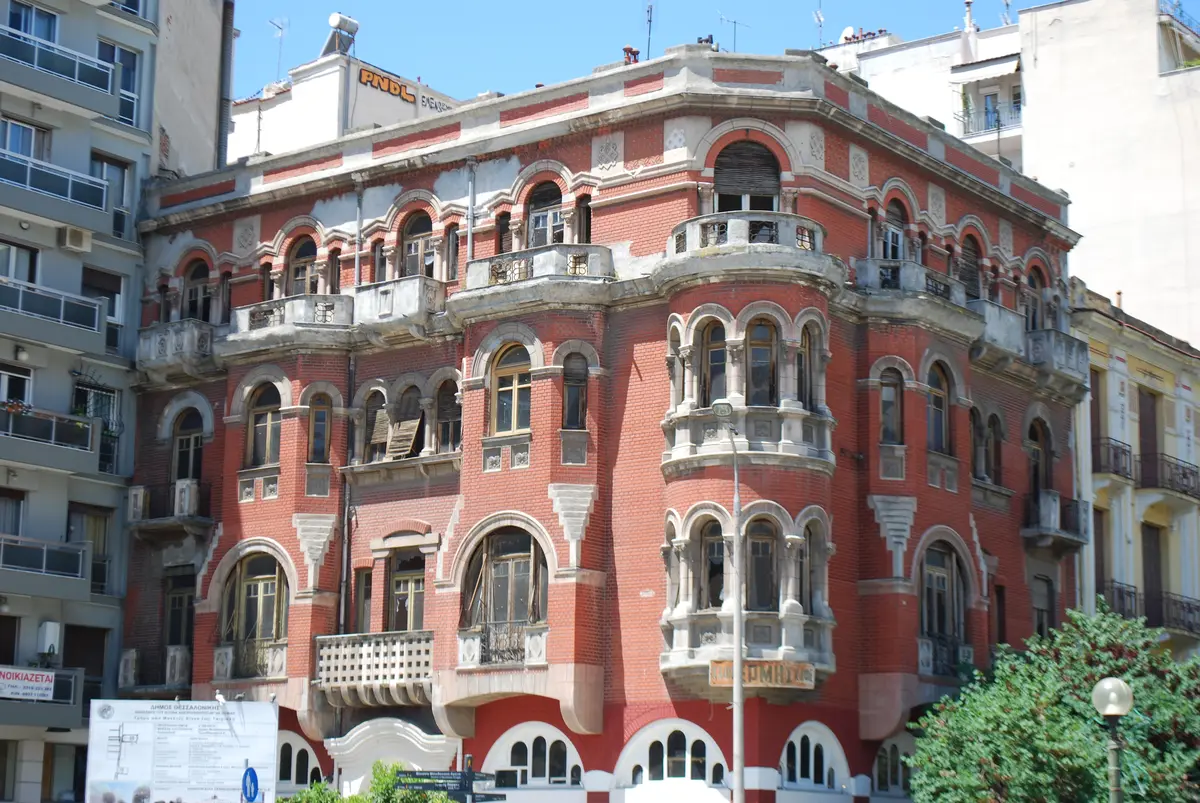
It is not built of red brick: the architects who surveyed it for its 2014-2019 restoration recorded stamped red-tinted render imitating brickwork, with the pale carved ornament imitating stone in the same material. And it was never a mansion abandoned for seventy years. What the documents say is stranger. Ioannis K. Longos, of the Naousa textile family, bought the plot on 16 June 1923 in the zone burnt out by the great fire of 1917, and much of the cost came from the dowry of his wife, Thomai Karamperi. Then the builder went bankrupt in 1931, the family mill in Naousa burned, Longos died in Switzerland, and a deed dated 19 July 1934 handed the house to a landowner from Nymfaio at forced auction. Talk of suicides, curses and vampires grew around a facade that was visibly rotting while a literary cafe traded downstairs. Almost every ghost story now circulating was published after 2014, the year the building was sold and restored.
What is the history of Longos Mansion?
Thessaloniki's Red House exists because the old city burned. The great fire of 1917 destroyed the centre, and the reconstruction plan drawn up under Ernest Hebrard rebuilt it on a new street grid organised around the monuments that had survived. The Byzantine church of Hagia Sophia was one of them, and the plan gave it a square. The blocks framing that square fell inside the sought-after sector of the burnt zone, earmarked for services and for middle- and high-income housing.
On 16 June 1923 a title deed registered at the Thessaloniki land registry (volume 23, no. 231) recorded the purchase of plot 6 in block 5, on the south-west side of the square, by Ioannis Konstantinou Longos. He belonged to the Longos family of textile manufacturers from Naousa and was an active figure in the industrial and political life of the city. His wife, Thomai Karamperi, was a tobacco merchant's daughter, and according to the family testimony of Eleni Daniilidou, née Karamperi, collected by the team that later surveyed the building, her dowry covered a large part of the construction cost. Almost every popular account, including both the English and Greek Wikipedia articles, credits the house instead to Grigorios Longos; the architects who worked from the deeds place Grigorios D. Longos elsewhere in the same family, trading plots in the burnt-zone property boom.
The builder was the newly founded Anonymos Oikodomiki Etairia Neon Choron, the Building Company of the New Lands, with Panagiotis Stais as supervising engineer. The design is habitually attributed to the Italian architect Leonardo Gennari, and that attribution is repeated everywhere; it is worth knowing that the architects who prepared the restoration study state plainly that the building cannot be assigned with certainty to any architect or engineer, because the signature on the surviving elevation drawing is illegible and no other evidence exists. In October 1925 the owner asked to add a third floor to the building permit, which is why the house has the profile it has today.
The result, finished in 1926, is a hybrid: load-bearing masonry stiffened with reinforced concrete, an L-shaped plan, basement, ground floor, mezzanine and three storeys, with two flats on each of the first two floors and, on the third, the owner's apartment. That apartment had two front doors purely for symmetry, one opening on the formal rooms and one on the private ones. It had a full direct-current electrical installation and a boiler room for central heating and hot water, both luxuries in the Thessaloniki of the 1920s. The painted ceilings are usually filed under art nouveau, but the survey found them closer to the geometric, stylised manner of the Viennese Secession, stencilled in outline and finished freehand.
Then everything failed at once. The construction company went bankrupt in 1931, shortly after the house was completed; the Longos textile plant in Naousa burned to the ground; Ioannis Longos died in Switzerland and his wife not long after. The mansion had been mortgaged to the National Mortgage Bank of Greece, and it was sold off. A deed dated 19 July 1934 records the transfer to Stergios Missios, a landowner from Nymfaio in Florina, whose family kept it for the next eighty years.
The ground floor never stopped working. Until 1992 it held the literary cafe Ermis, a meeting place for the city's schoolteachers and professors, whose sign stayed on the facade long after it closed; the beer hall and restaurant Kourdisto Gourouni followed. The apartments above were another matter, empty for long stretches, with one of the owners living on the top floor until shortly before the building was finally left alone.
Protection came in 1983, when the Ministry of Culture listed it as a historic monument (Government Gazette 393 of 15 June 1983); the ministry responsible for planning issued its own preservation order, Δ-734α, on 28 November of the same year. In 2007, at the proposal of the Ephorate of Newer Monuments of Central Macedonia, the minister of culture Georgios Voulgarakis approved either compulsory expropriation or direct purchase so the state could restore it for cultural use; in 2009 his successor Antonis Samaras revoked the decision, finding that the public interest was no longer justified. That left the Red House on the open market, and in 2013-2014 it was bought by Atlantis Pak Properties B.V., the vehicle of the Greek-Russian businessman Ivan Savvidis, for a reported 4.7 million euros. The restoration study was drawn up between 2014 and 2017 by the architects Giorgos Pavlidis, Pigi Sarvani and Vasiliki Massen, with structural work by the Penelis practice. Work began in August 2017. On 20 November 2018 a 65-year-old man working for the contractor Redex fell from scaffolding on the top floor and was dead on arrival at Papanikolaou hospital. The scaffolding started coming down that same month, the restored building was inaugurated in mid-2019, and its upper floors became offices.
Timeline: the documented record of Longos Mansion
- 1917 The great fire destroys the centre of Thessaloniki. The reconstruction plan drawn up under Ernest Hebrard lays out a new square around the surviving church of Hagia Sophia and reserves the surrounding sector for services and for middle- and high-income housing.
- 16 June 1923 A title deed at the Thessaloniki land registry records Ioannis Konstantinou Longos buying plot 6 of block 5 on the south-west side of the square. His wife Thomai Karamperi, a tobacco merchant's daughter, contributes the dowry that pays for much of the building.
- October 1925 The owner applies to add a third floor to the building permit. The original drawings held in the city planning archive show only a ground floor and two storeys with a roof terrace.
- 1926 The mansion is completed by the Building Company of the New Lands, with Panagiotis Stais as supervising engineer. The design is traditionally credited to the Italian architect Leonardo Gennari, but the signature on the surviving elevation drawing is illegible and the attribution remains unproven.
- 1931 The construction company goes bankrupt shortly after finishing the house, and the Longos textile mill in Naousa burns to the ground. Ioannis Longos dies in Switzerland and his wife not long after. Rumours of suicides and ghosts begin to attach to the emptying building.
- 19 July 1934 A deed records the transfer of the mansion, mortgaged to the National Mortgage Bank of Greece and sold at forced auction, to Stergios Missios, a landowner from Nymfaio in Florina. His family will hold it for the next eighty years.
- 1983 The Ministry of Culture lists the Longos Mansion as a historic monument for its historical and artistic importance, by Government Gazette 393 of 15 June 1983.
- 1992 The Ermis cafe, a meeting place for the city's schoolteachers and professors, closes after decades on the ground floor. Its sign stays on the facade. The Kourdisto Gourouni beer hall takes over the premises.
- 2009 Culture minister Antonis Samaras revokes the 2007 decision of his predecessor Georgios Voulgarakis, which had approved expropriating or buying the listed building for cultural use. The Red House returns to the open market.
- 2013–2014 Atlantis Pak Properties B.V., the vehicle of businessman Ivan Savvidis, buys the mansion for a reported 4.7 million euros and commissions a restoration and change-of-use study from architects Giorgos Pavlidis, Pigi Sarvani and Vasiliki Massen.
- 20 November 2018 A 65-year-old worker for the contractor Redex falls from scaffolding on the top floor during the restoration and is dead on arrival at Papanikolaou hospital. It is the only death at this address that can be documented.
- Mid-2019 The restored building is inaugurated. The three upper floors, some 900 square metres, become offices for the Savvidis group; the two ground-floor units go back to retail and catering.
- July 2023 The PAOK FC store that had opened in the restored ground floor in November 2018 closes for good; the club's commercial director confirms the premises had been let to another business.
- 28 March 2024 A meze restaurant named after the building itself, To Kokkino Spiti, opens on the ground floor. By mid-2026 a Greek restaurant directory lists it as closed.
Is there a rational explanation for Longos Mansion?
Start with the name. Everyone, this site included until now, describes the Red House as a red-brick mansion, and the English Wikipedia article says the nickname comes from its red brick exterior. It is not brick. The architects who surveyed every square metre of the facade for the restoration record that the external walls were finished in stamped red-tinted render imitating solid brickwork, and that the pale carved ornament standing out against it imitates whitish stone in the same material. The single most repeated fact about the building is a misreading of its plaster, which is a fair measure of how carefully the rest of the story has been checked.
The second claim to fall is abandonment. The usual telling has the house standing empty for seventy years or more. It did not: the ground floor traded continuously, first as the Ermis literary cafe until 1992 and then as the Kourdisto Gourouni beer hall, and the business press of the city credits precisely those two establishments with keeping the building alive. What was empty, for long stretches, was the flats above, and even there one of the owners lived on the top floor until shortly before the end. A local architecture blog notes that an elderly woman used to be seen at the windows and then stopped appearing, which is a more economical explanation for figures at the windows than anything supernatural.
Third, the dates do not survive arithmetic. One widely copied version says the family was ruined by a fire in 1939 and finished off by the war; another, told to a city magazine in 2018, puts the fire in 1937. Neither can be the reason the Longos family lost the house, because the deed transferring it to Stergios Missios is dated 19 July 1934. The account that fits the paperwork is the one published in the newspaper THESSNEWS in November 2018: the builder went bankrupt in 1931, the Naousa mill burned, the mortgage to the National Mortgage Bank was called in, and the house went at forced auction three years before the earliest of the fire dates on offer.
Fourth, the vampires. A 2016 Greek listicle claims that the Red House is inhabited not by ghosts but by vrykolakes, "or prosgeioi, as they used to be called in Thessaloniki". That is where our own previous text got its beings living close to the earth. The word prosgeioi does not appear in any folklore collection I could consult; the Greek Wikipedia entry on the vrykolakas, which does list regional synonyms such as katachanades, tympaniaioi and vourvoulakes, does not include it. Until someone produces a folklore source, it should be treated as an internet coinage, not as dialect.
Fifth, the suicides. Rumours of suicides inside the empty mansion are reported by the local press as rumours, never as events with a name or a date, and the 2018 newspaper feature that lists the misfortunes of the house mentions one suicide without either. The only death at this address that can be documented is the 65-year-old worker who fell from the top-floor scaffolding on 20 November 2018 during the restoration, which is to say after the curse had supposedly been laid to rest. The same 2018 interview that supplied the 1937 fire also claims the Gestapo requisitioned the building during the occupation and fitted it out as cells, and that bones turned up in the rubble in 1992; neither claim is corroborated anywhere else, and neither sits easily with a chain of title that runs through the Missios family from 1934 onwards.
Finally, date the telling rather than the tale. A summer 2014 photo feature devoted to the Red House in the Thessaloniki magazine Parallaxi calls it a leftover of another era and speaks only of nostalgia and admiration; there are no ghosts in it. Every account of curses, vampires and voices at the windows that I have been able to date was published from 2015 onwards, that is, after the building was sold, scaffolded and restored. That does not prove the stories are recent, since a rumour can circulate for decades before anyone prints it, but the printed record of this haunting is younger than the restoration that supposedly ended it. The architects who wrote the restoration study called their own account of the building The Red House beyond the myth.
Can you visit Longos Mansion?
The Longos Mansion stands at the corner of Agias Sofias 31 and Ermou 52, on the south-west side of Agias Sofias Square in central Thessaloniki, facing the Byzantine church of Hagia Sophia across the square. Leonardo Gennari designed it in 1926 for Grigorios Longos, a textile manufacturer from Naoussa, and the Ministry of Culture listed it as a preserved building in 1983. Agias Sofias is pedestrianised in front of the house, so the two ornamented facades can be seen properly from the street. The Agias Sofias station of Thessaloniki Metro Line 1, which opened on 30 November 2024, is on the square, is step-free, and displays some of the archaeology the metro works turned up.
There is no visit. The building is private property, bought in early 2014 by Ivan Savvidis for a reported four million euros, and the three upper floors, about 900 square metres in all, were converted into offices for his group's companies. The painted ceilings, the plaster reliefs and the staircase that make the interior remarkable are closed to the public, and whatever can be seen indoors depends entirely on which business happens to be trading in the two ground-floor units.
Those tenants turn over fast: the Ermis cafe, a meeting place for the city's teachers, closed in 1992; the Kourdisto Gourouni restaurant shut when the restoration began; a PAOK club shop opened in the restored ground floor in November 2018 and closed for good in July 2023, its stock moved to the store at the Toumba stadium; a branch of the Lunchbox chain opened in 2019; and a meze house that took the building's own name, To Kokkino Spiti, opened on 28 March 2024. That one has gone too: on 22 September 2026 its domain no longer resolved, and the tavernoxoros restaurant directory headed its entry «έχει κλείσει», has closed.
Almost every photograph of the Red House in circulation predates the works of 2017 to 2019 and shows stained render, boarded windows and a to-let sign. The building standing on the square has been fully restored and no longer resembles them.
Sources consulted
- Βασιλική Μάσεν, Γιώργος Παυλίδης, Πηγή Σαρβάνη, «Το «Κόκκινο Σπίτι» πέρα από το μύθο…» — Θεσσαλονικέων Πόλις, τχ. 62 (Πολιτιστική Εταιρεία Επιχειρηματιών Βορείου Ελλάδος) academic
- Θεοδώρα Καρακιουλάχ, «Το κόκκινο σπίτι: Οι Θρύλοι και οι Μύθοι που «στοίχειωσαν» το οίκημα» — THESSNEWS αρ. 133 / Rthess, 2018 newspaper archive
- Άννη Καρολίδου, «Αποκλειστικό: Το σχέδιο του Ιβάν Σαββίδη για το «Κόκκινο Σπίτι»» — Voria.gr, 2017 newspaper archive
- Αλεξία Καλαϊτζή, «Φεύγουν οι σκαλωσιές από το «Κόκκινο Σπίτι»» — Voria.gr, 2018 newspaper archive
- Voria.gr, «Κατέληξε ο 65χρονος εργάτης που έπεσε από σκαλωσιά στο Κόκκινο Σπίτι» — Voria.gr, 2018 newspaper archive
- Θανάσης Μυλωνάς, «Έκλεισε η μπουτίκ του ΠΑΟΚ στο κέντρο της Θεσσαλονίκης» — Voria.gr, 2023 newspaper archive
- Λία Μαλλίδου, ««Κόκκινο Σπίτι» ή «μέγαρο Λόγγου» στη Θεσσαλονίκη» — Thessaloniki Arts and Culture (copia archivada en la Wayback Machine), 2015 web
- Χρύσα Φραγκούδη, «ΜΕΓΑΡΟ ΛΟΓΓΟΥ (ΚΟΚΚΙΝΟ ΣΠΙΤΙ)» — thessarchitecture, 2020 web
- Biscotto, «Οι αστικοί μύθοι πίσω από το Κόκκινο Σπίτι στην Αγ. Σοφίας (testimonio de «κ. Δέσποινα»)» — biscotto.gr, 2018 interview
- Seleo, «Ανατριχιαστικοί θρύλοι και μύθοι για τα στοιχειωμένα σπίτια στη Θεσσαλονίκη» — seleo.gr web
- Μηχανή του Χρόνου, «Γιατί θεωρούσαν στοιχειωμένο το «κόκκινο σπίτι» της Θεσσαλονίκης» — mixanitouxronou.gr web
- Newsroom, «Το Κόκκινο Σπίτι: Μεζεδοπωλείο αυθεντικών γεύσεων της Θεσσαλονίκης, στο διατηρητέο της πλατείας Αγίας Σοφίας» — Μακεδονία (emakedonia.gr), 2024 newspaper archive
- Typosthes Newsroom, «Θεσσαλονίκη: Ο Ιβάν Σαββίδης αποκαθιστά το εμβληματικό «Κόκκινο Σπίτι»!» — Typosthes, 2016 newspaper archive
- Ελισάβετ Κιλιντάρη, «Εικόνες μιας Όμορφης Πόλης: Το κόκκινο σπίτι» — Parallaxi Magazine (copia archivada en la Wayback Machine), 2014 web
Reviewed by V. Serrano on 2026-08-13 · How we verify our content
💬 Field testimonies (0)
No testimonies yet. Add the first.
Add your testimony
🔒 Log in to add a testimony