👻 HAUNTED PLACE · EXP. Nº9474
ACTIVE
Dragsholm Castle
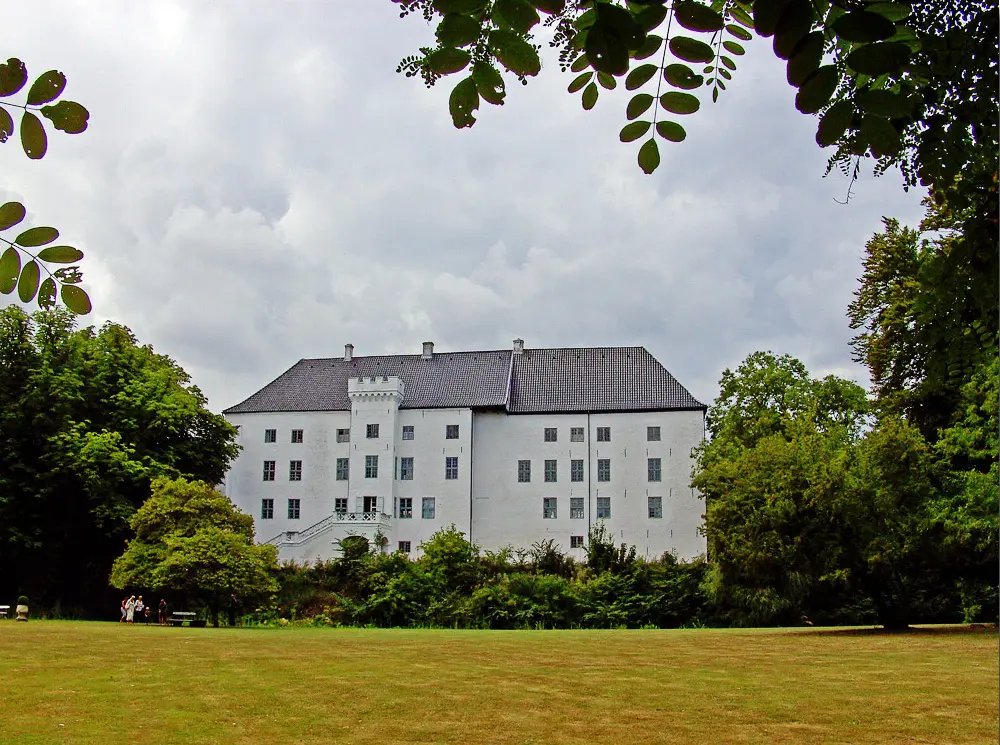
Dragsholm Castle stands on the Odsherred coast of Zealand, built around 1215 as a bishop's house and rebuilt in baroque form after the Swedes blew part of it up around 1660.
Where is Dragsholm Castle?
- Location
- Zealand, Denmark
- Type
- Castle
- Coordinates
- 55.772, 11.391
- Last updated
LOCATION
Why is Dragsholm Castle said to be haunted?
Between 1536 and 1664 it was a Danish state prison, and a note in a sixteenth-century Danish calendar puts James Hepburn, fourth Earl of Bothwell and third husband of Mary, Queen of Scots, inside its walls on 16 June 1573; the same source gives his death there on 14 April 1578. The pillar with a worn groove that guides show is not in the archives: the scholar who worked through them in 1863 found tradition pointing instead at two iron bars in a wall, and said even that was too recent to trust. The castle's best-known ghosts are den hvide dame, a nobleman's daughter said to have been walled up alive for loving a stable hand, and den grå dame, a housekeeper who disapproves of change; the phrase naming the first appears in the Danish press only from 1969. Dragsholm is now a Michelin-starred hotel that has stopped telling the stories entirely.
What is the history of Dragsholm Castle?
Dragsholm was a bishop's house before it was ever a prison or a hotel, and the castle's own timeline is careful to say only that it was "most likely built around 1215 as a palatium rather than a castle", with masonry details pointing to the workshop of Roskilde Cathedral. Popular accounts credit Bishop Peder Sunesen, but he died on 29 October 1214, and the castle's current history page no longer names him. Over the fourteenth and fifteenth centuries the palatium was walled into a four-winged fortress: thicker walls, smaller windows, a widened moat. It held out through a siege of several months during the Count's Feud in 1535 and passed to the Crown only with the Reformation of 1536.
From 1536 to 1664 Dragsholm was a royal fief and a state prison for noblemen and clergy. Its most famous inmate arrived on a datable day. James Hepburn, fourth Earl of Bothwell and third husband of Mary, Queen of Scots, had been a Danish state prisoner since 1567, held at Copenhagen and then at Malmöhus in Scania under conditions loose enough that his contemporaries spoke of honourable confinement. At the end of May 1573 Edinburgh Castle, the last stronghold of Mary's party, surrendered; a fortnight later the French ambassador Charles de Dancay reported from Copenhagen, on 28 June 1573, that Frederik II had suddenly moved Bothwell to "un fort mauluaise et estroite prison" — a very bad and narrow prison. Dancay did not name it. A Danish note does: in Eiler Brockenhuus's annotated copy of Paul Eber's Calendarium Historicum, under 16 June 1573, someone wrote "Anno 1573. Bleff den skotiske Greffue indseth paa Dragsholm" — in 1573 the Scottish Earl was put into Dragsholm.
He was not the only Scot behind those walls. Captain John Clark, who had faced Bothwell across the field at Carberry Hill and whose imprisonment Bothwell himself had helped bring about, had been sent to Dragsholm in 1571 and died there; the same calendar records his death on 14 April 1575. Three years later, under 14 April 1578, it records Bothwell's. His coffin was carried to the nearest church, at Fårevejle, a few kilometres away across the water meadows.
The castle did not survive the seventeenth century intact. During the Dano-Swedish wars the occupying troops blew up part of the structure around the peace of 1660, and a survey of 1662 reported the place utterly destroyed, walls only. Frederik Christian Adeler bought the ruin in 1694 and, with his wife Henriette Margrethe von Lente, had it rebuilt by 1697 in the baroque form still standing: whitewashed walls, hipped slate roofs, a symmetrical court. The estate was made a barony and renamed Adelersborg in 1785; Georg Frederik Otto Zytphen-Adeler, one of the promoters of the draining of Lammefjorden, restored the old name in 1868. The Adeler line ended in 1932 and Johan Frederik Bøttger bought castle and estate in 1937, since when it has been run as a hotel.
The modern chapter is unusually well documented because the owner wrote it down himself. Mads Hylleholt Bøttger joined as director in 2005; the cellar was rebuilt in 2006 with a kitchen and gourmet restaurant, Claus Henriksen took over the stoves in 2008, a kitchen fire on 27 November 2014 spread through the ventilation and damaged roughly two thirds of the building, and the Michelin star arrived in February 2017. Dragsholm today has forty-one rooms, three restaurants and a place in Relais & Châteaux.
Timeline: the documented record of Dragsholm Castle
- c. 1215 Dragsholm is built, on the castle's own reading of the architectural evidence, as a palatium of the bishops of Roskilde rather than a fortress; the masonry is linked to the workshop of Roskilde Cathedral. Bishop Peder Sunesen, to whom popular accounts credit it, had died on 29 October 1214.
- 16 June 1573 A note in Eiler Brockenhuus's annotated copy of Paul Eber's Calendarium Historicum records that the Scottish Earl was put into Dragsholm. Two weeks after the fall of Edinburgh Castle, the French ambassador Charles de Dancay reported from Copenhagen on 28 June that Frederik II had moved Bothwell to a very bad and narrow prison, without naming it.
- 14 April 1578 The same Danish calendar gives day and year for Bothwell's death at Dragsholm. His coffin was taken to the nearest church, at Fårevejle. Under 14 April 1575 the calendar had already recorded the death there of another Scot, Captain John Clark, imprisoned at Dragsholm since 1571 and buried in the same church.
- 1582 George Buchanan, Bothwell's bitterest enemy, prints in his Rerum Scoticarum Historia that the earl died insane after about ten years — post decennium — of squalor. Melvil, Spottiswood, De Thou and Lord Herries repeat it; the Catholic apologist Robert Turner contested it in 1588 because he needed a lucid deathbed confession exonerating Mary.
- 1847 An illustrated survey of Danish manor houses records what tradition then pointed to in the cell called Bothwell's: not a pillar, but two iron bars in the wall to which his fetters were said to be fastened so that he could move round with them.
- 31 May 1858 The unmarked coffin at Fårevejle is opened to test the tradition. Schiern records that nothing positive was seen to show the corpse was Bothwell's, and answers the argument that the head looked Scottish by noting that Bothwell was not the only Scot buried in that church. The body was nonetheless exhibited as Bothwell's mummy.
- 7 November 1938 Patrick Ramsay, of the British legation in Copenhagen, writes for King George VI's household that an expert committee has re-examined the burial with X-rays and published in the Sunday supplement of Berlingske Tidende: the mummy is that of a bailiff, Chresten Pedersen Poder, who died in 1683, the crypt is some seventy-five years later than Bothwell, and the coffin fittings date from about 1700. Poul Nørlund of the National Museum concurred.
- 28 August 1969 Holbæk Amts Venstreblad prints the account of the White Lady that the Odsherred local-history wiki still cites as its source. It is also the first year in which the phrase den hvide dame paa Dragsholm appears anywhere in the digitised Danish press, against some fifteen hundred pages pairing Dragsholm with Bothwell since 1862.
- 3 December 2018 Owner Mads Hylleholt Bøttger publishes a signed essay recalling that Dragsholm was known for ghost stories and bad food when he took over, and that the unimaginative ghost tales had to go. By 2026 the castle's own history pages, in Danish and English, contain no occurrence of ghost, haunted, White Lady, Grey Lady or Bothwell.
- October 2019 During a Halloween culture night, Museum Vestsjælland shows tiny pieces of the body's skin, mounted on silicone blocks in a display case, at Asnæs shopping centre. The body itself lies in a closed oak coffin in a crypt under Fårevejle Church.
Is there a rational explanation for Dragsholm Castle?
In Danish the two ladies are den hvide dame and den grå dame, and the walling-up belongs to the white one. She is told as a nobleman's daughter, whom the tourist literature calls Celestine Mariann de Bayonne Gyldenstierne and whose disappearance it dates to about 1550, made pregnant by a stable hand and immured by her furious father. Gorm Benzon's collection of Danish castle legends tells the same scene with a Swedish officer in place of the stable hand and death by starvation in the south wing. The grey lady is nobody's prisoner: the guides name her Louise Katrine Jensdatter, a maid who stole from the household silver, was trained by her mistress when she could have been dismissed, ended as housekeeper in the sixteen-hundreds and now objects to changes and to portraits being rehung.
Both ladies are late in print. In the digitised Danish newspaper corpus of the Royal Danish Library, queried through its open LabsAPI on 1 October 2026, the phrase "den hvide dame paa Dragsholm" appears on seventeen pages, the first in 1969 and the last in 2008, with the same seventeen when the query is spelled with å. The name Celestine appears alongside Dragsholm on five pages, the first in 1970. The control in the same corpus is Dragsholm with Bothwell: 1,413 pages, from the 1860s onwards. Looser pairings do occur earlier, on about thirty pages between the 1860s and the 1960s that carry both Dragsholm and "hvide dame" somewhere on the page; the only two of those articles old enough to be read in full through the API, from 1868 and 1877, are theatre listings for Boieldieu's opera Den hvide Dame. The Odsherred local-history wiki, independently, gives Holbæk Amts Venstreblad of 28 August 1969 as its source for the legend. Two pointers to the same year. The measurement dates the phrase in print, and a belief can be older than its first printing.
The skeleton cannot be examined. Danish media date the find to a repair in 1910; the local-history wiki, following Benzon, says "around 1900" and adds that the bones were reburied in the churchyard without the spot being recorded. That is incompatible with the castle tour's claim that the remains lie behind glass. And the walled-up daughter in love with an enemy officer is a travelling motif: the magazine feature that tells the Dragsholm version also tells it of Olavinlinna in Finland, where the castellan's daughter Ingel lets in a Russian officer and is bricked up for it.
Bothwell's pillar dissolves under the same treatment. Frederik Schiern's monograph of 1863, written from the Danish archives and translated in 1880, is the fullest account there is: in its 163,000 words the string "pillar" occurs zero times, against 1,113 occurrences of Bothwell and 29 of Dragsholm. What Schiern found tradition pointing at, citing an 1847 illustrated survey of Danish manor houses, was "two iron bars in the wall to which the Earl's fetters are said to have been so fastened that he could move round with them", and he added at once that "an historical critic has, however, repeatedly shown of late how such traditions first arose at a period too recent for any one fully to believe the unauthenticated report." The circular groove worn in the floor around a pillar is a later prop. So is the arithmetic: the sentence on English Wikipedia that gives it, and which carries no citation at all, says he was chained there "for the last ten years of his life", but Dragsholm held him four years and ten months. The ten years come from George Buchanan's post decennium of 1582, and they cover the whole Danish captivity.
On the madness, the scepticism runs the other way, because the report is old. Buchanan wrote in 1582 that Bothwell died insane, and Melvil, Spottiswood, De Thou, Lord Herries and the anonymous Narratio of 1587 all repeat it. It was contested in 1588 by the Catholic apologist Robert Turner, who needed a lucid deathbed for the confession that exonerated Mary. The earliest of those voices belongs to Bothwell's bitterest enemy.
The mummy is the strongest documented thread. The coffin was opened on 31 May 1858 "without any positive mark being seen that the corpse found in it was really Bothwell's"; the anatomist Ibsen thought the head had an unmistakable Scottish cast, and Captain Marryat wrote that he defied any impartial Englishman to look at it and not call it an ugly Scotchman. Schiern demolished both in a footnote: a whole series of state prisoners had been held at Dragsholm, and Bothwell was not the only Scotsman buried at Fårevejle, since John Clark lay there too. In 1938 an expert committee re-examined the burial with X-rays and published its report in the Sunday supplement of Berlingske Tidende. A letter of 7 November 1938 from Patrick Ramsay of the British legation in Copenhagen, written for King George VI's household and quoted from the British file in a 2013 post on the history blog Strange Company, summarised the finding: the mummy was that of a bailiff named Chresten Pedersen Poder who died in 1683, the crypt post-dated Bothwell by some seventy-five years, and the coffin's pole fittings dated from about 1700. The director of the National Museum, Poul Nørlund, agreed that the so-called Bothwell burial belongs to the decades around 1700. In the Danish newspaper corpus, Bothwell and Poder share 30 pages in 1938 and 35 in 1939, and none before. Danish Wikipedia adds that an analysis showed head and body probably belong to two different men; its only reference is the single word "Skalk", the name of a Danish archaeology magazine, with no issue and no year.
Finally the commercial incentive, which points the opposite way from what is usually assumed. Dragsholm is repeatedly called one of Europe's most haunted buildings and credited with about a hundred ghosts; neither claim comes from the castle. Its own website in 2001 told the whole history without a single ghost. By 2010 it allowed exactly one, hedged: "it is said that the horse-drawn carriage that carried his coffin away is still heard in the courtyard from time to time!" In 2018 the owner published a signed essay saying that when he took over, the castle was known for ghost stories and bad food, and that "De uopfindsomme spøgelsesfortællinger skulle ud", the unimaginative ghost tales had to go. On 1 October 2026 the English history page of the official site, 850 words, contained no occurrence of ghost, haunted, White Lady, Grey Lady, Bothwell or mummy; the same page gives Adeler six times and 1215 twice, and its timeline names James Hepburn without the title he is famous by. The ghost tour that once ran at 75 kroner for adults and 35 for children has become a "historical guided tour with lunch" at 395 kroner, sold out for its October 2026 dates. Here the hotel is the sceptic and the visitors are the believers.
Can you visit Dragsholm Castle?
Dragsholm Slot is a hotel, at Dragsholm Allé 1, 4534 Hørve, telephone +45 59 65 33 00. Its website presents it as a Relais & Châteaux castle hotel with forty-one rooms, three restaurants (Gourmet, which holds a Michelin star, Bistro and Herskabsstalden), a cocktail bar, a wine cellar, two vineyards, a castle church and a shop. The whitewashed baroque form of the main building dates from Frederik Christian Adeler's rebuilding of 1694 to 1697.
The castle's own FAQ, read on 23 September 2026, says that only overnight guests may use the castle's facilities, that anyone may walk in the castle park except where signs close it for a private event, and that in that case parking has to be paid for in one of the car parks. Herskabsstalden, at the entrance, holds the reception and the castle shop, open from 08:00 to 18:00 every day, and serves breakfast, lunch and coffee to walk-in customers without reservations; the gourmet restaurant also takes diners who are not staying. Otherwise the interior is shown on historical guided tours held a few times a year. The events page on the same date lists one on 13 and 14 October 2026, at 11:00, lasting about an hour, at 395 kroner per person with lunch, coffee and cake in Herskabsstalden, and no ghost tour.
Dragsholm Kirke, fitted into the north wing of the main building, is an annex church of Fårevejle parish, according to Lex; sogn.dk lists it at the castle's address.
The Bothwell burial is at Fårevejle Kirke, Fårevejle Kirkevej 35, 4540 Fårevejle, about 4.7 km (2.9 miles) north-east of the castle in a straight line. VisitOdsherred gives the church's telephone as 59 65 30 42 and lists it among its free sights. The earl's chapel on the north side of the church was inaugurated on 29 July 1949 with the mummified body on show, according to the Odsherred local-history wiki; on 18 October 1976 the body was laid in a closed oak coffin made in seventeenth-century style by the National Museum's joiners. Lex describes the earl as lying in that 1976 oak coffin in the chapel's crypt.
The castle and the church are inside Geopark Odsherred, a UNESCO Global Geopark. Hørve and Fårevejle both have stations on the Odsherred railway line from Holbæk.
Sources consulted
- Frederik Schiern (trans. David Berry), «Life of James Hepburn, Earl of Bothwell» — Thomas and Archibald Constable, Edinburgh (Danish original 1863), 1880 book
- Dragsholm Slot, «History of the Castle / Slottets historie» — Official website of Dragsholm Slot, 2026 web
- Dragsholm Slot, «Historie (official history page, Internet Archive capture of 13 February 2010)» — Wayback Machine, Internet Archive, 2010 archive
- Det Kgl. Bibliotek (Royal Danish Library), «Mediestream newspaper archive: timeline measurements for Dragsholm, Bothwell, den hvide dame, den grå dame and Celestine, 1800-2013» — Mediestream / LabsAPI newspaper corpus, 2026 newspaper archive
- Mads Hylleholt Bøttger, «Hvad indad tabes skal udad vindes» — POV International, 2018 newspaper archive
- TV 2 Nyheder, «Dragsholms dramatiske historie: Hjemsøgt, besat og brændt» — TV 2 (Denmark), 2014 newspaper archive
- Odsherred local-history wiki (odswiki), «Den hvide dame (citing Gorm Benzon and Holbæk Amts Venstreblad, 28 August 1969)» — Odsherred Bibliotek og Kulturhus, 2026 web
- Anders Houmøller Thomsen, «8 nordiske spøgelsesslotte» — Historienet.dk, 2021 web
- Undine, «Where In the World Is the Earl of Bothwell? (quoting Patrick Ramsay's letter of 7 November 1938 from the British Public Record file)» — Strange Company, 2013 web
- Sjællandske Nyheder, «Museums-uhygge i centret: Det er små stykker af Jarlen af Bothwell» — sn.dk, 2019 newspaper archive
- DR Nyheder, «Fårevejle vil ikke af med Jarlen af Bothwell» — Danmarks Radio, 2006 newspaper archive
- Wikipedia contributors, «James Hepburn, 4th Earl of Bothwell (source of the uncited pillar sentence) and James Hepburn, 4. jarl af Bothwell (Danish article citing only 'Skalk')» — Wikipedia, 2026 web
Reviewed by V. Serrano on 2026-08-17 · How we verify our content
💬 Field testimonies (0)
No testimonies yet. Add the first.
Add your testimony
🔒 Log in to add a testimony