📜 LEGEND · EXP. Nº3657
ACTIVE
Holger Danske, Asleep in Kronborg
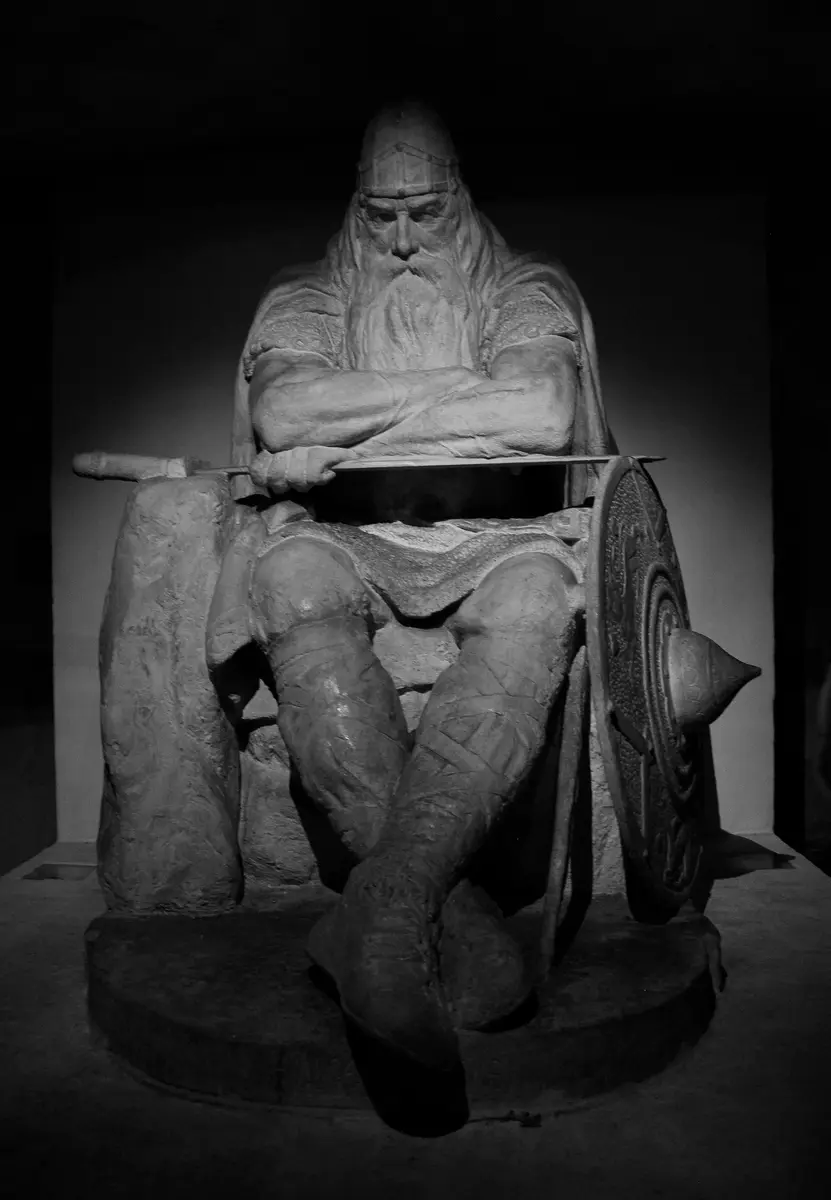
Under Kronborg Castle at Helsingør, in the galleries the garrison once used, a bearded man in armour sits with his beard grown into the table in front of him: Holger Danske, who will wake when Denmark is in mortal danger.
Where does the legend of Holger Danske, Asleep in Kronborg come from?
- Location
- Castillo de Kronborg, Helsingør, Denmark
- Kind of legend
- Myth
- Coordinates
- 56.039, 12.621
- Last updated
LOCATION
What is the legend of Holger Danske, Asleep in Kronborg?
The story is told as one thing and it is three. Ogier le Danois is a minor baron in the Chanson de Roland, named eight times in the whole poem. He became a Danish hero through a chapbook that Christiern Pedersen, unable to read French, paid to have turned into Latin before writing his Danish from that; it was printed at Malmö on 30 January 1534. The sleeper under Kronborg is first legible in Just Mathias Thiele's Danmarks Folkesagn of 1843, where the table is stone and cracks right through when he lifts his head, and where Thiele himself files the tale beside Barbarossa in the Kyffhäuser and Arthur in England. Hans Christian Andersen turned the table to marble in 1845. The figure visitors photograph is younger than all of it: a concrete cast of 1985, after a plaster model of 1907.
What is the history of Holger Danske, Asleep in Kronborg?
Three different things are usually told here as one story, and they are three centuries apart. The first is a Frankish nobleman. The second is a chapbook printed in Malmo. The third is a plaster figure carried down into the casemates in October 1907.
The oldest layer that can be pointed at is a man called Autcharius, a Frankish magnate of the late eighth century whose only recorded acts are that he was hostile to Charlemagne and that, after Carloman's death in 771, he went with Carloman's widow Gerberga and her two small sons when she fled to her father, the Lombard king Desiderius. He is mentioned in the ninth-century Latin chronicle written by the monk of St Gall. The philologist Kristoffer Nyrop set the chain out in 1893, in his introduction to a school edition of Ingemann's poem, and it is from him that the derivation Autcharius > Audgar > Ogier comes. After Autcharius the record goes quiet for two centuries, and the man reappears in French around the time of the First Crusade with a surname attached: le Danois.
In the Chanson de Roland he is already there, and he is a small part. Counted in Joseph Bedier's edition of the Oxford manuscript, Ogier is named eight times in the whole Old French text, against 125 occurrences of Rollant. Charlemagne summons him to council under the pine: "Le duc Oger e l'arcevesque Turpin" (v. 170). Ganelon, asked who will ride the vanguard, answers "Oger de Denemarche: n'avez barun ki mielz de lui la facet" (vv. 749-750). One laisse, CCLVI, is his alone: "Li quens Oger cuardise n'out unkes", the count Ogier never knew cowardice. At the judicial duel that closes the poem it is he who formally carries the double challenge. Where the byname le Danois came from, Nyrop wrote in 1893, is not known, and every attempt to show that the man was of Danish descent had so far failed. Only in the following century, in La Chevalerie d'Ogier de Danemarche, does he become the protagonist and the son of the Danish king Gudfred, handed over to Charlemagne as a hostage.
He came north twice. First through the Norse Karlamagnus saga, turned into the Danish Karl Magnus' Kronike, a manuscript of 1480 printed in 1509. Then, decisively, through a chapbook, and the chapbook's own preface records how it was made. Christiern Pedersen, canon of Lund, writes that he was "budet og befalet", bidden and commanded, to hunt down the old chronicle of Holger Danske, and that he was promised good pay for it; the commission is generally read as having come from King Christian II. He found the book in Paris, printed in French, under the title L'hystoire d'Ogier le Dannoys, duc de Dannemarche, probably during his stay of 1527. And here is the part that gets left out. Pedersen could not read French. In his own words: "Saa lod jeg hende vdsaette paa latine oc gaff der fore guld oc paenninge, thi jeg kunde icke selff forstande det Frantsoske tungemaall. Siden screff jeg hende paa danske effter latinen met stort arbeyde." He paid to have it put into Latin, and wrote his Danish from the Latin. The Danish national hero arrived in Denmark as a translation of a translation.
The colophon dates the book to the day, once you do the arithmetic: "prentet i Malmo af Johan Hochstraten Den fredag nest fore Kyndelmosse Aar MDXXXIIII", the Friday before Candlemas, 1534. Candlemas is 2 February; in 1534, in the Julian calendar then in use, 2 February fell on a Monday, so the Friday before it was 30 January 1534. Pedersen's text insists that Holger was a real man, "Kong Gottricks Son og fodder her i Danmarck", the eighty-eighth king of the realm, and complains that Danes had forgotten him so thoroughly that ordinary people could say nothing of him except that he had beaten Burmand. The book then stayed in Danish cottages for three centuries. In 1795 the literary historian Rasmus Nyerup wrote in the monthly Iris that it was to be found in nearly every second peasant's hut and was read aloud on holy evenings and at carding-bees. In 1837 B. S. Ingemann rebuilt the whole thing as a poem in five song-cycles, Holger Danske, which went to a second edition in 1845 and a third in 1847 and gave Danish song two standards, "I alle de Riger og Lande" and "Jeg saa kun tilbage".
None of that is Kronborg. The sleeper under the fortress is a separate story, and the oldest printed version I have been able to read is Just Mathias Thiele's, in Danmarks Folkesagn, first volume, published by C. A. Reitzel in Copenhagen in 1843, pages 18 to 19, under the heading "Holger Danske under Kronborg". It is short and it is specific. For a long time the clash of weapons was heard now and then under Kronborg fortress, and nobody in the whole country dared go down the lowest passages. A slave who had forfeited his life was offered his freedom if he would descend as far as the passage led and report what he found there. He came at last to a great iron door that opened of itself when he knocked on it, and saw before him a deep vault. A nearly burnt-out lamp hung under the ceiling, and beneath it stood "et maegtig stort Steenbord", a mighty great stone table, with steel-clad champions sitting round it, bowed, their heads resting on crossed arms. The one at the head of the table rose, and it was Holger Danske; and as he lifted his head from his arm the stone table cracked right through, "thi hans Skaeg var ivoxet", for his beard had grown into it. He asked for the man's hand. The slave did not dare to give it, and held out an iron bar instead, which Holger squeezed until the marks showed in the metal, and let go with the words "Nu! det glaeder mig, at der dog endnu er Maend i Danmark", it gladdens me that there are still men in Denmark.
Two years later Hans Christian Andersen printed his own tale, Holger Danske, and changed the furniture. In Andersen the table is marble, not stone, and an angel of God comes every Christmas Eve to tell the sleeper that Denmark is not yet in real danger. What the summaries lose is that the tale is a frame story about an old carver of ships' figureheads, and that its point runs the other way from a sleeping knight: the grandfather believes he served beside Holger at the Battle of Copenhagen, "den danske anden april", in Steen Bille's squadron, and the tale ends by naming who Holger really is in the carver's account, namely Holberg, Tycho Brahe and the sculptor Bertel Thorvaldsen, to whom the family raises its glass in the last lines.
The figure in the casemates is younger than any of this. Hotel Marienlyst in Helsingor commissioned a bronze Holger Danske from the sculptor Hans Peder Pedersen-Dan in 1907, and the bronze was unveiled at the hotel that July. To cast it, Pedersen-Dan first modelled a large plaster figure, and in October 1907 that plaster, not the bronze, was placed in Kronborg's casemates, where it became far better known than the finished statue. Damp destroyed it in the end, and in 1985 it was replaced by a copy in concrete cast by Eric Erlandsen. The concrete is what visitors photograph today. The bronze stayed at Marienlyst until 2013, when it was auctioned for 3.2 million kroner to buyers from western Jutland and re-erected in Skjern.
And in the spring of 1943, in a flat at Overgaden neden Vandet 51B on Christianshavn in Copenhagen, a resistance group took the name Holger Danske. It counted some 350 members by 1945. Its best-known action was the destruction of the Forum exhibition hall in Copenhagen on 24 August 1943; Danish accounts credit the group with more than a hundred sabotage operations. Two of its members, Bent Faurschou-Hviid, called Flammen, and Jorgen Haagen Schmith, called Citronen, both died in October 1944, and 64 members of the group were killed or executed.
Timeline: the documented record of Holger Danske, Asleep in Kronborg
- 771 The historical kernel, as reconstructed by Kristoffer Nyrop in 1893: Autcharius, a Frankish magnate hostile to Charlemagne, accompanies Carloman's widow Gerberga and her two young sons when she flees to her father, the Lombard king Desiderius. He is named in the ninth-century Latin chronicle of the monk of St Gall, and then the record falls silent for two centuries.
- around 1100 In the Chanson de Roland, as preserved in the Oxford manuscript, Ogier is already "Oger de Denemarche" and "Oger li Daneis", but a minor baron: eight namings in the whole poem. Ganelon proposes him for the vanguard (vv. 749-750) and one laisse, CCLVI, states that he never knew cowardice. Danish reference works, and Kronborg's own website, date the poem to about 1060.
- 1509 Karl Magnus' Krønike, the Danish version of the Norse Karlamagnús saga and the first route by which Ogier reaches Danish readers, is printed; the manuscript behind it is dated 1480. This is Kronborg's own account of the transmission.
- 30 January 1534 Christiern Pedersen's "Kong Olger Danskis Krønicke" is printed at Malmö by Johan Hochstraten. The colophon says "the Friday before Candlemas, MDXXXIIII"; Candlemas is 2 February, which in the Julian calendar of 1534 fell on a Monday, so the date is 30 January. In his preface Pedersen states that he was bidden and commanded to find the chronicle, that he found it printed in French in Paris, that he could not read French and paid to have it turned into Latin, and that he wrote his Danish from the Latin.
- 1795 The literary historian Rasmus Nyerup writes in the monthly Iris that the Holger Danske chapbook is to be found in nearly every second peasant's hut and is read aloud on holy evenings and at carding-bees. It is the earliest dated measure of how widely the story circulated in Denmark.
- 1837 B. S. Ingemann publishes "Holger Danske. Et Digt i fem Sangkredse", which reaches a second edition in 1845 and a third in 1847. It fuses the French romance material — Gloriande, Burmand, Morgana, Avalon — with the immortal national hero. Kronborg is not in it: in the 1893 edition of the poem the word appears once, and only in the editor's introduction, against 142 occurrences of Holger.
- 1843 Just Mathias Thiele prints "Holger Danske under Kronborg" on pages 18-19 of the first volume of Danmarks Folkesagn: the condemned slave sent down the passages, the iron door that opens by itself, the great stone table that cracks through because the beard has grown into it, and the iron bar squeezed until it is marked. In the same notes Thiele files the story beside Barbarossa in Grimm's Deutsche Sagen, Charlemagne in the Untersberg, the three Tells and Arthur, and cites as his own source "Boesens Beskriv. over Helsingør, 94".
- 1845 Hans Christian Andersen publishes the tale "Holger Danske". The table becomes marble — marmorbord twice, steenbord not once — and an angel comes every Christmas Eve to report that Denmark is not yet in danger. The frame story, which summaries drop, has a carver of ships' figureheads who believes he served beside Holger at the Battle of Copenhagen, and ends by identifying Holger with Holberg, Tycho Brahe and Thorvaldsen.
- October 1907 Hotel Marienlyst had commissioned a bronze Holger Danske from Hans Peder Pedersen-Dan, unveiled at the hotel that July. The large plaster model made for the casting is placed in Kronborg's casemates in October, and becomes far better known than the bronze.
- 24 August 1943 The resistance group founded that spring at Overgaden neden Vandet 51B in Christianshavn, and named Holger Danske, destroys the Forum exhibition hall in Copenhagen. The group grew to some 350 members by 1945; Bent Faurschou-Hviid ("Flammen") and Jørgen Haagen Schmith ("Citronen") both died in October 1944, and 64 of its members were killed or executed.
- 1985 The plaster figure, ruined by the damp of the casemates, is replaced by a copy in concrete cast by Eric Erlandsen. This is the statue photographed by visitors today, including the photograph on this page, taken on 15 July 2010.
- 2000 Kronborg is inscribed on the UNESCO World Heritage list. The castle itself was built by Frederik II between 1574 and 1585, burnt in 1629 and rebuilt by Christian IV, and plundered by the Swedes in 1658.
- 2013 The original 1907 bronze, which had stood at Hotel Marienlyst for 106 years, is auctioned for 3.2 million kroner to buyers from western Jutland and re-erected in Skjern. The concrete copy stays in the casemates.
Is there a rational explanation for Holger Danske, Asleep in Kronborg?
There is nothing here to test with instruments, and nobody, Kronborg's own museum included, argues that a knight is asleep under the castle. What can be checked is the paper trail, and the checks came out against the version this page used to carry.
The statue first, because it is the cheapest check and our text failed it twice in one paragraph: it called the figure a stone statue in one sentence and a bronze statue in the next. It is neither. What sits in the casemates is a concrete cast made in 1985 by Eric Erlandsen, after H. P. Pedersen-Dan's plaster model of 1907, which the damp had destroyed. The bronze the plaster was modelled for never stood at Kronborg at all: it stood at Hotel Marienlyst from 1907 to 2013 and now stands in Skjern, in western Jutland. The photograph on this page was taken on 15 July 2010, so it shows the concrete.
Then the dating. "Fully adopted as Danish national legend by the 16th to 19th centuries" is a three-hundred-year bracket, and a claim that wide cannot be wrong, which is exactly why it should not be written. The dates exist and they are on this page: 30 January 1534 for Pedersen's chronicle, 1795 for Nyerup's note on how widely it was read, 1837 for Ingemann's poem, 1843 for Thiele's Kronborg version, 1845 for Andersen's tale.
Then the chroniclers. "Chroniclers recorded that during the German occupation the name was adopted by a resistance group" has nobody behind it, and it was laid on top of one of the best-documented facts in the entry. There were no chroniclers. There was a resistance group with an address, a founding season, a list of operations and a casualty count, and naming it is better than the formula that replaced it.
The motto is the one thing I could not anchor. The line quoted on postcards and at the statue, "naar Danmark stander i vaade, saa vil Holger Danske vaagne op til daad", is in none of the three texts I was able to read in full. Searching Thiele's first volume of 1843, 187,153 words, for vaade returns zero, with daad appearing five times, Danmark 47 and Holger 40 in the same pass. Searching the 1893 edition of Ingemann's poem, 19,605 words, returns zero for vaade, with Holger 142 times, Morgana 21, Avalon 11 and Burmand 9. Andersen's tale contains neither vaade nor daad, with Danmark ten times and Holger twenty-four. The Danish encyclopaedic account traces the sentence no further back than a news item of 2020. It may well be old; since I cannot show where it comes from, it is not quoted here as anybody's words.
Where the sleeper comes from is not a mystery either, and Thiele said so in print in 1843. In his own notes to the Kronborg entry he files the story beside Grimm's Deutsche Sagen I, 29, where the same thing is told of the emperor Frederick Barbarossa, and I, 33, where it is Charlemagne in the Untersberg near Salzburg; beside the three Tells waiting in a Swiss mountain cleft, beside Arthur in England, and beside a giant in Bohuslan who was handed a boathook instead of a hand and crushed it. What was Danish about the story was where the vault was placed, and even that was contested inside Denmark: Thiele's own notes send the same sleeper to Havrebjerg near Slagelse and, spelled Olger, to a hill at Mogeltonder in Slesvig, and his neighbouring entries put Holger's grave near Horsens and his awakening at Viborg lake.
Two limits of this account should be stated rather than hidden. Thiele cites a source under the Kronborg entry, "Boesens Beskriv. over Helsingor, 94", a description of Helsingor that I could not obtain: the last link below Thiele is therefore still unread, and it is the place to look for anything older. And Thiele's preface, dated December 1842, says that this collection differs from the one he published twenty years earlier not only in its title but by being enlarged with some three hundred legends, so the presence of the Kronborg story in 1843 does not prove it was in his first collection of 1818-1823, whose scanned Fraktur text I could not search reliably.
One last correction, and it runs the other way. The old entry said the beard had grown into a stone table, and that is right: Thiele has a Steenbord, and it is Andersen who turned it to marble. Distrusting it would have been the error.
Can you visit Holger Danske, Asleep in Kronborg?
Kronborg stands on the point of land at 3000 Helsingør where the Øresund is at its narrowest, and it has been on the UNESCO World Heritage List since 2000. The casemates, with the statue at the far end of them, are part of the ordinary castle ticket. The castle's visitor page, read on 23 September 2026, gives the adult price as 150 DKK at the door or 135 DKK online; children go free, and "the ticket is valid for 1 year after purchase".
The same page sets out three opening seasons. From 28 March to 31 October the castle is open every day from 10:00 to 17:00. From 2 January to 28 March it closes on Mondays and opens 10:00 to 16:00 on the other days, with daily opening during the winter break of 7 to 22 February. From 1 November to 30 December it again closes on Mondays, opening 10:00 to 16:00 on weekdays and 10:00 to 17:00 at weekends; over Christmas it shuts on 24 and 25 December, and it is also closed on 31 December.
Kronborg's page puts Helsingør station a ten-minute walk from the castle, with DSB's coastal line, the Kystbanen, running from Copenhagen roughly every twenty minutes and bus lines 801A and 802 stopping at the station. Public pay parking is at Nordhavnsvej, five minutes' walk to the north; the castle says the car park "is often filled in peak hours during the midday", and accessible bays are inside the grounds to the left of the red gate.
The castle's casemates page describes vaulted galleries where "up to 350 men could seek shelter with enough supplies for a six-week siege", and says that under Frederik II they also held a forge and a stable. The same page asks visitors to bring a flashlight and follow the glow of the oil lamps, and notes that bats hibernate in the galleries in winter and are protected. The figure at the end is the concrete cast of 1985 (ref. 4); the plaster original placed there in October 1907 was destroyed by damp.
The accessibility note is short: "Kronborg has many stairs and no elevator, therefore it is not easy to get around as a wheelchair user." Dogs are not admitted, apart from guide and service dogs, and a valid companion card gives one companion free entry.
Pedersen-Dan's bronze Holger, the statue the plaster was modelled for, is not at Kronborg. After the 2013 auction it was set up on 10 November 2014 on Mølletorvet in Skjern, western Jutland, which was renamed Holger Danskes Plads the same day; that is about 255 km west of the castle in a straight line.
Sources consulted
- Just Mathias Thiele, «Danmarks Folkesagn. Første Deel — "Holger Danske under Kronborg", pp. 18-19» — C. A. Reitzels Forlag, Kjøbenhavn, 1843 book
- Hans Christian Andersen, «Holger Danske (eventyr), dansk tekst» — Nye Eventyr, Kjøbenhavn, 1845 book
- Kristoffer Nyrop (udg.), «Indledning til B. S. Ingemann, "Holger Danske. Et Digt i 5 Sangkredse" (Dansklærerforeningen, Danske Forfattere 27-28)» — Det Reitzelske Forlag, København — digitaliseret af Det Kgl. Bibliotek, 1893 book
- Joseph Bédier (éd.), «La Chanson de Roland, publiée d'après le manuscrit d'Oxford (vv. 170, 749-750, laisse CCLVI, v. 3856)» — L'Édition d'Art H. Piazza, Paris, 1922 book
- Kronborg Slot (Slots- og Kulturstyrelsen), «Historien om Holger Danske i kasematterne / The story of Holger the Dane; Enter the casemates; Plan your visit» — kronborg.dk, 2026 web
- Helsingør Leksikon (efter Lars Bjørn Madsen), «Holger Danske — statuen på Marienlyst, gipsfiguren i kasematterne og betonkopien fra 1985» — helsingorleksikon.dk, 2026 web
- Den danske Wikipedia, «Holger Danske (modstandsgruppe)» — da.wikipedia.org, 2026 web
- Wikimedia Commons, «File:Kronborg, statue of Ogier the Dane.jpg — ficha del fichero (autor, licencia CC BY 3.0, tomada el 15-07-2010, subida por Panoramio upload bot el 23-03-2017)» — commons.wikimedia.org, 2017 web
Reviewed by V. Serrano on 2026-08-16 · How we verify our content
📎 Source: Enigma Atlas
💬 Field testimonies (0)
No testimonies yet. Add the first.
Add your testimony
🔒 Log in to add a testimony