👻 HAUNTED PLACE · EXP. Nº9474
ACTIVE
Hegra (al-Hijr / Madāʾin Ṣāliḥ)
Hegra — al-Ḥijr in Arabic, Madāʾin Ṣāliḥ, "the cities of Salih" — is the southern city of the Nabataeans: 111 monumental tombs cut into sandstone outcrops in the AlUla valley of north-western Saudi Arabia, and the first site in the country inscribed on the UNESCO World Heritage List, on 6 July 2008.
Where is Hegra (al-Hijr / Madāʾin Ṣāliḥ)?
- Location
- Al-Ula, Medina Province, Saudi Arabia
- Type
- Ruin / ancient site
- Coordinates
- 26.792, 37.953
- Last updated
LOCATION
Why is Hegra (al-Hijr / Madāʾin Ṣāliḥ) said to be haunted?
Several tombs carry their own date. Jaussen and Savignac copied one in 1907 giving the year four of Rabbel, king of Nabataea, which they equated with AD 74. The same ground is the al-Ḥijr of the Qur'an, which gives the fifteenth sūra its name, where the people of Thamūd carved houses in the mountains and were destroyed after hamstringing the she-camel sent to Ṣāliḥ as a sign. Ibn ʿUmar related that the Prophet, halting here on the way to Tabūk, told his companions not to enter such dwellings "unless you enter weeping", then covered his head and rode on. Read loosely it all becomes a cursed city. Read properly it is three separate things — scripture, dated archaeology and a coach tour that runs daily — and they are best kept apart.
What is the history of Hegra (al-Hijr / Madāʾin Ṣāliḥ)?
Two different places share this ground, and running them together is the commonest error made about Hegra.
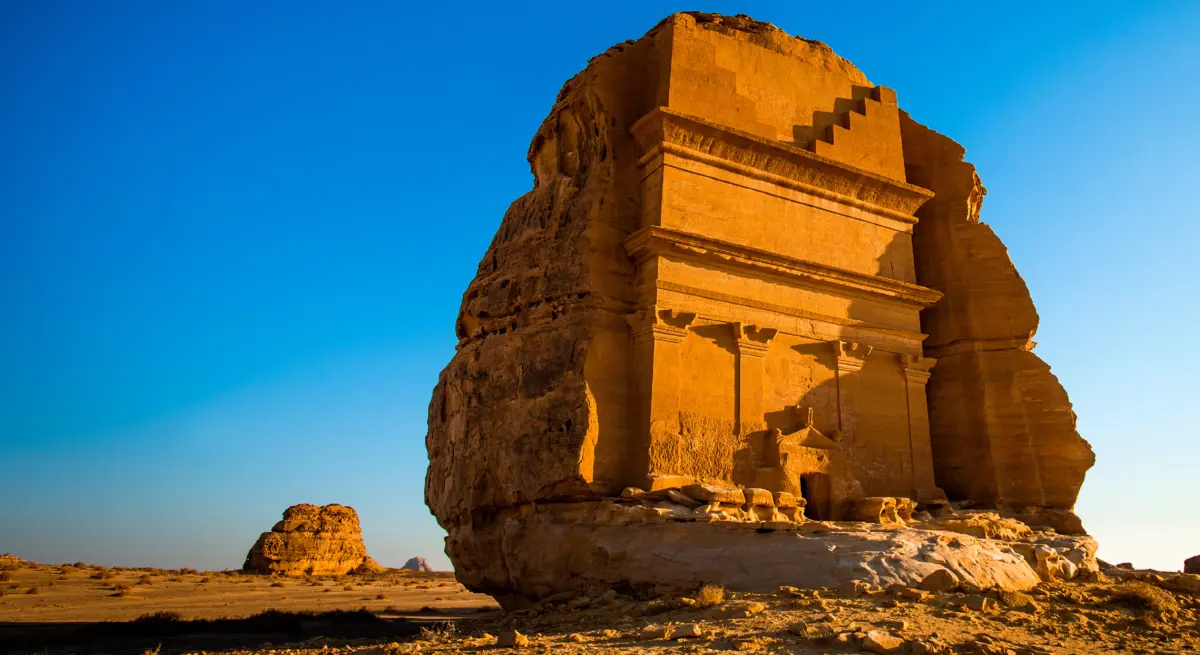
The first is an archaeological site. Al-Hijr was the southern city of the Nabataeans, the caravan people whose capital was Petra, and UNESCO's inscription record for the property counts 111 monumental tombs cut into isolated sandstone outcrops around the walled town, 94 of them with decorated façades, along with some fifty inscriptions of the pre-Nabataean period and rock drawings. The tombs are dated to the 1st century BC and the 1st century AD, and several of them carry their own date. In the spring of 1907 the Dominicans Antonin Jaussen and Raphaël Savignac copied one that reads "this is the tomb which belongs to ʿAmat daughter of Kamûlat, for herself and for her children and her posterity, in the year four of Rabbel, king of Nabataea" — year four of Rabbel being, by their reckoning, AD 74. Another, which they numbered 21, stands on the single enormous free-standing block that local Arabs called al-Farid, "the unique one": it carries one line only, which they read as "For Ḥaydn son of Kûzâ and his posterity", and which they suspected had been left unfinished, like the monument itself. That block is the tomb in almost every photograph of Hegra. The Royal Commission for AlUla labels it today the Tomb of Lihyan son of Kuza.
The Arabic name Madāʾin Ṣāliḥ means "the cities of Salih", and it is a plural: local tradition told Jaussen and Savignac that seven cities had once stood in this plain. The place was never lost. It was a staging post on the Damascus pilgrim road to Medina, with a fort and a garrison, and Charles Doughty lodged in that fort through the winter of 1876-77, having left Damascus with the Hajj caravan on 18 November 1876. He copied the Nabataean inscriptions — Ernest Renan translated them for his book — and summed up the situation in his own chapter heading: few pilgrims ever saw the monuments they were camping beside.
Jaussen and Savignac travelled south in March 1907, using the Hejaz Railway as far as the line then ran and camels after that, and published their survey in Paris in 1909. The railway, begun in 1900, was built past the site; its station and locomotive are part of the visit the Royal Commission runs today.
Systematic excavation is recent. In 2008 a Saudi–French team led by Daifallah al-Talhi, Laïla Nehmé and François Villeneuve opened the first season, reporting that the tombs, famous for centuries, had never been systematically investigated and that the city itself lay hidden under the sand. That same year, on 6 July, the World Heritage Committee inscribed the property: the first site in Saudi Arabia to be listed. One of the tombs worked on in 2008 held the remains of a Nabataean woman the archaeologists named Hinat, and a reconstruction of her face is now shown at the Hegra Visitor Centre.
The second place is the al-Ḥijr of the Qur'an, and it is not folklore: it is scripture. The fifteenth sūra takes its name from it. "And certainly did the companions of Thamud deny the messengers. And We gave them Our signs, but from them they were turning away. And they used to carve from the mountains, houses, feeling secure. But the shriek seized them at early morning" (15:80-83). The people are Thamūd, to whom God sent their brother Ṣāliḥ with a she-camel as a sign; they hamstrung her, and were destroyed (7:73-79; 11:65; 26:141-159; 54:23-31; 91:11-15).
From that account comes a counsel that still shapes how many Muslims regard the site. Ibn ʿUmar related that when the Prophet passed al-Ḥijr he said: "Do not enter the dwellings of those who wronged themselves, unless you enter weeping, lest what befell them should befall you" — then covered his head with his cloak and rode on quickly until he had crossed the valley (Ṣaḥīḥ al-Bukhārī 3380 and 4419). The same chapter reports that, halting at al-Ḥijr during the expedition to Tabūk, he ordered water drawn from its wells to be poured away and dough kneaded with it fed to the camels, and told his companions to draw instead from the well the she-camel had used (Bukhārī 3378-3379).
Timeline: the documented record of Hegra (al-Hijr / Madāʾin Ṣāliḥ)
- AD 74 A tomb at Hegra is dated in its own inscription: "this is the tomb which belongs to ʿAmat daughter of Kamûlat… in the year four of Rabbel, king of Nabataea". Jaussen and Savignac, who copied it in 1907, equated year four of Rabbel with AD 74.
- AD 106 The Nabataean kingdom is annexed by the Roman Empire. The Royal Commission for AlUla notes that traces of the rampart found in the early 20th century show a wall some three kilometres long with three to five gates, towers and buttresses.
- c. 630 (year 9 of the Hijra) Ibn ʿUmar relates that on the expedition to Tabūk the Prophet halted at al-Ḥijr, ordered water taken from its wells to be poured away, and told his companions not to enter the dwellings of those who wronged themselves "unless you enter weeping", covering his head and riding on quickly.
- 18 November 1876 Charles Doughty leaves Damascus with the Hajj caravan. He winters in the fort beside Medain Salih, copies the Nabataean inscriptions, and records that the plain was thought to hide a mischief that would let it never be tilled or inhabited again.
- 1888 Doughty publishes Travels in Arabia Deserta, with the inscriptions he copied translated by Ernest Renan. His own chapter summary notes that few pilgrims ever saw the monuments beside which the caravan camped.
- March–May 1907 The Dominicans Antonin Jaussen and Raphaël Savignac survey the site, using the Hejaz Railway as far as it then ran. They catalogue the tombs and their inscriptions, including no. 21 on the isolated block called al-Farid, which they read as "For Ḥaydn son of Kûzâ and his posterity" and thought unfinished.
- 1909 Their Mission archéologique en Arabie appears in Paris. It records the living oral legend of the she-camel as their own men told it, and notes that the Qur'an alludes to her without detail while the commentators supplied versions "in which the marvellous keeps growing".
- 2008 A Saudi–French team led by Daifallah al-Talhi, Laïla Nehmé and François Villeneuve opens the first excavation season, reporting that the famous tombs had never been systematically investigated and that the city itself remained hidden under the sand.
- 6 July 2008 The World Heritage Committee inscribes the property under criteria (ii) and (iii): 1,621.2 ha, 111 monumental tombs, 94 of them decorated. It is the first site in Saudi Arabia on the World Heritage List.
- 19 December 2019 – 7 March 2020 The Winter at Tantora festival runs each weekend, with heritage sites "specially opened for the festival": Hegra was already receiving visitors seasonally before the date usually given for its opening.
- 2020 On 3 June the official site still reads "Hegra is currently closed to visitors due to Covid-19. AlUla is planning to reopen at the end of October 2020"; by 1 November it describes Hegra as open at limited capacity, with tickets booked online and coach tours from Winter Park, daily 09:00-17:00.
- 12 August 2026 Checked on the official site: Hegra open daily and year-round, guided tours only, self-driving not allowed, from SAR 95 per person for the coach day tour and SAR 1,000 for a private 4x4.
Is there a rational explanation for Hegra (al-Hijr / Madāʾin Ṣāliḥ)?
Three things are true here at once, and Hegra gets misdescribed whenever they are collapsed into one.
The Qur'anic account of Thamūd and Ṣāliḥ is an article of faith for well over a billion people, and nothing in this file is offered as a test of it. What can be dated is the elaborate folk narrative that grew around it — and Jaussen and Savignac noticed the gap themselves in 1909. The Qur'an, they wrote, alludes to the she-camel as something already known to the reader, without going into detail; the commentators could not be so sparing, so they told the story at length, each in his own way, in versions "in which the marvellous keeps growing". The version their own men told them in 1907, and told "with emotion", has the camel brought out of a rock, draining the well of Madain every evening by plunging in her long neck, going round the seven cities giving milk to everyone, then killed by sharpened dagger blades fixed on either side of the narrow defile at Mabrak an-Nāqa, "the place where the she-camel knelt"; her calf fled across the plain and was turned into an enormous rock still pointed out to travellers. The two of them are said to be heard groaning to this day, which is why, the fathers record, the Hajj caravan passing Mabrak an-Nāqa shouted and fired guns: if the camels heard those groans, the whole caravan would kneel down and refuse to go on.
The second layer is the archaeology, and it is simply of a different order. What a visitor sees are dated Nabataean burial monuments of the 1st century AD, several of which give the regnal year of their king in their own inscription. They were cut as tombs.
The third layer is modern, and it is where the older version of this entry went wrong. Hegra is regularly sold as a cursed or shunned city preserved by dread. UNESCO's own Statement of Outstanding Universal Value gives a different reason for the state of the monuments: the testimony the site bears is of outstanding integrity and authenticity "because of its early abandonment and the benefit over a very long period of highly favourable climatic conditions". Nor was the plain shunned. The dread Doughty recorded in 1876-77 was narrower and more interesting than the tourist version: the Hejr loam was famously rich, he wrote, and people had sown it and done well for a while, "but always in the reaping-time there has died some one of them", so a hidden mischief was thought to lie in soil once overturned by divine judgment, which might never be tilled or inhabited again. He also reports a young man of the Fehjat who, less than twenty years before, had dug a well and planted palms within gunshot of the fort, raised the best melons and pumpkins in the district, and died in the middle of it — after which the venture was abandoned. That is a belief about farming the ground, and Doughty recorded it while an Ottoman garrison was living in the fort a few hundred metres away.
Can you visit Hegra (al-Hijr / Madāʾin Ṣāliḥ)?
The pin of this file, at 26.7917 N 37.9528 E, lies about 130 m south of the rock-cut tomb that OpenStreetMap maps as Al Faqir Tomb, and about 0.9 km north-north-west of the reference point UNESCO gives for the World Heritage property, N26 47 1 E37 57 18. In a straight line it is about 26 km north of the town of AlUla, 15 km north-north-east of Winter Park, where the coach tour starts, and 37 km north-north-west of AlUla International Airport.
Visits to Hegra are sold as guided tours. On 24 September 2026 the Royal Commission for AlUla's site, experiencealula.com, sold two of them, each listed as open daily and available year-round, and its Hegra page stated: "Self-driving is not allowed." The Hegra Day Tour, from SAR 95 per person, takes two to three hours including transfer time. It leaves from the Winter Park bus stop in an air-conditioned coach that carries up to 45 people, with a guide from AlUla's Rawis speaking English or Arabic, and its stops include the Tomb of Lihyan son of Kuza and the Diwan halls. The Hegra Premium Tour, from SAR 1,000 per vehicle, is a two-hour drive in a private 4x4 with a driver, for up to seven passengers; it starts at the Hegra Visitor Centre with a rawi and a ranger, and one guide serves two cars, up to a group of 14. Both tour pages include entry to the World Heritage Site in the price and describe the tours as not suitable for wheelchairs or strollers. Refunds are allowed up to three days before the booked date, and changes of date or time up to one day before; on the day itself the pages allow neither. The Premium Tour page adds that "due to maintenance and excavation work, some sites at Hegra might be closed during your visit".
The questions section of the Hegra page, read the same day, requires visitors to keep to the designated walking paths and prohibits entering the tombs, warning that entering them or touching the engravings "may cause irreparable damage". It lists the tour stops as Jabal Ithlib, Jabal Banat, the Tomb of Lihyan son of Kuza, Jabal Ahmar, Jabal Khuraymat and the Handcraft Pavilion, and states that children aged four and under go free. Parking is free at Hegra South Gate, where the tour meeting points are. AlUla's Visitor Centres page gives the Hegra Visitor Centre's hours as 06:30 to 18:00 on Sundays and Mondays and 06:30 to 20:30 from Tuesday to Saturday. The tour pages recommend closed-toe shoes, a hat and sunscreen, and note that "all experiences" are "subject to weather and visibility conditions".
The Commission's practical information page states that "the sale, purchase and consumption of alcohol is illegal in Saudi Arabia", and that "tourists are not permitted to fly drones in the Kingdom". It also says that women "do not need to wear a headcover or an abaya", while places of worship "require you to dress modestly". Its travel page gives AlUla as a three-hour drive from Medina to the south and from Tabuk to the north, and lists scheduled flights into AlUla International Airport for 29 March to 24 October 2026, including flydubai from Dubai. Enquiries and booking changes go to +966 920 025 003, Sunday to Thursday, 08:00 to 17:00 Saudi time.
The counsel on passing al-Ḥijr recorded in Ṣaḥīḥ al-Bukhārī 3380 and 4419, quoted in the history of this file, still shapes how many Muslims regard the site.
Sources consulted
- Sahih International (EN); Julio Cortés (ES), «The Qur'an, sūras 7:73-79, 11:65, 15:80-84, 26:141-159, 41:17, 54:23-31 and 91:11-15 (Thamūd and the prophet Ṣāliḥ)» — consulted through the alquran.cloud text API book
- Muḥammad al-Bukhārī, «Ṣaḥīḥ al-Bukhārī 433, 3378, 3379, 3380, 3381, 4419 and 4420 (al-Ḥijr and the Tabūk expedition)» — sunnah.com, Arabic text with English translation book
- Charles M. Doughty, «Travels in Arabia Deserta, vol. I, chapters IV-VII (Medain Salih)» — Cambridge University Press, 1888; edition consulted, London, 1921, 1888 book
- Antonin Jaussen and Raphaël Savignac, «Mission archéologique en Arabie (mars-mai 1907), I: De Jérusalem au Hedjaz, Médain-Saleh» — Publications de la Société française des fouilles archéologiques, Paris, Ernest Leroux, 1909 book
- UNESCO World Heritage Centre, «Hegra Archaeological Site (al-Hijr / Madāʾin Ṣāliḥ): inscription record and Statement of Outstanding Universal Value, property 1293» — World Heritage List, 2008 report
- Laïla Nehmé, Daifallah al-Talhi and François Villeneuve, «Report on the First Excavation Season at Madâ'in Sâlih, 2008, Saudi Arabia» — Madâ'in Sâlih Archaeological Project; record and abstract consulted on HAL, 2008 report
- Royal Commission for AlUla, «Hegra, Hegra Day Tour, Hegra Premium Tour and Practical Information (consulted 12 August 2026)» — experiencealula.com, 2026 web
- Royal Commission for AlUla, «Experience AlUla, Hegra and Winter at Tantora pages as archived on 11 October 2019, 3 June 2020, 1 November 2020 and 22 November 2020» — Internet Archive Wayback Machine, 2020 archive
- Royal Commission for AlUla, «AlUla's Visitor Centres (consulted 24 September 2026) — opening hours of the Hegra Visitor Centre and the other visitor centres» — experiencealula.com, 2026 web
- Royal Commission for AlUla, «Getting to and around AlUla (consulted 24 September 2026) — flight schedule 29 March to 24 October 2026 and driving times from Medina and Tabuk» — experiencealula.com, 2026 web
- OpenStreetMap contributors, «OpenStreetMap map data queried through Nominatim on 24 September 2026 — Al Faqir Tomb (way 986930782), the town of AlUla (node 7700293159), Winter Park (way 849463099) and AlUla International Airport (way 232975410)» — OpenStreetMap, 2026 web
Reviewed by V. Serrano on 2026-08-12 · How we verify our content
💬 Field testimonies (0)
No testimonies yet. Add the first.
Add your testimony
🔒 Log in to add a testimony