📜 LEGEND · EXP. Nº0270
ACTIVE
The Djinn
The Qur'an gives them a chapter of twenty-eight verses, and the oldest thing anyone can read about them in Arabia may be a line scratched on basalt: a Safaitic inscription found in Jordan in 2021 asks Ḏgn, he of the ǧinn, for the security of the hidden ones.
Where does the legend of The Djinn come from?
- Location
- Mecca (Masjid al-Jinn), Saudi Arabia
- Kind of legend
- Creature legend
- Coordinates
- 21.433, 39.829
- Last updated
LOCATION
What is the legend of The Djinn?
The jinn are created beings in a living faith. What a document can settle about them is still plenty. The Quranic Arabic Corpus counts the word twenty-two times as jinn, ten as jinna and seven as jann, and five of the ten mean madness rather than spirits. The famous smokeless fire is a classical gloss on marij reported from Ibn Abbas, not the Arabic of the verse. Sahih Muslim tells a household to warn a snake for three days before killing it, and elsewhere denies the desert ghoul outright. And the genie of the lamp has a birthday: 5 May 1709, the day a Maronite from Aleppo called Hanna Diyab finished telling the tale to Antoine Galland in Paris.
What is the history of The Djinn?
The oldest thing anyone can read about the jinn in Arabia is not a story. It is a line scratched on basalt.
On 18 June 2021 the collector Ali Al-Manaser found a Safaitic inscription in situ at al-Wadi al-Abyad, in the Mafraq governorate of Jordan. The Online Corpus of the Inscriptions of Ancient North Arabia catalogues it as AAWAB 4, reads it l ṯlg bn ḏkr bn ẓʿn bn nks¹ bn s¹hwt w ḫrṣ s²nʾ f h ḏgn s¹lm h- ḫfyt h- s¹nt, and translates it: "By Ṯlg son of Ḏkr son of Ẓʿn son of Nks¹ son of S¹hwt and he kept watch for enemies and so, O Ḏgn, [grant] the security of the hidden ones [the Ǧinn] this year." Ahmad Al-Jallad, who published the text in Semitica et Classica in 2025, reads ḏgn as "he of the gn" and takes gn to be Ginn or Gann; the same article argues that another Safaitic verb, 'lmn, means "to seek refuge". The nomads who carved these texts east of the Hawran were writing at the beginning of the first millennium of our era, centuries before Islam and centuries before anyone wrote the word down in Arabic script.
That matters because the Qur'an itself preserves a memory of the practice. Sura 72, al-Jinn, twenty-eight verses long, reports jinn who overheard a recitation and believed; and its sixth verse records, in order to condemn it, something people used to do: "And there were men from mankind who sought refuge in men from the jinn, so they [only] increased them in burden." Elsewhere the Qur'an says that people made the jinn partners of God (6:100), that they worshipped them (34:41), and that they claimed a kinship between God and the jinn (37:158). The scripture is, among other things, a hostile witness to an older Arabian cult.
How often does the word appear? The morphological index of the Quranic Arabic Corpus gives, for the root j-n-n, 201 occurrences in all: jinn 22 times, jinna 10, jann 7, majnun ("possessed", "mad") 11, junna ("shield") 2, ajinna ("embryos") 1, the verb janna once, and janna ("garden", "paradise") 147. The figure repeated everywhere, "32 times", is exactly 22 plus 10 across 31 verses. It is arithmetically right and semantically slack: five of the ten occurrences of jinna mean madness, as at 23:70 ("Or do they say, In him is madness?") and 34:8. The number that circulates on the internet quietly counts the accusation levelled at the Prophet as if it were a census of spirits.
Two verses give the substance they are made of, and they do not agree word for word. Sura 55:15 has wa-khalaqa l-jānna min mārijin min nār, and 15:27 has "the jann We created before from scorching fire", nar al-samum. The English "smokeless fire" that every popular account repeats translates the commentators' gloss on marij, an old and respectable one: Ibn Kathir reports it from Ibn Abbas through al-Dahhak, "the tip of the flame of a smokeless fire", and through al-Awfi, "from the best part of the fire, from its smokeless flame". The wording entered English through Edward William Lane, whose notes were collected in 1883 as Arabian Society in the Middle Ages: "The Jann were created of a smokeless fire."
The hadith layer adds bodies and rules. Sahih Muslim 2996, on the authority of Aisha through Urwa and al-Zuhri, has the Prophet say that the angels were created from light, the jinn from marij of fire, and "Adam was created from what has been described to you". Sahih Muslim 2236 tells of a young bridegroom killed in Medina on the same day as a snake he had speared in his own house, and ends with an instruction that is a piece of household law rather than a scare story: "There are in Medina jinns who have accepted Islam, so when you see any one of them, pronounce a warning to it for three days, and if they appear before you after that, then kill it." Muslim 510a, from Abu Dharr, reports the terse "the black dog is a devil".
The lexicographers arrived last and explained everything by concealment. Ibn Manzur finished Lisan al-Arab in 689 AH / 1290 CE; al-Zabidi's Taj al-Arus followed. Edmund Teuma's philological survey of the root, published in Melita Theologica in 1993, compares Lane's Lexicon with both and with a dozen European dictionaries, and concludes that within classical usage the primitive sense of janna is "to cover, conceal", with madness and possession derived from it. The same root gives the tomb (janan), the shield (junna), the foetus (janin) and the garden (janna). Two details from that survey do real work here: jann is also a white, black-eyed, harmless snake common in houses, which is why the snake of Muslim 2236 is not a metaphor; and majanna is a noun of place meaning a country haunted by jinn, so that Lane can gloss the verb ajanna as "he came to a place haunted by jinn". Al-Jallad's derivation of Safaitic gn from Palmyrene gny', and beyond that from Latin genii, sits uneasily beside the native root; both readings are on the table.
Then the lamp, which has a date. Antoine Galland began publishing Les mille et une nuit in 1704 from a Syrian Arabic manuscript. On 25 March 1709 in Paris he realised that Hanna Diyab, a young Maronite from Aleppo who had travelled from Syria with Paul Lucas, was a gifted storyteller; on 5 May 1709 he noted that Diyab had "finished" the tale of the lamp. Ulrich Marzolph, editing Galland's diary summaries in Marvels and Tales in 2018, counts sixteen tales received from Diyab in eleven sessions between 6 May and 2 June 1709, of which Galland published ten in volumes nine to twelve. Aladdin appeared in volume nine in 1712; volumes eleven and twelve came out in 1717, Galland having died in 1715. No Arabic manuscript of Aladdin is known that predates him, and the Arabic versions that surfaced later are held to derive from his French. And the word Galland used, throughout, is genie: the spirit of the ring and the spirit of the lamp both open with the same formula, Que veux-tu? me voici prêt à t'obéir comme ton esclave. The lamp-bound genie of storybooks therefore comes from a tale told in Paris in 1709 by a man from Aleppo, printed in French in 1712, and named with a French word that happened to sound like the Arabic one.
Timeline: the documented record of The Djinn
- c. 610-632 The Qur'anic material takes shape. Sura 72, al-Jinn, twenty-eight verses, reports jinn who overheard a recitation; 72:6 records, in order to condemn it, that men used to seek refuge with jinn; 6:100, 34:41 and 37:158 accuse contemporaries of making them partners of God, worshipping them and claiming kinship with them.
- d. 261 AH / 875 Muslim ibn al-Hajjaj dies in Nishapur. His Sahih fixes the four passages this file rests on: 2996 (the jinn made from marij of fire), 2236 (the snake of Medina and the three days' warning), 2220 (there is no ghul) and 510a (the black dog is a devil).
- 689 AH / 1290 Ibn Manzur completes Lisan al-Arab, which explains jinn from the root sense of covering and concealing and records jann as a harmless white house snake and majanna as a place haunted by jinn.
- d. 774 AH / 1373 Ibn Kathir, in his commentary on 55:15, reports the reading of marij as smokeless flame from Ibn Abbas through al-Dahhak and again through al-Awfi. The English phrase everyone repeats is a classical gloss, not a Victorian one.
- 1704 Antoine Galland publishes the first volumes of Les mille et une nuit in Paris, translated from a Syrian Arabic manuscript. Aladdin is not in it, because it is not in the manuscript.
- 25 March 1709 Galland notes in his diary that Hanna Diyab, a young Maronite from Aleppo travelling with Paul Lucas, knows some very beautiful Arabic tales, and that he has promised to write them down.
- 5 May 1709 Galland records that the Maronite Hanna of Aleppo has finished giving him the tale of the lamp. Between 6 May and 2 June, Diyab tells him fifteen more tales in eleven sessions. This is the birth certificate of the genie of the lamp.
- 1712 Aladdin appears in print for the first time, in the ninth volume of Galland's Nights. The spirit of the ring and the spirit of the lamp are both called genie, and both open with the same formula: what do you want? here I am, ready to obey you as your slave.
- 1717 The eleventh and twelfth volumes appear, two years after Galland's death. No Arabic manuscript of Aladdin is known that predates him, and the Arabic versions that later surfaced are held to derive from his French.
- 1883 Stanley Lane-Poole collects his uncle's notes as Arabian Society in the Middle Ages. Chapter two, Demonology, is where English-language writing on the jinn gets the smokeless fire, the ghul who leads travellers astray and the domestic snakes asserted to be jinn.
- 1993 Edmund Teuma publishes his philological survey of the root in Melita Theologica: within classical usage the primitive sense is to cover and conceal, madness and possession are derived, and majanna means a country haunted by jinn.
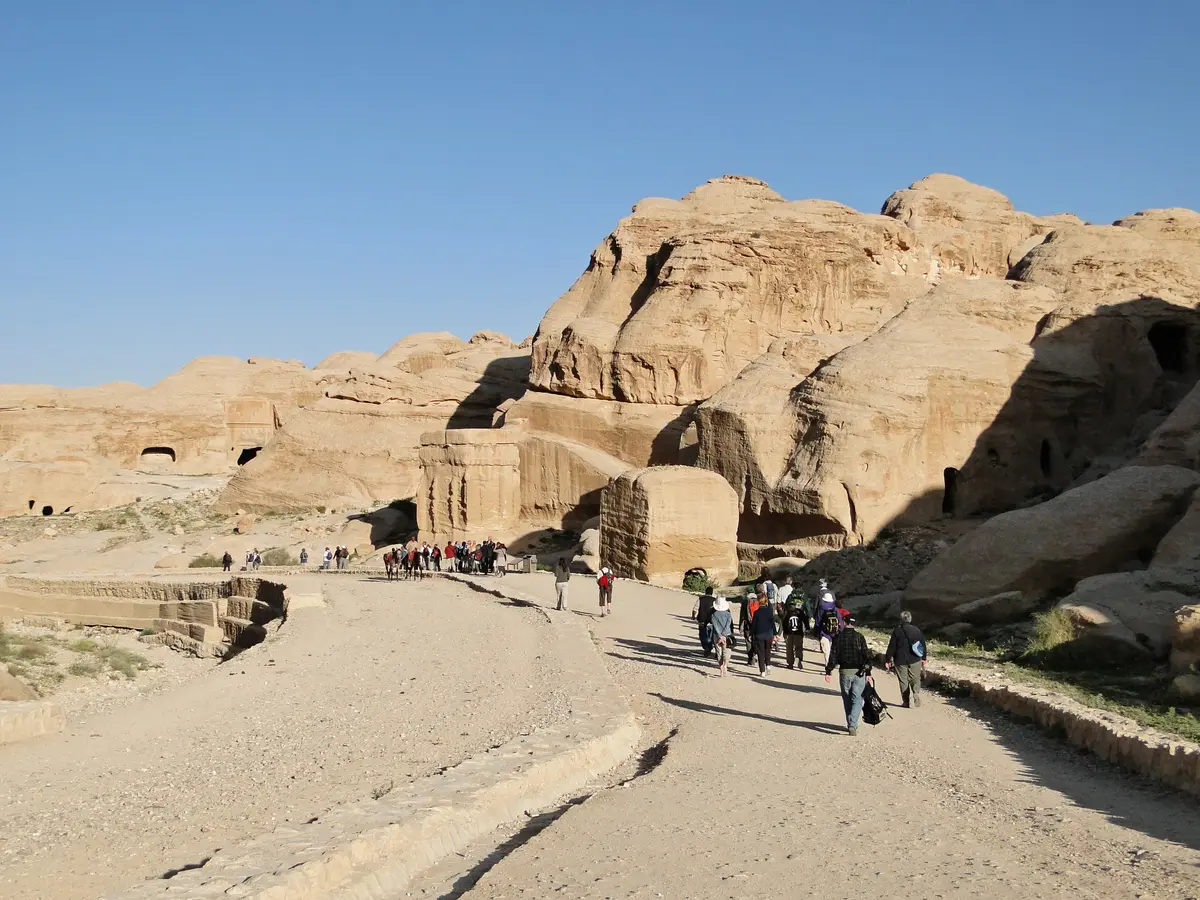
- 14 April 2010 Bernard Gagnon photographs the Djinn Blocks on the path into Petra, in Jordan, at 30.32194 N, 35.46585 E. That photograph is the one illustrating this file, more than a thousand kilometres from the map pin, in another country and about a thousand years younger than anything else on this list.
- 2012 Najat Khalifa, Tim Hardie and Mohammad Mullick report a survey of 431 Muslims in Dhaka and Leicester: 73% and 80% believe in jinn, 61% and 58% in possession, and 44% and 52% that jinn can cause mental health difficulties.
- 18 June 2021 The collector Ali Al-Manaser finds a Safaitic inscription in situ at al-Wadi al-Abyad, Jordan. Catalogued as AAWAB 4, it asks Dhgn for the security of the hidden ones, and it is the oldest Arabian text this file can point to.
- 2025 Ahmad Al-Jallad publishes the inscription in Semitica et Classica, reading ḏgn as he of the ginn and arguing that the Safaitic verb 'lmn means to seek refuge, the same act that Qur'an 72:6 attributes to the pre-Islamic Arabs.
Is there a rational explanation for The Djinn?
Whether the jinn exist is an article of faith for Muslims everywhere, stated in the Qur'an and elaborated in the hadith, and this site does not adjudicate it. What can be examined is narrower: whether the documents say what they are quoted as saying, and whether particular events attributed to the jinn have another explanation.
Start with what the tradition itself denies. The Qur'an says twice, and pointedly, that the jinn do not know the unseen. Sura 34:14 has Solomon die standing, propped on his staff, and the jinn go on labouring until a creature of the earth eats through the wood: "when he fell, it became clear to the jinn that if they had known the unseen, they would not have remained in humiliating punishment." Sura 72:26-27 closes the chapter named after them with God as "Knower of the unseen, and He does not disclose His [knowledge of the] unseen to anyone except whom He has approved of messengers". In the Qur'anic account the jinn cannot serve anyone as a channel to hidden knowledge, and the Solomon episode ends by drawing exactly that conclusion.
Second, the tradition contains its own denial of the classic desert bogey. Lane defines the ghul as a kind of evil jinnee that appears to a solitary traveller by night and lures him out of his way. But Sahih Muslim 2220, on the authority of Abu Hurayra, has the Prophet say "There is no adwa, no tiyarah, no hamah, no safar, no nawa, and no ghul", and Teuma notes that commentators have argued ever since about whether the denial abolishes the being or only its power to shapeshift and lead men astray. An account that reports the danger and leaves out the denial reports half of the tradition.
Third, the modern attribution that can actually be measured. Najat Khalifa, Tim Hardie and Mohammad Mullick reported in 2012 a survey of 431 Muslims, 320 in Dhaka and 111 in Leicester, who were asked plainly. Belief in jinn: 80% in Leicester, 73% in Dhaka. Belief in possession by jinn: 58% and 61%. Belief that jinn can cause mental health difficulties: 52% and 44%. Asked who should treat such difficulties, 64% and 56% named religious figures, 23% and 33% named doctors, and 54% and 33% wanted both working together. Their conclusion is that clinicians "need to be prepared to enlist the help of religious figures if necessary, although the underlying mental disorders should be treated using conventional psychiatric methods". The authors themselves list the limits of the work: convenience sampling, an unvalidated questionnaire, no back-translation, and a Leicester sample of mixed ethnic origin.
Fourth, a translation caution that cuts against scepticism as often as for it. It is tempting to declare "created from smokeless fire" a Victorian invention, because the Arabic of 55:15 says marij and the Arabic of 15:27 says nar al-samum, and neither word means "smokeless". It would be wrong. Ibn Kathir reports the smokeless reading from Ibn Abbas through two separate transmitters, centuries before any European touched the text. The Qur'an does not use the word; the commentators do, and English took it from them.
Finally, the stone in the photograph that illustrates this file. It shows the Djinn Blocks on the path into Petra, in Jordan, about 1,080 kilometres from the map pin at the Mosque of the Jinn in Mecca. The Petra Development and Tourism Region Authority calls them the "so-called Djinn Block Tombs", Nabataean burial monuments among "some of Petra's oldest", and states on its own visitor page that "there is no link between the name and the Nabataean sculptures"; the caption under the photograph repeats it.
Can you visit The Djinn?
A belief held from Morocco to the Gulf has no single address, and the map point on this file is a convention. It now falls on the Mosque of the Jinn, Masjid al-Jinn, which stands on Al-Masjid al-Haram Road in the Sulaymaniyah district of Mecca, close to the Jannat al-Mualla cemetery. It exists because of the episode narrated in sura 72 and in 46:29-32 [1], and as far as this entry can establish it is the only building in the world that exists for that reason. Wikidata (Q6812533) places it at 21.433389, 39.828944 and OpenStreetMap way 443792238 at 21.433454, 39.828966, two independent readings 7.6 metres apart [15].
Mecca is closed to non-Muslims: the Government of Canada's travel advice for Saudi Arabia states that "Non-Muslims are forbidden from travelling to the holy city of Mecca". The page carried a last-update stamp of 9 September 2026 when this entry consulted it on 10 September 2026 [16], and the restriction covers the whole city with the mosque inside it.
The place in the photograph on this page is open to anyone. The Djinn Blocks stand in the Bab al-Siq at Petra, in Jordan, about 400 metres from the visitor centre and past the gate, on the way down to the Siq. The official visitor information counts four such block monuments in the Bab al-Siq area, says the first encountered are "three massive Djinn blocks", dates them as "possibly the earliest group of monumental tombs at Petra, likely dating from the 2nd century B.C." and states that "there is no link between the name and the Nabataean sculptures" — djinn is what local Bedouin called them (visitpetra.jo, consulted 10 September 2026) [13]. Petra is a ticketed archaeological park with its main entrance at Wadi Musa, inscribed on the World Heritage List in 1985 under reference 326, and the walking distances inside it are long over uneven ground.
The rest of the subject is read rather than visited, and all of it is free. The Quranic Arabic Corpus gives the word-by-word Arabic of 55:15, of 15:27 and of 72:6 with the full morphological index of the root [12]. The Safaitic inscription AAWAB 4 is published open access in the OCIANA database at Ohio State with a transliteration and a translation [2]. Lane's Arabian Society in the Middle Ages is on Project Gutenberg, and its second chapter is the nineteenth-century English account of the jinn from which most later popular writing descends [9]. Galland's Aladdin is on Wikisource in the Le Normant edition of 1806, in French [6].
Belief in the jinn belongs to a living religion: Khalifa, Hardie and Mullick compared beliefs about the jinn among Muslims in Dhaka and in Leicester [10]. Ruqya sessions and household precautions are religious acts performed by people who are often in distress, and none of them is staged for onlookers.
Sources consulted
- Saheeh International translation, «The Qur'an: sura 72 (al-Jinn) in full, and 6:100, 15:27, 23:70, 27:38-40, 34:8, 34:12-14, 34:41, 37:158, 46:29-32, 51:56, 55:14-15» — Quran.com, 1997 book
- Online Corpus of the Inscriptions of Ancient North Arabia (OCIANA), «AAWAB 4 - Safaitic inscription from al-Wadi al-Abyad, Mafraq, Jordan: transliteration, translation, provenance and bibliography» — The Ohio State University, 2025 archive
- Muslim ibn al-Hajjaj (d. 261 AH / 875), «Sahih Muslim, nos. 2996 (Kitab al-Zuhd), 2236 and 2220 (Kitab al-Salam; the denial of the ghul also heads the chapter numbered 2222) and 510a» — Read in the Arabic text with English translation at hadithunlocked.com and quranx.com, 875 book
- Edmund Teuma, «Philological survey of Arabic root JNN» — Melita Theologica 44(1), pp. 21-31, 1993 academic
- Ismail ibn Kathir (d. 774 AH / 1373), «Tafsir Ibn Kathir on Qur'an 55:15: the glosses of marij reported from Ibn Abbas through al-Dahhak and al-Awfi» — English translation at Quran.com, 1373 book
- trans. Antoine Galland, «Les Mille et Une Nuits: Histoire d'Aladdin, ou la Lampe merveilleuse» — Le Normant, Paris, vol. V, pp. 377-466, read on Wikisource, 1806 book
- Ulrich Marzolph, «The Man Who Made the Nights Immortal: The Tales of the Syrian Maronite Storyteller Hanna Diyab» — Marvels & Tales 32(1), pp. 114-129, 2018 academic
- Antoine Galland, publisher Florentin Delaulne, «Les mille et une nuit, vols. IX-X (1712) and XI-XII (1717): the publication history of the orphan tales» — Publication data cross-checked against Marzolph 2018 and the Bibliotheque nationale de France, 1712 book
- Edward William Lane, ed. Stanley Lane-Poole, «Arabian Society in the Middle Ages: Studies from The Thousand and One Nights, chapter II, Demonology, pp. 25-46» — Chatto and Windus, London; read on Project Gutenberg, 1883 book
- Najat Khalifa, Tim Hardie and Mohammad S. I. Mullick, «Jinn and psychiatry: comparison of beliefs among Muslims in Dhaka and Leicester» — Royal College of Psychiatrists, Spirituality and Psychiatry Special Interest Group, 2012 academic
- Ahmad Al-Jallad, «Seeking refuge and the Ginn: two notes on Safaitic lexicography» — Semitica et Classica 18(1), pp. 59-64, DOI 10.1484/J.SEC.5.152630 (abstract and Crossref record consulted; full text behind a paywall), 2025 academic
- Kais Dukes, «The Quranic Arabic Corpus: morphological index of the root j-n-n and word-by-word analysis of 15:27, 55:15, 72:6» — University of Leeds, 2011 academic
- Petra Development and Tourism Region Authority, «Djinn Block Tombs» — visitpetra.jo, official visitor information, 2026 web
- Bernard Gagnon, «File:Djinn Blocks.jpg - view of the Djinn Blocks on the road leading to al-Siq, Petra, Jordan, photographed 14 April 2010 at 30.32194 N, 35.46585 E» — Wikimedia Commons, CC BY-SA 3.0, 2010 archive
- Wikidata and OpenStreetMap contributors, «Mosque of the Jinn (Q6812533), coordinate 21.433389 / 39.828944; cross-checked against OpenStreetMap way 443792238 at 21.433454 / 39.828966» — Wikidata; Nominatim, 2026 archive
- Government of Canada, «Saudi Arabia travel advice: 'Non-Muslims are forbidden from travelling to the holy city of Mecca'» — travel.gc.ca, official travel advice, updated 6 August 2026, 2026 report
Reviewed by V. Serrano on 2026-08-17 · How we verify our content
📎 Source: Enigma Atlas
💬 Field testimonies (0)
No testimonies yet. Add the first.
Add your testimony
🔒 Log in to add a testimony