👻 HAUNTED PLACE · EXP. Nº9474
ACTIVE
Majlis al Jinn
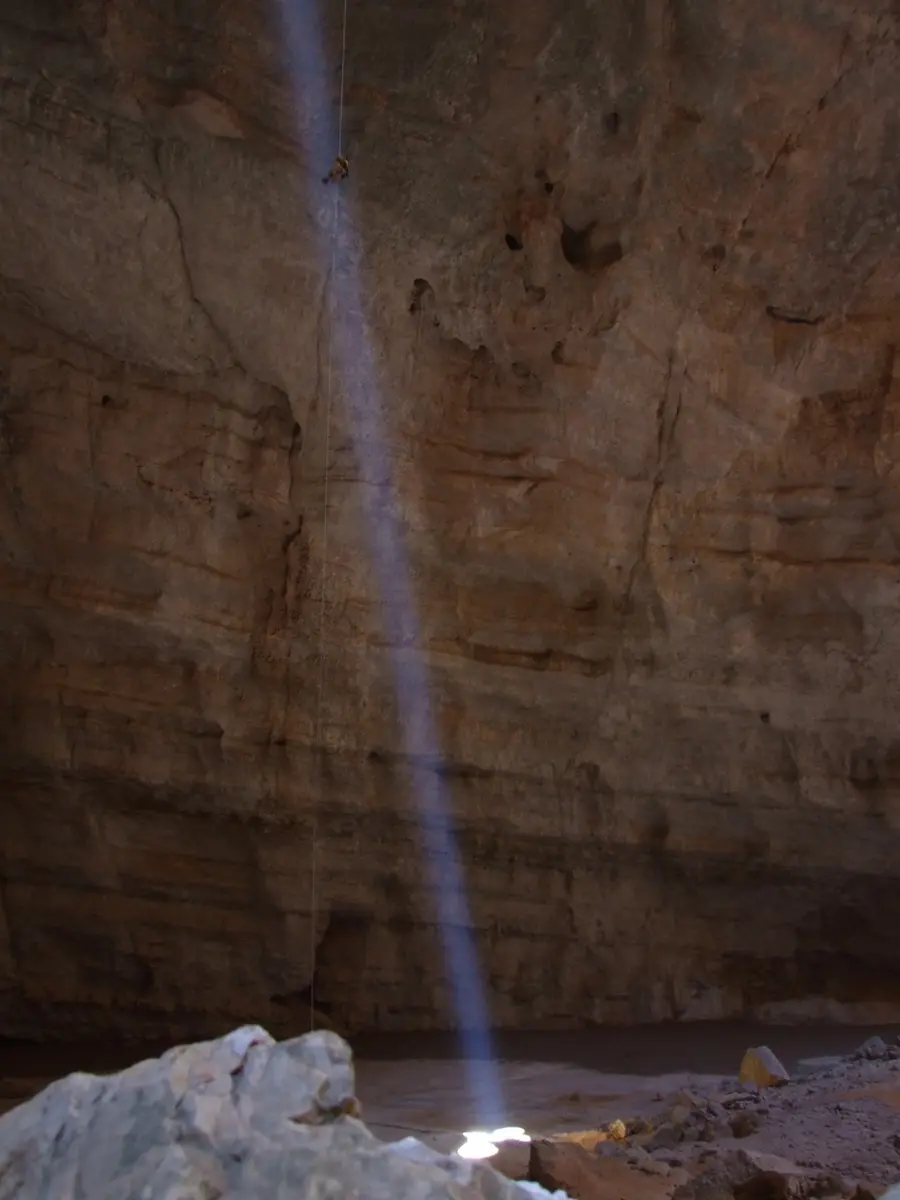
Under the Selma Plateau in Oman, about 100 kilometres south-east of Muscat, lies one of the largest underground rooms on Earth: a single domed chamber 120 metres high with a floor of 58,000 square metres, reachable only by rope through three shafts that pierce a roof some 40 metres thick.
Where is Majlis al Jinn?
- Location
- Selma Plateau, Oman
- Type
- Cave / sinkhole
- Coordinates
- 22.881, 59.105
- Last updated
LOCATION
Why is Majlis al Jinn said to be haunted?
Its Arabic name, مجلس الجن, means the meeting place of the jinn — and the story usually told about that name is the wrong way round. It was not handed down by Bedouin before outsiders arrived. The American hydrogeologist W. Don Davison Jr., who spotted two full-stop-sized dots on a 1982 aerial photograph and made the first descent alone on 23 June 1983, wrote that he and his wife, the caver Cheryl S. Jones, gave the cavern its name only after finishing their survey in 1985. Jones was first down the narrowest shaft, a 158-metre free fall that still carries her name. Local people called these holes khoshilat, and the plateau kept a different legend: that stars were cast from the heavens to form seven of them, in memory of a woman named Selma.
What is the history of Majlis al Jinn?
Majlis al Jinn is a single limestone room under the Selma Plateau, in Oman's Ash Sharqiyah South governorate, about 100 kilometres south-east of Muscat. It has no walk-in entrance. The only ways in are three vertical shafts that pierce a roof roughly 40 metres thick and open, without warning, into a domed chamber some 300 metres across and 120 metres high.
The man who found it was not an adventurer but a civil servant. W. Don Davison Jr., an American hydrogeologist, arrived in Oman in September 1980 to work in the Karst Research Program of the Sultanate's Public Authority for Water Resources (PAWR). The programme's purpose was practical and unromantic: to work out how water moves through limestone country, because in an arid nation that is a question of national supply. Davison began looking for large caves as part of the job.
For two years the search produced almost nothing. Then, in 1982, he pulled an aerial photograph of the Bani Jabir mountains and saw a karstic plateau standing out among some of the most broken and inaccessible terrain in Oman. What caught his eye were several large swallow-holes — and, at the northern edge, two black dots each about the size of a full stop. As he later wrote, they "gave no clue, even under magnification, to the scale of the discovery hidden in their featureless depths."
In January 1983 Davison and his wife, the caver Cheryl S. Jones, reached the plateau after a strenuous six-hour hike from the coast, passing the small herding camp of Sukun on the way up. They ran out of time and turned back without finding a single one of the features on the photograph.
He returned in June 1983, this time by air: an adventure training instructor named Doug Green arranged seats on an Omani air force helicopter working in the area. Dropped in the middle of the plateau, the two men walked a compass line north across thorn scrub and rubble and located five cave entrances in one day. Two of them were the dots. They measured each drop with a small weight and a spool of fine copper wire: one about 120 metres, the other 140.
On the morning of 23 June 1983 Davison went back alone, with four hours until the helicopter returned. He rigged a rope to a large rock at the lip of the overhung pit and went over the edge. "A short distance down, the shaft opened out," he wrote, "and as I dropped lower, turning slowly in midair on the rope, a stupendous panorama was revealed." Five minutes later he landed on a cone of collapse debris beside the skeleton of a large snake and a brightly coloured cloth bundle someone had thrown in from the surface.
What he walked across over the next few hours is worth recording, because it is the actual content of the place. A dry lake bed of mud-cracked polygons, 200 metres by 50, that floods only in storms. Stream channels whose gravel is mixed with the bones of animals that had come down the shafts rather faster than he had. Thousands of white cave pearls, some four centimetres across, lying loose in dry pools. A forest of metre-high stalagmites fringed with erratic mineral growths that the surveyors nicknamed "Friar Tuck". Eyeless, translucent cave-adapted pill bugs under a piece of rotting wood. A constant 17–18 °C. Occasional cracks of rockfall echoing across the room. And a slow, disorienting failure of scale: Davison wrote that his sense of distance "could not immediately accommodate such huge distances being under a roof."
From the floor he glimpsed a hint of daylight high on the wall — a third, much narrower opening. Cheryl Jones made its first descent in March 1984. At 158 metres it is the longest free-fall drop in Arabia, and it carries her name: Cheryl's Drop.
The chamber's status was not established until Davison and Jones completed their mapping survey over five trips in April and May 1985, work written up in the government report PAWR 85-20 in October of that year. The survey gave a floor area of 58,000 square metres and a volume of over four million cubic metres, and made it, at the time, the second largest known cave room on Earth after Sarawak Chamber in Malaysia. Later surveys elsewhere — notably the 2013 laser measurement of the Miao Room in Guizhou, China — have since expanded the table, and it now sits inside the top ten rather than at number two.
And it was only at that point, in 1985, that the cave got the name the world now knows it by. Davison is explicit about it: "it was only then that we gave the cavern its name."
Timeline: the documented record of Majlis al Jinn
- September 1980 The American hydrogeologist W. Don Davison Jr. arrives in Oman to work in the Karst Research Program of the Public Authority for Water Resources, a groundwater project. He begins searching for large caves as part of that work.
- 1982 Davison spots two black dots, each the size of a full stop, on an aerial photograph of the Bani Jabir mountains. He later writes that even under magnification they gave no clue to the scale of what lay below.
- January 1983 Davison and his wife, the caver Cheryl S. Jones, reach the plateau after a six-hour hike from the coast, passing the herding camp of Sukun. They run out of time and turn back without locating any of the features.
- June 1983 Flown in by Omani air force helicopter thanks to instructor Doug Green, Davison and Green locate five cave entrances in a single day and measure two of the drops with a weight and a spool of copper wire: about 120 and 140 metres.
- 23 June 1983 Davison makes the first descent, alone, with four hours until the helicopter returns. Landing on the debris cone beside a snake skeleton, he finds a chamber 120 metres high, a dry lake bed, thousands of cave pearls and the bones of animals that had fallen in.
- 1 March 1984 Cheryl Jones makes the first descent of the narrow third entrance, a shaft only about two metres wide at the surface. At 158 metres it is the longest free-fall drop in Arabia and is named Cheryl's Drop after her.
- April–May 1985 Davison and Jones complete the mapping survey over five trips, establishing a floor area of 58,000 m² and a volume above four million m³. Davison states that it was only then that they gave the cavern its name, Majlis al Jinn. The results are filed as government report PAWR 85-20 that October.
- September–October 1990 Davison publishes his first-person account, "Meeting Place of the Spirits", in Aramco World. It remains the primary source for the discovery and the only account by a participant of how the cave was named.
- 1995 Sir Donald Hawley records that the shafts are known by local people as khoshilat and that the site "has now become known as Majlis al-Jinn" — contemporary confirmation that the famous name was recent, not ancestral.
- 2001 Anne Dale and Jerry Hadwin publish Adventure Trekking in Oman, recording khoshilat as the local word for a steep cleft or hole and a plateau legend in which stars were cast from the heavens to form the seven khoshilat as a memorial to Selma's bravery.
- April 2003 A visit by American cavers is featured in National Geographic Magazine, the first time the chamber reaches a wide international public and the point at which visitor interest begins to grow.
- 2008 Oman's Ministry of Tourism announces a plan to develop the cave as a show cave and it is closed pending the work; students at the University of Innsbruck draft a management plan the same year. Nothing is built and the project is quietly abandoned.
Is there a rational explanation for Majlis al Jinn?
The sceptical question here is not whether spirits gather underground. It is a question about provenance: who said this, and when?
The claim repeated in almost every account of Majlis al Jinn is that local Bedouin named it "the meeting place of the jinn" long before outsiders confirmed it existed. The only first-hand source contradicts that directly. Writing in Aramco World in 1990, the discoverer states that the ranking of the chamber "was not known until Cheryl and I completed our mapping survey during five trips in April and May of 1985, and it was only then that we gave the cavern its name." The name Majlis al Jinn was coined by two American explorers, in Arabic, seven years before it was published to a general readership — and it has since been reported back to the world as ancient nomadic lore.
The contemporary literature supports the same reading. Sir Donald Hawley, writing in 1995, notes that the shafts "are known by local people as Khoshilat. It has now become known as Majlis al-Jinn." Peter J. Ochs's guidebook of 1999 calls the site Khoshilat Maqandeli, "referred to of late as the Majlis Al Jinn". Khoshilat is not a proper name at all: Anne Dale and Jerry Hadwin record that local tribes "call these holes khoshilat, being the local word for a steep cleft or hole". The three entrances still carry their local designations — Khoshilat Maqandeli (First Drop), Khoshilat Beya al Hiyool (The Asterisk) and Khoshilat Minqod (Cheryl's Drop).
None of this makes the name frivolous or the belief it invokes a superstition. Jinn are not marginal folklore: they are part of Islamic theology, the subject of an entire Qur'anic sura (72, al-Jinn), described as created from smokeless fire, morally accountable and subject to judgement like human beings. Popular belief across the Arabic-speaking world has long associated them with deserts, ruins, wells and caves — desolate places away from settlement. A vast, unlit, unreachable room under a plateau is, in that framework, an entirely legible thing to name after them. What is not established is that anyone did so before 1985.
The plateau does have a tradition of its own, and it is a different story. Dale and Hadwin record a legend in which stars were cast down from the heavens to form the seven khoshilat as a memorial to the bravery of Selma — the woman for whom the plateau itself is named. That is the local narrative on record. The jinn story is the newcomers'.
Two further details often attached to the cave do not survive checking. There is no source for a wind howling up from the shafts and dragging livestock, or shepherds, over the edge; Davison recorded the opposite conditions inside — "little air circulation" and a steady 17–18 °C. The bones are real, but their explanation is gravity: animals fell through overhung openings between 118 and 158 metres above the floor, in open ground with no rim, no fence and no warning. And no one who has descended has reported anything anomalous. What they report is silence, dust, distant rockfall, and the difficulty of judging distance under a 120-metre ceiling — an ordinary perceptual effect that Davison, who had no reason to downplay it, described honestly as his own sense of scale failing to calibrate.
Can you visit Majlis al Jinn?
Entry to Majlis al Jinn is by rope, and since 2026 it has been run as a booked and guided operation. Oman's Ministry of Tourism announced a plan in 2008 to develop the chamber for visitors and closed it pending the work; students at the University of Innsbruck drew up a management plan the same year, and nothing was built. In July 2024 the Ministry of Heritage and Tourism signed a usufruct agreement with Omran covering the site. Muscat Daily reported on 30 July 2026 that Husaak Adventures had spent the preceding six months turning the entrance into a controlled operation, with safety barriers, a fixed platform and a rope system rated for descenders of 45 to 120 kilograms, and that each expedition runs with four trained staff, three at the surface and one below, holding international certification and Ministry of Tourism approval. Neither a lift nor a stairway nor a tunnel leads into the chamber.
The cave lies under the Selma (Salma) Plateau, in the governorate of Ash Sharqiyah South, at about 1,380 metres above sea level and some 108 kilometres south-east of Muscat, at 22°52′50″N 59°06′19″E. A rough single-lane track climbs onto the plateau from near Tiwi, on the coast road from Muscat to Sur, about 16 kilometres east-south-east of the entrances. A capable four-wheel-drive reaches the vicinity of the shafts from there. Before that track existed the approach was a walk of some six hours, or hired donkeys from a village an hour and a half away. Dale and Hadwin's Adventure Trekking in Oman describes a walking route from 'Umq to Ta'ab that passes the cave.
Three free-fall shafts pierce a roof about 40 metres thick. First Drop, or Khoshilat Maqandeli, is 118.0 metres deep and up to some 20 metres across, and it is the one normally rigged; The Asterisk, or Khoshilat Beya al Hiyool, is 139.6 metres; Cheryl's Drop, or Khoshilat Minqod, is 158.2 metres and barely two metres wide at the surface. The commonly quoted "150-metre abseil" flattens three different drops into a single figure, and the lowest point of the floor lies 178 metres below the highest entrance. The chamber beneath them measures about 310 by 225 metres, with a domed ceiling 120 metres high and a floor of some 58,000 square metres. The descent is single-rope technique on around 200 metres of rope, and the prusik back out is a long climb in free air.
For anyone who is not descending, the experience on offer is standing on open desert pavement near the rim of a hole. The openings are unfenced, unmarked and overhung; Davison, who found the second pit, described it as "ready to swallow the unsuspecting or clumsy", and animal bones lie on the floor 120 metres below. During storms the runoff of the plateau pours into the shafts. Al Hoota Cave, near Al Hamra, is the developed show cave of Oman and needs no ropes at all.
Sources consulted
- Don Davison Jr., «Meeting Place of the Spirits — first-person account of the discovery, the 1985 survey and the naming of the cave, written and photographed by its discoverer» — Aramco World, vol. 41, n.º 5, pp. 16-23, 1990 newspaper archive
- Anne Dale y Jerry Hadwin, «Adventure Trekking in Oman — khoshilat como palabra local para una sima, la leyenda de Selma y los siete khoshilat, y la ruta a pie de 'Umq a Ta'ab por Majlis al Jinn» — Cordee, 2001 book
- Sir Donald Hawley, «Oman — «the shafts are known by local people as Khoshilat. It has now become known as Majlis al-Jinn»» — Stacey International, 1995 book
- Peter J. Ochs, «Maverick Guide to Oman — el sitio como «Khoshilat Maqandeli (referred to of late as the Majlis Al Jinn)»» — Pelican Publishing Company, 1999 book
- Jochen Duckeck, «Majlis Al-Jin — ficha de la cueva: dimensiones, las tres bocas, cronología del cierre de 2008 y estado «not yet open» comprobado en 2023, con la bibliografía del informe PAWR 85-20» — Show Caves of the World (showcaves.com), 2023 web
- Wikipedia contributors, «Majlis al Jinn — profundidades de las tres bocas (118,0 m, 139,6 m y 158,2 m), cota del punto más bajo a 178 m y coordenadas» — Wikipedia, 2026 web
Reviewed by V. Serrano on 2026-08-11 · How we verify our content
💬 Field testimonies (0)
No testimonies yet. Add the first.
Add your testimony
🔒 Log in to add a testimony