📜 LEGEND · EXP. Nº3657
ACTIVE
Iram of the Pillars
Iram of the Pillars and the City of Brass are two different stories that are almost always run together as one.
Where does the legend of Iram of the Pillars come from?
- Location
- Shisr, Dhofar, Oman
- Kind of legend
- Myth
- Coordinates
- 18.255, 53.648
- Last updated
LOCATION
What is the legend of Iram of the Pillars?
The Quran names Iram once, in Surah 89:6-8, alongside the tribe of ʿAd: “Iram dhat al-ʿimad, the like of which was never created in the land”. It does not use the Arabic word for a city, gives no location, and leaves ʿimad ambiguous between stone columns and tent poles — which is exactly what Ibn Khaldun argued around 1377, when he called the city reading a fictitious fable. The palace of gold belongs to Quranic commentary, and from there to the Thousand and One Nights, where the tale of Iram and the camel-herd Abdullah occupies nights 276-279. “The City of Brass” is a separate tale, nights 566-578, with a different caliph, a different hero, a Maghribi setting and no mention of Iram at all. Ubar is a third name again, Bedouin and modern, attached in 1992 to an excavated fort at Shisr in Oman — by a press announcement its own excavator later walked back.
What is the history of Iram of the Pillars?
The Quran names Iram once in three lines and never calls it a city.
Surah 89 (al-Fajr), verses 6-8, opens with a question — in Sahih International's English, "Have you not considered how your Lord dealt with 'Aad" — and goes on: "Iram dhāt al-ʿimād, the like of which was never created in the land", which is the whole of it. The Arabic gives neither a location nor a ruler nor a date, and it uses neither of the ordinary words for a town, madīna or qarya. The one contested word is ʿimād, which in Arabic covers both the columns of a building and the poles that hold up a tent. Translators divide along that seam: Marmaduke Pickthall prints "With many-columned Iram", A. J. Arberry "Iram of the pillars", and Sahih International "[With] Iram - who had lofty pillars", which reads the phrase as describing the people rather than a place.
The palace of gold and the emerald columns are nowhere in those verses; they come from the commentators. Ibn Khaldūn, writing around 1377, names the Quran commentators who carried the story — al-Ṭabarī, al-Thaʿālibī, al-Zamakhsharī — and summarises it: a king, Shaddād son of ʿĀd, hears a description of Paradise, decides to build its equal, spends three hundred years on a city in the desert of Aden with castles of gold and silver and columns of emerald and hyacinth, and dies with all his people, struck by a clamour from heaven, when he is one day and a night away from it. The eyewitness is one ʿAbdallāh b. Abī Qilāba, who stumbles on the empty city while searching for strayed camels and carries off as much as he can; summoned to the caliph Muʿāwiya, he has to explain himself.
That is the tale that reached Europe: it is in the Thousand and One Nights, headed in Richard Burton's 1885 translation "The City of Many-Columned Iram and Abdullah son of Abi Kilabah" (vol. IV, nights 276-279), and it follows the commentators closely, with Kaʿb al-Aḥbār explaining the ruins to Muʿāwiya. The strayed she-camel is there, and so are the pearls that "were grown yellow and had lost pearly colour" and the king struck down when "there remained but one day's journey between him and Iram".
"The City of Brass" is a different story, and it occupies nights 566-578 of the same collection (Burton, vol. VI). Its caliph is ʿAbd al-Malik b. Marwān and its hero the governor Mūsā b. Nuṣayr, whom the Shaykh ʿAbd al-Ṣamad guides; the errand is the recovery of Solomon's brass vessels with jinn sealed inside them; Burton's own footnote places the city in the Maghrib. The word Iram does not occur in the tale once. Shaddād son of ʿĀd is named four times: twice at a palace the travellers reach on the way, where the tablet of the dead king Kūsh calls him Shaddād's son, and twice in the warnings inscribed inside the city, in a roll-call of vanished rulers — "Where is Shaddad son of Ad?" — that also asks after Korah, Haman, Nimrod and Pharaoh.
Ubar is a third name again, and it reached English print much later. Bertram Thomas recorded it on the crossing he began from Dhofar on 10 December 1930, when his guides on the southern rim of the Empty Quarter pointed at tracks in the plain: "Look, Sahib," they cried. "There is the road to Ubar." Thomas wrote that "other Arabs on my previous journeys had told me of Ubar, the Atlantis of the sands, but none could say where it lay", fixed the tracks at roughly 18° 45' N, 52° 30' E. In a footnote crediting Philby he added that the name matched the Wabar of the Arab geographer Yāqūt, a land of the tribe of ʿĀd in the sands. Sixty years later the Los Angeles filmmaker Nicholas Clapp took that page as a starting point and asked the Jet Propulsion Laboratory to look for caravan trails in satellite and shuttle-radar imagery; with the lawyer George Hedges, the explorer Ranulph Fiennes and the archaeologist Juris Zarins he dug at the well of Ash Shisar, in Dhofar, in November 1991.
Timeline: the documented record of Iram of the Pillars
- 7th century The Quranic passage that starts everything is three verses long. Surah 89:6-8 names ʿĀd and "Iram dhāt al-ʿimād, the like of which was never created in the land". It gives no place, no king, no date, and it does not use the Arabic word for a city.
- c. 1377 Ibn Khaldūn attacks the story in the Muqaddimah. He names al-Ṭabarī, al-Thaʿālibī and al-Zamakhsharī as the commentators who transmitted it, points out that the Yemeni desert where they put the city has been continuously travelled without anyone reporting it, and rules that "the 'pillars' are tent poles".
- 1885-1886 Richard Burton prints the two tales that later got fused. "The City of Many-Columned Iram" is nights 276-279 in volume IV; "The City of Brass" is nights 566-578 in volume VI, with a different caliph, a different hero and a Maghribi setting. Iram does not appear in it; a sweep of all ten volumes returns no occurrence of Ubar either.
- December 1930 On the crossing he began at Dhofar on 10 December 1930, Bertram Thomas's guides point at tracks in the plain on the southern rim of the Empty Quarter: "Look, Sahib, there is the road to Ubar." He fixes them near 18° 45' N, 52° 30' E — about 132 km north-west of Shisr, where he had watered his camels earlier on the same march and seen only "conspicuous ruins of a rude fort".
- 1932 Arabia Felix is published, with a four-page foreword by T. E. Lawrence signed "T. E. S.". Page 161 carries Thomas's own phrase, "Ubar, the Atlantis of the sands". The foreword never mentions Ubar, Iram or any lost city, and calls the Rub' al-Khali "virgin" until Thomas crossed it.
- Summer 1990 After JPL imagery picks out caravan tracks running under the dunes, a first ground reconnaissance follows them and rules out several other candidate sites in the area. The trails converge on the well of Ash Shisar.
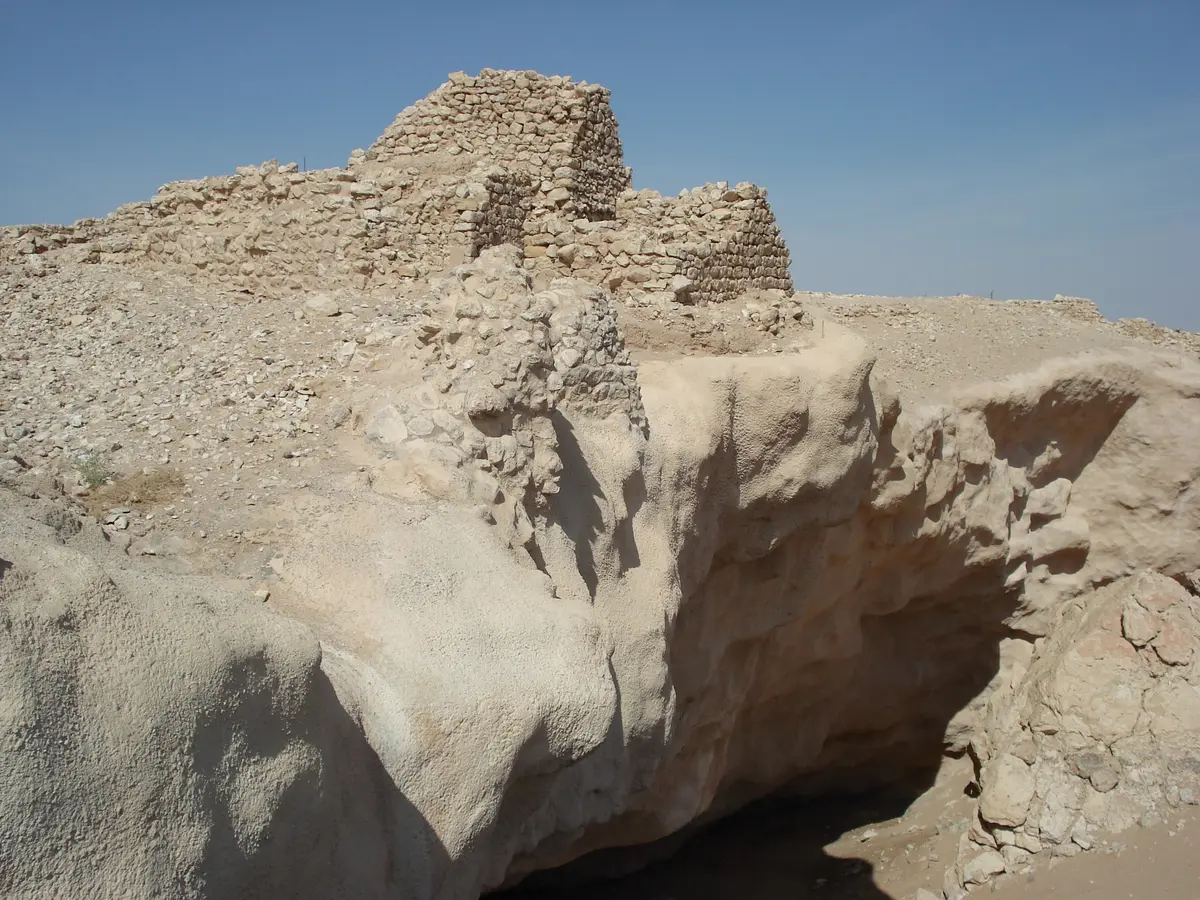
- November 1991 The full team digs at Shisr. Juris Zarins reports an octagonal structure with eight towers, each estimated at some 30 feet, built around a water reservoir in a limestone cavern; the report has him explaining that the structures collapsed under their own weight.
- 5 February 1992 The New York Times announces the find on page A1. Zarins is quoted saying "there doesn't seem to be much question that we have discovered Omanum Emporium"; Donald Whitcomb, of the Oriental Institute, dissents in the same piece. The article also credits "the Atlantis of the sands" to T. E. Lawrence and says the destruction is told in the Arabian Nights. Both statements are wrong, and both are still in circulation.
- May-June 1997 Writing in Archaeology, the excavator gives his own verdict: "it would appear that the city of Ubar was an Arabian Nights fantasy". He identifies Shisr with Ptolemy's Marimatha, not Omanum Emporium, and dates a spring occupied since the Neolithic (c. 5000-2500 BC) and a fortress first built in the Bronze Age (2500-1300 BC) and in use until AD 1500.
- December 2000 UNESCO's World Heritage Committee inscribes the property then called The Frankincense Trail under criteria (iii) and (iv), describing "the Oasis of Shisr and the entrepots of Khor Rori and Al-Balid" as outstanding examples of medieval fortified settlements. Neither Ubar nor Iram is named in the decision.
Is there a rational explanation for Iram of the Pillars?
The oldest and sharpest criticism of this legend is six hundred years old and it is not about archaeology. It is about grammar.
Ibn Khaldūn devoted a passage of the Muqaddimah (c. 1377) to demolishing the Iram story. He noted that the desert of Aden where the commentators put the city "has been inhabited continuously, and travelers and guides have explored its roads in every direction. Yet, no information about the city has been reported. No antiquarian, no nation has mentioned it." He traced the error to its source: the reading was forced by Arabic syntax, "for Arabic grammar requires the expression, 'that of the pillars', to be an attribute of Iram", and the commentators then took "pillars" to mean columns and narrowed Iram to a building. His own verdict is one line: "(In fact,) however, the 'pillars' are tent poles." If it is a genitive construction, he adds, it is the ordinary tribal kind — ʿĀd of Iram, like "the Quraysh of Kināna". He calls the stories built on the other reading "fictitious fables".
The modern round of doubt was on the record from day one. In the New York Times report of 5 February 1992 that announced the find on page A1, Donald Whitcomb of the Oriental Institute in Chicago is reported as saying that some scholars suspected "that Iram would be found not in Southeast Arabia but in the Northwest, perhaps near the Jordan-Saudia Arabia border". The excavator himself moved: in the same 1992 article Juris Zarins said "there doesn't seem to be much question that we have discovered Omanum Emporium", but by May 1997, writing in Archaeology, he identified Shisur instead as Ptolemy's Marimatha, observed that "no city of that name appears on maps" of Ptolemy, and concluded flatly that "it would appear that the city of Ubar was an Arabian Nights fantasy" — Shisur was "very possibly one of the cities that gave birth to the Ubar myth", which is a different claim. When UNESCO inscribed the site in 2000 as part of the property then called The Frankincense Trail, the committee's own wording called the Oasis of Shisr an outstanding example of a "medieval fortified settlement". Neither Ubar nor Iram appears in the citation.
Two details in the 1992 report are simply wrong, and both are still repeated. The article says Ubar's destruction is "recounted also in the Arabian Nights"; a search of the complete Burton translation — ten volumes, about 1,626,000 words — returns no occurrence of Ubar at all, against 165 for Solomon, 461 for Baghdad and 430 for jinn in the same sweep. (Zarins made the same slip in a 1996 interview, crediting the late-medieval Nights with turning Ubar into a city.) And the article states that Ubar "was called 'the Atlantis of the sands' by T. E. Lawrence... who had planned to look for the site before his death". The phrase is Bertram Thomas's own, printed on page 161 of Arabia Felix in 1932. Lawrence wrote the foreword to that very book, signed T. E. S. and running four pages: it does not contain the words Ubar, Iram, city or ruin once. What it does contain is the admission that until Thomas crossed it the Rub' al-Khali was "that virgin Rub' al Khali, the last unwritten plot of earth". Lawrence never explored the Empty Quarter, and the sentence that says he searched it for Iram can be dated to a newspaper paragraph of 1992.
Can you visit Iram of the Pillars?
The excavated site that was put forward as Ubar lies at the edge of the village of Shisr, or Ash Shisar, in the wilayat of Thumrait in the Dhofar governorate of Oman. The pin of this file, at 18.2552 N 53.6482 E, falls on an information board that OpenStreetMap maps as "Shisr (Wubar)". The node that OpenStreetMap tags as the archaeological site of Ubar is about 80 m to the east-north-east of it. The UNESCO record of the World Heritage property gives the Shisr component a reference point of N18 15 4.00, E53 38 7.00, about 1.4 km west-south-west of the pin.
A request to the public OSRM routing service on 24 September 2026, from the point Nominatim returns for Salalah to the archaeological site, gives a road distance of 171 km and a driving time of about 2 hours 45 minutes. UNESCO's description of the property places Shisr "about 180 km north of Salalah in the desert". In 1997 the excavator, Juris Zarins, called it "a ruined city some 90 miles northwest of Salalah on the edge of the desert".
In the same article Zarins wrote that "a permanent spring there had attracted people since the Neolithic". He added that a fortress first built in the Bronze Age "was in use until A.D. 1500", and that "Bedouin still camp there year-round".
Shisr is one of the four components of the World Heritage property now listed by UNESCO as Land of Frankincense, together with the frankincense park of Wadi Dawkah and the two ports of Khor Rori and al-Balid. The report of the World Heritage Committee's session of 2000, which inscribed it, records the name as "The Frankincense Trail" and describes "the Oasis of Shisr and the entrepots of Khor Rori and Al-Balid" as outstanding examples of medieval fortified settlements. The UNESCO page, in a capture of 31 August 2026, states that Al Baleed and Khor Rori have visitor interpretation centres, which received more than 150,000 visitors in 2014, and that "an Interpretation Centre for Shisr is being planned".
Sources consulted
- —, «Corán, sura 89 (al-Fajr), aleyas 6-8 — texto uzmaní y traducciones de Pickthall, Arberry, Sahih International, Cortés y Asad» — Cotejo de ediciones a través de la API de alquran.cloud, 650 book
- Ibn Jaldún, trad. Franz Rosenthal, «Muqaddimah, introducción del Libro Primero (sobre la falsedad en la información histórica): el pasaje sobre «Iram, la de las columnas» (la copia enlazada es la edición abreviada de N. J. Dawood, Princeton/Bollingen, 1969, en préstamo controlado del Internet Archive)» — The Muqaddimah: An Introduction to History, Princeton University Press, 1377 book
- trad. Richard F. Burton, «The Book of the Thousand Nights and a Night, vol. IV: «The City of Many Columned Iram and Abdullah son of Abi Kilabah» (noches 276-279, p. 113)» — Edición del Kama Shastra Society; texto consultado en Project Gutenberg (ebook 3438), 1885 book
- trad. Richard F. Burton, «The Book of the Thousand Nights and a Night, vol. VI: «The City of Brass» (noches 566-578, p. 83), y vol. X, Terminal Essay, donde Burton las lista como dos cuentos distintos» — Edición del Kama Shastra Society; texto consultado en Project Gutenberg (ebooks 3440 y 3444), 1886 book
- Bertram Thomas, «Arabia Felix: Across the Empty Quarter of Arabia — «el camino de Ubar» y «Ubar, la Atlántida de las arenas» (pp. 160-161); el fuerte de Shisur (pp. 135-137); prólogo de T. E. Lawrence (pp. xvii-xx)» — Charles Scribner's Sons, Nueva York / Jonathan Cape, Londres, 1932 book
- John Noble Wilford, «On the Trail From the Sky: Roads Point to a Lost City» — The New York Times, 5 de febrero de 1992, sección A, página 1, 1992 newspaper archive
- Juris Zarins, «Entrevista con el Dr. Juris Zarins» — NOVA Online, PBS (septiembre de 1996), 1996 interview
- Juris Zarins, «Atlantis of the Sands, Archaeology 50(3), pp. 51-53» — Archaeological Institute of America, 1997 academic
- UNESCO, Comité del Patrimonio Mundial, «Informe del Comité del Patrimonio Mundial, 24.ª sesión (Cairns): inscripción del bien «The Frankincense Trail», id. 1010, Omán, criterios (iii) y (iv)» — Documento WHC-00/CONF.204/21, 2000 report
- UNESCO World Heritage Centre, «Land of Frankincense (property 1010): description, maps with the component coordinates (Shisr N18 15 4.00 E53 38 7.00) and state of conservation» — whc.unesco.org (Internet Archive capture of 31 August 2026; the live site returns 403 to automated clients), 2026 web
Reviewed by V. Serrano on 2026-08-16 · How we verify our content
📎 Source: Enigma Atlas
💬 Field testimonies (0)
No testimonies yet. Add the first.
Add your testimony
🔒 Log in to add a testimony