👻 HAUNTED PLACE · EXP. Nº9476
ACTIVE
Nam Koo Terrace
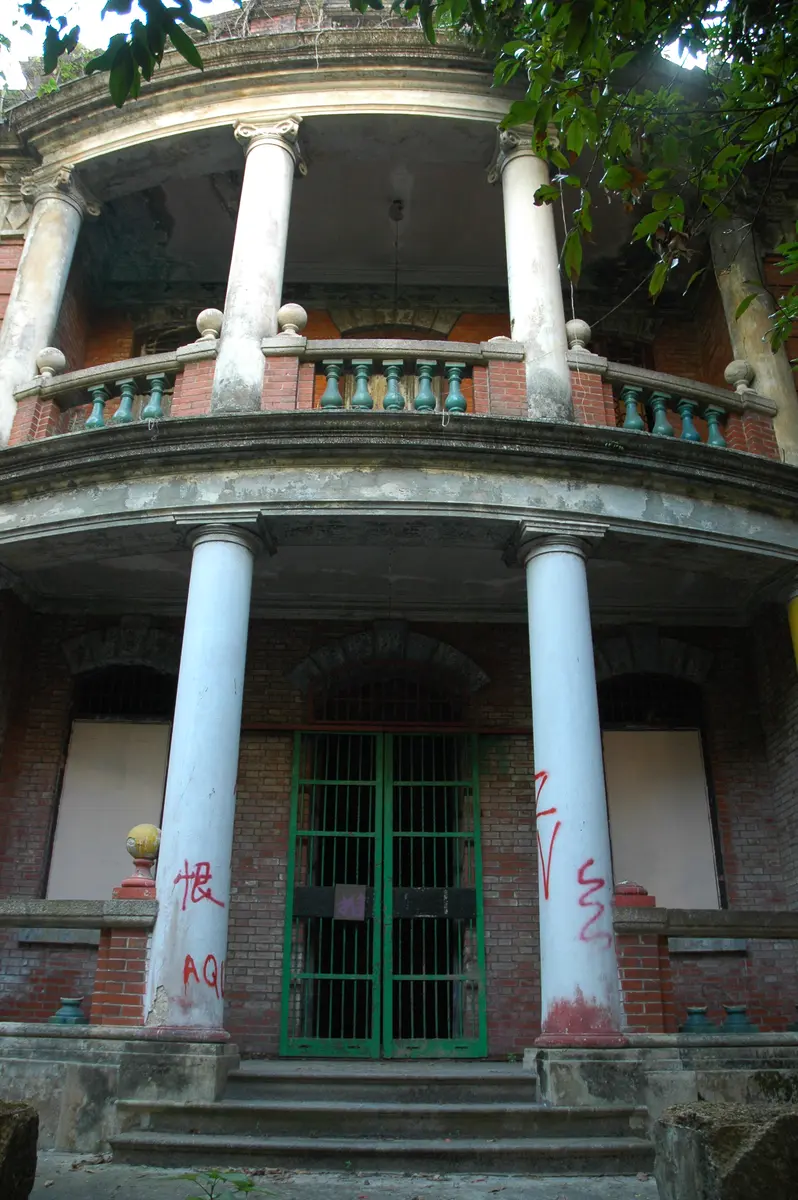
Nam Koo Terrace is a two-storey red-brick mansion at No. 55 Ship Street, Wan Chai, standing at the top of a flight of stone steps on the Hong Kong Island hillside, and it is the most famous haunted address in the city.
Where is Nam Koo Terrace?
- Location
- Wan Chai, Hong Kong Island, Hong Kong
- Type
- House / mansion
- Coordinates
- 22.275, 114.17
- Last updated
LOCATION
Why is Nam Koo Terrace said to be haunted?
The Antiquities Advisory Board dates it to about 1915-1921 and records that it was built as the home of the To family, wealthy Shanghai merchants; To Chak-man was chief Chinese silks salesman at the Wing On department store. The family sold up in 1988, Hopewell Holdings bought the house in 1993, and it has stood empty and overgrown ever since. The ghost story attaches to the Japanese occupation of 1941-1945, when the mansion is said to have served as a military comfort station, and to the women held there. The heritage appraisal that graded the building repeats that account and then adds, in its own words, that the story is still subject to verification; the documented Wan Chai comfort stations were on Jaffe Road and Luard Road, several blocks away. What is certain is that this is a Grade 1 historic building, privately owned, sealed, and now hemmed in by an approved redevelopment.
What is the history of Nam Koo Terrace?
Ship Street climbs the hillside below Kennedy Road on a flight of stone steps, and at the top of them stands a two-storey red-brick mansion that Hong Kong has spent decades calling the Wan Chai Haunted House. The official record of the building is far less lurid than its reputation, and considerably more specific.
The Historic Building Appraisal prepared for the Antiquities Advisory Board (item 124) states that the lot was first leased in 1915 to a "Victoria Hong Kong gentleman" named To Chung-man (杜仲文). The house was sold in 1921 to To Chak-man (杜澤文), who mortgaged it back to To Chung-man in the same year. On that documentary basis the appraisal dates construction to "probably between 1915 and 1921" — not to 1918, the round number repeated by property portals and travel listings, which no heritage document supports.
To Chak-man made his living in commerce: around 1915 he was Chief Chinese Silks Salesman (專理紗羅綢緞員) at Wing On Company Limited, the Chinese department-store empire, and was later promoted to Assistant Manager. He was also Secretary of the Commercial Chamber of the Heung Shan District and a member of the Chinese General Chamber of Commerce. The To family were wealthy Shanghai merchants, and Nam Koo Terrace was their home.
The house itself is a deliberate hybrid: the appraisal classes it as Colonial Eclectic, mixing Classical Revival and Italianate Renaissance features with Chinese decoration: red brick walls relieved by rusticated quoins, moulded cornices and voussoired arches over the windows; a curved colonnaded porch and verandah facing the garden that the assessors compared to a temple portico, with both Doric and Ionic columns; a main gate set into the side wall above the Ship Street steps combining Greek and Roman features; and, on the roof, a pavilion in traditional Chinese style. The position of that gate, the rooftop pavilion and the asymmetrical plan led the assessors to conclude that fung shui shaped the design. Their verdict on its condition was blunt: no obvious alterations, authentic, "seriously neglected and in need of renovation".
The To family held the property until 1988, when it was sold to YUBA Co. Ltd; Hopewell Holdings has owned it since 1993, and it has stood empty throughout. Emptiness is what made it famous. Trees rooted in the parapet, the windows were boarded, taggers reached the porch columns, and the ruin acquired a story.
Redevelopment has circled the site for a generation. On 19 November 2008 Hopewell published a revised scheme for Hopewell Centre II, and in a reply to the Legislative Council that same day the Development Bureau recorded the developer's undertaking to "preserve and revitalize the adjoining Nam Koo Terrace" — which lies outside the application site — and to turn the surrounding land, also owned by the developer, into open space for public use. The Antiquities Advisory Board confirmed the building's Grade 1 status on 18 December 2009. A fresh planning application followed in July 2022, and on 20 January 2025 the Town Planning Board gave partial approval to a 28-storey residential block of 312 flats on the land beside the mansion, with the fate of the fountain and the garden in front of it still unresolved.
Timeline: the documented record of Nam Koo Terrace
- 1915 The Ship Street lot is first leased to a "Victoria Hong Kong gentleman" named To Chung-man (杜仲文). The Antiquities Advisory Board's appraisal uses this lease, and the 1921 sale that follows, to date the house to "probably between 1915 and 1921".
- 1921 The house is sold to To Chak-man (杜澤文), Chief Chinese Silks Salesman at Wing On Company Limited and later its Assistant Manager, who mortgages it back to To Chung-man in the same year.
- 4 May 1942 A Japanese Navy document, now held at Japan's National Institute for Defense Studies, records four naval comfort facilities set up in occupied Hong Kong. The Wan Chai addresses identified from it in 2025 are on Jaffe Road and Luard Road; Nam Koo Terrace is not one of them.
- 1988 The To family, owners for some seventy years, sell Nam Koo Terrace to YUBA Co. Ltd.
- 1993 Hopewell Holdings buys the mansion. It has stood vacant ever since, and no restoration work has been carried out on it.
- 30 November 2003 Hong Kong newspapers report that eight secondary-school pupils spent part of a night inside the derelict house and that three girls were taken to hospital in distress. This is the date the paranormal literature gives, and the episode is what turned a neglected ruin into a national story; the original report is attributed to Oriental Daily.
- 19 November 2008 Hopewell publishes a revised scheme for Hopewell Centre II. The same day the Development Bureau tells the Legislative Council that the developer undertakes to "preserve and revitalize the adjoining Nam Koo Terrace", which lies outside the application site, and to open the surrounding land as public space.
- 18 December 2009 The Antiquities Advisory Board confirms Nam Koo Terrace as a Grade 1 historic building, item 124 of the assessment of 1,444 buildings. The board's own appraisal notes that the wartime comfort-station story "is still subject to verification".
- July 2022 Hopewell files a planning application to redevelop the 2,845 m² site around the mansion, proposing to renovate Nam Koo Terrace for public and non-profit use.
- 20 January 2025 The Town Planning Board partially approves a 28-storey residential building of 312 flats on the adjoining land. No agreement is reached on the fountain in front of the terrace or on the garden.
- 10 August 2026 The Antiquities Advisory Board's published list of the 1,444 assessed buildings still shows item 124, Nam Koo Terrace, as Grade 1, privately owned, and built c. 1915-1921.
Is there a rational explanation for Nam Koo Terrace?
The claim that carries the ghost story — that Nam Koo Terrace was a Japanese military "comfort station" between 1941 and 1945, and that the women held there are the ones heard weeping — is recorded by the heritage authority as unverified. The Antiquities Advisory Board's own appraisal of the building says so in as many words: "A story goes that during the Japanese Occupation of Hong Kong in 1941-1945, Nam Koo Terrace was used as a 'comfort house' (慰安所) as well as 'geisha (藝妓) house' for the Japanese soldiers. However, the story is still subject to verification." That is the heritage authority which graded the building declining to assert it.
Comfort stations in Wan Chai are documented, and the question is their addresses. In 2025 the investigations desk of Wen Wei Po published work based on a Japanese Navy document dated 4 May 1942 held at Japan's National Institute for Defense Studies and verified through the Japan Center for Asian Historical Records, with the sites mapped by Kwong Chi-man, associate professor of history at Hong Kong Baptist University, and analysed by Su Zhiliang of Shanghai Normal University, who heads the Chinese Centre for "Comfort Women" Research. That reporting places four naval comfort facilities in Hong Kong within five months of the occupation, and the Wan Chai addresses that surface are Nos. 98 and 101 Jaffe Road and Nos. 6 and 8-12 Luard Road: flat reclaimed streets near the naval installations at Admiralty, several blocks north of the Ship Street steps. Nam Koo Terrace is not among them.
Nor is there a name. Neither the heritage appraisal nor the 2025 archive research names any woman held at No. 55 Ship Street. The China Daily Hong Kong report of 29 August 2025 on the Jaffe Road and Luard Road stations names historians and campaigners but no victims either; Hong Kong's comfort women have gone very largely unrecorded, so the silence leaves open what happened in this district. It does mean that everything the ghost tours say about the women of Nam Koo Terrace, down to the number of them, is invention.
The reported phenomena have ordinary readings. "Ghostly flames" seen from the street below are what a fire lit by someone sheltering in a roofless house looks like from underneath. Sound behaves strangely on a steep hillside boxed in by tower blocks. And the episode that made the mansion famous is thinner than it sounds: on 30 November 2003 Hong Kong newspapers reported that eight secondary-school pupils had spent part of a night inside and that three girls were taken to hospital in distress. What is described there is a group of teenagers breaking into a dark, derelict building they already believed to be full of murdered women.
The English Wikipedia article sources the comfort-station claim to Patricia Lim's Discovering Hong Kong's Cultural Heritage (Oxford University Press). The Internet Archive holds a scanned copy of that book in its full-text index, where a search for the book's own title finds it. A search of the same index for the phrase "Nam Koo Terrace", run through Open Library on 8 October 2026, returns sixteen books, including walking guides, and Lim's is not one of them.
Can you visit Nam Koo Terrace?
Nam Koo Terrace stands at No. 55 Ship Street, Wan Chai, on Hong Kong Island. Ship Street begins at Johnston Road, the 850-metre stretch of Wan Chai that the tramway has run along since 1904 and where Wan Chai MTR station has its exit A3. It crosses Queen's Road East and climbs south towards Kennedy Road as a flight of stone steps that runs along the side of the property.
The house is a Grade I historic building, item 124 on the list of the Antiquities Advisory Board. Its appraisal puts the main entrance gate «in the side wall to the Ship Street steps» and calls it «a combination of Greek and Roman features»; of the fabric it says that «No obvious alterations have taken place in the house, which remains authentic, although seriously neglected and in need of renovation». Hopewell Holdings has owned it since 1993, and the same appraisal records that the house «has been left vacated for many years».
The plot is closed by a wall with a locked iron gate and nothing on it is open to visitors; no operator has authorisation to bring anyone inside, so the footage filmed within the building records entries into a derelict structure with rotten floors.
On 20 January 2025 The Standard reported that the Town Planning Board had given partial approval to a 28-storey residential building of 312 flats on the land next to the house. The same report said the fountain in front of the terrace and the neighbouring garden were still unsettled. Ming Pao and HK01 reported in the same month that the applicant undertakes to restore the Grade I building with its Ship Street entrance and its landscaped garden, to separate it from the new residential block and to put it to non-profit use with public access.
The appraisal lists graded buildings within a few streets: the shophouse at No. 18 Ship Street, Hung Shing Temple at Nos. 129-131 Queen's Road East and the old Wan Chai Market at No. 264 Queen's Road East. Ship Street itself is a lived-in street, and the flats above the steps look straight down on the walled garden.
Sources consulted
- Antiquities and Monuments Office, «Historic Building Appraisal — Nam Koo Terrace, No. 55 Ship Street, Wan Chai, Hong Kong (item 124)» — Antiquities Advisory Board, Government of the Hong Kong SAR, 2009 report
- Antiquities Advisory Board, «List of the 1,444 Historic Buildings with Assessment Results (as at 10 August 2026)» — Government of the Hong Kong SAR, 2026 report
- Wen Wei Po news investigation department, «Unsealed archives reveal true extent of Japan's wartime 'comfort stations' in HK» — Dot Dot News, 2025 newspaper archive
- China Daily Hong Kong, «Facing up to history» — China Daily Hong Kong Edition, 29 August 2025, 2025 newspaper archive
- Development Bureau, «LCQ5: Hopewell Centre II» — Press release, Government of the Hong Kong SAR, 19 November 2008, 2008 report
- The Standard, «Redevelopment of "Wan Chai Haunted House" receives partial approval: A new chapter for Nam Koo Terrace» — The Standard (Hong Kong), 20 January 2025, 2025 newspaper archive
- Maureen Wood and Ron Kolek, «A Ghost a Day: 365 True Tales of the Spectral, Supernatural, and… Just Plain Scary!» — Adams Media, 2010 book
- Mingtiandi, «Hopewell Applies to Develop $459M Residential Project in Wan Chai» — Mingtiandi, 2022 web
- Wikipedia contributors, «Nam Koo Terrace» — English Wikipedia (consulted 13 August 2026; its Patricia Lim citation could not be verified), 2026 web
- Patricia Lim, «Discovering Hong Kong's Cultural Heritage (scanned copy in the Internet Archive full-text index; a full-text search for "Nam Koo Terrace" on 8 October 2026 does not return it)» — Oxford University Press, 1997 book
Reviewed by V. Serrano on 2026-08-13 · How we verify our content
💬 Field testimonies (0)
No testimonies yet. Add the first.
Add your testimony
🔒 Log in to add a testimony