👻 HAUNTED PLACE · EXP. Nº9475
ACTIVE
Sai Ying Pun Community Complex
Hong Kong knows the granite arcade at 2 High Street as the High Street Haunted House, and assumes it was an asylum.
Where is Sai Ying Pun Community Complex?
- Location
- Sai Ying Pun, Hong Kong Island, Hong Kong
- Type
- Public building
- Coordinates
- 22.285, 114.144
- Last updated
LOCATION
Why is Sai Ying Pun Community Complex said to be haunted?
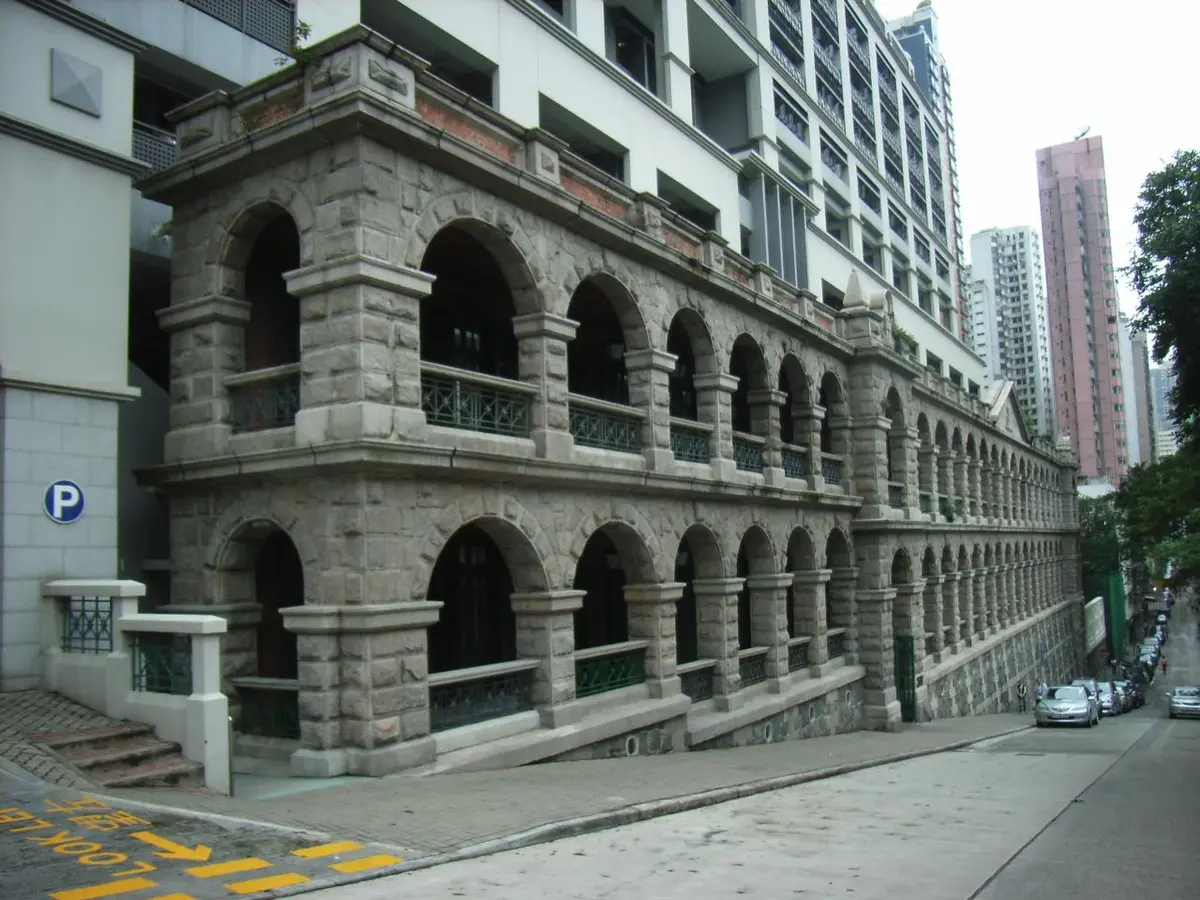
It was not. The building was completed in June 1892 as the Medical Staff Quarters of the Government Civil Hospital — ten bedrooms and five sitting rooms for the Assistant Superintendent, the Government Analyst, the Apothecary and the hospital's European nurses — on a site the Antiquities and Monuments Office says was picked for its quiet, away from Queen's Road. The asylum stood across the road on Eastern Street. Only in 1939, when war closed the route that sent patients to Guangzhou, were the quarters converted into wards for mentally ill women; they became an out-patient clinic in 1961 and were emptied in 1971. The ghost stories belong to what came next: twenty-seven years standing empty, during which, in the Antiquities and Monuments Office's words, the building "was given an infamous name, the Haunted House in High Street". The interior was demolished in 1999 and a nine-storey community complex opened behind the retained façade in 2001. The façade alone was declared a monument on 23 October 2015; its arcaded verandah opened to the public, free, in September 2023.
What is the history of Sai Ying Pun Community Complex?
The granite arcade on High Street was built for the staff who looked after the patients.
The construction contract was signed in November 1889 and the building was completed and occupied in June 1892 as the Medical Staff Quarters of the Government Civil Hospital. The Antiquities and Monuments Office records exactly what was inside: ten bedrooms, five sitting rooms, an office and a dining room, plus servants' quarters, bath and lavatory, for the Assistant Superintendent, the Government Analyst, the Apothecary and the European nurses of the hospital. The site was chosen, in the AMO's words, "because of its isolation and quietness away from the noisy thoroughfare of Queen's Road", which "was considered good for the health of the medical staff".
It kept growing as staff housing. In 1906 an extension ran eastwards up High Street to take more nurses: a dining room, a sitting room, six bedrooms, three bathrooms, a box room, a pantry and four rooms for servants, its granite dressings deliberately cut to match the older façade. In 1908 a further two-storey extension of four bedrooms and two bathrooms was added for staff of the Hong Kong Nursing Institute, which the Government had taken over. The building remained the Medical Staff Quarters until 1939 — forty-seven years, the longest single chapter in its life.
The asylum was across the road. The Chinese Lunatic Asylum stood at No. 45 Eastern Street, opposite, with the European Lunatic Asylum beside it; the AMO notes the two were united in 1906 and renamed the Mental Hospital in 1929. Psychiatrist W. H. Lo, writing a century-long survey of Hong Kong psychiatry, gives their scale: eight beds when the European asylum opened in 1885, sixteen when the Chinese asylum opened in 1891.
What pushed the nurses out was a war two hundred kilometres away. Hong Kong had been sending mentally ill Chinese patients to the John Kerr Refuge for the Insane in Guangzhou; when the Japanese occupied Guangzhou in October 1938 the transfers stopped and the small hospital on Eastern Street became badly overcrowded. The Government endorsed converting the quarters into wards for mentally ill women in 1938; the works ran from March to August 1939. Lo records that the conversion took the mental hospital to 84 beds, and that its main function was custodial care for disturbed patients awaiting transfer to Canton. From that moment the building on High Street was itself called "the Mental Hospital", and the name stuck for good.
The psychiatric use lasted 32 years and ended quietly. Castle Peak Hospital, purpose-built and far larger, was opened in 1961 by the Governor, Sir Robert Black; in the same year the High Street building was downgraded to an out-patient clinic for the mentally ill with some limited day-hospital accommodation, and in 1971 it was emptied.
Then came the chapter that actually made it famous: twenty-seven years standing empty. Local press accounts describe two fires that destroyed most of the timber structure and brought down part of the roof, leaving the granite outer walls and the arcaded verandahs on High Street and Eastern Street standing over a burnt shell. The Antiquities Advisory Board graded it II in 1981 and raised it to Grade I in 1992. Redevelopment began in 1998, the interior was cleared in 1999, and the nine-storey Sai Ying Pun Community Complex opened behind the retained façade in 2001. On 23 October 2015 the façade — and only the façade — was declared a monument.
Timeline: the documented record of Sai Ying Pun Community Complex
- November 1889 The construction contract is signed for new Medical Staff Quarters for the Government Civil Hospital, on a High Street site chosen for its quiet, away from Queen's Road.
- June 1892 The building is completed and occupied: ten bedrooms, five sitting rooms, an office and a dining room for the Assistant Superintendent, the Government Analyst, the Apothecary and the hospital's European nurses. It is not a hospital and holds no patients.
- 1906 An extension is built eastwards up High Street for more nurses, its granite dressings cut to match the original façade. The same year, the Chinese and European lunatic asylums across the road on Eastern Street are united; they are renamed the Mental Hospital in 1929.
- 1908 A second two-storey extension of four bedrooms and two bathrooms is added at the east end for staff of the Hong Kong Nursing Institute, newly taken over by the Government.
- October 1938 Japan occupies Guangzhou and the transfer of Chinese psychiatric patients to the John Kerr Refuge for the Insane stops. The small Mental Hospital on Eastern Street becomes badly overcrowded and the Government endorses converting the High Street quarters into wards.
- March–August 1939 Conversion works turn the staff quarters into wards for mentally ill women. Psychiatrist W. H. Lo records that this took the mental hospital to 84 beds, its main function being custodial care for patients awaiting transfer to Canton. From now on the building is itself called "the Mental Hospital".
- 1941–1945 Japanese occupation of Hong Kong. The Antiquities and Monuments Office states in its heritage appraisal that "there is no accurate record of the use of the Building" in these years — the exact period on which the execution-hall legend depends.
- 1961 Governor Sir Robert Black opens Castle Peak Hospital. The High Street building is downgraded the same year to an out-patient clinic for the mentally ill with limited day-hospital places.
- 1971 The building is emptied. It will stand vacant for twenty-seven years; local press accounts describe two fires that gut the timber structure and bring down part of the roof, leaving the granite walls and verandahs over a burnt shell.
- 1981 The Antiquities Advisory Board grades the derelict building II; it is raised to Grade I in 1992, while still a ruin.
- 1992 The site appears in the shockumentary The Supernormal (大迷信), a domestic hit about Hong Kong superstitions, and later in Triad Underworld (江湖, 2004). This is the oldest dated appearance of its haunted reputation that can be fixed to a year — twenty-one years after the building emptied.
- 1998–2001 Redevelopment begins in 1998, the interior is cleared in 1999 and the nine-storey Sai Ying Pun Community Complex opens in 2001 behind the retained granite façade — a compromise the AMO itself concedes may be criticised as "facadism".
- 23 October 2015 The façade is declared a monument, the 111th in Hong Kong. Hong Kong Free Press reports the declaration and describes the wartime execution-site story explicitly as rumour.
- 28 June and 29 September 2023 The Government tells the Legislative Council that the verandah is closed for maintenance and will open from September. It opens to the public free of charge on 29 September 2023, for the first time in the building's history as a community complex.
Is there a rational explanation for Sai Ying Pun Community Complex?
The strongest evidence against the best-known part of the legend comes from the document that protects the building.
The heritage appraisal on which the 2015 declaration rests states, without hedging, that "there is no accurate record of the use of the Building during the Japanese Occupation (1941-1945)". That is the Antiquities and Monuments Office writing about its own monument, after going through the Hong Kong Administration Reports and the Government Gazette closely enough to date the 1889 contract and count the bedrooms. It found nothing on the war years. The story that the Japanese army used the building as an execution hall — or to hold so-called comfort women — has no documentary anchor at all, and Hong Kong journalism has said so at the moments it mattered: Hong Kong Free Press reported it as rumour on the day of the declaration in October 2015, and Bernice Chan, writing in the South China Morning Post on 27 October 2016, introduced it explicitly as "urban myth".
The arithmetic is worth doing, because nobody does it. The fabric stood from 1892 to 1999, one hundred and seven years. Forty-seven of them it was staff housing, twenty-two a women's ward, ten an out-patient clinic and twenty-seven an empty ruin. The four years everyone tells stories about are the ones for which the AMO has "no accurate record". The AMO's earlier brief for the Grade I assessment, reproduced on Gwulo, dates the reputation to the empty decades: "Over a two-decades' abandonment, the building was given an infamous name, the 'Haunted House in High Street.'"
The named believers are honest about where their account comes from — and it comes from the undocumented years. The Hong Kong ghost-story broadcaster Edmond Poon, quoted by the SCMP in 2016, put it this way: "Many people died there. And because of the lack of medical supplies [because of the war], or they couldn't be saved, some people were there waiting to die, so there are many ghosts there." The explanation is entirely load-bearing on the wartime period that the AMO says is blank.
The conditions that generated the reports are not mysterious. Between 1971 and 1998 this was an empty granite shell in a dense residential district, across Eastern Street from the old Chinese asylum that the AMO lists as the Eastern Street Methadone Clinic. East Week, writing in 2023, says the "High Street Haunted House" has never lacked young people coming to test their nerve (不乏年輕人前來挑戰膽量). A derelict building that people climb into at night produces noises and lights whoever is inside it.
Dating the story matters more than debunking it. The oldest dated appearance of the reputation is in the AMO's own appraisal, which notes that the site featured in the shockumentary The Supernormal (大迷信, 1992), a domestic hit about Hong Kong superstitions, and later in Triad Underworld (江湖, 2004). That is twenty-one years after the building emptied and a full century after it was built. The related claim that King George V Memorial Park, below the building, was a wartime mass grave travels the same way: East Week repeated it in September 2023, alongside the execution-ground story, as something "understood" (據了解), without naming a source for either.
Can you visit Sai Ying Pun Community Complex?
2 High Street, Sai Ying Pun, is a working government building. Behind the granite screen stands the nine-storey Sai Ying Pun Community Complex, run by the Home Affairs Department, with a community hall on the 3rd floor, a singleton hostel called High Street House on the 6th floor operated by a non-governmental welfare body, and social welfare offices; people are housed and served there every day. The interior went up between 1998 and 2001 and keeps nothing of the old hospital.
The declared monument is the L-shaped façade, visible in full from the pavement. The Antiquities and Monuments Office describes a wide arched verandah over a lower level of rusticated granite blocks, with fine dressed ashlar mouldings, cornices, quoins and band courses above, and pediments, pinnacles, decorative parapets and ornamental wrought-ironwork balustrading along the verandahs. The AMO calls the style Early Baroque and notes that it is rare in Hong Kong; the façade was declared a monument in 2015.
Answering the Legislative Council on 28 June 2023, the Government confirmed that the verandah was closed to the public and under maintenance; the same reply said the Central and Western District Office planned to open the façade and verandah from September. The Hong Kong press reported the opening on Friday 29 September 2023, free of charge, under that District Office. As of 22 September 2026, neither the AMO monument page nor the Government's own GoHK tourism page publishes opening hours for it.
The MTR Island line reaches Sai Ying Pun station, where Exit C is signposted for Bonham Road, the David Trench Rehabilitation Centre and the Sai Ying Pun Community Complex, and is step-free. Sai Ying Pun is built on a slope, with High Street well above the waterfront, so an approach from Queen's Road West is a steep climb.
Filming requires an application to the Home Affairs Department. The complex is listed in the Government's location library, with the form due fourteen working days ahead and a fee scale of "$7,110 (basic charge) for the first 4 hours, $2,050 for each subsequent 4-hour block", plus a refundable deposit. The Grade 2 building opposite, at 45 Eastern Street, is the old Chinese Lunatic Asylum; it is today the Eastern Street Methadone Clinic and treats patients daily. The old Upper Levels Police Station (1F High Street, Grade 3) is now the David Trench Rehabilitation Centre, and the old Pathological Institute at 2 Caine Lane, a declared monument in its own right, houses the Hong Kong Museum of Medical Sciences.
Sources consulted
- Antiquities and Monuments Office, «Heritage Appraisal of Facade of the Old Mental Hospital» — Government of the Hong Kong Special Administrative Region, 2015 report
- Antiquities and Monuments Office, «Declared Monuments in Hong Kong: Facade of the Old Mental Hospital, High Street, Sai Ying Pun» — Government of the Hong Kong Special Administrative Region, 2015 web
- Development Bureau, «LCQ2: Making good use of government-owned monuments to develop tourism» — Hong Kong SAR Government press release, 28 June 2023, 2023 report
- Hong Kong Free Press staff, «Three locations including 'High Street Haunted House' declared as monuments» — Hong Kong Free Press, 23 October 2015, 2015 newspaper archive
- Bernice Chan, «Hong Kong horror stories – the hottest haunted sites in the city and beyond» — South China Morning Post, 27 October 2016, 2016 newspaper archive
- 東周刊 (East Week), «西營盤高街鬼屋:法定古蹟「舊精神病院」周五起全面開放參觀» — East Week / Sing Tao Headline, 27 September 2023, 2023 newspaper archive
- Gwulo: Old Hong Kong, «Medical Staff Quarters / Mental Hospital [1892-1999] — reproduces the AMO's brief for the Grade I assessment: "Over a two-decades' abandonment, the building was given an infamous name, the 'Haunted House in High Street.'"» — Gwulo, 2026 web
- W. H. Lo, «A Century (1885 to 1985) of Development of Psychiatric Services in Hong Kong — with Special Reference to Personal Experience» — Hong Kong Journal of Psychiatry 13(4), pp. 21-29, 2003 academic
- Film Services Office, Create Hong Kong, «Location Library: Sai Ying Pun Community Complex» — Government of the Hong Kong Special Administrative Region, 2026 web
Reviewed by V. Serrano on 2026-08-13 · How we verify our content
💬 Field testimonies (0)
No testimonies yet. Add the first.
Add your testimony
🔒 Log in to add a testimony