👻 HAUNTED PLACE · EXP. Nº9474
ACTIVE
Rose Hall, Montego Bay
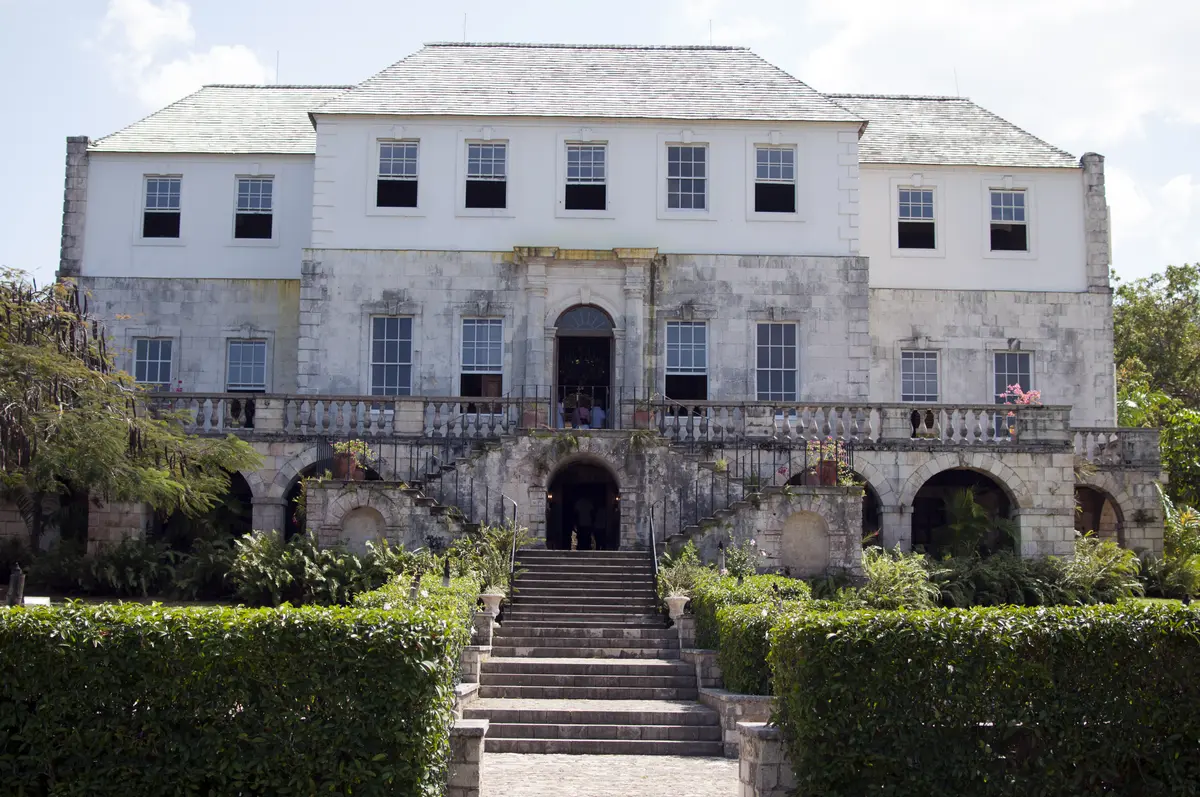
Rose Hall is a Jamaican Georgian great house above the north coast, midway between Montego Bay and Falmouth, and the story sold at its door is a novel.
Where is Rose Hall, Montego Bay?
- Location
- Saint James, Jamaica
- Type
- House / mansion
- Coordinates
- 18.517, -77.819
- Last updated
LOCATION
Why is Rose Hall, Montego Bay said to be haunted?
The White Witch of Rosehall, published by Herbert G. de Lisser in 1929, invented the title, the Haitian childhood, the obeah, the three husbands with the island's rumour that she killed them, and Annie Palmer's death at the hands of an enslaved man during the Christmas rising of 1831. The parish records give another life: Annie Mary Paterson married John Rose Palmer in 1820, was widowed in 1827, left the estate around 1830 and was buried in Montego Bay in 1846. The estate her name is attached to worked 152 enslaved people in 1817. The house stood roofless for over a century until the American Rollins family restored it between 1966 and 1971, and it has been a paying attraction ever since, with a night tour, a ghost hunt and a cocktail named after the witch. It is the best-documented case in this catalogue of a legend that can be dated to the year, printed source by printed source, from 1863 to 1973.
What is the history of Rose Hall, Montego Bay?
The best description of Rose Hall was written while the woman of the legend was still alive, and it contains no witch.
The English architect James Hakewill toured Jamaica's estates in 1820 and 1821 and published the plates in 1825. His entry begins: "Rose-Hall, the property and residence of John Rose Palmer, Esq., is situated on the sea-side, at nearly equal distance from Montego Bay and Falmouth. The house of which we give a view is justly considered as the best in Jamaica, and was erected about fifty years since by the uncle of the present proprietor, at the expense of £30,000 sterling." He notes the double flight of stone steps up to an open portico, the eating-room on the left and drawing-room on the right, a mahogany staircase "seldom excelled", and the general air of "a handsome Italian villa". He then gives the figure the legend never mentions: "On the two estates are 252 negroes, and 276 head of cattle."
The uncle was in fact a great-uncle: the Hon. John Palmer, Custos of St James, who according to the Jamaica Archives built the house between about 1770 and 1780 on the site of an earlier one named for its mistress, Rosa Kelly. Rosa was Palmer's second wife and he her fourth husband; they were married twenty-five years and she died on 1 May 1790. Her marble monument, carved by John Bacon the Elder, still stands in St James Parish Church in Montego Bay. Remember it: the whole legend grows out of that slab.
The money did not last. Palmer lived on credit, his creditors foreclosed in 1792, and he mortgaged Rose Hall and Palmyra and retreated to a smaller house at Brandon Hill, where he died in 1797. The estates fell to the Court of Chancery, and from 1792 the great house stood empty except for a housekeeper. In 1818 John Rose Palmer, the great-nephew and heir, arrived from England to try to prise the properties back. On 28 March 1820 he married seventeen-year-old Annie Mary Paterson of The Baulk, near Lucea, at her stepfather's house at Mount Pleasant. In November 1827 he died at Rose Hall, aged 42, some £6,000 in debt; his obituary in the Royal Gazette praised "his intrinsic worth, kind heart, and generous disposition".
The house Hakewill drew was built and run by people whose names the legend never uses. Edward Long recorded 323 enslaved people at Rose Hall in September 1774. The 1817 slave register (The National Archives, T71/202) lists 152 at Rose Hall — 79 men and 73 women — held under the receiver Edward Mountague; by 1826 the count was 123. At abolition, claim Jamaica St James 657 paid £2,239 13s 2d in compensation for them, to their owners. The historian Celia E. Naylor and her digital project have since reconstructed all 208 people recorded on the estate between 1817 and 1832.
Hakewill was not the only witness on the ground. The Scottish missionary Hope Masterton Waddell reached St James in 1830 and served the congregations of Cornwall, Cinnamon Hill and Rose Hall itself; the chapter of his memoir covering 1830-31 is headed "Preaching in Rose Hall Great House", and his journal has him on the property in the evenings, visiting the sick in the village. He was there through the exact years in which the tour places Annie Palmer's reign of terror, and he was a man with every professional reason to write cruelty down: he records overseers who obstructed him, the fear of poisoning among the people, the Myal outbreak that seized a meeting-house on Palmyra, and the executions that followed the rebellion. About a murderous mistress at Rose Hall he records nothing whatever. On the night the Baptist War began he was at Cornwall, and the only explanation his fleeing congregation would give him was the cry "Palmyra on fire".
Timeline: the documented record of Rose Hall, Montego Bay
- September 1774 Edward Long's list of the sugar estates of St James records 323 enslaved people at Rose Hall, belonging to the Hon. John Palmer, and an output of 200 hogsheads of sugar. The great house is under construction or newly finished.
- 1789 John Moore publishes Zeluco, the novel to which Waddell will later trace the Palmyra atrocity stories. Its plantation is in Cuba, near Havannah, its cruel owner is a man, and across both volumes the word "Jamaica" appears zero times.
- 1 May 1790 Rosa Palmer dies at 72 after twenty-five years of marriage. Her husband commissions John Bacon the Elder to carve the marble memorial in St James Parish Church whose inscription praises manners "open, chearful and agreeable".
- 1792 John Palmer's creditors foreclose. Rose Hall and Palmyra are mortgaged and pass to the Court of Chancery; from this point the great house stands empty but for a housekeeper, and the Chancery accounts record no spending on its upkeep.
- June 1817 The slave register for Rose Hall (The National Archives, T71/202, ff. 540-545) lists 152 people — 79 men and 73 women — in the possession of the receiver Edward Mountague. Their names are the part of the estate's history the legend has never used.
- 28 March 1820 John Rose Palmer, great-nephew and heir of the builder, marries seventeen-year-old Annie Mary Paterson at Mount Pleasant, St James. She was born in the autumn of 1802 near Lucea, in Hanover, to a Jamaican family of Scottish descent — not in Haiti.
- 1825 James Hakewill publishes the view of Rose Hall drawn in 1820-21, calling the house "justly considered as the best in Jamaica" and counting "252 negroes" on the two estates. There is not a word about murder, obeah or terror.
- November 1827 John Rose Palmer dies at Rose Hall aged 42, some £6,000 in debt. His death is reported within days in the Royal Gazette and the Kingston Chronicle — the detail that later versions of the legend claim was never recorded.
- 9 July 1846 Annie Mary Palmer, who had sold her remaining interest in the estates for £200 in 1830, is buried in the churchyard at Montego Bay by the Rev. T. Garrett, having died at Bonavista near Anchovy. She never remarried and left everything to a two-year-old goddaughter.
- 1863 Hope Masterton Waddell, who had preached in Rose Hall Great House in 1830-31 and recorded nothing untoward there, publishes his memoir. Its footnote on page 53 gives iron collars, spikes and a nameless lady owner found strangled in her bed — at Palmyra, with no obeah and no ghost. It is the earliest printed link in the legend.
- 1868 John Castello, proprietor of the Falmouth Post, publishes the pamphlet Legend of Rose Hall Estate: the earliest datable printed version of the story, built around an imaginary monument and a mistress strangled by the people she tortured. His villain is closer to Rosa than to Annie, and works no magic.
- 1911 Joseph Shore's In Old St. James is, on Glory Robertson's account, the book that transfers the blame to Anne Mary Paterson — the Mrs Palmer who had died peacefully sixty-five years earlier.
- 1929 Herbert G. de Lisser publishes the novel The White Witch of Rosehall, which invents the title, the Haitian upbringing, the obeah, the murdered husbands and Annie's death at the hands of Takoo during the Christmas rising of 1831. Every version told since descends from this book.
- c. 1965 Geoffrey S. Yates, Assistant Archivist at the Jamaica Archives, publishes "Rose Hall — Death of a Legend", stating on the strength of the Chancery accounts, almanacs, registers and wills that neither Mrs Palmer was ever murdered. He notes that the house has just been bought and is to be restored for some £300,000.
- 1966-1971 The American developer John Rollins and his wife Michele restore the ruined great house and reopen it as a museum at the centre of a resort development. The property's own site describes it today as "a colonial ruin restored to its former majesty in the 1960's".
- 15 January 1973 Columbia releases Johnny Cash's Any Old Wind That Blows with "The Ballad of Annie Palmer", written after Cash bought the neighbouring Cinnamon Hill estate in 1972 from Rose Hall's own restorer. The ballad puts about five thousand enslaved people on a property whose 1817 register lists 152, and carries the ghost — absent from de Lisser — to a mass audience.
- 2022 Celia E. Naylor publishes Unsilencing Slavery: Telling Truths About Rose Hall Plantation, Jamaica, with a companion digital project that documents all 208 enslaved people recorded on the estate between 1817 and 1832 — the history the tour leaves out.
Is there a rational explanation for Rose Hall, Montego Bay?
Date the story rather than the events and the legend collapses in public, decade by decade.
There is no Annie Palmer in the archives who fits. Geoffrey S. Yates, Assistant Archivist at the Jamaica Archives, went through the Chancery accounts, the almanacs, the parish registers and the wills around 1965 and stated it flatly: "neither Mrs. Rosa Palmer nor Mrs. Annie Mary Palmer was ever murdered by slaves at Rose Hall or Palmyra". Annie Mary Palmer sold what remained of her interest in the estates for £200 in 1830, lived on at Bellevue and then at Bonavista near Anchovy, and was buried in the churchyard at Montego Bay by the Rev. T. Garrett on 9 July 1846 — fifteen years after the date the tourist story gives for her murder. Her will, in the Jamaica Archives, leaves everything to her two-year-old goddaughter Giolia Mary Spence.
The oldest printed link in the chain is a footnote, written in 1863 by a man who had lived on the estate. On page 53 of Waddell's memoir, hanging from the cry of "Palmyra on fire" that scattered his congregation on the night the rebellion began, stands this: "This estate furnished scenes and characters for Dr. Moore's novel, 'Zeluco.' The iron collars and spikes used by a lady owner there for the necks of her slaves I have seen, and also the bed on which she was found dead one morning, having been strangled." It is worth reading for what it does not contain. The estate is Palmyra, not Rose Hall. The woman has no name. There is no obeah, no Haiti, no witchcraft and no ghost.
And the oldest link was already damaged where it stood. John Moore's Zeluco (1789) is set on an estate in Cuba, near Havannah, and its cruel owner is a man; across both volumes — 177,272 words — the word "Jamaica" does not appear once, with "lady" 232 times, "Hanno" (the enslaved man Zeluco kills) 13, "Havannah" 3 and "Cuba" 2 in the same pass as controls. The first witness in the chain had already hung the story on the wrong book. The footnote has since been damaged a second time in transmission: the modern version copied from site to site reads "cellars and spikes", where the page reads iron collars — which is also the only reading that makes sense of "for the necks of her slaves". The line is set in small type, the mass-digitised OCR of it is unreadable, and it has to be read off the page image. Five years later the story would move house.
The story grew around two objects: a stained monument and a ruin. Rosa Palmer's white marble memorial discoloured in a way that suggested bloodstains, and by 1891, according to Glory Robertson's survey of the literature, guidebooks were pointing them out. In 1868 John Castello, proprietor of the Falmouth Post, published a pamphlet, Legend of Rose Hall Estate, that opens on an imaginary monument to an "Ann Palmer" of "purest white, without a speck or blemish" and then tells, by contrast, a horror story of a mistress strangled by the people she tortured. Castello's villain was closer to Rosa than to Annie, and there was no obeah in it. A survey of the literature credits F. M. Alleyne, writing in Longman's Magazine, with the argument that the discoloured marble was the whole seed of the tale; the citation circulates as 1896 but with a volume number that belongs to 1898, and the volume itself could not be consulted here, so it is repeated as reported and not as checked.
The name arrives late and the witchcraft later still. Joseph Shore's In Old St. James (1911) was, on Robertson's account, the book that pinned the story on Anne Mary Paterson — the one Mrs Palmer whose husband's death was reported in the newspapers of the day. Herbert G. de Lisser's novel The White Witch of Rosehall (1929) supplied everything else that is now told at the door: the Haitian upbringing, the voodoo tutor, the obeah, the three husbands and the island's rumour that she killed them, the strangling by Takoo — and, crucially, Annie's death during the Christmas rising of 1831. Yates was blunt about the title itself: it "was invented by H. G. DeLisser for his novel". That 1831 is a novelist's date, borrowed from the real Baptist War that began in St James at Christmas 1831; the great house had not been lived in for years by then, and the widow Palmer had left in 1830.
Yates was right, and the novel itself can be made to prove it. The full text is online, so the claims sold at the door can be counted inside it. In its twenty-three chapters — 82,932 words of body text — the phrase "White Witch" does not occur once: it is the title on the cover and nothing else, against "witch" alone 34 times, "Annie" 223, "Takoo" 123 and "Rosehall" 113 in the same pass. Poison appears six times and never as something Annie does: every instance concerns Takoo, "considered in these parts a master in the art of poisoning". Her husbands do not die by poison either — she gives the causes herself: "my first husband died of apoplexy, the second one went mad, tried to stab me and actually succeeded, and then stabbed himself. The last one — he was my first husband's nephew — died of drink." Her lovers are not enslaved men but Ashman, the white overseer, and Robert Rutherford, a young English book-keeper; and Takoo kills her not as a discarded lover but as the grandfather of Millicent, the girl she destroys. There is no ghost in the book at all: all 22 uses of "ghost" and 18 of "haunt" belong to Millicent, who believes herself haunted by Annie's obeah, and the novel ends with Annie's corpse under a sheet and the surviving Englishman sailing home in February.
So the spirit that the night tour sells is younger than the novel, and it arrives with the restored house. Johnny Cash bought the neighbouring Cinnamon Hill estate in 1972 from the same developer who had just restored Rose Hall, and Columbia released "The Ballad of Annie Palmer" on the album Any Old Wind That Blows on 15 January 1973. The ballad puts about five thousand enslaved people on the property. The 1817 register lists 152.
Rose Hall Developments Limited still tells the story. Its own website describes "the plantation's beautiful but wicked 19th century plantation mistress, Annee Palmer", "known famously to have killed three husbands and taken on numerous slave lovers, only to die by the hands of the one she loved the most", and bills the night visit as "Jamaica's ONLY Haunted Night Tour". That is what the property asserts, and it is a fair source for that; it is not evidence about 1831.
Can you visit Rose Hall, Montego Bay?
Rose Hall Great House is open, commercial and easy to reach. It stands on Rose Hall Road, in Rose Hall, Saint James, above the north-coast highway; the coordinate on this file, 18.5167 N and 77.8193 W, falls within about 45 m of the point OpenStreetMap labels "Rose Hall Great House (1770)", and Sangster International Airport lies 9.8 km — 6.1 miles — due west of it in a straight line. The property publishes 1-888-ROSEHAL (767-3425) as its main number and 876-953-2323 for admissions, and states flatly that it does not provide transport: "Currently, we do not offer transportation."
The house opens Monday to Saturday and closes on Sundays and public holidays. The Day and Garden Tour is run at any time between 9:15 and 16:00. The Haunted Night Tour runs Wednesday to Saturday, with departures at 18:00, 18:30, 19:00, 19:30 and 20:00, and reservations required; reservations are also required for groups over fifteen. The Cinnamon Hill Great House Tour, Monday to Friday between 10:00 and 15:00, covers the Jamaican house of Johnny and June Carter Cash — the same Johnny Cash who recorded "The Ballad of Annie Palmer" on the 1973 album Any Old Wind That Blows.
The price of a child's day ticket depends on where on the page it is read. Consulted on 22 September 2026, the tour panel gives "$30 USD / $12 USD for ages 4 – 11 years old", while the FAQ further down the same page gives "US$30 per adult and US$10 per child (12 years and under)" and adds that children of two and under are free. The night tour is US$35 and US$15 in both places, and Cinnamon Hill US$25 and US$10. Jamaican residents get a reduced rate: "A valid Jamaican ID has to be presented upon checking in to receive the Jamaican discounted rates." Either Rose Hall tour lasts 45 minutes to an hour, is guided in English with scripts available in ten other languages at Admissions, and takes in the historical museum and the eighteenth-century graveyard. The night tour is credited to a director, Douglas Prout, and ends at the Dungeon Bar, where the "Witches Brew" cocktail is "not included in tour cost". Photography is refused indoors: "No photos or videos are allowed in the house." So is step-free access — the property lists itself as "Not handicapped accessible" and "Not recommended for people with back problems or who have had a recent back surgery", and the approach is still the double flight of stone steps James Hakewill drew in 1825.
What the house sells at the door is a novel. Its own page introduces Annee Palmer as "Known famously to have killed three husbands and taken on numerous slave lovers, only to die by the hands of the one she loved the most", and adds a parental warning about the night tour for children under twelve. The graveyard on both tours contains a tomb presented as hers, crossed on three sides and left open on the fourth by a ritual said to have been botched. Whatever that structure is, the burial register has Annie Mary Palmer interred in the churchyard at Montego Bay on 9 July 1846, sixteen years after she left the estate. The people the estate actually held are documented elsewhere and by name: the slave registers and the compensation claim Jamaica St James 657 are in the Legacies of British Slavery database at University College London, and Celia Naylor's Unsilencing Slavery (University of Georgia Press, 2022) is built on them.
Sources consulted
- James Hakewill, «A Picturesque Tour of the Island of Jamaica, from Drawings Made in the Years 1820 and 1821 — plate and text "Rose-Hall, St. James's"» — Hurst and Robinson, London, 1825 book
- Geoffrey S. Yates, Assistant Archivist, Jamaica Archives, «Rose Hall — Death of a Legend» — reprinted by Jamaican Family Search Genealogy Research Library, 1965 archive
- Centre for the Study of the Legacies of British Slavery, University College London, «Rose Hall Estate [Jamaica | St James] — estate record, ownership, slave registers and compensation claim Jamaica St James 657» — Legacies of British Slavery database, 2023 archive
- Anne M. Powers, «The White Witch and a Cautionary Tale» — A Parcel of Ribbons, 2012 web
- The Uncertaintist, «Another ghost witch, overlooking Montego Bay — the Castello pamphlet, Rosa Palmer's monument and the stages of the legend» — uncertaintist.wordpress.com, 2017 web
- Celia E. Naylor, «Unsilencing Slavery: Telling Truths About Rose Hall Plantation, Jamaica» — University of Georgia Press, Athens GA, 2022 book
- Rose Hall Developments Limited, «Rose Hall Great House — tours, opening hours, prices and the property's own account of "Annee Palmer"» — rosehall.com (consulted 13 August 2026), 2026 web
- Hope Masterton Waddell, «Twenty-nine Years in the West Indies and Central Africa: a Review of Missionary Work and Adventure, 1829-1858 — St James congregations, and the footnote on Palmyra on p. 53» — T. Nelson and Sons, London, 1863 book
- John Moore, «Zeluco: Various Views of Human Nature, Taken from Life and Manners, Foreign and Domestic (2 vols.)» — A. Strahan and T. Cadell, London, 1789 book
- Herbert G. de Lisser, «The White Witch of Rosehall — complete text, 23 chapters» — Ernest Benn, London; open edition, Toronto Metropolitan University Library, 1929 book
- Jennifer Donahue, «The ghost of Annie Palmer: Giving voice to Jamaica's "white witch of Rose Hall"» — The Journal of Commonwealth Literature, vol. 49 no. 2, pp. 243-256, 2014 academic
- Johnny Cash, «Any Old Wind That Blows — album details and track listing, including "The Ballad of Annie Palmer" (written by Johnny Cash)» — Columbia Records, released 15 January 1973, 1973 web
Reviewed by V. Serrano on 2026-08-16 · How we verify our content
💬 Field testimonies (0)
No testimonies yet. Add the first.
Add your testimony
🔒 Log in to add a testimony