📜 LEGEND · EXP. Nº3657
ACTIVE
The Enchanted Moura of Sintra
The Enchanted Moura of Sintra is a legend from Sintra, Lisboa, PT — a folk story passed down over generations. This file collects its origins, its meaning and how it has been retold.
Where does the legend of The Enchanted Moura of Sintra come from?
- Location
- Sintra, Lisboa, PT
- Kind of legend
- Myth
- Coordinates
- 38.792, -9.389
- Testimonies
- 0
- Last updated
LOCATION
What is the legend of The Enchanted Moura of Sintra?
Portuguese folklore is full of mouras encantadas, enchanted women who guard treasure beside springs and comb golden hair with golden combs. Sintra's claim on them is older and stranger than that. In Gil Vicente's play Triunfo do Inverno, performed before King Joao III around 1529 and printed in 1562, the Serra de Sintra walks on stage as a character and says in her own voice that she holds treasures that "ficarao encantados, delles de tempo de mouros" - enchanted, some from the time of the Moors and some from the ancestors. It is the earliest datable claim of enchanted Moorish treasure at Sintra, and there is no moura in it: what the mountain guards is a pagan prince held by a magician for a thousand years and three months. The word moura reaches Sintra in print only in 1838, in the Visconde de Juromenha's Cintra Pinturesca, in the plural and without a story; the golden comb and the night of Saint John arrive later still, in a footnote written as a joke. This page follows that chain link by link, and says plainly where it runs out.
What is the history of The Enchanted Moura of Sintra?
Sintra's enchanted treasure has a first text, it is dated, and it is a stage play.
In the second part of Gil Vicente's "Triunfo do Inverno" — printed in the "Copilaçam de todalas obras de Gil Vicente" (Lisbon, 1562) and conventionally dated to 1529, when it was performed before King Joao III at the birth of a daughter of Queen Catarina — the Serra de Sintra walks on as a character and speaks in the first person. Summer courts her; she asks him for a gift worthy of the Queen and answers with her own inventory: "Eu tenho muitos tisouros, / Que lhe poderao ser dados, / Mas ficarao encantados, / Delles de tempo de mouros, / Delles dos antepassados." That is the earliest datable statement that the mountain of Sintra holds enchanted treasure from the time of the Moors, and it is four centuries older than any guidebook.
Read whole rather than summarised, the passage does not contain a moura. What the Serra guards is a man: "Hum filho de hum Rei passado / Dos gentios Portugueses / Tenho eu muito guardado, / Ha mil annos e tres meses / Per hum magico encantado" — a prince of the pre-Christian Portuguese, held a thousand years and three months by a male magician, together with a garden of the earthly paradise that Solomon is said to have sent to a king of Portugal. The spell carries no comb and no mortal who snatches it: it ends "quando a bella foi nacida", when the royal child was born, which is the compliment the whole play exists to pay. The dancers who close the scene sing "Quem diz que nao he este / San Joao o verde?", so midsummer is in the text from the start.
The word moura reaches Sintra much later, and when it does it arrives in the plural and without a story. In "Cintra Pinturesca" (Lisbon, 1838), the Visconde de Juromenha writes of the ruined Castelo dos Mouros that the people fill it with "esses fantasmas tao conhecidos entre nos com o nome de mouros e mouras encantados", believe there are enchanted treasures there, and hold that a king lies buried in a sarcophagus with all his riches, guarded by "genios malfazejos". Juromenha then cites Gil Vicente to prove how old the tradition is — correctly for the treasure, and without evidence for the mouras, who are not in the verses he quotes.
The golden comb and the night of Saint John only surface at Sintra in the second, annotated edition of the same book (1905), inside a footnote whose material its editor, Antonio Augusto Rodrigues da Cunha, credits to Camilo Castelo Branco's notes to "A Formosa Lusitania" (Porto, 1877), his annotated version of Lady Jackson's "Fair Lusitania" (London, 1874). The sentence runs: "A lenda popular de que as filhas do crescente se lavam e penteam, por noutes de S. Joao, no espaldo das montanhas, mirando-se no crystal das correntes" — and it is a joke, the punchline being that they therefore washed once a year. Lady Jackson's English book contains nothing of the kind.
Meanwhile the folklorists who were collecting mouras in the 1880s put them everywhere except here. Consiglieri Pedroso's "As mouras encantadas" (1881) locates them at Penela, Caldas da Rainha, Silves, Moncorvo, Braganca, the Citania; Jose Leite de Vasconcelos's "Tradicoes populares de Portugal" (1882) adds Penafiel, Torre de Dona Chama, Tondela, Briteiros, Mondim da Beira, Lamego and Galicia. The standard portrait comes from those pages: mouras combing golden hair with golden combs beside springs, appearing at dawn on Saint John's day, winding skeins of gold, a loom heard working inside a cistern, mouras who spin with the distaff at their waist while carrying stones on their heads to build convents and towers, and the "bichas mouras" who offer a choice between their eyes and their golden scissors.
The one Sintra spring that does carry a documented legend carries a different one. The 1905 appendix records that the water of the Fonte da Sabuga was held to work like Lethe: whoever drinks it before any other water forgets the land he came from and never wants to leave Sintra, whence the local saying "Aquelle bebeu a agua da Sabuga!". The same pages record the prosaic reason the spring mattered — in May 1868 the town council levied one real per litre on water exported from the municipality, the Lisbon water dealers appealed and won four years later, and the council's pleadings note that they sold it at ten reis a glass.
The named Sintra moura who circulates today, Zaida of the Cova Encantada, belongs to a different family again: an alcaide's daughter who loves a captive Christian knight, hides him wounded in a cave and is struck by an arrow while fetching him water, after which a maiden in white is said to appear by the cave on moonlit nights, filling a jug. A blog of Portuguese legends published that version on 25 June 2006, credited to a contributor signing as M. Seleiro, with no printed source. It is a Reconquest romance, and the treasure, the comb and the Saint John's dawn of the 1880s collections are absent from it.
Timeline: the documented record of The Enchanted Moura of Sintra
- 1529 Gil Vicente's "Triunfo do Inverno" is performed before King Joao III in Lisbon at the birth of a daughter of Queen Catarina. The Serra de Sintra appears as a speaking character and declares that her treasures "ficarao encantados, delles de tempo de mouros, delles dos antepassados". This is the earliest datable statement that Sintra holds enchanted Moorish treasure.
- 1562 The play is printed for the first time in the "Copilaçam de todalas obras de Gil Vicente" (Lisbon), assembled by the author's son Luis Vicente. Every later quotation of the Sintra verses descends from this edition.
- 1838 The Visconde de Juromenha publishes "Cintra Pinturesca". Describing the ruined Castelo dos Mouros he records the local belief in "mouros e mouras encantados", enchanted treasure and a king buried in a sarcophagus guarded by "genios malfazejos", and cites Gil Vicente as proof of antiquity. It is the first time the word moura is attached to Sintra in print, and it comes with no story and no named woman.
- May 1868 Sintra town council levies one real per litre on water carried out of the municipality. The Lisbon dealers in Sabuga water appeal and win four years later. The council's pleadings, reprinted in 1905, record that they sold it at ten reis a glass: the real reason a Sintra spring mattered.
- 1874 Lady Jackson publishes "Fair Lusitania" in London, with a chapter on Sintra and its Moorish castle. The English text contains no combing moura and no night of Saint John.
- 1877 Camilo Castelo Branco brings the book out in Portuguese as "A Formosa Lusitania" (Porto), with his own notes. The 1905 edition of "Cintra Pinturesca" credits those notes with the sentence about "as filhas do crescente" washing and combing on the nights of Saint John, told as a joke about their hygiene.
- 1881 Consiglieri Pedroso publishes "As mouras encantadas" in the journal O Positivismo. He calls them feminine water spirits, lists their haunts from Penela to Silves, and declines to explain their origin. Sintra is not among the places he lists.
- 1882 Jose Leite de Vasconcelos publishes "Tradicoes populares de Portugal", the fullest early inventory of mouras: golden combs at springs, skeins of gold, a loom heard in a cistern on Saint John's morning, mouras who spin while carrying building stones on their heads. In 93,241 words, Cintra appears once, and it is about magpies.
- 1905 Antonio Augusto Rodrigues da Cunha issues the annotated second edition of "Cintra Pinturesca". His additions carry the comb, Saint John's night and the Lethe-like water of the Fonte da Sabuga, none of which is in the 1838 text.
Is there a rational explanation for The Enchanted Moura of Sintra?
The claim worth testing here is whether Sintra has a moura of its own, and that can be counted. The counts below were taken on 4 October 2026 from the Internet Archive's OCR text of each book.
In the 59,401 words of the digitised text of Juromenha's "Cintra Pinturesca" (1838) — close description of Sintra, of its palaces, its parishes and even its plants — the string "moura" appears five times. Two of them are "Erva Moura", the black nightshade, in the botanical appendix; one is a surname in a list of local families; one describes the Alhambra at Granada, quoted as a comparison; and one is the collective phrase at the Castelo dos Mouros. There is no tale, no named woman, no well and no comb. The same file gives 25 hits for "mouro", 16 for "S. João" and nine for "encantad", so the corpus is not empty and the search works; "pente" and "pentea", comb and combing, give none. In the annotated second edition of 1905 (95,071 words) the string "pente" occurs six times, and five of those are inside "repente" and "serpente"; the one comb is the verb "penteam", in Rodrigues da Cunha's footnote.
The two founding Portuguese collections give the same answer. Leite de Vasconcelos's "Tradições populares de Portugal" (1882) runs to 93,241 words of digitised text; "moura" and "mouras" appear 44 times, "moira" and "moiras" 21 times, words for comb and combing 12 times and "S. João" 71 times counting the OCR variant "Joào", and "Cintra" appears exactly once — as the magpies of the Sala das Pegas, a palace legend with no moura in it. Consiglieri Pedroso's chapter of 1881 names some three dozen places across Portugal and Galicia, from Penela and Silves to the Citania, the Serra da Estrela and the Foz do Tua, and Sintra is not one of them.
The two scholars who assembled the Portuguese material did not read the mouras as a folk memory of the Muslim population. Pedroso called them "divindades ou genios femininos das aguas, analogas as nixen germanicas, as lac-ladies inglesas, as rusalki russas", and wrote in the same chapter that "escusado e dizer que agora, como ate aqui, nao nos abalancaremos a explicar. Coligimos apenas materiais que permitam mais tarde essa explicacao." Vasconcelos filed them with the nymphs and the Wasser-Nixen as "divindades das aguas".
What can be said plainly is what the ruins do. Juromenha, who reported the belief, also judged it, calling it "a desvairada imaginacao do vulgo": a visible ruin nobody can explain attracts a buried king and a guarded treasure, in Sintra as in a hundred other Iberian castles. And the 1529 verses are a courtier's compliment, in which the mountain offers her enchanted hoard to a queen and the spell obligingly expires at a royal birth. The tradition they attest is real; what they attest is that in 1529 an audience in Lisbon already recognised the joke.
Can you visit The Enchanted Moura of Sintra?
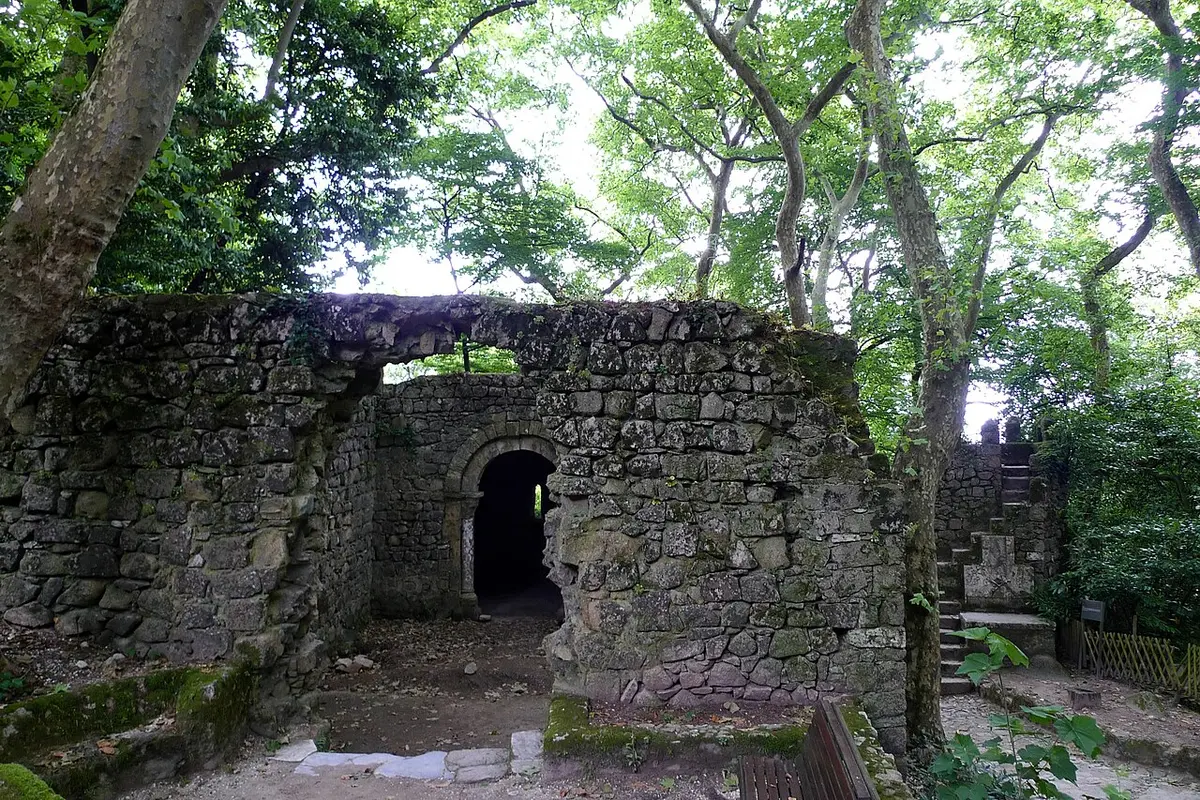
The legend has no site of its own, and the oldest readable prose that ties it to a place, Juromenha's Cintra Pinturesca of 1838, puts the enchanted treasure in the ruins of the Castelo dos Mouros, which is run by Parques de Sintra - Monte da Lua.
Parques de Sintra's prices page, read on 24 September 2026, gives the castle's hours as 09:30 to 18:00, with last ticket and last admission at 17:30; the ticket office closes between 12:00 and 13:00, when a ticket machine is available. Tickets cost 12 euros for adults aged 18 to 64, 10 euros for young people aged 6 to 17 and for over-65s, and 33 euros for a family ticket covering two adults and two young people. The castle's own page publishes its GPS position as 38°47'24.25" N, 9°23'21.47" W and says private cars are not allowed on the access roads. It gives bus 434, run by Scotturb, from Sintra railway station, which the CP Sintra line serves from Lisbon's Oriente, Rossio and Entrecampos stations. Of the signposted footpaths, the Santa Maria path, starting from the Info Parques de Sintra point at São Pedro de Sintra, is 1,770 metres long and timed at one hour; the Vila Sassetti path from Largo Ferreira de Castro is 1,850 metres and 45 minutes.
The Fonte da Sabuga, whose water the annotated 1905 edition of Cintra Pinturesca says made anyone who drank it forget their homeland and never want to leave Sintra, is a public fountain on Rua Marechal Saldanha, in the town below the castle. OpenStreetMap places it about 600 metres north-north-east of the castle's published GPS point, in a straight line.
Of the several places in Portugal named Cova da Moura, the one inside Sintra municipality is a hamlet of São João das Lampas, which OpenStreetMap places about 13 kilometres north-north-west of the centre of Sintra, well away from the Serra. The cave that present-day retellings call the Cova Encantada, home of the moura Zaida, belongs to a different story and is not the subject of this page.
Sources consulted
- Gil Vicente; ed. Mendes dos Remedios, «Obras de Gil Vicente, vol. II (contains Triunfo do Inverno)» — Coimbra, Franca Amado, 1907 book
- Joao Antonio de Lemos Pereira de Lacerda, Visconde de Juromenha, «Cintra Pinturesca, ou Memoria descriptiva da villa de Cintra, Collares e seus arredores» — Lisboa, 1838 book
- Visconde de Juromenha; notas de Antonio Augusto Rodrigues da Cunha, «Cintra Pinturesca, 2.a edicao anotada e ilustrada» — Lisboa, Empreza da Historia de Portugal, 1905 book
- Zofimo Consiglieri Pedroso, «As mouras encantadas (Contribuicoes para uma mitologia popular portuguesa, IX)» — O Positivismo, vol. III, pp. 371-385; ed. critica Etnografica Press, 1881 academic
- Jose Leite de Vasconcelos, «Tradicoes populares de Portugal» — Porto, Livraria Portuense, 1882 book
- Catherine Charlotte, Lady Jackson, «Fair Lusitania» — London, Richard Bentley and Son, 1874 book
- Gil Vicente; ed. Luis Vicente, «Copilacam de todalas obras de Gil Vicente» — Lisboa; exemplar da Biblioteca Nacional de Portugal, 1562 archive
- Parques de Sintra - Monte da Lua, «Horarios e precos - Castelo dos Mouros» — parquesdesintra.pt (consultado 24-IX-2026), 2026 web
- Parques de Sintra - Monte da Lua, «Castelo dos Mouros: how to get there (GPS 38º 47' 24.25" N 9º 23' 21.47" W; bus 434; signposted footpaths with distances and times)» — parquesdesintra.pt (consultado 24-IX-2026), 2026 web
- OpenStreetMap contributors, «Fonte da Sabuga, Rua Marechal Saldanha, Sintra (node 1556081900)» — openstreetmap.org, 2026 web
- OpenStreetMap contributors, «Cova da Moura, São João das Lampas, Sintra (node 6489243098)» — openstreetmap.org, 2026 web
- Lendas de história e outras (blog), contribution by M. Seleiro, «Lenda da Cova Encantada ou da Casa da Moura Zaida — the Zaida version, credited to the contributor M. Seleiro, with no printed source» — tradicional3.blogs.sapo.pt, 25 June 2006, 2006 web
Reviewed by V. Serrano on 2026-08-16 · How we verify our content
📎 Source: Enigma Atlas
💬 Field testimonies (0)
No testimonies yet. Add the first.
Add your testimony
🔒 Log in to add a testimony