📜 LEGEND · EXP. Nº3657
ACTIVE
The Rooster of Barcelos
The Rooster of Barcelos is a legend from Barcelos, Minho, PT — a folk story passed down over generations. This file collects its origins, its meaning and how it has been retold.
Where does the legend of The Rooster of Barcelos come from?
- Location
- Barcelos, Minho, PT
- Kind of legend
- Folk tale
- Coordinates
- 41.528, -8.622
- Testimonies
- 0
- Last updated
LOCATION
What is the legend of The Rooster of Barcelos?
In the Archaeological Museum of Barcelos, in the Minho, stands a rough granite cross carved with a hanged man, Saint James holding up his feet, and a rooster. Until the 1940s it stood across the river in Barcelinhos, on the verge of the old Porto road, some eighty paces from the town gallows — a stone gallows whose building contract the town council dated 26 January 1712. The story attached to it is Portugal's most exported legend: a Galician condemned for a theft he did not commit swears that the roasted cock on the judge's table will crow to prove his innocence, and it does, and the rope around his neck goes slack. But the story is younger and stranger than the souvenir stalls suggest. The oldest printed version, published in a Barcelos newspaper in 1866, has Saint James saving the man and mentions the crowing cock only as one variant among several — and its author states plainly that nothing at all had been written on the subject. The judge's dinner, the pilgrim's return and the painted clay rooster all joined the story later, and each of them can be dated.
What is the history of The Rooster of Barcelos?
The Rooster of Barcelos is usually introduced as an immemorial tale. It can be dated more precisely than that, because the printed versions survive and they do not all say the same thing.
The physical anchor is a lump of coarse granite now standing indoors at the Archaeological Museum of Barcelos. It did not always stand there. Until the 1940s it stood in scrubland on the left-hand verge of the old road out of Barcelinhos towards Porto, some eighty-odd paces from the town gallows — and the gallows can be dated from a municipal document. The contract for building the new stone gallows on that spot was entered in the Barcelos council book at folio 17 verso and is dated 26 January 1712. Both nineteenth-century writers who described the monument cite that entry.
The earlier of the two nineteenth-century descriptions of the cross is by António Maria do Amaral Ribeiro (1809-1879), who published his "Notícia descritiva da muito nobre e antiga vila de Barcelos" in instalments in the Barcelos paper Jornal do Povo during 1866, then as a book that November and in a corrected second edition in July 1867. His version is not the one told today. He writes that the stone "commemorates, according to tradition, the miracle of a Galician innocently condemned to the gallows having been freed from the scaffold by Saint James, the rope going slack and he hanging in the air as if someone were holding him up". The rooster in his account is a carved figure on the stone, turned to face the gallows, below the feet of the crucified Christ. The roasted cock that crows appears only as an afterthought — one of several versions, he says, "with more or fewer variants, such as that of a roasted cock having crowed as proof of the accused man's innocence". And then he adds the sentence that matters most: "There being nothing written on the subject, so far as we know, we refrain from relating the episodes that go about on the lips of the common people."
The following year the priest Domingos Joaquim Pereira reproduced Amaral Ribeiro almost word for word in chapter XI of his own "Memória Histórica da Villa de Barcellos", opening it by saying he would repeat what Amaral Ribeiro had published "and shall add little more, because we know little more". He signs off the chapter with a remark that dates it exactly: gallows are now redundant, he writes, because "in this present year of 1867 Portugal struck the death penalty from its legislation".
The recognisable modern story — the pilgrim on his way to Santiago, the judge interrupted at dinner, the bird rising from the platter, the freed man coming back to raise the monument in thanks — was assembled later, and its pieces can be traced. The folklorist A. Gomes Pereira recorded a version in which an innkeeper plants a silver place-setting on a family of pilgrims and the condemned man produces a chicken from his own bag; there is no judge and no monument, and the innkeeper hangs in his place. Teotónio da Fonseca has the judge at table and the freed man commissioning the padrão. The full version, with the roasted bird turning back into a live feathered cock and the pilgrim erecting the monument on his way home, was published by the writer Isaura Correia dos Santos in O Comércio do Porto on 1 April 1961 and reprinted in O Barcelense on 8 April — she had it from José Augusto Landolt de Sousa, who had it from the Jesuit archaeologist Eugène Jalhay.
Four years later the ethnographer Fernando de Castro Pires de Lima, director of the Museum of Ethnography and History of Porto, gathered all of it into "A Lenda do Senhor do Galo de Barcelos e o Milagre do Enforcado" (1965), published by the Fundação Nacional para a Alegria no Trabalho — the Estado Novo's leisure organisation — with a preface by the Galician writer Ramón Otero Pedrayo. It is that book, and not any old chronicle, that put the legend and the painted clay rooster in the same sentence.
Timeline: the documented record of The Rooster of Barcelos
- 26 January 1712 The Barcelos council enters the contract for the new stone gallows at the Barcelinhos site later known as Senhor do Galo, at folio 17 verso of the council book. Both nineteenth-century descriptions of the cross cite this entry, and it is the reason the monument facing the gallows is dated to the early eighteenth century rather than the Middle Ages.
- 1866 António Maria do Amaral Ribeiro publishes his description of Barcelos in instalments in the Jornal do Povo, and in book form that November. It is the oldest identified printed account of the story: Saint James holds up a Galician innocently condemned, the rope goes slack, and the roasted cock that crows is mentioned only as one of several variants. He states that nothing had been written on the subject as far as he knew.
- 1867 The priest Domingos Joaquim Pereira reproduces Amaral Ribeiro almost verbatim in chapter XI of his Memória Histórica da Villa de Barcellos, announcing that he will add little because he knows little more, and closing the chapter by observing that gallows are now pointless since Portugal has just abolished the death penalty.
- 1900 Rocha Peixoto publishes As olarias de Prado in Portugalia. The cock, he writes, exceeds every other creature in number and variety among the clay figures, and he explains its prestige by folk belief and Christian symbolism, citing Leite de Vasconcelos and Teofilo Braga. He does not connect it to the Barcelos legend at any point.
- 1939-1940 Francisco Lage commissions Barcelos to reproduce in clay the drawings from Rocha Peixoto's study, glazed green, for the Pavilion of Arts and Industries of the Portuguese World Exhibition. Barcelos figurado had been all but abandoned; the potters Rosa Faria and Manuel Faria were hired for months to revive it. According to Joao Macedo Correia, who ran the stand, the figurado did not sell, a few roosters aside, and Antonio Ferro barred them from continuing to sell painted ware; they packed up and went home.
- 10 July 1958 The Diario de Lisboa publishes the second part of Manuela de Azevedo's piece on the clay figures of Barcelos. Joao Macedo Correia cites it for the claim of the potter Joao Domingos da Rocha, who died on 2 May 1959, to have invented the wheel-thrown rooster. Macedo Correia adds that he has never found any old reference to wheel-thrown or large roosters, and concludes they are recent.
- 1 April 1961 Isaura Correia dos Santos publishes in O Comercio do Porto the version that would become canonical: the pilgrim bound for Santiago, the judge surrounded by guests, the roasted cock turning back into a live feathered bird, the hanged man found alive with the rope loose, and the pilgrim raising the monument on his way home. It was reprinted in O Barcelense a week later, on 8 April.
- 1965 Fernando de Castro Pires de Lima publishes A Lenda do Senhor do Galo de Barcelos e o Milagre do Enforcado through the Estado Novo's leisure body, the Fundacao Nacional para a Alegria no Trabalho. He suggests that the origin of the clay rooster may perhaps lie in the legend, in explicitly tentative language. The same year, in the same town, the curator Joao Macedo Correia writes that relating the legend to the pottery is a mistake and that the clay-modellers did not even know it.
- 27 June 2014 The government of La Rioja lists the Miracle of the Hanged Man and the Cock and Hen of Santo Domingo de la Calzada as protected intangible heritage. The decree calls it a variant of the widespread hanged-man miracle found in the Codex Calixtinus, in Alfonso X's cantigas and in Berceo, dates documentary references to the cathedral's live cock and hen to around 1350, and notes that a very similar version exists in Barcelos.
Is there a rational explanation for The Rooster of Barcelos?
Three claims that travel with this legend do not hold up, and the evidence against them is in print.
The first is the date: the English Wikipedia article attaches the story to "the 17th-century calvary" in the museum, and names no text of that century. Amaral Ribeiro, the earlier of the two nineteenth-century writers who described the cross, states in 1866 that nothing had been written on the subject as far as he knew, and declines to set down the oral episodes. The date that can be documented belongs to the stone. The municipality's page on the legend still calls it a "cruzeiro medieval", but both nineteenth-century descriptions cite the contract for the gallows the cross faced, entered in the council book on 26 January 1712, and the cock carved on the cross is turned towards that gallows.
The second is that the pilgrim carved or commissioned the monument in thanks. That element is absent from the two nineteenth-century accounts, which say only that the stone was raised to commemorate the event. It appears in Teotónio da Fonseca and in the 1961 newspaper version, and from there in everything since.
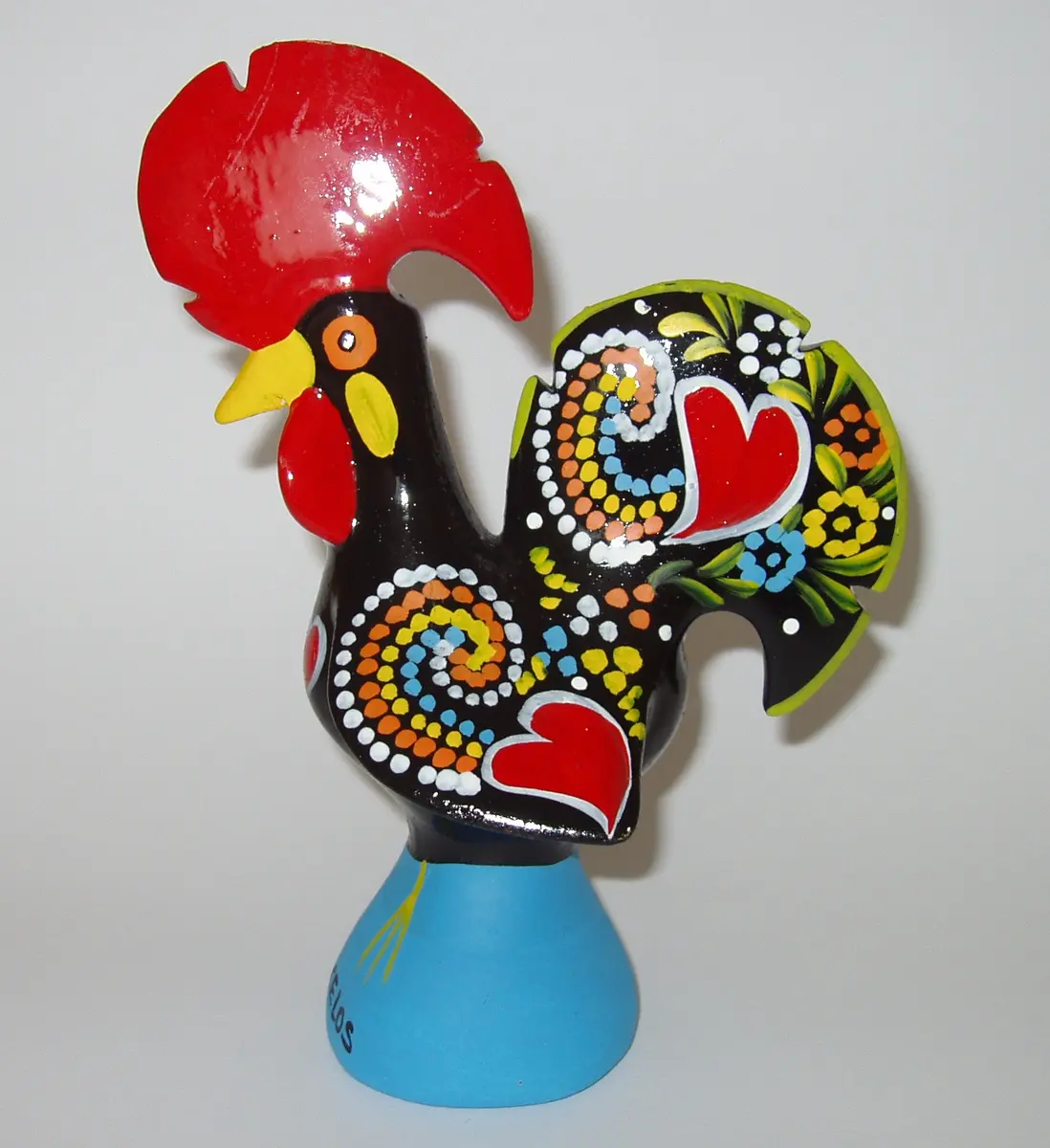
The third is the painted clay rooster. The link between bird and legend is not old and is not anonymous. In 1900 Rocha Peixoto published the classic study of the potteries of Prado, which supplied Barcelos, and devoted a page to the cock: it "exceeds in number and in variety every species of the fauna", he wrote, and is the best modelled. He explains its prestige entirely by folk belief and Christian symbolism — the cock that affirmed the divinity of Jesus while the apostles doubted at table, the cock that announces dawn, the cock whose crowing routs the malignant powers of darkness — citing Leite de Vasconcelos and Teófilo Braga. He never mentions the Senhor do Galo. Pires de Lima, who proposed the connection in 1965, does not cite Rocha Peixoto once in 190 pages, and his own wording is tentative: the rooster's origin "perhaps" lies in the legend; "I am inclined to believe" it "possibly" has a relation with it. In the same year, from Barcelos itself, the curator João Macedo Correia wrote in "As louças de Barcelos" that Rocha Peixoto had not mentioned the legend "surely because he saw no relation" between that plain bird and the modern plumed one, and added flatly: "I believe it is a mistake to relate the legend — which our clay-modellers did not even know — to this ceramic manufacture."
Finally, the miracle itself is not Barcelos property. The Spanish decree that in 2014 listed the Miracle of the Hanged Man and the Cock and Hen of Santo Domingo de la Calzada as protected intangible heritage describes it as a local variant of the widespread hanged-man miracle found in the Codex Calixtinus, in the cantigas of Alfonso X and in Gonzalo de Berceo, records documentary references to the live cock and hen kept in that cathedral from around 1350, and notes in passing that a very similar version exists in Barcelos. Pires de Lima knew this perfectly well: his book is titled after the hanged-man miracle and returns to Santo Domingo de la Calzada on page after page.
Can you visit The Rooster of Barcelos?
The Cruzeiro do Senhor do Galo stands in the Archaeological Museum of Barcelos, installed in the early twentieth century in the ruin of the Paço dos Condes de Barcelos, the fifteenth-century palace of Dom Afonso (eighth Count of Barcelos, first Duke of Bragança). The palace, at 41.5281, -8.6221 above the Cávado, has been a National Monument since a decree of 16 June 1910. VisitPortugal, the national tourist board's site, gives the museum's address as Rua Dr. Miguel Fonseca, 4750-322 Barcelos. On the same site, read on 23 September 2026, the museum opens every day from 09:00 to 19:00 in summer and from 09:00 to 17:30 in winter. The cross is carved on both faces. Amaral Ribeiro described them in 1866: on one, the hanged man with Saint James holding up his feet, the cock and the crucified Christ; on the other, the sun, the moon, a figure taken for Our Lady, another taken for Saint Benedict and a very crude dragon.
Until the 1940s the cross stood across the river in Barcelinhos, on the verge of the old road towards Porto, some eighty paces from the town gallows, at the site that came to be known as Senhor do Galo.
The clay rooster has its own museum, the Museu de Olaria, at Rua Cónego Joaquim Gaiolas, 4750-306 Barcelos, telephone +351 253 824 741. Its visiting page, read on 23 September 2026, gives opening hours of 10:00 to 17:30 from Tuesday to Friday (last entry 17:00) and 10:00 to 12:30 and 14:00 to 17:30 at weekends and on public holidays (last entries 12:00 and 17:00). It is closed on Mondays, 1 January, Easter Sunday, 15 August, 1 November and 24 and 25 December. A general ticket costs 2.20 euros. The reduced ticket, at 1.10, is for pensioners and students; holders of the Cartão Jovem or Cartão Barcelos Jovem pay the same. Under-12s and visitors of 65 and over enter free, as do school groups. Entry is free for everyone on Sunday mornings from 22 September to 21 June and on Sunday afternoons from 22 June to 21 September.
The weekly fair is held on Thursdays at the Campo da República, known as the Campo da Feira. The municipality describes a traditional fair of a markedly rural kind, where local farm produce is sold next to crafts that include Barcelos pottery and roosters. It dates the earliest charter to 1412, when João I granted an annual fair on the Campo do Salvador at the request of Count Dom Afonso; the Campo do Salvador is today's fairground. The same page places the weekly Thursday market in the late seventeenth or eighteenth century. The painted rooster sold there is a twentieth-century form: in 1965 João Macedo Correia recorded the claim of the potter João Domingos da Rocha, who died on 2 May 1959, to have invented the wheel-thrown rooster.
Sources consulted
- António Maria do Amaral Ribeiro, «Notícia descritiva da muito nobre e antiga vila de Barcelos, pp. 112-116 (passage transcribed verbatim in Pires de Lima 1965, pp. 33-35, the copy actually read)» — Jornal do Povo (serialised) / Tipografia do Jornal do Povo, Barcelos; 2nd ed. July 1867, 1866 book
- Domingos Joaquim Pereira, «Memória Histórica da Villa de Barcellos, Barcellinhos e Villa Nova de Famelicão, ch. XI 'Forca e Senhor do Gallo', pp. 205-208» — Typ. de J. Ribeiro & C.ª Filho, Vianna, 1867 book
- Rocha Peixoto, «As olarias de Prado, pp. 38-39 of the 1966 reprint (originally Portugalia, vol. I, fasc. 2, pp. 227-270)» — Portugalia, Porto; 2nd ed. Cadernos de Etnografia, Museu Regional de Cerâmica, Barcelos, 1966, 1900 academic
- Fernando de Castro Pires de Lima, «A Lenda do Senhor do Galo de Barcelos e o Milagre do Enforcado, preface by Ramón Otero Pedrayo» — Fundação Nacional para a Alegria no Trabalho, Gabinete de Etnografia, 1965 book
- João Macedo Correia, «As louças de Barcelos, Cadernos de Etnografia 4, pp. 22-26» — Museu Regional de Cerâmica, Barcelos, 1965 book
- Gobierno de La Rioja, «Decreto 27/2014, de 27 de junio, por el que se declara bien de interés cultural, de carácter inmaterial, el patrimonio cultural del Milagro del Ahorcado y del Gallo y la Gallina de Santo Domingo de la Calzada» — Boletín Oficial del Estado, no. 266, 3 November 2014, pp. 89947-89952, 2014 report
- Francisco Joaquim Barbosa Gonçalves and Carlos Manuel Martins da Costa, «O Contributo da Interpretação do Património para o Desenvolvimento do Turismo Criativo. O Caso do Galo de Barcelos» — Revista Portuguesa de Estudos Regionais, no. 52, 2019 academic
- Museu de Olaria, «Visitar: horários e bilhetes» — Museu de Olaria, Barcelos, 2026 web
- Município de Barcelos, «Feira semanal, mercados e feiras (quinta-feira)» — Câmara Municipal de Barcelos, 2026 web
- Município de Barcelos, «A lenda do Galo — the municipality's telling of the legend, which calls the cross 'cruzeiro medieval'» — Câmara Municipal de Barcelos, 2026 web
- Wikipedia contributors, «Rooster of Barcelos — the encyclopedia article that associates the story with 'the 17th-century calvary'» — Wikipedia, 2026 web
Reviewed by V. Serrano on 2026-08-16 · How we verify our content
📎 Source: Enigma Atlas
💬 Field testimonies (0)
No testimonies yet. Add the first.
Add your testimony
🔒 Log in to add a testimony