📜 LEGEND · EXP. Nº0270
ACTIVE
El Silbón (The Whistler)
El Silbón is never told on its own: it is told inside a job of work.
Where does the legend of El Silbón (The Whistler) come from?
- Location
- Los Llanos, Portuguesa, Venezuela
- Kind of legend
- Ghost story
- Coordinates
- 9.042, -69.742
- Last updated
LOCATION
What is the legend of El Silbón (The Whistler)?
The llano — Portuguesa, Cojedes, Barinas, Guárico and Apure in Venezuela, Arauca, Casanare, Meta and Vichada in Colombia — is savanna with almost nobody in it, and the file the two countries submitted to UNESCO counts fewer than ten inhabitants per square kilometre on the Colombian side and under five on the Venezuelan. Cattle work there is done singing: to the head of the herd on the drive, to each cow by her own name at the dawn milking, and to the whole herd through the night so it does not bolt. UNESCO inscribed those songs in 2017 on the List of Intangible Cultural Heritage in Need of Urgent Safeguarding. That is the setting of the whistler — men awake at night, out in the open, listening — and the rule everyone repeats about him, that he is far away when the whistle sounds close and close when it sounds far, describes a real failure of human hearing rather than a ghost.
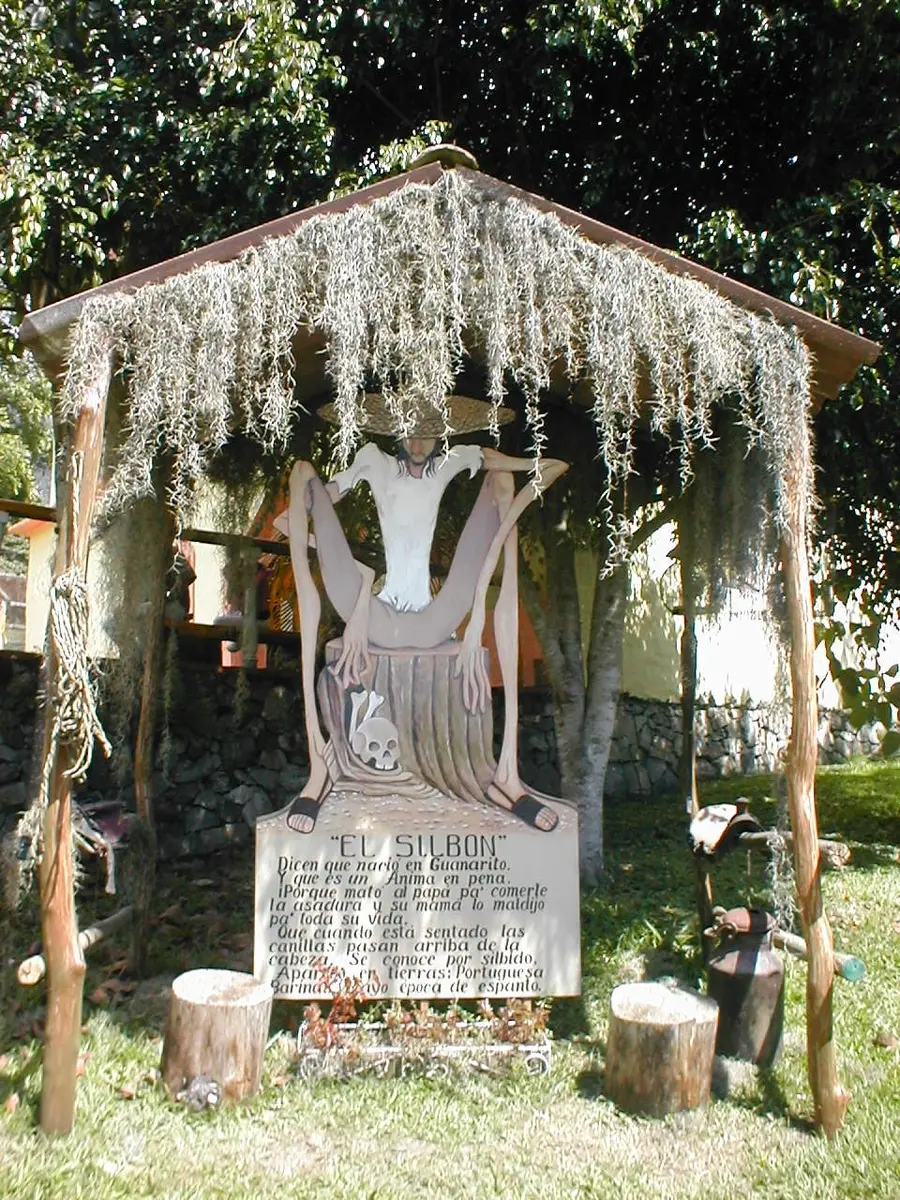
What is the history of El Silbón (The Whistler)?
El Silbón is never told on its own. It is told inside a job of work.
The llano — Portuguesa, Cojedes, Barinas, Guárico and Apure in Venezuela; Arauca, Casanare, Meta and Vichada in Colombia — is savanna with very few people in it: the file the two countries submitted to UNESCO describes 84,000 square kilometres on the Colombian side with fewer than ten inhabitants per square kilometre, and under five on the Venezuelan. In that emptiness cattle work is done singing, and the file sets out when: on the drive, where the cabrestero sings to the head of the herd to make it ajilar — fall into line — for hundreds of kilometres; at the dawn milking, where every cow has her own name and her own tune; and on the vela de ganado, the nights when the herd must be sung to so it does not bolt into a barajuste, a stampede. UNESCO inscribed those songs in 2017 on the List of Intangible Cultural Heritage in Need of Urgent Safeguarding.
That is the setting of El Silbón: men awake at night, out in the open, listening. And the same repertoire that carries the work songs carries the stories. At parrandas and in contrapunteos — the sung duel of the joropo, which in Casanare has a tournament of its own — men compete in improvised verse, and the great work in that form, Florentino y el Diablo by Alberto Arvelo Torrealba, written in 1940 and reworked in 1950 and 1957, is a plainsman who beats the Devil by singing all night. The llano does not keep its ghosts apart from its music. It sings them.
The versions do not agree. The one the columnist Alfredo Cisneros set out in Últimas Noticias in 2022 is the most widespread in Venezuela: a spoiled young man kills his father over a hunting quarrel, serves his organs to his mother, is cursed by her when she finds out, is flogged by a brother who rubs chilli into the wounds, and is condemned to wander with a sack of bones. In the version Daiana González Navas gathered in 2015 for the Colombian outlet Las2orillas, the trigger is a wife's infidelity, the pursuer is the grandfather with his dogs, and the guilty man ends up a long-tailed bird with black and grey plumage. What never varies is the rule of the whistle: if it sounds far away he is near, and if it sounds near he is still far off.
Behind the version everyone knows today there is a name. Dámaso Delgado, born in Guanarito in 1940, a singer with Los Turpiales del Llano and from 1963 a student of voice, acting and radio in Caracas, wrote La leyenda del Silbón in 1966 and recorded it in 1967. The Venezuelan press calls him its author and its creator; what is documented is that he fixed the story and spread it, because the recording became a favourite of folklore radio. Our sources do not allow us to date the oral figure that preceded him.
Timeline: the documented record of El Silbón (The Whistler)
- 24 November 1940 Dámaso Delgado is born in Guanarito, Portuguesa, into a poor family. Orphaned at five, he finishes primary school but cannot complete secondary education, and studies theatre at the Ateneo de Guanare.
- 1963 After regional success singing with the group Los Turpiales del Llano, Delgado moves to Caracas to study voice, acting and radio production, and makes a name for himself in broadcasting.
- 1966 Delgado writes La leyenda del Silbón — the narrated version that fixes the canonical account of the parricide, the curse and the sack of bones for a national audience.
- 1967 The piece is recorded and becomes an immediate favourite of the radio programmes devoted to folk music. This recording, not a fieldwork collection, is what carried El Silbón beyond the plains.
- 1996 Delgado is declared Cultural Heritage of the state of Portuguesa. He is later named favourite son of Guanarito and illustrious citizen of Guanare, and decorated with the Orden Juan Fernández de León, first class.
- 2015 The Colombian outlet Las2orillas publishes Daiana González Navas's account of the legend as it is told in Vichada, Meta, Casanare and Arauca, with a variant in which the parricide is triggered by a wife's infidelity and the culprit ends up transformed into a long-tailed bird.
- 2017 UNESCO inscribes the Colombian-Venezuelan llano work songs on the List of Intangible Cultural Heritage in Need of Urgent Safeguarding. The nomination file documents the vela de ganado, the night watch in which the herd is sung to so that it does not stampede — the working context in which the whistle is heard.
- November 2022 The 48th Festival Internacional de Música Llanera El Silbón de Oro is announced for 24-26 November in Portuguesa, with categories for canto recio, unpublished poetry, recitation, storytelling and joropo dancing: the legend has become the name of a music competition.
- 18 January 2025 Dámaso Delgado dies in Guanare at 84. He had left performing decades earlier to work as an evangelical pastor and raise eight children. Venezuelan media obituaries call him the author of the legend.
Is there a rational explanation for El Silbón (The Whistler)?
Three ordinary explanations, and none of them needs a ghost.
The first is acoustic, and it is the most interesting, because the rule of the whistle describes a real failure of human hearing. The review by Kolarik, Moore, Zahorik, Cirstea and Pardhan (2016) on auditory distance perception is explicit that level is a relative cue: the ear cannot work out how far away something is from the level that reaches it, because that level depends on the acoustic power of the source, which the listener usually does not know. The most reliable cue — the ratio of direct to reverberant sound — works mainly indoors and all but vanishes in open country. And the spectral cue, the loss of high frequencies to air absorption, carries no information below about fifteen metres. A night whistle on a savanna with no obstacles and no visual landmarks is close to the worst possible stimulus for judging distance. On top of that, judgements are compressed: near sources are heard as farther away, far ones as nearer. The plainsmen's rule does not describe a supernatural whistle. It describes something that genuinely cannot be judged, turned into a formula that can never be wrong.
The second is ornithological. The same savanna is where the common potoo (Nyctibius griseus) sings at night — pájaro bruja, witch bird, in Colombia — its song described as a long whistle like a human lament followed by short notes that fall away in both pitch and volume. A sound that dies while descending the scale imitates a source moving away almost perfectly.
The third is social, and it is not the least of them. Cisneros notes that El Silbón was used to make children behave; the Colombian version punishes adulterers and troublemakers. The story regulates who goes out alone, at night and drunk, onto a plain where the night is genuinely dangerous.
Can you visit El Silbón (The Whistler)?
There is no Silbón house to visit. There is a plain and a calendar.
The territory is the territory of the work songs: Portuguesa, Cojedes, Barinas, Guárico and Apure in Venezuela; Arauca, Casanare, Meta and Vichada in Colombia. On the Venezuelan side, Portuguesa state holds the Festival Internacional de Música Llanera El Silbón de Oro in November — Últimas Noticias announced the 48th edition for 24 to 26 November 2022, with categories for canto recio, unpublished poetry, recitation, storytelling and joropo dancing — and, since 2024, the children's festival El Silboncito Portugueseño, whose second edition brought more than 150 children from the state's fourteen municipalities to the Centro Cultural Tomás Montilla in Guanare in November 2025.
The Colombian side is the more practicable calendar: the Torneo Internacional del Joropo in Villavicencio, Meta, whose 58th edition was announced for 13 to 17 August 2026; the Torneo Internacional de Contrapunteo y Voz Recia Cimarrón de Oro in Yopal, Casanare, in December; and the Festival Internacional de la Bandola Llanera Pedro Flórez in Maní, Casanare, in January. Dates move from year to year, so confirm them before booking anything.
The honest warning is about safety. Spain's foreign ministry advises against travel to Venezuela unless necessary and specifically against the border strip with Colombia, Apure included, because of guerrilla and drug-trafficking activity; for Colombia it advises against Arauca, Casanare and Meta among other departments. Both sets of advice agree on one very concrete point: do not travel by road at night. That is, literally, El Silbón's own advice.
Sources consulted
- Alba Ciudad 96.3 FM, «Dámaso Delgado, autor de La Leyenda El Silbón, dio su paso a la inmortalidad dejando un invaluable legado cultural» — Alba Ciudad 96.3 FM, 2025 newspaper archive
- Kariney Pimentel, «Falleció el autor de la leyenda llanera El Silbón» — Últimas Noticias, 2025 newspaper archive
- Alfredo Cisneros, «¡Ahí viene El Silbón! (columna Punto Criollo)» — Últimas Noticias, 2022 newspaper archive
- Daiana González Navas, «El Silbón, vengador de hombres» — Las2orillas, 2015 newspaper archive
- Colombia y República Bolivariana de Venezuela, «Colombian-Venezuelan llano work songs — nomination file no. 01285 for inscription on the List of Intangible Cultural Heritage in Need of Urgent Safeguarding» — UNESCO, Intangible Cultural Heritage, 2017 report
- Andrew J. Kolarik, Brian C. J. Moore, Pavel Zahorik, Silvia Cirstea y Shahina Pardhan, «Auditory distance perception in humans: a review of cues, development, neuronal bases, and effects of sensory loss» — Attention, Perception & Psychophysics, vol. 78, n.º 2, pp. 373-395, 2016 academic
Reviewed by V. Serrano on 2026-07-29 · How we verify our content
📎 Source: Enigma Atlas
💬 Field testimonies (0)
No testimonies yet. Add the first.
Add your testimony
🔒 Log in to add a testimony