📜 LEGEND · EXP. Nº0270
ACTIVE
La Sayona
On the Venezuelan plains they say the Sayona comes out at night to the man who is out carousing: a tall, beautiful, long-haired woman who invites him to follow her along a lonely road and then, when he draws near, shows him enormous fangs.
Where does the legend of La Sayona come from?
- Location
- Los Llanos, Barinas, Venezuela
- Kind of legend
- Ghost story
- Coordinates
- 8.623, -70.207
- Last updated
LOCATION
What is the legend of La Sayona?
That scene has been in print since April 1919, when Rómulo Gallegos put it in a short story; and in 1919 it had no biography attached — no name, no husband, no mother, no curse. The tale of the jealous woman arrives much later, and no two recorded versions agree on who died. The national heritage census carries four incompatible ones: in one she burns the hut with her son inside while the husband is in jail; in another it is God, not her mother, who condemns her. The name comes from the garment, the saya, and specialists of the llano treat the Sayona and the Llorona as one and the same. There is even a Sayona who was arrested: in Achaguas a local woman used to dress up as her during the nightly blackouts, until a group of young men worked it out.
What is the history of La Sayona?
La Sayona is told as though she came down from colonial times. What can actually be read with a date on it starts much later, and it does not start with her life story. It starts with her teeth.
The dress came first. In his glossary of Venezuelan speech, Lisandro Alvarado (1858-1929) records the entry "SAYÓN. Saya" and credits it to Miguel Carmona's Diccionario indo-hispano, o venezolano-español (Caracas, 1858-1859): in mid-nineteenth-century Venezuela a sayón was a garment. A century and a half later the national heritage census still explains the name the same way — the apparition goes "dressed in a tunic or a long saya, hence her name" (entry "Sayona, leyenda", municipalities of Biruaca and Pedro Camejo, Apure).
The oldest dated mention that Alvarado quotes is from April 1919: a short story by Rómulo Gallegos, "Pegujal", published in the Caracas magazine Actualidades on 20 April 1919 and signed at the foot "Caracas, April 1919". Describing the night of the plains he writes: "the disquieting night of the accursed lands […] in whose blackness there phosphoresce the frightful teeth of the sayona, who waits for the night-walker at the roadside and invites him to follow her." That is the whole of it in 1919: teeth, a road and an invitation. No name, no husband, no mother, no fire and no curse.
Alvarado gave her an entry of her own soon afterwards and could not tell her life either: "La Sayona is a nocturnal vision feigned by popular imagination and legend, alongside others that survive in Venezuelan folklore." To document it he used two literary passages. One is the Gallegos line quoted above. The other he signs "A. Carias, Jacinto", and the list of sources in the same volume expands it as "Carias, Alejandro: Jacinto", with no date or imprint. Its passage recalls the tales heard "in the first days of infancy", dark tales "of apparitions and spells, adorned with names of ugly prestige such as that of 'la Sayona'". Alvarado died on 10 April 1929 and that volume was not printed until 1955, in the Obras completas issued by the Ministry of Education. A lexicographer who wrote down everything he knew about a word knew that the Sayona frightened people at night; he did not know who she had been.
The biography arrives late, and it arrives with proper names. The oldest complete telling with a date sits in an official register: the entry "Sayona de las montañas y sabanas" in the First Census of Venezuelan Cultural Heritage, municipalities of Páez and Rómulo Gallegos, Apure. There the woman is called Casilda; her man, Severiano, is a carouser; and the neighbour who wants her has a nickname, Burro Tesero. Severiano accidentally kills a woman called la negra Timotea at a dance and the village constable takes him away to jail. With the husband gone, Burro Tesero tells Casilda that Severiano has been sleeping with her own mother. Next morning, when the mother arrives with the coffee she brings every day, Casilda sets fire to the hut with her son inside it and stabs her mother three times. The dying woman curses her: "You have taken my life, Casilda. You have taken my life, Sayona; you have taken the life of your own mother who brought you into the world." And then: "Cursed you shall be all your life! Without God and without Holy Mary you will walk the world looking for womanising men to ease your sins […] May God grant it be so." Then the fangs come through.
In the register the husband is in jail, and the one who burns is the child. The child is the piece that links the Sayona to the Llorona, and specialists of the plains treat them as one figure. Edgar Colmenares del Valle — the philologist who edited the Diario de un llanero of Antonio José Torrealba, the guide who took Gallegos through Apure in 1927 — describes her in En el espejo de la memoria (Barinas, 2000, p. 61), quoted by Jenny González Muñoz, as "an evil woman with an apparently beautiful face but great fangs, who walks the streets of the plains towns before dawn, screaming and weeping with a dead child in her arms".
That long version does not belong to one town: the same text, almost word for word, is also registered in the municipality of Barinas, and there it carries details the Apure version lacks. The woman appears "with blonde hair", makes the man believe she lives alone so that he will walk her home, and once inside begins to undress while her body turns "into a skull with a toad's face"; she is "exceedingly afraid of the blessed palm cross and of prayers"; and "every man she frightens takes one sin off her". That last detail is what closes the curse: her mother condemned her to look for womanisers "to ease your sins", and here we are told how they are eased.
And there is a third, shorter version, registered in three more Barinas municipalities — Obispos, the pair Cruz Paredes-Arismendi and the pair Rojas-Sosa: "La Sayona is a tale native to the Llanos and dates from colonial times. It is said to be the story of a very jealous woman who killed her husband and her mother, believing they were having an affair." And it goes on: "Her mother, in her death agony, cursed her, saying: Sayona you shall be for ever, and in the name of God, so be it." That paragraph is, but for the commas, the one published on Spanish Wikipedia on 13 November 2008. The Obispos volume carries the census label "2004-2007", earlier than the article; the Cruz Paredes-Arismendi one carries "2004-2010", later. The labels do not settle who copied whom. They do show that the three registrations and the article share one circulating text, and that part of what looks like registered tradition is a photocopied paragraph.
And no two recorded versions agree on who died. The chapter Carmen Pérez Montero devoted to the Sayona in Portuguesa state opens with a summary of her own, with no informant behind it, and says something else again: "she was a very pretty woman, but very jealous, extremely jealous, and on suspicion of infidelity she killed her husband" — the husband only. And she goes about "in a white saya". After that come the first-person testimonies, each headed by the name of the person telling it — Juan Francisco Tovar, Francisco Ignacio Pérez, Antonio 'Toñito' Angulo aged 42, Tomasa Pérez aged 85 — and none of them tells the origin at all: they tell encounters. The plains glossary of Erics Blanco (2024) says the opposite: "a woman who out of jealousy killed her own mother" — the mother only. The first version of the Spanish Wikipedia article, dated 13 November 2008, kills both and names nobody, with a different curse: "Sayona you shall be for ever, and in the name of God, so be it."
And there is still a fourth, in the municipality of Pedraza, which resembles none of the others: "she was an evil woman who out of jealousy murdered her husband and killed her children. As punishment, God condemned her to be hideous and to wander the streets at night begging forgiveness." Here God does the condemning, and at night she begs to be pardoned; the mother, the stabbing and the maternal curse are absent. Four versions registered by the same census, on the same plains, and no two of them agree on who died or on who did the cursing.
What does repeat across a whole century is short and always the same: a beautiful, tall, long-haired woman on a lonely road at night; an invitation; and, when the man comes close, the fangs. And a target: the reveller, the womaniser, the man out of the house at an hour when he should not be.
Timeline: the documented record of La Sayona
- 1858-1859 Miguel Carmona's Diccionario indo-hispano, o venezolano-español (Caracas) records the Venezuelan word sayón as meaning simply saya, a skirt or long garment. Lisandro Alvarado cites him for it in his own glossary. The clothing that gives the ghost her name is documented decades before any text describes the ghost.
- April 1919 Rómulo Gallegos publishes the short story 'Pegujal' in the Caracas magazine Actualidades. In a passage about the night of the plains he writes of 'the frightful teeth of the sayona, who waits for the night-walker at the roadside and invites him to follow her'. It is the oldest dated mention that Lisandro Alvarado quotes in his glossary, and it contains no origin story whatsoever.
- before 10 April 1929 Lisandro Alvarado dies in Valencia. Among his unpublished papers is the entry SAYONA: 'La Sayona is a nocturnal vision feigned by popular imagination and legend.' He documents it with two literary quotations and gives her no name, no crime and no curse. The volume will not be printed until 1955.
- 1955 The Ministry of Education prints the second part of Alvarado's Glosarios del bajo español en Venezuela as volume III of his Obras completas. The SAYONA entry appears in public for the first time, twenty-six years after its author's death.
- 1973 In Achaguas (Apure) the electricity utility Cadafe begins supplying power 24 hours a day. The heritage census records that until then the town had lived with a woman who dressed up as La Sayona once the generator was switched off at ten at night, and who was eventually unmasked and seized by a group of young men.
- 2000 Edgar Colmenares del Valle publishes En el espejo de la memoria (Barinas). He treats 'La Sayona or la Llorona' as one figure: a beautiful face with great fangs, walking the streets of the plains towns before dawn, 'screaming and weeping with a dead child in her arms'. The dead child is the detail most retellings drop.
- 2004-2007 The First Census of Venezuelan Cultural Heritage registers the entry 'Sayona de las montañas y sabanas' for the municipalities of Páez and Rómulo Gallegos, Apure. It is the oldest datable full version: Casilda, Severiano in jail, the neighbour Burro Tesero, the hut burnt with the child inside, the mother stabbed three times and the curse quoted verbatim.
- 13 November 2008 A user creates the article 'La Sayona' on Spanish Wikipedia. Its version of the origin kills both husband and mother, names nobody, and gives the curse as 'Sayona you shall be for ever, and in the name of God, so be it'. The same paragraph, near verbatim, is registered in three volumes of the heritage census for Barinas state — Obispos, Cruz Paredes-Arismendi and Rojas-Sosa; the Obispos volume carries the label '2004-2007', earlier than this article. The labels do not establish who copied whom.
- 2014 Fundación Empresas Polar publishes Carmen Pérez Montero's Mitos y leyendas del estado Portuguesa, a collection of testimonies from informants identified by name and age. None of the four Sayona accounts tells her origin: they give a white saya, long fangs, eyes 'like fire' and roadside encounters. The only origin in the chapter is in the compiler's own summary, and there the woman kills her husband and nobody else.
- 2024 Erics Blanco's Vocabulario coloquial del llanero, based on interviews with plains farmers and tradition-bearers, defines her as 'a woman who out of jealousy killed her own mother' and adds that the legend 'is not native to the Llano, since Spain, Mexico and other Ibero-American peoples have it too'.
Is there a rational explanation for La Sayona?
The best-documented ordinary explanation was not supplied by an outside sceptic. It is in the state register itself, with a village, a mechanism and an expiry date.
In Achaguas (Apure) the town's generator gave light from six in the evening until ten at night, and before stopping it gave three warnings, five minutes apart, each consisting of three quick blackouts, so that people would go indoors. The Catálogo del Patrimonio Cultural Venezolano records that in those unlit hours "many anecdotes arose, such as the case of the woman who dressed up as La Sayona after the plant's light was switched off. For a long time the inhabitants remained worried about the existence of this ghost, until she was discovered by a group of young men who realised it was a scheme, and managed to arrest whoever was playing La Sayona." And it gives the ending: "Thus the population of Achaguas lived until 1973, when Cadafe supplied the town with permanent electricity 24 hours a day." A ghost that kept the blackout's timetable, an impostor arrested, and a date on which it ended when the lights came on.
And it is not the only recorded case of a Sayona taken apart. In La Unión, municipality of Cruz Paredes (Barinas), the catalogue collects from Benito Pérez Flores that three men of the village — Sebastián Herrera, Manuel Valdez and Rafael Muñoz — spent years frightening people: after drinking, they used cattle horns to produce "a strange sound" like a mournful weeping that was associated with the Sayona's. The local prefect went out looking for the source of the noise with a policeman, "because they were convinced that no such ghost existed", and eventually caught them on a day they had drunk too much.
Thirteen municipal volumes of the heritage census for the states of Apure and Barinas, some 718,000 words, name the Sayona 33 times, all of them in nine volumes; the other four do not mention her. Eight entries are devoted to her and six carry an origin story, spread across four incompatible versions. In the same thirteen volumes "Silbón" occurs 41 times and "Llorona" 22.
The second argument is chronological, and it can be measured. In 1919 the story had no biography; in the glossary Alvarado left written before his death in 1929 it still had none, and neither of the two literary passages he quotes gives her one. The tale of the jealous woman with proper names and a verbatim curse is dated by the census volumes labelled 2004-2007 and by the Spanish Wikipedia article of November 2008. Print cannot reach what was said aloud, so this dates the writing down: the apparition is in print for decades before any life story is attached to her.
The third is that the versions do not agree on the essentials. In the Apure census the woman burns her son and stabs her mother, and the husband is in jail. In Portuguesa she kills the husband. In Pedraza she kills her husband and her children, and the one who condemns her is God. In Erics Blanco's glossary she kills only the mother. On Wikipedia she kills both and has no name at all. A story that cannot keep track of who died is not the memory of an event: it is an explanation that has gradually been attached to an apparition that already existed.
Two voices also take her out of the plains altogether. Erics Blanco, who compiled his vocabulary by interviewing plains farmers and tradition-bearers, writes bluntly: "This legend is not native to the Llano, since Spain, Mexico and other Ibero-American peoples have it too." In the same glossary the Llorona appears as "a belief of the plains brought by the Spanish conquerors", with the rider "in the plains she is known as la Sayona". Colmenares del Valle and González Muñoz name them together, "La Sayona or la Llorona". Both are opinions, and they are given here with their authors' names.
That leaves what the legend does, which is the least mysterious and the most checkable part. In the Portuguesa testimonies the Sayona never appears to just anyone: she comes out to the "gallant and flirtatious" man walking alone at night, to the driver who gives a lift to a stranger, to the man who boasts that he is not afraid of her. The mother-in-law in the Wikipedia anecdote puts it better than any analysis: "Oh son, it looks to me like you are cheating on my daughter." On a savanna where the danger after dark is real, the story regulates who goes out, with whom and at what hour.
One last honest note about the limits of all this. None of it can be used to deny that anyone saw anything: the testimonies collected are from named people, with their ages, telling what happened to them. What the documents will support is more modest and more interesting — that the name comes from a garment, that the teeth have been in print since 1919, that the biography arrived far later and in incompatible versions, and that in one town in Apure there was a Sayona who could be arrested.
Can you visit La Sayona?
La Sayona is a roadside apparition, and the places attached to her are stretches of road. The pin on this file sits in the centre of the city of Barinas, whose municipal volume of the heritage census registers the long version of her story; it does not mark a spot where anyone says she was seen.
The official registers localise her in several places at once. The First Census of Venezuelan Cultural Heritage places her "on the outskirts of the settlement of Sabanas de Bagazú", municipality of Biruaca (Apure); in the mountains of San Camilo, municipalities of Páez and Rómulo Gallegos, where she appears to the drovers taking cattle towards San Cristóbal; and as a belief of the whole municipality of San Fernando. The testimonies Carmen Pérez Montero gathered in Portuguesa put her at the Araure creek, at the spot called Los Palmares and on the old road towards San Carlos. None of those points has a monument on it.
The documents can be consulted free of charge. The municipal volumes of the Catálogo del Patrimonio Cultural Venezolano are online in full as PDFs, in copies hosted by the Venezuelan outlet Alba Ciudad; the chapter "La Sayona" from Pérez Montero's book downloads on its own from the digital library of Fundación Empresas Polar; the digital library of the National Library of Venezuela holds Lisandro Alvarado's Glosarios as a PDF; Erics Blanco's Vocabulario coloquial del llanero was published in open access in 2024 by Fundación Editorial El perro y la rana; and "Pegujal", Gallegos's story of 1919, can be read in full at literatura.us.
The Spanish Ministry of Foreign Affairs revised its advice for Venezuela on 17 September 2026. The version in force on 23 September recommends extreme caution and staying away from certain areas: among the zones of risk to be avoided it lists the states on the Colombian border — Zulia, Táchira, Apure and Amazonas — where, in its words, guerrillas and drug-trafficking groups operate, and the states of the Llano, especially southern Aragua and Guárico. It also advises against travelling around the interior of the country at night, which is the Sayona's hour on the Sayona's roads, and reports recent outbreaks of yellow fever in several states, Barinas, Apure and Portuguesa among them.
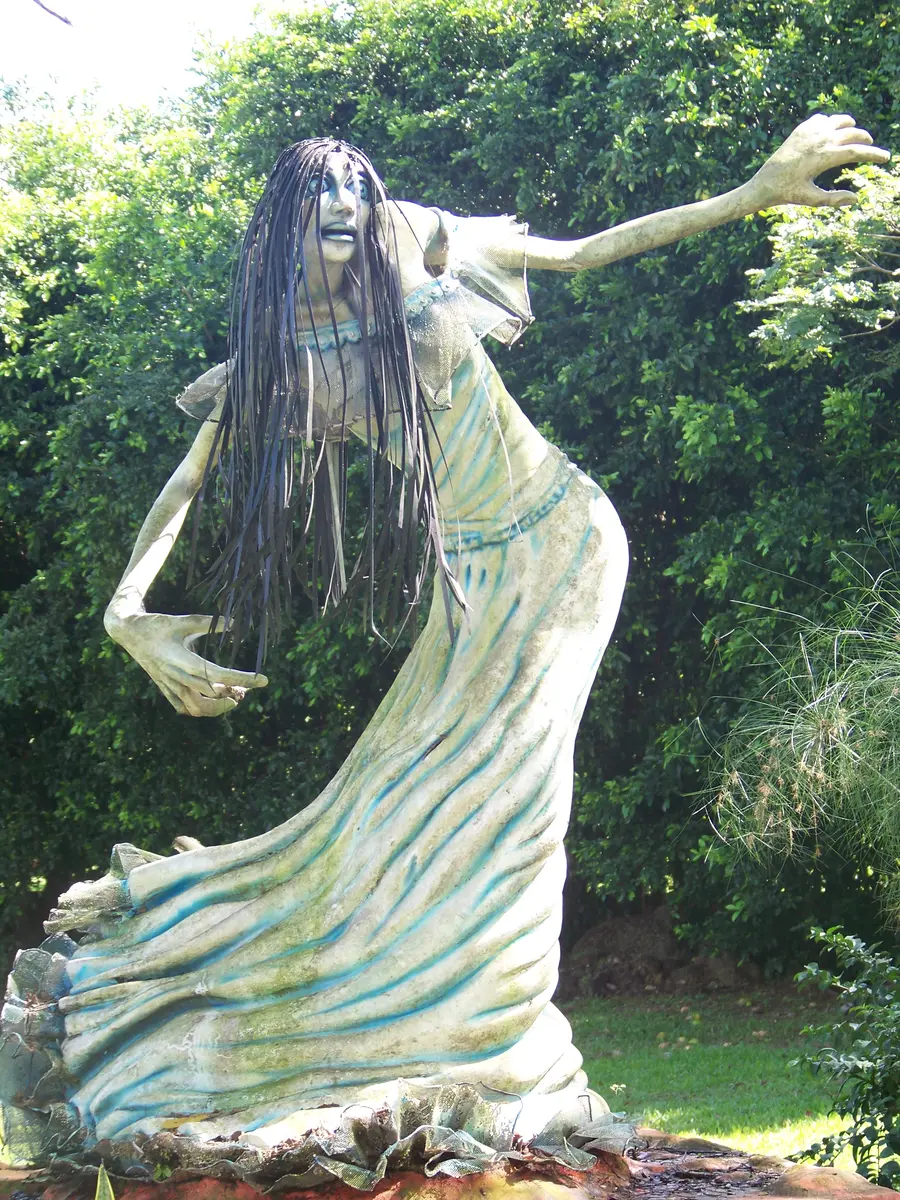
The photograph on this page shows a modern open-air statue of the Sayona. Its Wikimedia Commons record, uploaded by the user Neotours on 5 July 2019 under a CC BY-SA 4.0 licence, has the Spanish description "Estatua de la Sayona en los llanos venezolanos" ("Statue of la Sayona in the Venezuelan plains") and a date field of 1 January 2007; it names no town and carries no coordinates.
Sources consulted
- Rómulo Gallegos, «Pegujal» — Actualidades (Caracas), 1919 newspaper archive
- Lisandro Alvarado, «Glosarios del bajo español en Venezuela, segunda parte: neologismos y arcaísmos (Obras completas, vol. III)» — Ministerio de Educación, Caracas, 1955 book
- Instituto del Patrimonio Cultural, «Catálogo del Patrimonio Cultural Venezolano 2004-2007: municipios Páez y Rómulo Gallegos, estado Apure» — Ministerio del Poder Popular para la Cultura, Caracas, 2007 report
- Instituto del Patrimonio Cultural, «Catálogo del Patrimonio Cultural Venezolano: municipio San Fernando, estado Apure» — Ministerio del Poder Popular para la Cultura, Caracas, 2005 report
- Instituto del Patrimonio Cultural, «Catálogo del Patrimonio Cultural Venezolano 2004-2008: municipios Achaguas y Muñoz, estado Apure» — Ministerio del Poder Popular para la Cultura, Caracas, 2008 report
- Instituto del Patrimonio Cultural, «Catálogo del Patrimonio Cultural Venezolano 2004-2007: municipios Biruaca y Pedro Camejo, estado Apure» — Ministerio del Poder Popular para la Cultura, Caracas, 2007 report
- Carmen Pérez Montero, «Mitos y leyendas del estado Portuguesa» — Fundación Empresas Polar, Caracas, 2014 book
- Jenny González Muñoz, «Los espantos de la sabana: leyendas y religiosidad de los Llanos venezolanos» — Horizonte, vol. 11, n.º 30, pp. 572-592, 2013 academic
- Erics Blanco, «Vocabulario coloquial del llanero. De uso en faenas, cantos y diversiones» — Fundación Editorial El perro y la rana, Caracas, 2024 book
- Wikipedia en español, «La Sayona (primera versión del artículo, 13 de noviembre de 2008)» — Wikimedia Foundation, 2008 web
- Ministerio de Asuntos Exteriores, Unión Europea y Cooperación, «Recomendaciones de viaje: Venezuela» — Gobierno de España, 2026 web
- Instituto del Patrimonio Cultural, «Catálogo del Patrimonio Cultural Venezolano 2004-2006: municipio Barinas, estado Barinas» — Ministerio del Poder Popular para la Cultura, Caracas, 2006 report
- Instituto del Patrimonio Cultural, «Catálogo del Patrimonio Cultural Venezolano 2004-2010: municipios Cruz Paredes y Arismendi, estado Barinas» — Ministerio del Poder Popular para la Cultura, Caracas, 2010 report
- Instituto del Patrimonio Cultural, «Catálogo del Patrimonio Cultural Venezolano 2004-2007: municipio Obispos, estado Barinas» — Ministerio del Poder Popular para la Cultura, Caracas, 2007 report
- Instituto del Patrimonio Cultural, «Catálogo del Patrimonio Cultural Venezolano 2004-2006: municipio Pedraza, estado Barinas» — Ministerio del Poder Popular para la Cultura, Caracas, 2006 report
- Instituto del Patrimonio Cultural, «Catálogo del Patrimonio Cultural Venezolano 2004-2010: municipios Rojas y Sosa, estado Barinas» — Ministerio del Poder Popular para la Cultura, Caracas, 2010 report
Reviewed by V. Serrano on 2026-08-16 · How we verify our content
📎 Source: Enigma Atlas
💬 Field testimonies (0)
No testimonies yet. Add the first.
Add your testimony
🔒 Log in to add a testimony