📜 LEGEND · EXP. Nº3657
ACTIVE
The Näcken, Fiddler of the River
The Näcken is famous as a naked fiddler in a Swedish waterfall, and that is the newest thing about him.
Where does the legend of The Näcken, Fiddler of the River come from?
- Location
- Lago Siljan, Dalarna, Sweden
- Kind of legend
- Creature legend
- Coordinates
- 60.85, 14.75
- Last updated
LOCATION
What is the legend of The Näcken, Fiddler of the River?
The oldest complete Swedish sentence the Swedish Academy Dictionary can quote, from Olaus Petri's chronicle of about 1540, contains no music at all: the Necken is in the water, and he 'takes away those who drown'. A document of 1596 gives his name to a sickness, one of 1637 to a drowning. Music reaches print only in the 1810s, and at first with a harp; the fiddle belongs to Romantic poets, and above all to Ernst Josephson's paintings of 1882-84 and Bror Hjorth's fountain of 1967. The bargain everybody tells is real and catalogued — Christiansen's migratory legend ML 4090, af Klintberg's Swedish types F111 to F130 — and its terms are precise: three Thursday nights by running water, and a payment of a black cat, three drops of blood or a good leg of lamb. If the bone has already been gnawed, the pupil learns only how to tune his fiddle and never how to play it.
What is the history of The Näcken, Fiddler of the River?
Sweden's water being was a drowner for three centuries before anyone wrote down that he played.
The word is medieval: the Swedish Academy Dictionary's entry NÄCK, published in 1948, gives Old Swedish 'neker, näkker' from the manuscript Codex Upsaliensis C 20, and cognates from Old Norse 'nykr' to Old English 'nicor'. But the oldest complete Swedish sentence the dictionary can quote about him is from about 1540, in Olaus Petri's 'En swensk cröneka', a chronicle the reformer left unpublished. It sits inside an argument that Sweden's old gods were misremembered Romans: «Neptunus haffuer här ock warit nampnkunnog, Och ther aff weet man än nw tala om Necken som seyes wara i watnet, och at Necken tagher them bort som drunkna» — Neptune was famous here too, and from that people still speak of the Necken, who is said to be in the water, and that the Necken takes away those who drown. No fiddle, no bargain, no tune: a body in the water and a name for what took it.
The attestations that follow are legal and medical. The dictionary dates 'näckbett', the näck-bite — a pain or sickness that came on suddenly and, folk belief held, never healed properly — to a document of 1596, and quotes a record drawn from a 1637 document about men who swam after a servant «som tå bleff af näcken grijpen», who was then seized by the näck. The name 'strömkarl', the man of the current, is first recorded in this sense by Samuel Columbus around 1678.
Music reaches print late, and with the wrong instrument. The compound 'strömkarlsslag' — the strömkarl's stroke on his harp — appears in the journal Phosphoros in 1811, and 'strömkarlsharpa' in the Poetisk kalender for 1818. In 1812 Arvid August Afzelius printed in Iduna the poem beginning «Djupt i hafvet på Demantehällen / Necken hvilar i grönan sal», later sung as 'Näckens polska'. Around 1815 Erik Johan Stagnelius wrote of «den bladbekrönta Necken / Gigan rör i silfverbäcken» — the leaf-crowned Näck moving his fiddle in the silver brook. And in 1843 the botanist Elias Fries recorded it as a living belief rather than a poem: the Näck has his dwelling among the water lilies and, rising onto their leaves on a moonlit night, still charms whoever listens with his string-playing.
The folklorists then catalogued the bargain as a numbered type. Reidar Th. Christiansen listed it in 1958 as migratory legend ML 4090, 'Watersprite Teaches Someone to Play'; Bengt af Klintberg gave the Swedish material the numbers F111 to F130, 'Water Spirit (Näck, Strömkarl) as Master Musician'. Terry Gunnell, summarising both catalogues in 2026, sets out the conditions: the place must be right — a north-flowing river, or a fall where four streams meet like a cross — and the time is usually three Thursday nights running, or else Christmas, Midsummer or New Year. The payment is specific and it is not money: a black animal, often a cat (F111); three drops of blood (F112); a good leg of lamb (F113); in one type the fiddler's own uppermost limb (F117). If the lamb bone is too small or has already been gnawed, the pupil learns only to tune his instrument and never to play it. In F118 pupil and teacher tie their belts together and the teacher means to drag the pupil into the rapids at the end of the lesson; the pupil survives by cutting his own belt.
Sweden's state folklore institute, Isof, publishes the same core from its archives, with record numbers and interviews ranging from 1860 to 1974: three Thursday nights, a sacrifice on the third, a black cat or three drops of blood. It also gives the regional names — älven and bäckahästen in Skåne, strömkarlen from Småland up to Värmland, forskarl and kvarngubbe further north — and the two things everyone remembered about the tune: it forced listeners to dance until sunrise, and it could pull a whole household, furniture included, towards the water. The tune itself had several names in the tradition, among them älvaspelet, älvaleken, strömkarlns polska, näckens polska and fans polska, the Devil's polska.
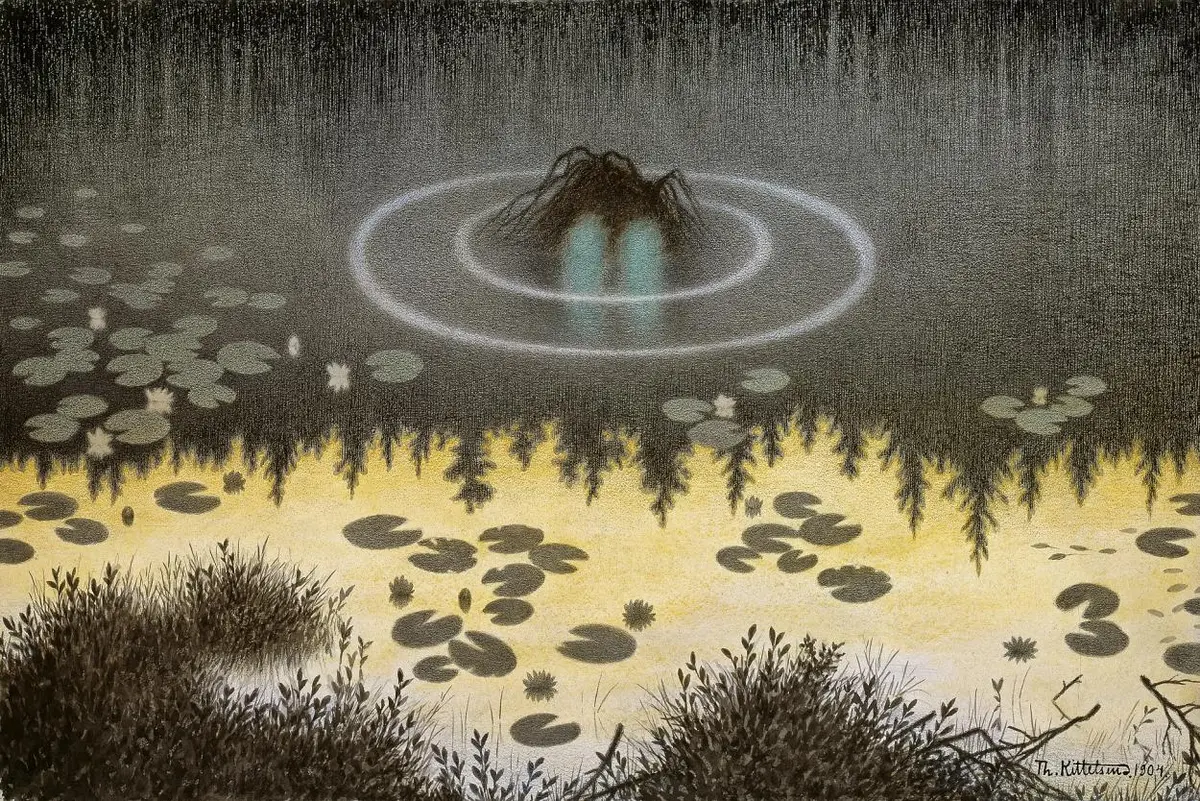
The fiddler that the world now pictures is younger than any of this and was largely made by painters. Ernst Josephson worked on the subject for a decade and painted the version now in the Nationalmuseum in Stockholm (NM 1905) in 1882–83; the museum notes that his landscapes came from the Norwegian mountains. A further version is in Göteborgs konstmuseum, and the 1884 'Strömkarlen', painted from a live model placed in a waterfall in Norway, is at Prins Eugens Waldemarsudde. Uppsala commissioned Bror Hjorth in 1951 for a fountain called 'Näckens polska'; the six-metre bronze went up in front of the railway station in 1967, and enough residents objected to the figure's nakedness beforehand to fill a postbag. And the picture at the head of this file is not Swedish at all: it is Theodor Kittelsen's 'Nøkken' of 1904, in the Nasjonalmuseet in Oslo.
Timeline: the documented record of The Näcken, Fiddler of the River
- c. 1540 Olaus Petri writes 'En swensk cröneka' and, arguing that Sweden's old gods were misremembered Romans, produces the oldest complete Swedish sentence about the being that SAOB can quote: the Necken is in the water and 'takes away those who drown'. There is no music in it.
- 1596 First dated attestation of 'näckbett', the näck-bite, in a Swedish legal document, according to the Swedish Academy Dictionary's entry NÄCK. The being's earliest documentary traces are about injury and drowning, not about tunes.
- 1637 A document of this year, quoted in SAOB, records men swimming after a servant 'som tå bleff af näcken grijpen' — who was then seized by the näck. The name is being used in a record of an actual death.
- c. 1678 Samuel Columbus, in 'En swensk ordeskötsel', gives the first recorded use of 'strömkarl' — the man of the current — as a name for the näck, according to SAOB's entry for the compound.
- 1811 The journal Phosphoros prints 'strömkarlsslag', the strömkarl's stroke on his harp; the Poetisk kalender follows with 'strömkarlsharpa' in 1818. In print, the water spirit's instrument at this date is still a harp, not a fiddle.
- 1812 Arvid August Afzelius publishes in the journal Iduna the poem beginning 'Djupt i hafvet på Demantehällen / Necken hvilar i grönan sal'. Sung to a folk melody, it became the song known as 'Näckens polska'.
- c. 1815 Erik Johan Stagnelius writes of 'den bladbekrönta Necken / Gigan rör i silfverbäcken' — the leaf-crowned Näck moving his fiddle in the silver brook. One of the earliest printed images of this being with a fiddle is a Romantic poet's.
- 1820s The phrase 'Neckens/Näckens polska' makes its first appearance in the digitised Swedish press. Counted across the 340 sub-corpora of Kubhist 2, the phrase returns 1,467 hits and none before this decade, against 16,343 hits for the being's name alone, present from the 1680s.
- 1843 The botanist Elias Fries writes in 'Botaniska utflygter' that the Näck is believed to dwell among the water lilies and, climbing onto their leaves on a moonlit night, still charms the listener with his string-playing. Isof's archive material likewise records that water-lily beds were held to be his and were avoided.
- 1882–1884 Ernst Josephson paints the 'Näcken' now in the Nationalmuseum in Stockholm (NM 1905, oil on canvas, 144 × 114 cm), followed by the Gothenburg version and by 'Strömkarlen' in 1884. These are the pictures that fixed the Swedish water spirit as a naked young man with a fiddle.
- 1904 Theodor Kittelsen signs 'Nøkken', the drawing at the head of this file: two luminous eyes among the water lilies of a Norwegian tarn, and no instrument anywhere in the picture. Olaf Schou gives it to the Nasjonalmuseet in Oslo in 1909.
- 1958 Reidar Th. Christiansen catalogues the story as migratory legend ML 4090, 'Watersprite Teaches Someone to Play', in FF Communications 175: a water spirit teaches the violin in exchange for an offering, and a pupil who tries to cheat learns only to tune the instrument.
- 2010 Bengt af Klintberg publishes 'The Types of the Swedish Folk Legend' (FF Communications 300), numbering the Swedish material F111–F130 and separating the payments: a black animal (F111), three drops of blood (F112), a leg of lamb (F113), the fiddler's uppermost limb (F117), and the tied belts of F118. No version pays in money.
Is there a rational explanation for The Näcken, Fiddler of the River?
The first explanation offered inside the tradition itself is acoustic, and it comes from people who play. Arne Bjørndal and Brynjulf Alver, in their standard work on Norwegian fiddling, observe that it is natural to hear music in a waterfall or in a millstone; the legend's favourite settings — the fall, the mill-race, the mill at night — are exactly the places where moving water produces broadband noise that the ear resolves into tones. Terry Gunnell quotes a Shetland witness, Tommy Goudie, on a burn said to sound of fiddles: «mainly it was the water running over the stones and making a nice tinkling sound». Goudie went on to the second half of the explanation: his mother and her companions, walking home from a wedding, «of course the music was still in their ears, as you might say, the fiddle music, and they sat down there and they thought they could hear the fiddles playing». Expectation, fatigue and running water are sufficient.
The second explanation is professional, and folklorists have been blunt about it. Åsa Nyman, in her commentary to the Atlas of Swedish Folk Culture, notes how often a district's most celebrated fiddler was said to have learned from the being or to have had his fiddle tuned by it — and adds that many players worked on that reputation themselves, making use of the folk belief. The legend is, among other things, a professional credential; the tale of the black cat and the three Thursday nights is told about the best player in the parish, which is the sort of story a best player has an interest in.
The third is that the belief did a practical job. Isof records that the Näck and his relatives were used by parents to keep children away from wells, jetties, bridges and mill-races. A being who «takes away those who drown» is the exact shape of a drowning warning, and that is what the oldest datable Swedish sentence about him says he does.
Dating helps as well, and it can be measured. Searching Kubhist 2, the digitised Swedish newspaper corpus at Språkbanken in Gothenburg (333 sub-corpora on 8 October 2026, 1640s to the 1920s), the being's name is present from the seventeenth century: 14,422 hits for the old spelling 'Necken' from the 1690s onward and 1,874 for the modern 'näcken' from the 1680s. The phrase 'Neckens/Näckens polska' returns 1,461 hits, the earliest of them in the 1820s, a decade after Afzelius printed his poem in 1812. The control makes the zero mean something: the same corpus, the same query shape and the same decades hold the word in the thousands.
Finally, the Devil. Where Swedish and Finnish versions replace the water spirit with the Devil, Nyman regards the substitution as a late development, produced by a church that preferred to file every supernatural being as a fallen angel. The related migratory legend ML 5050 has the waterfall spirit, seen as a fallen angel, weeping because he has no prospect of salvation.
Where he played is a separate question. Isof's page on the Näck names no place in Dalarna: its regional names run from Skåne through Småland, Västergötland, Värmland and Uppland to "further north". The distribution map is Åsa Nyman's plate XII in the Atlas of Swedish Folk Culture, 'Waterspirits in the Shape of Men: Teachers of Fiddlers', cited here through Gunnell. In the newspaper corpus, 31 of the 1,461 printed occurrences of the phrase (2.1 per cent) are in Dalpilen and Falu-Posten, two Dalarna papers; Fahlu Weckoblad, the third Dalarna title in the corpus, has none. Those are counts of print, and they say nothing about where people believed in him.
Can you visit The Näcken, Fiddler of the River?
A word about the pin first. This legend is not a place: the fiddling water spirit is recorded across Sweden, Norway and western Finland under a dozen local names, and the marker on Lake Siljan in Dalarna is an editorial convention, chosen because Dalarna is the province most identified with Swedish fiddle music. It is not an anchor found in a source, and nothing in the file below should be read as saying the legend belongs there rather than anywhere else.
What is genuinely on Lake Siljan is the living end of the tradition. Folkmusikens hus, Dalarna's folk music centre, has occupied the old parish school at Dalagatan 7, 795 31 Rättvik since 2000; it runs exhibitions, concerts and dances, and its archive makes more than 80,000 tunes, songs, interviews and dance recordings from Dalarna, Hälsingland, Gästrikland and Uppland available digitally, which is the practical way to hear what a polska actually sounds like. Twenty-five kilometres inland, at Bingsjö in the same municipality, the Bingsjöstämman fiddlers' gathering fills a hamlet for two days at the turn of June and July — in 2026 on 30 June and 1 July, opened at three in the afternoon on the dance floor, which is turned into a stage for up to eighty players.
The single most visitable object connected to this legend is not in Dalarna. Bror Hjorth's bronze fountain 'Näckens polska', six metres high, stands in the open in front of Uppsala's central station: no ticket, no opening hours. Hjorth's studio and home, Bror Hjorths Hus at Norbyvägen 26 in Uppsala, keeps the sketches and the working models for it.
The paintings that shaped the modern image are in four museums. Ernst Josephson's 'Näcken' of 1882–83, oil on canvas, 144 × 114 cm, is Nationalmuseum inv. NM 1905 in Stockholm, bought in 1915 with help from the museum's friends' association; the 1884 'Strömkarlen' is at Prins Eugens Waldemarsudde, also in Stockholm; a further version is at Göteborgs konstmuseum, left to the city by Pontus and Göthilda Fürstenberg in 1902. The drawing at the head of this page — Theodor Kittelsen's 'Nøkken', 1904, pen, brush, watercolour, pencil and crayon on paper, 47.5 × 69.4 cm — is Nasjonalmuseet inv. NG.M.00863 in Oslo, a gift from Olaf Schou in 1909. Paintings and drawings on paper rotate off display; check the collection database or ask before travelling for one of them.
Opening hours and prices change; none are quoted here on purpose. One practical warning does belong in a file about this being: Swedish inland water is cold all summer, currents below mill dams and rapids are stronger than they look, and the reason parents told children about the Näck at all was that people drown at exactly those places.
Sources consulted
- Olaus Petri, «En swensk cröneka» — Samlade skrifter av Olavus Petri (Project Runeberg full text), 1540 book
- Svenska Akademien, «NÄCK (entry in the historical dictionary of the Swedish language)» — Svenska Akademiens ordbok (SAOB), volume published 1948, 1948 book
- Svenska Akademien, «STRÖM-KARL and compounds (entry in the historical dictionary of the Swedish language)» — Svenska Akademiens ordbok (SAOB), volume published 1993, 1993 book
- Institutet för språk och folkminnen (Isof), «Näcken (Väsengalleriet: folk belief archive material with record numbers IFGH and DAGF, interviews 1860–1974)» — Isof, Swedish state institute for language and folklore, 2024 report
- Terry Gunnell, «The Fiddler and the Waterfall: The Quest for Inspiration in Norwegian Legends of Fiddlers» — Scottish Studies 42/2, pp. 151–160, 2026 academic
- Tiber F. M. Falzett, «Music from the Source: ML 4090 and its Gaelic cognates» — Scottish Studies 42/2, pp. 99–133, 2026 academic
- Språkbanken Text, University of Gothenburg, «Kubhist 2, corpus of digitised Swedish newspapers (340 sub-corpora in August 2026, 333 on 8 October 2026; 1640s–1920s); word counts run August and October 2026» — Korp corpus infrastructure, 2026 archive
- Nasjonalmuseet for kunst, arkitektur og design, Oslo, «Nøkken (The Water Sprite), Theodor Kittelsen, 1904 — catalogue record NG.M.00863» — Nasjonalmuseet collection database, 1904 archive
- Nationalmuseum, Stockholm, «Näcken, Ernst Josephson, 1882–83 — catalogue record NM 1905» — Nationalmuseum collection database, 1883 archive
- Bror Hjorths Hus, Uppsala, «Näckens polska, 1967» — Bror Hjorths Hus, work texts, 1967 report
- Folkmusikens hus, «Folkmusikens hus — Dalarnas folkmusikcentrum (address, archive of 80,000+ recordings)» — Folkmusikens hus, Rättvik, 2026 web
- Bingsjöstämman, «Bingsjöstämman (dates and programme)» — Bingsjöstämman official site / Rättviks kommun, 2026 web
Reviewed by V. Serrano on 2026-08-16 · How we verify our content
📎 Source: Enigma Atlas
💬 Field testimonies (0)
No testimonies yet. Add the first.
Add your testimony
🔒 Log in to add a testimony