📜 LEGEND · EXP. Nº0270
ACTIVE
The Wawel Dragon
Beneath Wawel hill in Kraków opens a limestone cave above the Vistula where tradition places the Smok Wawelski, the dragon that laid the region waste.
Where does the legend of The Wawel Dragon come from?
- Location
- Krakow, Wawel Hill, Poland
- Kind of legend
- Creature legend
- Coordinates
- 50.054, 19.935
- Last updated
LOCATION
What is the legend of The Wawel Dragon?
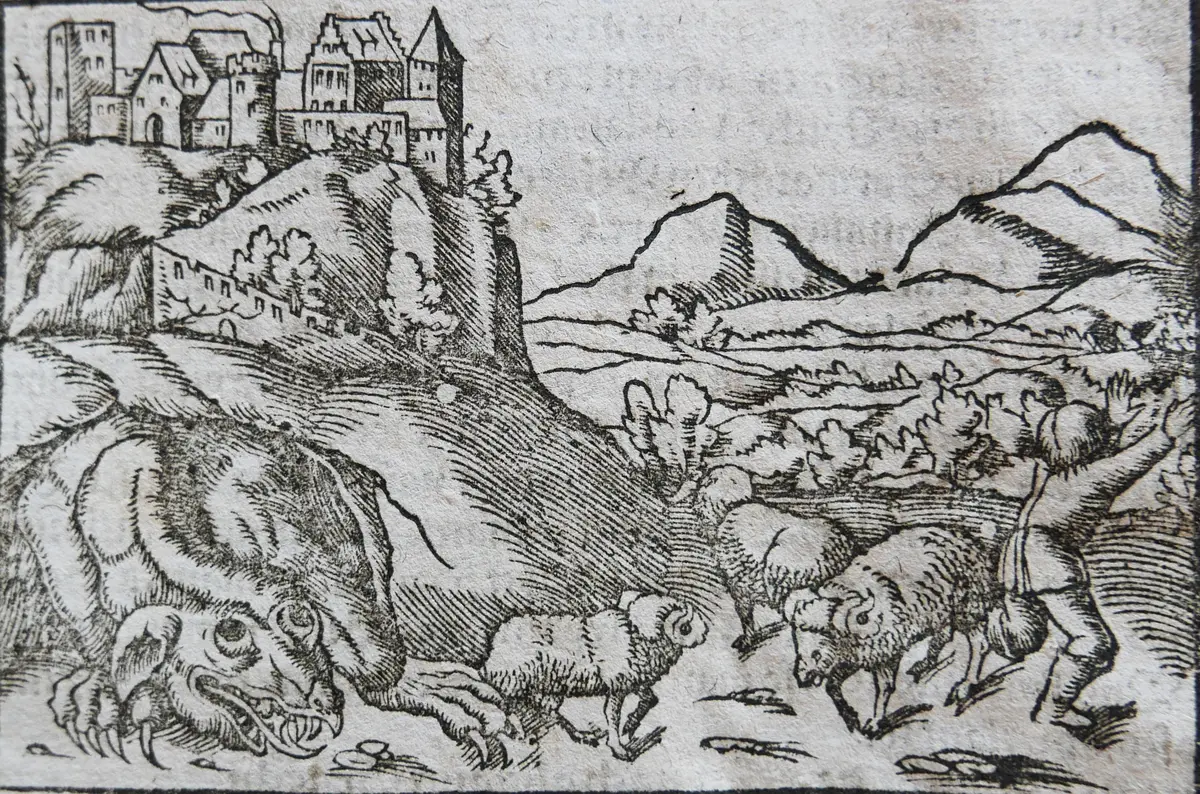
The version everyone knows — the cobbler's apprentice Skuba, the princess's hand, the dragon drinking until it bursts — is modern, and appears in none of the three texts that found the legend. Around 1200, in Wincenty Kadłubek's chronicle, the creature is not even a dragon: it is an olophagus, "the one that swallows whole", killed by the sons of King Grakch, and it dies suffocated by flames. In the fifteenth century Jan Długosz supplies the geography — the cave beneath the Wawel stronghold — and has the king himself kill it, "by his own art and ingenuity". Skuba does not appear until 1597, in Joachim Bielski's chronicle, and then as an adviser: the calfskin stuffed with sulphur is laid out "on the advice of one Skuba the Cobbler", whom the king rewards with money. Hanging at the cathedral door since at least 1583 are bones long called a dragon's; palaeontologists identified them as mammoth, whale and woolly rhinoceros. The cave can be visited under the castle, complete with a sculpture that really does breathe fire.
What is the history of The Wawel Dragon?
The Wawel dragon has something almost no story of its kind can offer: a birth certificate. Three of them, in fact. And in each one a different person kills the monster.
Around 1200: the "whole-swallower"
The first text is the Chronica Polonorum of Wincenty Kadłubek, bishop of Kraków, written at the turn of the thirteenth century. It is a Latin treatise cast as a dialogue between two churchmen, not a folk tale, and its monster is not even called a dragon. Kadłubek writes that in the windings of a certain crag there lived a monster of the most enormous ferocity quod quidam olophagum dici putant: "which some hold is called olophagus". The word is a piece of scholarly manufacture from the Greek, and it means literally the one that swallows whole.
The monster levies a tribute. Every seven days a fixed number of cattle is owed to it, and if the inhabitants fail to hand them over as victims, it takes the same number of human heads instead. Prince Grakch — Graccus, Krak — will not endure the ruin, summons his sons in secret and lays out the plan. What follows is the trick everybody knows, but in its original form: cattle hides packed with kindled sulphur, set down in the usual place instead of the livestock. The olophagus gulps them down greedily and dies suffocated by the flames breathing out inside it.
And then comes the part the guidebooks skip. The moment the victory is won, the younger son falls upon his elder brother and butchers him — not as a partner but as a rival, both in the victory and in the kingdom — attends his funeral crocodillinis lacrimis, with crocodile tears, and lies that the monster killed him. His father receives him gladly as the victor and makes him his heir. But, Kadłubek writes, he was filthy with fratricide for longer than he was distinguished in command: the deceit is uncovered and he is condemned to perpetual exile.
The city comes last: in scopulo olophagi fundata est urbs insignis a nomine gracci dicta Cracovia — on the whole-swallower's crag was founded the famous city called Cracovia after Graccus's name. And Kadłubek leaves a second, far grimmer etymology open: some called it so a crocitacione corvorum, from the croaking of the crows that flocked to the monster's carcass.
It is worth noting what is not in the oldest text: no Wawel Hill, no cave beneath a castle, no cobbler, no princess as a prize, no dead knights, and no dragon that bursts.
Fifteenth century: Długosz nails the legend to the ground
The second text is the history of Poland by Jan Długosz, canon of Kraków and tutor to the king's sons, who died in 1480. Długosz rewrites the episode and does two decisive things to it.
The first is geographical. In his first book, Prince Grachus raises the royal stronghold on the high hill which the inhabitants called Wawel, washed by the waters of the Vistula; and the beast — "of unusual size and having the appearance of a dragon or olophagus" — makes its lair in a cave of Mount Wawel, directly below. The printed marginal gloss puts it without ornament: draco ingens latitans sub arce, a huge dragon lurking beneath the citadel. By decree of the prince, three head of cattle are thrown to it daily.
The second concerns authorship. In Długosz there are no sons: Grachus himself orders the cattle carcasses stuffed with sulphur, wax and pitch, set alight inside and put out for the beast, which swallows them with its accustomed greed and collapses, burnt out from within. For this, the chronicler writes, Grachus was called parens et liberator patriae, parent and liberator of his country, for having destroyed the beast sua arte et ingenio, by his own skill and ingenuity. The hero is no longer the sons: it is the king.
1597: the cobbler arrives, and he is a consultant
The third text is the Kronika polska of Marcin Bielski, in the revised version published by his son Joachim Bielski at the end of the sixteenth century. It is the first time the story is told in Polish rather than Latin, and the Wawel Royal Castle places Skuba's entrance precisely here.
Bielski relates that Krok founded the castle on the rocky hill called Wawel and moved the royal seat there from Gniezno; and he adds: "our old chroniclers write that beneath this Wawel hill there was a great Dragon, which ate three head of cattle at once and also stole and ate people; and so they had to give it a ration, three calves or rams every day". Krok then orders a calf's skin stuffed with sulphur to be laid before the cave in the morning, za radą Skuba Szewca niejakiego: on the advice of a certain Skuba the Cobbler, "whom he afterwards rewarded well and provided for". The dragon comes out, believes it is swallowing a whole calf, and because the thing smoulders inside it so long, it drinks water until it dies. Then the line that fixed Kraków's tourism for good: "his cave is still there beneath the castle, they call it Smocza Jama", the Dragon's Den.
Read that slowly, because almost nobody does. In the very text that invents Skuba, Skuba gives advice. The one who orders it carried out is the king. And his reward is money and keep: no princess, no kingdom, no wedding. The cobbler's apprentice who kills the dragon with his own hands and marries the king's daughter is much later material: by the nineteenth century, according to the study Michał Kuziak and Magdalena Młodawska wrote for the Wawel Royal Castle, the cobbler appears as a rational hero who prevails alongside Krakus.
Three texts, three killers: the king's sons, the king, and — very late, and only as an adviser — the cobbler.
Timeline: the documented record of The Wawel Dragon
- c. 1200 Wincenty Kadłubek, bishop of Kraków, writes the Chronica Polonorum, the oldest known version: the monster is an olophagus, "the one that swallows whole", taking a weekly tribute of cattle or of human heads; it is killed by the SONS of Prince Grakch with hides packed with kindled sulphur. The younger son then butchers the elder, mourns him with "crocodile tears" (crocodillinis lacrimis), lies that the monster did it, inherits the kingdom and ends in perpetual exile. Kraków is founded on the monster's crag. There is no Wawel Hill, no cave and no cobbler.
- 15th century Jan Długosz, canon of Kraków (d. 1480), reworks the story in his history of Poland: he places the beast's lair in a cave of Mount Wawel beneath the royal stronghold, and has KING GRACHUS HIMSELF order the carcasses stuffed with sulphur, wax and pitch. For killing it "by his own skill and ingenuity" he is called parens et liberator patriae.
- 1583 First known written mention of the cathedral's "dragon bones": the Polish scholar Marcin Fox describes them by letter to the Bolognese naturalist Ulisse Aldrovandi — a rib some eight Roman feet long and another bone like a shin — and speculates that they belong to monsters. Aldrovandi went as far as asking the papal nuncio for a likeness of Kraków's reptile.
- 1597 Joachim Bielski publishes his father Marcin's revised Kronika polska and introduces Skuba the cobbler. In the text, Skuba only GIVES THE ADVICE: it is King Krok who orders the sulphur-stuffed calf's skin left at the cave, and Skuba "he afterwards rewarded well and provided for". There is no princess and no kingdom. Bielski also records the name Smocza Jama, the Dragon's Den.
- 17th–18th centuries Part of the Dragon's Den is used for storage and as the banqueting room of a tavern set up beside the Vistula. The polymath Benedykt Chmielowski recorded that beer and wine were drunk there, chilled by the rock, and dated the dragon's death to the year 770.
- 1829–1846 The historian Ambroży Grabowski enters the cave through its natural mouth. In 1830 the great brick dome sealing that entrance is built, and through his efforts the Dragon's Den opens to visitors between 1843 and 1846.
- 1870s–1884 The Austrian anatomist Karl Langer examines the cathedral bones and writes in his 1884 anatomy volume that one can see there "the bones of a mammoth, the skull of a Rhinoceros tichorhinus, and half of a mandible of a whale". A Professor Suess had already described them as fossils in the 1860s.
- After 1918 After Poland regains independence, professor Adolf Szyszko-Bohusz prepares the Dragon's Den for visitors, in the form in which it is walked today.
- 1937 The Jagiellonian University professor Henryk Hoyer identifies the cathedral bones as the remains of a mammoth, a whale and a rhinoceros. It is the verdict still cited today, although sources disagree over which bone is which.
- 1972 Bronisław Chromy's six-metre bronze dragon, with seven necks and a gas installation that lets it breathe fire, is placed beside the cave exit on a limestone rock by the Vistula. The original design was a fountain for Wolnica Square.
- 2012 Grzegorz Niedźwiedzki, Tomasz Sulej and Jerzy Dzik describe in Acta Palaeontologica Polonica a 5–6 metre predatory archosaur of the latest Triassic (c. 205–200 million years ago) found at Lisowice, and name it Smok wawelski: smok is Polish for dragon, and the epithet refers explicitly to Wawel Hill and its legendary dragon.
Is there a rational explanation for The Wawel Dragon?
The trick is not Polish
The first thing that collapses under scrutiny is the originality of the stratagem. Feeding a monster a stuffed decoy so that it dies from the inside is a motif that had been travelling around the Mediterranean for a very long time before Kadłubek. In the deuterocanonical book of Bel and the Dragon (Daniel 14), the prophet kills the serpent worshipped in Babylon by feeding it cakes of pitch, fat and hair. And in the Syriac Alexander Romance, Alexander orders two huge oxen flayed and their hides filled with gypsum, pitch, lead and sulphur; the beast inhales them, its head drops to the ground and it dies. The parallel with Kadłubek's scene is so close that the writer Jason Colavito, who reproduces the passage in E. A. Wallis Budge's translation, admits he finds it hard to think them independent, and points to Daniel Ogden's study of the dragon in the Greek and Roman worlds for the kinship of the whole group.
In other words: when the bishop of Kraków wrote his city's foundation, he was not recording a local event. He was applying to Kraków an international literary template with a thousand years of mileage on it.
The bones at the cathedral
The legend's physical exhibit is the most interesting part, because it exists and you can look at it. Beside the western door of Wawel Cathedral, hanging from an iron chain, are three large bones — the biggest is over a metre long — which tradition assigns to the dragon. They have hung there since the Middle Ages and are easy to miss: you have to look up.
The earliest known written mention is not medieval but from 1583, and it comes through scientific correspondence: the Polish scholar Marcin Fox described the bones to the Bolognese naturalist Ulisse Aldrovandi — a rib some eight Roman feet long, and another bone like a shin — and in later letters speculated that they belonged to "monsters". According to the account published by TVN24, Aldrovandi went so far as to ask the papal nuncio to send him a likeness of Kraków's famous reptile. There is no record that he got one.
The real identification arrived in instalments across seventy years. In the 1870s the Austrian anatomist Karl Langer saw the bones and wrote in his 1884 anatomy volume that at the door of the Castle Church in Kraków one could still see "the bones of a mammoth, the skull of a Rhinoceros tichorhinus, and half of a mandible of a whale". And in 1937 the Jagiellonian University professor Henryk Hoyer closed the matter with the verdict still cited today: mammoth, whale and rhinoceros.
Honesty requires saying that the sources do not agree on the details. The version circulating in Kraków today describes a fragment of a mammoth's leg, part of a whale's jaw and the skull of a woolly rhinoceros; other modern readings speak of a mammoth tibia, a whale rib and a rhinoceros skull, and some hold that the rhinoceros piece is actually a kneecap. What no source disputes is the essential point: these are bones of Pleistocene mammals, plus a cetacean bone that is the only one genuinely hard to explain in a city six hundred kilometres from the sea.
How did they get there? Nobody knows. The historian Michał Rożek proposed that they were fished out of the Vistula in the Middle Ages, and hanging them in the city's holiest place followed a common custom: monstrous finds were brought to the temple to protect the precinct from evil forces. Hence the superstition still repeated: if the chain breaks and the bones fall, the cathedral will collapse, or Kraków will end, or the world will. Since the whole hill is under conservation protection, the chain is not going to rust through.
And here is the turn that actually matters, the same one visible at Klagenfurt, where a rhinoceros skull unearthed in 1335 became the head of the local dragon: the bones do not illustrate the legend, the legend explains the bones. Something enormous and inexplicable turned up first, and only then did people look for an animal that could have left it.
The cave is no help either
The Smocza Jama is a karst cavity in Jurassic limestone which, according to the Wawel Royal Castle itself, began to form some twelve million years ago. No reptile was involved. And its documented historical use deflates whatever mystery is left: in the seventeenth and eighteenth centuries part of the cave served as storage and as the banqueting room of a tavern set up beside the Vistula. The eighteenth-century polymath Benedykt Chmielowski recorded that beer and wine were drunk in the Dragon's Den, nicely chilled by the rock; and he dated the dragon's death, with wonderfully invented precision, to the year 770.
And yet a Smok wawelski does exist
The ending is the best part. In 2012 the palaeontologists Grzegorz Niedźwiedzki, Tomasz Sulej and Jerzy Dzik published in Acta Palaeontologica Polonica the description of a large predatory archosaur from the latest Triassic, found in the Lisowice clay-pit in Upper Silesia: an animal five to six metres long with a skull of 50 to 60 centimetres, from roughly 205–200 million years ago, larger than any other known predatory archosaur of the Late Triassic and Early Jurassic of central Europe. They named it Smok — Polish for dragon — with the specific epithet wawelski, justified in a note that is an explicit homage: in reference to Wawel Hill in Kraków, where the legendary dragon lived.
Kraków has its dragon after all. It lived two hundred million years before Krak, three hundred kilometres from the city, and it was described in a scientific journal.
Can you visit The Wawel Dragon?
The legend is spread over three places on and under the hill, and two of them cost nothing.
The bones. They hang at the western entrance of Wawel Cathedral, on a chain to the left of the door and well above head height. There are three, the largest over a metre long, and they are mammoth, whale and rhinoceros. They have hung there since the Middle Ages, and Marcin Fox was already writing to Ulisse Aldrovandi in Bologna about them in 1583. Entering the cathedral needs its own ticket; the bones are outside it.
The Dragon's Den (Smocza Jama). Run by the Wawel Royal Castle, open 24 April to 31 October. On 22 September 2026 the castle's site published hours of 09:00 to 17:00 for September and October, and no hours at all for the rest of the season. Admission is 15 PLN, reduced 10 PLN, free for children aged 0 to 6, sold at the ticket offices, the machine or online. The castle's two language versions contradict each other on the last entry: the Polish page says "10 min przed zamknięciem" and the English one says "20 min prior", both read on 22 September 2026.
The descent starts near the Thieves' Tower, by a stair housed in a brick turret that was once an Austrian well. The cave is 270 metres long, of which 81 metres form the tourist route, and the visit is one-way, ending on the Vistula Boulevards. The 135 steep spiral steps make it inaccessible to wheelchairs and pushchairs.
The second and largest chamber is capped by the brick dome of 1830, which seals the hole in the roof through which the historian Ambroży Grabowski dropped into the cave in 1829; it was his campaign that got the Den opened to visitors between 1843 and 1846. In the seventeenth and eighteenth centuries part of that chamber served as the store and banqueting room of a tavern that stood on the riverbank in front of the lower entrance, and the last chamber, roofed by rock on two brick pillars, was the tavern's parlour.
The bronze dragon. The one-way route ends in front of it. Bronisław Chromy's sculpture was placed in 1972 on a limestone rock beside the Vistula: six metres of bronze, two legs, wings and seven necks with hissing heads. A gas installation inside makes it breathe fire. Chromy's original design was a fountain for Wolnica Square in Kazimierz, and it was the city's president who decided the dragon belonged beside the Dragon's Den.
One ticket for the whole thing. The castle sells a route called "Looking for the Dragon" (W poszukiwaniu smoka) linking the Between the Walls exhibition, along the city walls, with the cave, and running from the skeleton of the Triassic archosaur its discoverers named Smok wawelski to an animated retelling of Kadłubek's account. It costs 35 PLN, reduced 26 PLN, includes the Royal Gardens between 24 April and 30 September and an audio guide, and runs Tuesday to Sunday. The castle is closed on 1 November and on 24, 25, 26 and 31 December.
Sources consulted
- Wincenty Kadłubek; ed. Alexander Przeździecki, «Magistri Vincentii episcopi Cracoviensis Chronica Polonorum, sive Originale regum et principum Poloniae — texto latino del episodio del olophagus y de la fundación de Cracovia» — Typis Ž. J. Wywiałkowski, Cracoviae (edición del códice Eugeniano de Viena), 1862 book
- Jan Długosz, «Ioannis Dlugossi seu Longini canonici quondam Cracoviensis Historiae Polonicae libri XII, tomo I — libro primero: la bestia en la gruta del monte Wawel y Grachus como matador» — Edición de Leipzig, 1711 book
- Marcin Bielski (ed. Joachim Bielski), «Kronika polska Marcina Bielskiego, tomo I — pasaje del Smok bajo Wawel y del consejo de "Skuba Szewc" (reimpresión decimonónica del texto publicado por su hijo Joachim Bielski)» — Reimpresión de 1829, 1829 book
- Zamek Królewski na Wawelu (Castillo Real de Wawel), «Dragon's Den — página oficial de la Smocza Jama: formación kárstica, dimensiones, historia de la apertura al público, horarios y precios, y la transmisión de la leyenda de Kadłubek a Długosz y a Joachim Bielski» — wawel.krakow.pl, 2026 report
- Zamek Królewski na Wawelu (Castillo Real de Wawel), «Looking for the Dragon — ruta que une la exposición Between the Walls con la Cueva del Dragón: contenidos, precios y accesibilidad» — wawel.krakow.pl, 2026 report
- Redacción TVN24 Kraków, «"Kości smoka" od stuleci wiszą na katedrze. I, według legendy, lepiej by nigdy nie spadły — la correspondencia de Marcin Fox con Aldrovandi (1583), la hipótesis de Michał Rożek y el dictamen de Henryk Hoyer en 1937» — TVN24, 2018 newspaper archive
- Jason Colavito, «The Fossil Dragon Bones of Poland's Wawel Cathedral — Karl Langer (1884), el informe de Suess en los años 1860, el paralelo del Klagenfurt de 1335 y el texto de la Novela de Alejandro siríaca en la traducción de Wallis Budge» — jasoncolavito.com, 2015 web
- Grzegorz Niedźwiedzki, Tomasz Sulej y Jerzy Dzik, «A large predatory archosaur from the Late Triassic of Poland — descripción de Smok wawelski y etimología del nombre» — Acta Palaeontologica Polonica 57 (2): 267-276, 2012 academic
- Michał Kuziak y Magdalena Młodawska, «The dragon. A necessary monster — Part I: el olophagus de Kadłubek, el emplazamiento del cubil y la lectura cristiana del dragón» — Wawel Royal Castle en Google Arts & Culture, 2021 web
- Michał Kuziak y Magdalena Młodawska, «The dragon. A necessary monster — Part II: Joachim Bielski y el zapatero (1597), Benedykt Chmielowski y la taberna de la cueva, y las relecturas del siglo XIX» — Wawel Royal Castle en Google Arts & Culture, 2021 web
- Ewa Burdek, «Pomnik Smoka Wawelskiego — el dragón de bronce de Bronisław Chromy: proyecto original para la plaza Wolnica, instalación en 1972 y descripción de la pieza» — Chromy 2.0, Małopolski Instytut Kultury, 2020 web
Reviewed by V. Serrano on 2026-07-31 · How we verify our content
📎 Source: Enigma Atlas
💬 Field testimonies (0)
No testimonies yet. Add the first.
Add your testimony
🔒 Log in to add a testimony