📜 LEGEND · EXP. Nº3657
ACTIVE
Pan Twardowski, the Polish Faust
Pan Twardowski, the Polish Faust is a legend from Skałki Twardowskiego (Rocas de Twardowski), Dębniki, Kraków, PL — a folk story passed down over generations. This file collects its origins, its meaning and how it has been retold.
Where does the legend of Pan Twardowski, the Polish Faust come from?
- Location
- Skałki Twardowskiego (Rocas de Twardowski), Dębniki, Kraków, PL
- Kind of legend
- Folk tale
- Coordinates
- 50.04, 19.907
- Testimonies
- 0
- Last updated
LOCATION
What is the legend of Pan Twardowski, the Polish Faust?
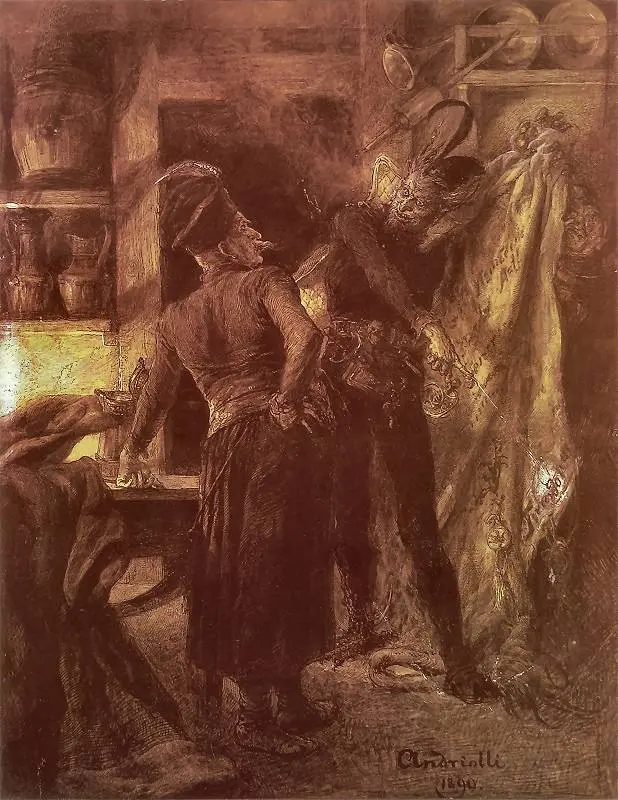
Pan Twardowski is Poland's Faust: a Kraków magician who signed a pact with the devil and slipped in one clause — the devil could only claim him in Rome. Devils cornered him in an inn called Rzym, which is the Polish for Rome, and as they carried him off he began a hymn to the Virgin he had written in his innocent youth. The flight stopped dead. What almost every retelling gets wrong is where the pieces came from. The oldest paper anyone invokes for him, a complaint heard by the councillors of Wyszogród in 1495, spells the name Fwardosky, puts him in Warsaw rather than Kraków, and mentions him only as somebody else's teacher. His first appearance in print, in Łukasz Górnicki's Dworzanin polski of 1566, is a joke at his expense: a swindler passes himself off as "Twardowski's pupil", rigs a miracle, and is exposed by the king. Adam Mickiewicz's celebrated ballad of 1822 has no moon, no spider and no rooster in it at all. The rooster is genuine — but in the oldest printed version he rides one, on long journeys, faster than a horse.
What is the history of Pan Twardowski, the Polish Faust?
Pan Twardowski's dossier is much thinner than his fame, and the honest way to tell it is in the order the papers appear.
1495, Wyszogród. The oldest document anyone invokes is not about him. The town councillors of Wyszogród, on the Vistula in Mazovia, heard a complaint against the master of their school: he had dabbled in magic at Twardowski's, in Warsaw, and was besides an apostate and a Hussite. Bronisława Nowicka printed the passage in her history of the town in 1971. Roman Bugaj went back to the record and reported that the name written there is not Twardowski but Fwardosky, and refused the identification. Zbigniew Kuchowicz and Jacek A. Ojrzyński replied in Przegląd Historyczny in 1978 that such a cluster of consonants cannot be pronounced in Polish, that scribal spellings of the period wander freely, and that on the likeliest reading "this is the only document that really testifies to Twardowski's historicity". Both sides agree on two things worth keeping: the paper places the magician in Warsaw, not Kraków, and it names him only as somebody else's teacher.
1565–1566, Tykocin and Kraków. Twardowski's first appearance in Polish print is a joke. In the second book of Łukasz Górnicki's Dworzanin polski — a Polish recasting of Castiglione's Cortegiano, its dedication dated at Tykocin on 18 July 1565 and the volume printed in Kraków by Maciej Wirzbięta in 1566 — two courtiers fall to talking about sorcery at a palace window. One of them sighs that he was born too late, when magic "was openly taught in the Kraków schools", and offers a hundred gold pieces and more to be taught it. The other swears him to secrecy and says: "and I, says he, am Twardowski's pupil". He then wins a thirty-ducat wager by making an old woman in the square below smash her own pots. The point of the tale is that the whole thing was rigged, and Górnicki dedicated the book to Sigismund Augustus himself — the very king at whose court the legend would later install its magician.
1551 or 1569, the queen's ghost. Queen Barbara Radziwiłł died on 8 May 1551. The famous séance in which Twardowski is said to have shown her shade to her widowed husband survives only in later accounts, and they do not agree. Joachim Possel, court physician to Sigismund III, put it in 1551 in the manuscript Historia Poloniae. Compendium historiae Posselianae, written about 1624 and kept in the Czartoryski Library (ms. 1322). An account attributed to the courtier Jan Gizy, on which Bugaj leaned heavily, puts it on the night of 7–8 January 1569 — eighteen years later. The Jesuit Stanisław Bielicki added a third version in his Niedziele kaznodziejskie (Częstochowa, 1712), and it is Bielicki who gives the address the legend has used ever since: Twardowski, he wrote, "had already founded an ungodly academy before Rękawka" — the mound on Lasota Hill, among the Krzemionki limestone ridges of Podgórze, on the right bank of the Vistula.
1706 to 1871, the one surviving object. In the sacristy of the parish church at Węgrów, in western Podlasie, hangs a metal mirror, framed with a Latin couplet cut probably around 1706 for the local Reformati: Luserat hoc speculo magicas Twardovius artes, lusus at iste Dei versus in obsequium est — "Twardowski played his magic arts with this mirror, but that play has been turned to the service of God". Teodor Narbutt gave the first scholarly notice of it in 1828, already reporting the plate cracked, and repeating that pupils used to hurl heavy things at it because faces pulled hideous grimaces in the glass. In 1871 Marcin Olszyński, art director of the Warsaw weekly Kłosy, cleaned and photographed it, and judged the metal to be mainly bismuth and antimony with a little copper, giving a faintly reddish image that goes blurred at eight or ten ells. Zygmunt Gloger reproduced that photograph in his Encyklopedia staropolska in 1903, with the mirror at 22 by 19 inches; Tadeusz Przypkowski measured it in 1958 at 560 × 465 mm, about 8 mm thick, 17.80 kg in all.
1818 to 1840, the writers take him. Tomasz Zan read a ballad called Twardowski at a name-day party for Adam Mickiewicz on 31 December 1818. Mickiewicz wrote Pani Twardowska in the first half of 1820 and printed it in Vilnius in 1822. Jan Nepomucen Kamiński staged Twardowski na Krzemionkach in Lwów in 1825; Kazimierz Władysław Wójcicki published the prose version in his Klechdy in 1837; Józef Ignacy Kraszewski's novel Mistrz Twardowski followed in 1840 and did more than anything else to fix the figure. Not one of them sends him to live on the Moon.
1986, the German. Roman Bugaj proposed that behind the legend stood Lorenz Dhur, born at Nuremberg about 1515, a physician trained at Wittenberg who served Duke Albrecht at Königsberg and was documented in Poland between 1565 and 1573 as Sigismund Augustus's astrologer, and who — knowing that the "ghost" of Barbara had been the king's mistress Barbara Giżanka in disguise — was murdered by the Mniszech faction at the inn called Rzym in the village of Mystki-Rzym in Podlasie. It is a superb story and the specialist literature does not accept it: Kuchowicz and Ojrzyński had already objected in 1978, and Ojrzyński returned to it in Przegląd Historyczny in 1987 under the title Master Twardowski. History and mystification.
Timeline: the documented record of Pan Twardowski, the Polish Faust
- 1495 The councillors of Wyszogród hear a complaint against their schoolmaster for practising magic "at Twardowski's, in Warsaw". It is the oldest document ever invoked for the magician's existence — and the name in it is written Fwardosky.
- 8 May 1551 Queen Barbara Radziwiłł dies. Possel's manuscript will date the séance in which Twardowski shows her ghost to this same year; the account attributed to Jan Gizy will date it to 1569.
- 18 July 1565 Łukasz Górnicki dates the dedication of Dworzanin polski at Tykocin, addressed to King Sigismund Augustus. Printed in Kraków in 1566, the book contains the first appearance of Twardowski's name in Polish literature — as the master invoked by a swindler.
- c. 1624 Joachim Possel, court physician to Sigismund III, writes the two Twardowski stories of his Compendium historiae Posselianae, seventy-three years after Barbara's death. Aleksander Brückner would later dismiss them as "a couple of the most commonplace fairy tales".
- c. 1706 The Reformati of Węgrów have the mirror in their church framed with the Latin couplet Luserat hoc speculo magicas Twardovius artes — the earliest dated inscription that names him.
- 1712 The Jesuit Stanisław Bielicki, in his sermon collection Niedziele kaznodziejskie, writes that Twardowski "had already founded an ungodly academy before Rękawka" — the first printed text to fasten the legend to the Krzemionki hills of Podgórze in Kraków.
- 31 December 1818 Tomasz Zan reads his ballad Twardowski at a name-day gathering for Adam Mickiewicz in Vilnius. It is the first Romantic treatment; it is printed only in 1824.
- 1822 Mickiewicz publishes Pani Twardowska in Vilnius. In its 577 words there is no moon, no spider and no rooster: the devil is beaten by the threat of a year with Twardowski's wife, and escapes through the keyhole.
- 1828 Teodor Narbutt publishes the first scholarly description of the Węgrów mirror, already cracked, and records the story that pupils threw heavy objects at it because grimacing faces appeared in the metal.
- 1837 Kazimierz Władysław Wójcicki prints the prose Twardowski in his Klechdy. The magician rides a rooster on long journeys, sees Kraków from the air "like two spiders together", sings a hymn to the Virgin, and is left hanging in mid-air until Judgment Day — not on the Moon.
- 1871 Marcin Olszyński cleans and photographs the Węgrów mirror for the weekly Kłosy, and reports the alloy as chiefly bismuth and antimony with a little copper, its image reddish and blurred beyond eight or ten ells.
- 1978 Zbigniew Kuchowicz and Jacek A. Ojrzyński take apart the case for a historical Twardowski in Przegląd Historyczny: the Gizy account bears the marks of a forgery, and the séance date of January 1569 is impossible because the king was not in Warsaw.
- 1986 Roman Bugaj publishes Nauki tajemne w dawnej Polsce – Mistrz Twardowski, identifying the magician with Lorenz Dhur of Nuremberg. It is the version that popular articles still repeat, and the one the specialist literature rejects.
- 2 June 2006 Jerzy Kędziora's moving figure of Twardowski is unveiled in a top-floor window on the Old Market Square of Bydgoszcz, appearing daily at 13:13 and 21:13.
Is there a rational explanation for Pan Twardowski, the Polish Faust?
The oldest debunking of Twardowski is older than most of the legend, and it is printed inside the first book that names him. In Górnicki's Dworzanin polski the self-declared "pupil of Twardowski" wins his bet by spinning round, muttering fake conjurations, waving a scrap of parchment daubed with monstrous letters — and then quietly dropping a handkerchief from the window, which was the signal the pot-seller had been paid to watch for. The dupe reports the miracle to the king. The king sends for the wonder-worker, points at the same woman restocked with pots, and asks for an encore. The answer is the whole of scepticism in one line: "Gracious King, I should have to arrange it with her again." Górnicki closes by noting that the dupe gave up sorcery from that day, "fearing something worse might come of it".
The historians have been just as unkind to the paperwork. Aleksander Brückner's verdict on the 1624 Possel manuscript, still the source most often waved about as proof, was that "Possel wrote down a couple of the most commonplace fairy tales", and Brückner read Twardowski as a collective name, a hook on which unrelated stories were hung. The rival account, attributed to Jan Gizy, is worse: the manuscript does not survive, it is known only through a twentieth-century booklet by Tadeusz Kutz which never quotes more than a few words at a time, and Kuchowicz and Ojrzyński judged that it bears the marks of a forgery. Its date fails a simpler test still — on the night of 7–8 January 1569 the king could not have been in Warsaw, being taken up with the business that led to the Union of Lublin, signed that 1 July.
The mirror at Węgrów is a real object with a real physics. A polished speculum of bismuth and antimony, faintly engraved and scratched, will show shifting shapes when breathed on or lit from the right angle, which is what visitors have reported for two centuries; Olszyński measured in 1871 that its image degrades past eight or ten ells. In 1956 Pantalejmon Juriew suggested it could project two figures engraved on its surface, one female and one devilish. No chemical analysis of it had been published as of 2008. And the single most repeated claim about it — that Twardowski summoned Queen Barbara's ghost in this glass — is not old at all: the museum of the Wilanów Palace calls it "a purely literary version, arising only in the nineteenth century".
Finally, the Moon. Wójcicki, in 1837, does not put Twardowski on it. His magician stops in mid-air, a voice out of a bluish cloud tells him he will hang there until Judgment Day, and the story ends with old men pointing, when the full moon shone, at a black speck they said was his body. Julian Krzyżanowski's index of Polish folk narrative records the same ambivalence in the plot itself: the devil drops him "before the gate of hell or seats him on the Moon". A man serving out a sentence in the Moon is a migratory motif with its own entry in that index (T 1150*, The man in the Moon), attached elsewhere to Cain, to King David and to Władysław of Varna. Twardowski did not invent the address; he moved into it.
Can you visit Pan Twardowski, the Polish Faust?
Kraków — Skałki Twardowskiego and Park Zakrzówek. The rocks that carry Twardowski's name are limestone crags above the flooded Zakrzówek quarry in the Dębniki district, roughly 3 km south-west of the Old Town, and they are free and open at all hours. Since the quarry lake was turned into a municipal park the site is run by the Zarząd Infrastruktury Sportowej w Krakowie: in 2026 the bathing area is open from 1 June to 30 September, Mondays 14:00–19:00 and Tuesday to Sunday 8:00–19:00, admission free, with a cap of 300 people on the floating platforms at any one time and free parking on ul. Norymberska. Note that Kraków's own older tourist page for Zakrzówek still says bathing is forbidden and that the park is under construction; it has not been updated. Outside the marked pools the water is around 20 m deep and swimming is at your own risk. The crags themselves are a working climbing area with bolted routes, and a blue waymarked trail of about 2.7 km runs through them.
A warning about the pin. Do not read the name as evidence. The tradition that the sources actually record puts Twardowski's workshop — the "school" or "cathedral of Twardowski" — on the Krzemionki of Podgórze, on the other bank of the Vistula: that is where Bielicki's sermon of 1712 places his "ungodly academy before Rękawka", where a Beskid narrative collected by Władysław Kosiński in 1881 has him build his hut "on the Krzemionki beyond Kraków", and where Wójcicki's magician walks out of the city to call up the devil. Lasota Hill, the Rękawka mound, is about 3.6 km east of the Skałki. Stanisław Gonet was still writing about "the Twardowski rocks in Podgórze" in the journal Lud in 1897. The name on today's map is a modern label, and the map pin follows the label.
Twardowski's Cave, in the same crags, is a genuine karst system of over 500 m of passages, but it is not a show cave: entrances are gated and secured and it is for cavers with permission. The neighbouring Jaskinia Jasna was closed off by the city's greenery board in April 2021 after part of its ceiling collapsed; the notices forbidding entry are there for a reason.
Węgrów, Podlasie. The only object of the legend that can actually be seen hangs in the sacristy of the parish basilica of the Assumption, about 90 km east of Warsaw. The church is normally open and can be visited alone or with a guide, but the sacristy is not a museum room — ask, and go outside Mass times.
Bydgoszcz. A moving figure of Twardowski by Jerzy Kędziora, in Sarmatian dress with a heron feather in his cap, a karabela at his side and the pact in his hand, was unveiled on 2 June 2006 in the top-floor window of Stary Rynek 15 and appears at 13:13 and 21:13 with a two-minute light and sound routine. Check before making a trip: the mechanism failed in 2015 and the figure was away until March 2016, and it has been withdrawn again during works on the building's roof and window.
The inn. There is no single Rzym. Józef Kuchta listed the candidates in Lud in 1930 — Łazany near Kraków, near Sandomierz, Wenecja and the neighbourhood of Wągrowiec in Wielkopolska, Mazovia on the Narew — and modern claims add the historic Karczma "Rzym" at Sucha Beskidzka, some 50 km south of Kraków, and the hamlet of Mystki-Rzym in Podlasie, 3 km from Wysokie Mazowieckie, where Stanisław Dworakowski recorded the local version in 1933.
Sources consulted
- Łukasz Górnicki, «Dworzanin polski, Księga wtóra (dedication dated Tykocin, 18 July 1565; printed Kraków, 1566)» — Maciej Wirzbięta, Kraków, 1566 book
- Kazimierz Władysław Wójcicki, «Twardowski, in Klechdy, starożytne podania i powieści ludowe (3rd enlarged edition; first published Warsaw, 1837)» — S. Lewental, Warszawa, 1876 book
- Adam Mickiewicz, «Pani Twardowska. Ballada, in Poezye Adama Mickiewicza, vol. 1, pp. 65-71» — Drukiem Józefa Zawadzkiego, Wilno, 1822 book
- Piotr Grochowski, «Pan Twardowski, in Słownik polskiej bajki ludowej (ed. Violetta Wróblewska), ISBN 978-83-231-4473-1» — Uniwersytet Mikołaja Kopernika, Toruń, 2018 academic
- Marcin Rozmysł, «Mistrz Twardowski w romantyzmie. Próba mitobiografii» — Pracownia Badań nad Folklorem, Uniwersytet Mikołaja Kopernika, Toruń, 2017 academic
- Zbigniew Kuchowicz, Jacek A. Ojrzyński, Roman Bugaj, «Czy Twardowski był Niemcem?, Przegląd Historyczny 69 (2), pp. 309-315» — Przegląd Historyczny, 1978 academic
- Hanna Widacka, «Zwierciadło Twardowskiego w Węgrowie (Silva Rerum)» — Muzeum Pałacu Króla Jana III w Wilanowie, 2008 report
- Hanna Widacka, «Legendy i fakty o Mistrzu Twardowskim (Silva Rerum)» — Muzeum Pałacu Króla Jana III w Wilanowie, 2008 report
- Zygmunt Gloger, «Zwierciadło czarnoks. Twardowskiego, in Encyklopedia staropolska ilustrowana, vol. IV» — Warszawa, 1903 book
- Jerzy Derenda, Bydgoszcz w blasku symboli, vol. II, «Rzeźba Pana Twardowskiego w Bydgoszczy (unveiled 2 June 2006; appears at 13:13 and 21:13)» — Towarzystwo Miłośników Miasta Bydgoszczy, 2008 book
- Zarząd Infrastruktury Sportowej w Krakowie, «Kąpielisko Zakrzówek — season, hours and rules for 2026» — zakrzowek.krakow.pl, 2026 web
Reviewed by V. Serrano on 2026-08-16 · How we verify our content
📎 Source: Enigma Atlas
💬 Field testimonies (0)
No testimonies yet. Add the first.
Add your testimony
🔒 Log in to add a testimony