📜 LEGEND · EXP. Nº3657
ACTIVE
Zahhak, the Serpent King Chained at Damavand
Iranian tradition says the tyrant Zahhak is still alive, chained inside Mount Damavand, and that at the end of time he will break loose and be killed.
Where does the legend of Zahhak, the Serpent King Chained at Damavand come from?
- Location
- Mount Damavand, Mazandaran/Tehran, Iran
- Kind of legend
- Myth
- Coordinates
- 35.955, 52.109
- Last updated
LOCATION
What is the legend of Zahhak, the Serpent King Chained at Damavand?
What makes the story unusual is that almost every stage of it can be pinned to a dated text, and the stages disagree. In the Avesta he is Azhi Dahaka, a three-jawed, three-headed, six-eyed dragon whom Thraetaona smites (Yasna 9.8; Yasht 19.37); he is not a king and there is no mountain. In Middle Persian he becomes a prisoner: the Bundahishn says flatly that Mount Dimavand "is that in which Bevarasp is bound", and that Faridun could not kill him. By the time al-Tabari writes, around 915, the dragon is a man with two growths on his shoulders that have to be anointed with human brains, a commoner from Isbahan raises a leather bag on a staff as a banner, and the victory is celebrated at the autumn festival of Mihrjan. Ferdowsi's Shahnameh, finished in 1010, gives the tale its final shape: the demon's kiss, the two serpents, Kava's eighteen sons, and the angel Sorush forbidding Faridun to kill him. The prison is a real 5,610-metre volcano that still vents sulphur.
What is the history of Zahhak, the Serpent King Chained at Damavand?
Zahhāk's legend can be dated stage by stage: almost every element of his career is attached to a datable text, and the texts do not say the same thing.
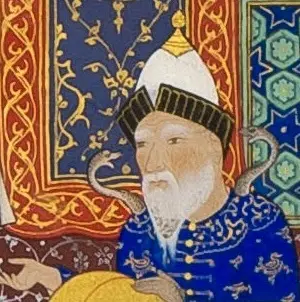
The oldest layer is Avestan. In the Hōm Yašt (Yasna 9.7-8) the plant Haoma names Āθwiya as the second man to press him, and the reward is a son, Θraētaona, "who smote Azhi Dahaka, three-jawed and triple-headed, six-eyed, with thousand perceptions". The Zamyād Yašt calls him "the strongest Druj that Angra Mainyu created against the material world, to destroy the world of the good principle" (Yt 19.37). In these hymns he is a dragon, with no throne, but he already behaves like someone who owns a country: in the Ābān Yašt he sacrifices to Arədvī Sūrā Anāhitā "in the land of Bawri" — read as Babylon in the later Middle Persian exegesis — "with a hundred male horses, a thousand oxen, and ten thousand lambs", and asks for a boon: "that I may make all the seven Karshvares of the earth empty of men", and she refuses him (Yt 5.29-31). Four verses later Θraētaona sacrifices in Varəna and asks to be allowed to free "his two wives, Savanghavach and Erenavach, who are the fairest of body amongst women" (Yt 5.34). The second name comes back much later. Erenavach, Avestan Arənauuāčī, is the Arnavāz who appears beside Zahhāk in the painting at the head of this file, two and a half thousand years later.
What the Avesta does not have: the shoulders, the snakes, the brains, the blacksmith, the mountain.
The mountain arrives in Middle Persian. The Bundahišn, the Zoroastrian cosmology compiled in Book Pahlavi out of Avestan material, disposes of it in a single line in its chapter on mountains: "The Dimavand mountain is that in which Bevarasp is bound" (Bd XII.31, E. W. West's translation). Bēvarasp, "he of the ten thousand horses", is Dahāg's standing epithet. Chapter 29 sets out the whole arrangement, and it is already the version we tell: "Faridoon when he captured Dahak was not able to kill him, and afterwards confined him in Mount Damawand; when he becomes unfettered, Sam arises, and smites and slays him" (Bd XXIX.9). Chapter 34, the reckoning of the years, gives him his thousand-year reign. And the Zand ī Wahman Yasn, the Zoroastrian apocalypse, runs the last act: the fetters give, Dahāg "swallows down one-third of mankind, cattle, sheep, and other creatures", and Sām — Kirsāsp the Sāmān — is shaken awake from his long trance and "the triumphant club strikes him on the head, and smites and kills him" (Bahman Yašt III.54-61 in West's numbering; chapter 9 in Anklesaria's). Ferēdūn is not allowed to finish him: the prisoner has to survive until the end of the world, because the apocalypse reserves his death for Sām.
The human body, the shoulders and the brains arrive with the Arabic historians, and they arrive before Ferdowsī. Al-Ṭabarī, who died in 923, gives a chapter to "Bīwarāsb, that is, al-Azdahāq". In it there are "two ganglia growing out of his shoulders, which caused pain to him"; he "killed two men each day and anointed his ganglia with their brains"; a commoner petitions and the daily quota is spread across the whole population; "a common man of Isbahan, named Kabi" takes a staff, hangs a leather bag on the end of it, raises it as a banner and calls the people out against the tyrant; Afrīdūn takes the tyrant "to Mount Danbawand where he tied him up securely"; and the day of the victory, "Riz Mihr of Mihr-Mah", is adopted as the festival of al-Mihrjān. Every element we habitually call Ferdowsian is there some eighty-five years earlier, in Arabic, drawn from the same lost Sasanian Xwadāy-nāmag that Ferdowsī's sources drew on.
Ferdowsī, who completed the second recension of the Šāhnāme in 400 AH / 1010 CE, gave the story its shape and its language. His chapter is headed "The reign of Ẓaḥḥāk the Arab was a thousand years". Eblīs kisses the shoulders, and the cooks Armāyīl and Garmāyīl save one of each day's pair by mixing in "the brain of a sheep" and sending the survivor to the hills — "and from that seed the Kurds have their descent". Kāva gets the line no summary should lose: "I had eighteen sons in this world; of them one is left to me now." He tears up the loyalty document, puts on a spear the leather the smiths wear over their insteps, and that becomes the Derafš-e Kāvīān. And in the twelfth and last section, Ferēdūn does not kill him: "Sorūš came in haste and said, do not strike, his time has not come." He "brought Ẓaḥḥāk like a swift horse, and bound him on Mount Damāvand"; he "chose a narrow place inside the mountain, and found a cave whose bottom was invisible"; he "brought heavy nails" and "fastened his hands to that rock, so that he should remain long in torment".
Timeline: the documented record of Zahhak, the Serpent King Chained at Damavand
- Avestan hymns, date uncertain The Younger Avesta already knows the whole cast. Yasna 9.8 has Thraetaona smiting "Azhi Dahaka, three-jawed and triple-headed, six-eyed"; Yasht 5.29-31 has the dragon sacrificing in the land of Bawri and asking Anahita for the power to empty the earth of men, and being refused. He is a monster, not a king, and there is no mountain and no blacksmith.
- Avestan hymns, date uncertain (Yasht 5.34) In the same hymn, Thraetaona sacrifices in Varena and asks to be allowed to free the dragon's "two wives, Savanghavach and Erenavach" (Yasht 5.34). Erenavach is the Arnavaz who sits beside Zahhak in Safavid painting two and a half millennia later: the woman in the picture is older than the picture by a very long way.
- 637 The Derafsh-e Kavian, the Sasanian imperial standard that tradition derives from Kava's apron, is captured by the Arabs at the battle of Qadisiya. It is sold for 30,000 dinars, and the caliph Umar is said to have had it burned once its jewels were removed. The banner was a real object; the apron is the story told about its name.
- 9th century The Bundahishn, compiled in Book Pahlavi from Avestan material, fixes the mountain in one line: "The Dimavand mountain is that in which Bevarasp is bound" (XII.31). Chapter XXIX.9 adds the rule of the whole story: "Faridoon when he captured Dahak was not able to kill him, and afterwards confined him in Mount Damawand; when he becomes unfettered, Sam arises, and smites and slays him." Chapter XXXIV gives him his thousand-year reign.
- 9th-10th century The Zand i Wahman Yasn, the Zoroastrian apocalypse, runs the last act: the fetters give way, Dahak "swallows down one-third of mankind, cattle, sheep, and other creatures", and Kirsasp the Saman is shaken awake from his trance and kills him with the club. The end-of-the-world release, which our own summary called simply "Iranian tradition", is this text and is not in Ferdowsi at all.
- c. 915 Al-Tabari devotes a chapter to "Biwarasb, that is, al-Azdahaq". It has the two growths on the shoulders anointed daily with the brains of two men, the commoner from Isbahan named Kabi who raises a leather bag on a staff as a banner, Afridun binding him at Mount Danbawand, and the victory day adopted as the festival of Mihrjan. Everything we call Ferdowsian is here some eighty-five years earlier.
- 400 AH / 1010 CE Ferdowsi completes the second recension of the Shahnameh. His Zahhak chapter supplies the details the story is now told with: Eblis's kiss, the cooks Armayil and Garmayil substituting a sheep's brain, Kava's eighteen sons and the torn document, Sorush forbidding the killing, the heavy nails and the bottomless cave on Mount Damavand.
- 614 AH / 1217 CE The oldest surviving manuscript of the Shahnameh is copied. It is unillustrated, incomplete, and it is now in the Biblioteca Nazionale Centrale in Florence, where it was identified in 1978. The gap between Ferdowsi's text and its oldest witness is roughly two hundred years.
- c. 1525-1535 The folio known as The Nightmare of Zahhak is painted at Tabriz for the Shahnameh of Shah Tahmasp: Zahhak starting awake from the dream that foretells Feridun, with Arnavaz beside him and the two serpents rising from his shoulders. The scene is Ferdowsi's, the picture is five hundred years younger than the poem, and the museum record names no artist.
- 1597 Sharaf Khan Bidlisi writes the Sharafnama at Bitlis. He reports the Zahhak story as one of several accounts of the origin of the Kurds - those who escaped having their brains taken and "spread up to mountains and wide places" - and names neither Kava, nor Feridun, nor Nowruz.
- 7 Shawwal 1230 / 31 August 1815 A popular feast is held in the town of Damavand celebrating the anniversary of Zahhak's death. It is the oldest dated observance of the legend this entry could find, it is reported at second hand by the Encyclopaedia Iranica citing Henri Masse, and it falls on 31 August - not at Nowruz.
- 1918-1919 The journal Jin, published in Istanbul by the Kurdistan Teali Cemiyeti, declares 31 August - "the day of 'Kawe' overcame the cruelty of Dehak" - the national day of the Kurds, while keeping 21 March as the new year and a "social" day. Delal Aydin's 2005 study takes this as the start of the fusion of Kawa with Newroz, a process that took about a century and dropped Feridun from the story.
- 2008 Mount Damavand is registered as the first national natural monument of Iran. The prison is now a protected landscape, climbed under permit from the Iran Mountaineering and Sport Climbing Federation.
Is there a rational explanation for Zahhak, the Serpent King Chained at Damavand?
Nothing here needs a supernatural explanation, because nothing here is presented as an event. What can be checked is the paper trail, and the paper trail contains its own skeptic.
The oldest complete account of the shoulders already argues about them. Al-Ṭabarī, writing around 915, reports the pious reading and then the deflating one in the same breath: "Many of those who are learned in books say that the things on his shoulders were two long, swollen pieces of flesh, each of which looked like the head of a serpent", adding that there are also people who say they really were snakes. A tenth-century historian recording tenth-century colleagues explaining away the snakes is a better skeptical source than anything a modern site could invent, and it is the reason this entry does not treat the two serpents as a single fixed image: the tradition never fixed them.
The mountain is real and so is the steam. Damāvand is a stratovolcano whose last known eruption the Smithsonian's Global Volcanism Program places at 5350 BCE; a party that reached the summit crater on 12 July 1993 reported a small fumarolic vent on its southern rim, emitting gas rich in sulphur dioxide, with sulphur deposits around it. The Encyclopaedia Iranica records the local reading of those features: the vapour is the prisoner's breath, the flames his eyes, the dull sounds his groans, and the yellowish water running in the streams at the foot of the mountain his urine. Earthquakes are not on that list.
"An Arab prince" is the tradition's own label for him, and it was already disputed when it was written down. Ferdowsī's chapter heading calls him tāzī, an Arab. Ṭabarī, earlier, records rival genealogies side by side: "The Yemenites claim him", with an Arab pedigree, while Persian accounts give another. The Avestan Aži Dahāka has no ethnicity at all; he has a country, Bawri, later read as Babylon.
The banner needs the same care. The Derafš-e Kāvīān was a real object: early Islamic historians describe it as an enormous animal-skin standard, roughly 5 by 7.5 m, it fell to the Arabs at the battle of Qādisīya in 637, was sold for 30,000 dinars, and the caliph ʿUmar is said to have had it burned once the jewels were stripped. What is not independently documented is the apron. Encyclopaedia Iranica notes that kāvīān can be read as "of the kays", that is of the Kayanian kings, as easily as "of Kāva"; on that reading the blacksmith and his leather are the tradition's explanation of an old royal name rather than a separate memory of how the standard began.
Finally, the modern political use, which is the part with the most confident dating and the least documentary depth. Šaraf Khan Bidlīsī's Šarafnāma of 1597 already tells the Zahhāk story as one account of the origin of the Kurds — those who escaped having their brains taken and "spread up to mountains and wide places" — but it names neither Kāva nor Ferēdūn nor Nowruz. Ehmedê Xanî, in the seventeenth century, writes about Newroz without Kāva in it. Delal Aydın's 2005 study traces the fusion to the journal Jin, published in Istanbul in 1918-19 by the Kurdistan Teali Cemiyeti, whose writers declared 31 August — "the day of 'Kawe' overcame the cruelty of Dehak" — the Kurdish national day, while 21 March was kept as the new year and a "social" day; the merging of the two took roughly a century. That 31 August is not arbitrary either: Iranica, citing Henri Massé, reports a popular feast held in the town of Damāvand on 7 Šawwāl 1230 / 31 August 1815 celebrating the anniversary of Ẓaḥḥāk's death. The medieval sources put the victory at Mihragān, in autumn. The Encyclopaedia Iranica's article on Čahāršanba-sūrī, the fire festival before Nowruz, by Manouchehr Kasheff and ʿAlī-Akbar Saʿīdī Sīrjānī (1990), surveys its rituals and regional variants without mentioning Zahhāk.
Can you visit Zahhak, the Serpent King Chained at Damavand?
The anchor is the mountain, and the coordinates of this file point at its summit.
Damāvand stands in the central Alborz, north-east of Tehran, on the border of Mazandaran and Tehran provinces. Its height is given as 5,610 m by Iran's national geographic names authority; other surveys and maps circulate 5,609 m, 5,598 m and 5,671 m, so treat any single figure as approximate. It is the highest peak in Iran and the highest volcano in Asia, with a topographic prominence of about 4,667 m. There are fumaroles and yellow sulphur deposits near the summit crater at roughly 5,550 m, and hot springs on the flanks; the smell at the top is not a metaphor. It was registered as Iran's first national natural monument in 2008.
Four routes are in normal use. The southern one is the standard: the village of Polūr on the Haraz road is Camp 1 and the administrative base, Goosfand Sarā ("the sheepfold") at about 3,040 m is the roadhead base camp, and Bargāh-e Sevom, Camp 3, sits at about 4,220 m with a hut. The north-east route uses the Takht-e Fereydūn shelter at about 4,300 m, and the western route the Sīmorgh shelter at about 4,100 m; the northern face is the hardest. Every foreign climber needs a permit from the Iran Mountaineering and Sport Climbing Federation, quoted at USD 50 per person as of 2022 and obtainable at the federation office at Polūr or in advance through an agency. The normal season is high summer; outside it the mountain is a serious winter objective, and altitude sickness above Camp 3 is the usual reason people turn back. In practice most foreign visitors climb with a licensed Iranian agency, which is also the simplest way to handle visas and permits — check your own government's current travel advice for Iran before booking anything.
There is no shrine, no plaque and no identified "cave of Zahhāk" to visit. Nothing on the mountain commemorates the story; the mountain is the story.
The texts and the pictures are easier to reach than the summit. The two oldest surviving manuscripts of the Šāhnāme are in the Biblioteca Nazionale Centrale in Florence (dated 614 AH / 1217 CE) and the British Library in London (675 AH / 1276-77 CE). The painting at the head of this file, The Nightmare of Zahhak, is a folio of the Šāhnāme made for Shah Tahmasp at Tabriz in the 1520s or 1530s, 47.2 by 32.1 cm, held by the Museum of Islamic Art in Doha as MS.41.2007.
Sources consulted
- trans. L. H. Mills, «Yasna 9 (the Hom Yasht), verses 7-8» — The Zend-Avesta, Part III, Sacred Books of the East vol. 31 (American edition); text consulted at avesta.org, 1898 book
- trans. James Darmesteter, «Aban Yasht (Yasht 5), verses 29-35» — The Zend-Avesta, Part II, Sacred Books of the East vol. 23; text consulted at avesta.org, 1883 book
- trans. James Darmesteter, «Zamyad Yasht (Yasht 19), verses 36-38 and 92-93» — The Zend-Avesta, Part II, Sacred Books of the East vol. 23; text consulted at avesta.org, 1883 book
- trans. E. W. West, «Bundahishn, chapters XII.31, XXIX.9 and XXXIV» — Pahlavi Texts, Part I, Sacred Books of the East vol. 5; text consulted at avesta.org, 1880 book
- trans. E. W. West (with B. T. Anklesaria's 1957 version alongside), «Zand i Wahman Yasn (Bahman Yasht), chapter III.54-61» — Pahlavi Texts, Part I, Sacred Books of the East vol. 5; text consulted at avesta.org, 1880 book
- Abu Jafar Muhammad ibn Jarir al-Tabari (d. 923), trans. William M. Brinner, «An Account of Biwarasb, that is, al-Azdahaq» — The History of al-Tabari, vol. II: Prophets and Patriarchs, SUNY Press, Bibliotheca Persica, 1987 book
- Abul-Qasem Ferdowsi, «Shahnameh, the Zahhak chapter, sections 2, 7 and 12 (Persian text)» — Persian text of the Moscow edition, consulted at Ganjoor, 1010 book
- Prods Oktor Skjaervo, «AZDAHA i. In Old and Middle Iranian» — Encyclopaedia Iranica III/2, pp. 191-199, 1987 academic
- Encyclopaedia Iranica, «DAMAVAND ii. In Iranian mythology» — Encyclopaedia Iranica VI/6, pp. 627-631, 1993 academic
- Encyclopaedia Iranica, «DERAFS-E KAVIAN» — Encyclopaedia Iranica, article on the Sasanian royal standard academic
- Delal Aydin, «Mobilizing the Kurds in Turkey: Newroz as a Myth» — MA thesis, Graduate School of Social Sciences, Middle East Technical University, Ankara, 2005 academic
- Museum of Islamic Art, Doha, «The Nightmare of Zahhak. Miniature from the Shahnama of Shah Tahmasp, MS.41.2007» — catalogue record published through Discover Islamic Art, Museum With No Frontiers, 2007 report
- Damavand Info / Damavand Adventures (damawand.de), «Damavand climbing permit and camps» — commercial website of the Damavand Adventures trekking and ski-tour operator, founded by mountain guide Ardeshir Soltani; permit fee quoted as of May 2022, 2022 web
- Global Volcanism Program, «Damavand (volcano number 232010): last known eruption 5350 BCE; Bulletin of the Global Volcanism Network reports of September 1993 (fumarolic vent on the summit crater rim, sulphur deposits) and October 1999» — Smithsonian Institution, Volcanoes of the World (read in the Internet Archive capture of 17 July 2026; the live page refuses automated requests), 2026 web
- Manouchehr Kasheff and ʿAlī-Akbar Saʿīdī Sīrjānī, «ČAHĀRŠANBA-SŪRĪ (usually pronounced Čāršamba-sūrī), the last Wednesday of the Persian solar year» — Encyclopaedia Iranica IV/6, pp. 630-634 (read in the Internet Archive capture of 9 September 2015), 1990 academic
Reviewed by V. Serrano on 2026-08-15 · How we verify our content
📎 Source: Enigma Atlas
💬 Field testimonies (0)
No testimonies yet. Add the first.
Add your testimony
🔒 Log in to add a testimony