👻 HAUNTED PLACE · EXP. Nº9474
ACTIVE
Rig-e Jenn
Rig-e Jenn is a location reputed to be haunted in Semnan and Isfahan provinces, IR. Its reputation comes from reported apparitions, unexplained phenomena and eyewitness accounts gathered over time.
Where is Rig-e Jenn?
- Location
- Semnan and Isfahan provinces, IR
- Type
- Forest / nature
- Coordinates
- 34.63, 53.376
- Testimonies
- 0
- Last updated
LOCATION
Why is Rig-e Jenn said to be haunted?
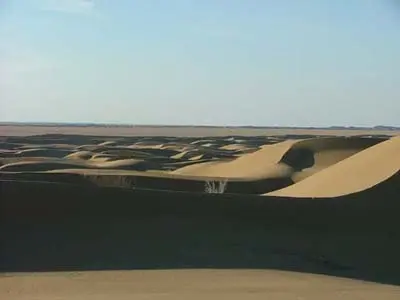
Rig-e Jenn, the Dune of the Jinn, is an erg of some 3,800 square kilometres in the western Dasht-e Kavir, lying south of Semnan, north of Anarak and west of Jandaq. The Persian account of it turns on a single fact: there is no spring and no well anywhere inside it. The caravan roads of the plateau went around it, and ground that stayed hidden from people took the name of the beings who are hidden from sight. Its modern history was made between 1997 and 2005 by Iranians who went in on foot, by camel, by jeep and in a rented light aircraft. Miran Zadeh, chief ranger of the neighbouring Kavir National Park, planted five iron rods to act as road-signs in terrain with no landmarks. The walkers of the Keshit group crossed the erg on foot in the autumn of 2003. Ali Parsa, who had been trying since 1997 and who took the photograph on this page, reached the centre by jeep in February 2005 and buried a geocache there. No disappearance inside the erg is documented in any source traced for this file, and the tag Iranian Bermuda Triangle reached the English record from a tour operator's blog.
What is the history of Rig-e Jenn?
Rig-e Jenn is an erg — a sand sea — in the western Dasht-e Kavir. The Persian Wikipedia article puts its extent at about 3,800 square kilometres and fixes it by the settlements around it rather than by a boundary: south of Semnan, south-east of Garmsar, east of the Kavir National Park, north of Anarak, west of Jandaq. The same article states the fact that governs everything else about the place: "هیچ گونه چشمه یا چاه آبی در این منطقه وجود ندارد" — there is no spring and no water well in this area at all. The caravan roads of the plateau ran around it. The name is built on the Arabic root j-n-n, whose sense is covering and concealment; the same root gives Persian jannat for paradise, junna for a shield and janin for the child hidden in the womb. Ground that stayed hidden from people got the name of the beings who are hidden from sight.
Two Europeans passed near it and neither went through. The Austrian physician and desert traveller Alfons Gabriel, who made three journeys through the Iranian deserts in 1927-28, 1933 and 1937 and published Durch Persiens Wüsten in 1935, "crossed the southern 'tail' of it on his way from Ashin to Aroosan in the 1930s". The Swedish explorer Sven Hedin is harder to pin down: Ali Parsa's page says he "avoided this area in his 1900s travels to Iranian deserts", the Persian Wikipedia article says he crossed the western and southern margins and later wrote about the erg at length, and the BBC's 2006 report says the two Europeans made only "اشارهای گذرا" — a passing reference. Hedin's own account has not been read for this file, and the three versions have not been reconciled here.
The modern record belongs to Iranians and it is dated and signed. Ali Parsa first saw the name on a map as a student and lost the idea to emigration and to "the revolution in 1979 and its aftermath"; it came back in 1996 in conversation with Miran Zadeh, chief ranger of the neighbouring Kavir National Park, who had wanted to go since childhood and who, in Parsa's words, "is a bit scared about this unknown, and un-traveled area which happened to be in the neighboring vicinity of the Park he manages". They rented a light aircraft in Tehran in November 1997 and flew over it first, a trip Parsa describes as being made "to assure Mr. Miran Zadeh (as well as ourselves) that there is nothing extraterrestrial there, just salt, mud and sand". A 4WD trip followed the same month, a second flight in October 1998, and a camel caravan from Jandaq in November 1999 with four camels supplied by Ali Heydari of Mesr village.
Miranzadeh left the most useful thing anyone has left there. Parsa photographed one of "five of these rods planted by Mr. Miranzadeh back in 1997 when he was the head of Kavir National Park", and explains what they are for: "The rods act as road-signs in an area with virtually no landmarks."
The erg was crossed before Parsa crossed it, and he said so himself. Between April and October 2004 the banner across the top of his Rig-e Jenn page read "Rig-e Jenn is crossed, and not by me! See for yourself." The Keshit group, Iranian walkers whose stated aim is "دست یابی به سقف توانایی های انسان در عبور از این مناطق خشن اما جذاب" (reaching the ceiling of human capability in crossing these harsh but attractive regions), list Rig-e Jenn in their programme under autumn 1382, that is autumn 2003, and Parsa credits them with going through on foot. An off-road group led by Hamid Boreiri had crossed east to west in 2003 without touching the middle. Parsa reached the centre by jeep in February 2005, entering from the south-west after rain: "Recent rains made the sandhills firm and passable." At the centre his party buried a plastic container with small objects in it and registered it as a geocache.
Timeline: the documented record of Rig-e Jenn
- 1927-28, 1933 and 1937 The Austrian physician and desert traveller Alfons Gabriel makes three journeys through the Iranian deserts, publishing Durch Persiens Wüsten in 1935. Ali Parsa's summary of the literature credits him with crossing only the southern 'tail' of the erg, on the road from Ashin to Aroosan.
- 1996 On a visit to the Kavir National Park, Ali Parsa and Farrokh Mostofi discuss Rig-e Jenn with the park's chief ranger, Miran Zadeh, who says he has wanted to go since childhood and has never found anyone willing.
- November 1997 Parsa rents a light aircraft in Tehran and overflies the erg with Miran Zadeh, then returns the same month by 4WD as far as the middle of the area. Miranzadeh plants five iron rods as markers in terrain with no landmarks.
- November 1999 A camel caravan sets out from Jandaq with four animals hired through Ali Heydari of Mesr village. Parsa navigates with a Garmin GPS 12 and calls the device his local guide.
- Autumn 1382 (autumn 2003) The Keshit group lists Rig-e Jenn in its programme for this season; Parsa credits its walkers with crossing the erg on foot. An off-road group led by Hamid Boreiri crosses it east to west the same year without passing through the centre.
- 17 October 2004 An anonymous editor creates the English Wikipedia article on Rig-e Jenn as a word-for-word copy of Ali Parsa's page, with a link to his site. Every English-language account of the place descends from this text.
- February 2005 Parsa's seventh expedition reaches the centre of the erg by jeep, entering from the south-west after rain had firmed the dunes, and buries a plastic container there which the party registers as a geocache.
- 9 June 2006 BBC Persian publishes Reza Hayeri's report from Tehran, «Breaking the spell of Rig-e Jenn», crediting Parsa with the crossing on his eighth attempt and linking to the personal site on which Parsa denies being the first.
- 28 October 2014 The Financial Tribune publishes «Rig-e Jenn, Desert of Spirits», the last English-language article traced here that names Ali Parsa. It also hedges the disappearance claim, saying that perhaps many had entered and never returned.
- 22 October and 17 November 2022 An editor adds an infobox to the English Wikipedia article carrying the coordinates 34.6295 N, 53.3762 E, with no source given. Four weeks later another editor removes the link to Parsa's site with the edit summary «awful».
- 24 January 2024 An editor deletes the sentences about Sven Hedin and Alfons Gabriel from the English Wikipedia article with the summary «delete uncited Original Research». What remains is the folklore, sourced to a tour operator's blog post, and the comparison with the Bermuda Triangle.
Is there a rational explanation for Rig-e Jenn?
The sources that carry the folklore also carry its explanation, and they are the Iranian ones. The Persian Wikipedia article says outright that the stories "عموماً نشأت گرفته از عجز حاشیهنشینان یا مسافران در عبور از این خطه بوده است" — that they arose generally from the inability of the people on its margins, or of travellers, to get across it. It names three physical causes for the reputation: the total absence of water, the sound the wind makes moving over the dunes, and the cracking of stones under the gap between day and night temperatures, a phenomenon known locally as "گریه سنگ", the weeping of the stone. Thermal fracturing was heard, and it was filed under the metaphysical. The Financial Tribune describes the acoustics in the same terms: "Sometimes the notorious winds of Rig-e Jenn howl ominously, sounding like a supernatural wail that triggers even the most rigid skeptics' imagination."
The claim that nobody comes back has never had a case attached to it. The Financial Tribune, which is the earliest English source traced here to make it, hedges it three times in one sentence: "This belief was strengthened by, and probably originated from the fact that perhaps many had entered the desert and never returned." The sentence produces neither a name nor a date nor an incident. The English Wikipedia article turned that into a flat statement of belief in January 2024 and sourced it to a tour operator's blog post published in May 2020, and the same edit introduced the comparison with the Bermuda Triangle. The label has no Iranian ancestry: the Persian article does not use it in its own voice, and its only citation for it is a Tasnim news item of 2017 whose headline asks the question.
The people who have actually stood in the middle of it report salt, mud, sand and one wolf. Parsa's account of the February 2005 trip records tracks of hares, of a sand cat, of a sand fox, and then this: "We never expected to see a mamal track in this place which has no water in a radius of almost 60 kilometers." The Persian Wikipedia account of the 1997 vehicle expedition ends on the same note, dryly: the party went in fully equipped and "نه گرفتار روح شدند و نه جنزدگی" — they were neither seized by a spirit nor jinn-possessed.
There is a second thing worth setting down, because it explains why the English-language material about this place is so thin. Everything the English internet says about Rig-e Jenn descends from one paragraph written by Ali Parsa. The English Wikipedia article was created on 17 October 2004 as a word-for-word copy of his page, link included. On 17 November 2022 an editor removed the link with the edit summary "awful". On 24 January 2024 another removed the Hedin and Gabriel sentences with the summary "delete uncited Original Research", leaving three tourism URLs and no explorer. The Financial Tribune had still named him in 2014 — "A successful desert crossing was finally achieved in 2005 by Ali Parsa" — and the Tehran Times reproduced his sentences in 2022 without him. The earlier version of this file inherited the end of that chain and added an apparatus of its own: an ethnographer who cannot be located, a government report at a bare domain root, permit requirements and a military zone. All of that has been removed.
Can you visit Rig-e Jenn?
Rig-e Jenn has neither a gate nor a permit office nor any military restriction, and the earlier version of this file was wrong to say otherwise. What it has is no water. The Persian Wikipedia article states it flatly — "هیچ گونه چشمه یا چاه آبی در این منطقه وجود ندارد" — and Parsa measured the consequence from inside: at his campsite in February 2005 the nearest water was "in a radius of almost 60 kilometers".
The approaches are named in the sources. Parsa's camel caravan of November 1999 started from Jandaq (34.04 N, 54.42 E), on the eastern side, hiring animals through Ali Heydari of Mesr. The vehicle route that finally worked runs in from the south-west, through the half-abandoned caravan village of Ashin (33.49 N, 53.49 E) in the Anarak district of Nain County, and then past a large saxaul that Parsa's party named Pir-e Tagh and treated as the gateway. Molkabad was the last settlement on the northern approach. Ashin and Baba Khaled are described as deserted, their mud houses used occasionally by people from Anarak. The BBC report of June 2006 records what changed: with GPS, satellite images from the internet and routes marked by desert travellers, "سفر به کویر برای همه ممکن شده است" — travel to the desert has become possible for everyone.
Possible is not the same as safe, and the record shows what goes wrong. On the sixth trip, in November 2004, a salt marsh on the usual northern approach stopped the party altogether: "the water this year was too much for us". On the seventh, a connecting rod broke a piece out of an engine block in the middle of the erg and a support team had to drive an M151 engine out from Tehran on a Unimog. Parsa's summary of what carried them is the practical sentence in the whole archive: "GPS was an indespensible device and actually acted as our 'local guide' in this trip."
Five iron rods planted by Miranzadeh in 1997 still stood as markers in 2004. At the centre, at the point Parsa labelled 720 in his own GPS log, there is a buried plastic container placed in February 2005 and registered as a geocache. Neither has been verified on the ground since. The nearest towns with services are Jandaq and Khur to the east and Anarak to the south; inside the erg itself there is neither accommodation nor signage nor a marked track.
Sources consulted
- Ali Parsa, «Rig-e Jenn: first to eighth trips (expedition pages, 1998-2005)» — aliparsa.com, archived by the Internet Archive, 2005 archive
- Reza Hayeri, «شکستن طلسم ریگ جن (Breaking the spell of Rig-e Jenn)» — BBC Persian, 2006 newspaper archive
- Financial Tribune, «Rig-e Jenn, Desert of Spirits» — Financial Tribune, 2014 newspaper archive
- Afshin Majlesi, «Rig-e Jenn: the bizarre land of elves!» — Tehran Times, 2022 newspaper archive
- Persian Wikipedia contributors, «ریگ جن (Rig-e Jenn)» — ویکیپدیای فارسی, 2026 web
- English Wikipedia contributors, «Rig-e Jenn: revision history, 2004-2026» — Wikipedia, 2026 archive
- Keshit desert group, «برنامه ها (Programme list) and درباره (About)» — keshit.com, archived by the Internet Archive, 2007 web
- Ali Parsa, «File:Rigejenn.jpg (uploaded 9 December 2005, photographed 3 January 2003)» — Wikimedia Commons, 2005 web
Reviewed by V. Serrano on 2026-09-07 · How we verify our content
💬 Field testimonies (0)
No testimonies yet. Add the first.
Add your testimony
🔒 Log in to add a testimony