👻 HAUNTED PLACE · EXP. Nº9046
ACTIVE
Bran Castle (Dracula's Castle)
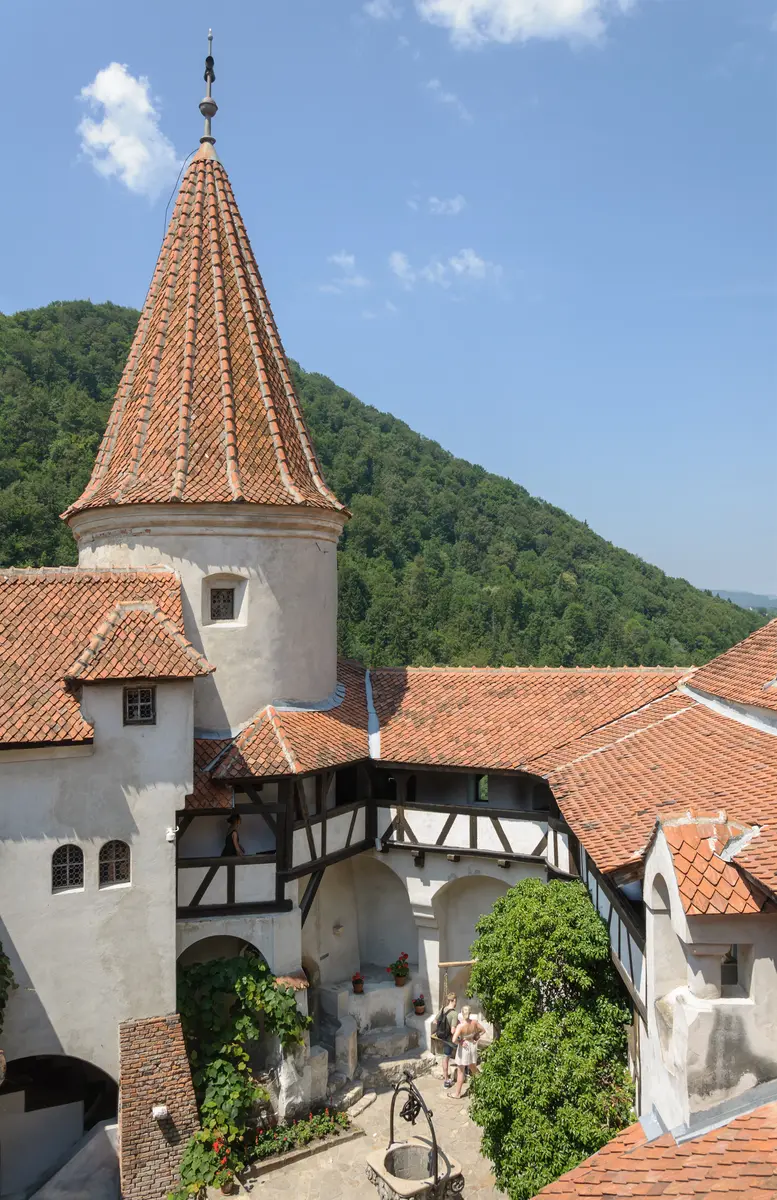
Perched on a rocky outcrop between Wallachia and Transylvania, Bran Castle was built by Saxon guildsmen of Brașov between 1377 and 1388 to guard a mountain trade route, and its silhouette became world-famous only after Bram Stoker described a castle matching its profile in his 1897 novel "Dracula," despite Stoker never having visited Romania or explicitly naming Bran in the text.
Where is Bran Castle (Dracula's Castle)?
- Location
- Transylvania, Romania
- Type
- Castle
- Coordinates
- 45.515, 25.367
- Last updated
LOCATION
Why is Bran Castle (Dracula's Castle) said to be haunted?
The connection to Vlad III, "the Impaler," whose brutal 15th-century reign inspired Stoker's count, is historically thin — the castle's own museum records his army passing through Bran in 1459 and says it is not known whether he ever took the castle — but the pairing stuck, and the fortress is now marketed worldwide as "Dracula's Castle." Guides tell of cold drafts moving through the narrow stone stairwells and of a secret passage connecting two floors that was hidden behind a fireplace, only rediscovered decades after the castle became a museum in the 1950s. Local Romanian folklore around vampiric strigoi predates Stoker by centuries.
What is the history of Bran Castle (Dracula's Castle)?
Bran Castle has a real history, and it has almost nothing to do with vampires.
It begins as a tollgate: on 19 November 1377 the chancellery of Louis I of Anjou, king of Hungary, issued a privilege authorising the Saxon townsmen of Brașov to raise a stone fortress “on Dietrich's rock”, at the mouth of the mountain pass into Wallachia — at their own expense, with their own materials and their own labour. The building was finished by 1388, and its job was mundane and lucrative: it guarded the border and it took a three per cent cut of every consignment of goods that crossed it. The garrison was tiny, a dozen to two dozen mercenaries. The Germans called it Törzburg; Bran is the Slavonic word for gate.
For three centuries it was commercial infrastructure that changed hands whenever the accounts demanded it. Sigismund of Luxembourg granted it as a fief to Mircea the Elder of Wallachia in 1407. In 1498 Brașov bought a ten-year lease on it for a thousand florins, together with the right to collect the customs duty. On 25 April 1651 the city finally bought it outright from Prince George Rákóczi II. After 1836, when the border moved to the mountains, the pass lost its military and commercial point, and in 1888 the town council handed the castle over to the regional forestry district; for the next thirty years foresters lived in the towers.
On 1 December 1920, two years after Transylvania joined Greater Romania, the Brașov city council under mayor Karl Schnell voted to hand the fortress to Queen Marie, born in Kent in 1875, a daughter of Queen Victoria's second son, whom the council praised as a great queen who spread her blessing wherever she went. Between 1920 and 1932 the Czech architect Karel Liman, who had worked on Peleș and Pelișor, rebuilt it as a summer residence: a 57-metre well, a small hydroelectric plant on the Turcu stream that also lit the surrounding villages, a lift for a queen whose knees were failing, an English park with ponds and a tea house.
Marie died on 18 July 1938, at Pelișor Castle in Sinaia, and in 1940 her heart was brought from Balchik to a crypt beyond the castle valley. Her will left Bran to her daughter, Princess Ileana, who ran a military hospital there, “The Queen's Heart”. In 1948, in the words of the museum's own chronology, “the newly installed communist government” forced her to leave the country with her family, her six children among them. In 1956 the new regime turned the family house into a museum. Nobody involved in any of this had mentioned Dracula.
Timeline: the documented record of Bran Castle (Dracula's Castle)
- 19 November 1377 The chancellery of Louis I of Anjou grants the Saxon townsmen of Brașov the privilege of building a stone fortress on Dietrich's rock, at their own expense, to guard the pass into Wallachia and collect a 3% customs duty.
- 1459 Vlad Țepeș passes through Bran and burns the outskirts of Brașov during a dispute with Saxon merchants over customs rates. The museum also records him crossing the Bran pass in 1460 and again in 1476.
- 25 April 1651 Brașov buys the castle outright from Prince George Rákóczi II, ending two and a half centuries of leases, loans and pledges over what was essentially a customs post.
- 1 December 1920 The Brașov city council, led by mayor Karl Schnell, votes to give the castle to Queen Marie of Romania, honouring her as a great queen who spread her blessing wherever she went.
- 18 July 1938 Queen Marie dies at Pelișor Castle, in Sinaia, with King Carol and Crown Prince Michael at her bedside.
- 1948 The newly installed communist government forces Princess Ileana to leave Romania with her family; she and her six children move to the United States in 1950. In 1956 the communist authorities turn the castle into a museum with three departments: the castle with pieces of the royal family's heritage, medieval customs, and ethnography.
- 1968 A Romanian academic visiting the United States is handed a tourist brochure describing Bran as “Dracula's Castle” — evidence that the nickname was coined and spread abroad, not in Romania.
- 1972 A New York agency launches the 18-day package “Spotlight on Dracula”, which advises tourists to stock up on garlic. It causes consternation in Bucharest; the state answers in 1973 with its own vampire-free tour, “Dracula: Legend and Truth”.
- 18 May 2006 After years of litigation the castle is legally restituted to the heirs of Princess Ileana — Archduke Dominic von Habsburg and his sisters Maria Magdalena and Elisabeth. It has been run privately as a museum ever since.
Is there a rational explanation for Bran Castle (Dracula's Castle)?
The label on the ticket office is the least historical thing about Bran.
Bram Stoker never visited Romania, a point the castle's own website makes; the same page suggests that Stoker drew his castle from an illustration of Bran in Charles Boner's book on Transylvania. The castle he described stands beyond the Borgo Pass in the north-east, and the geographer Duncan Light notes that Bran is never mentioned in the book and lies "over 100 miles from the location of the fictional castle". Where the name came from is documented: Stoker's working notes trace it to William Wilkinson's 1820 account of Wallachia and Moldavia, whose footnote explains that "Dracula in the Wallachian language means Devil". Wilkinson's narrative also tells of a voivode "also named Dracula" who, around 1460, crossed the Danube against the Turks, was driven back and escaped into Hungary. It never calls him Vlad, says nothing of impaling and puts him in no castle.
The museum's own history of the fortress says Vlad Țepeș "does not seem to have played a significant role in the history of Bran Fortress" and that the connection "was made much later and has very little to do with the historical deeds of the Wallachian ruler"; Light calls it "only tenuous". What the museum records are passages through the pass: early in 1459 Vlad's army passed through Bran and burned the outskirts of Brașov in a quarrel with Saxon merchants over customs duties; in 1460 he entered the Bârsa Land "through the Bran Pass"; in 1476 he went back to Wallachia "passing through Bran again". Its page on Count Dracula adds that "it is not known whether Vlad the Impaler conquered Bran Castle or not", and introduces the claim that he was held there for two months in 1462 with "it seems", resting it on a book published in 2002.
Light's interviews with socialist-era tourism officials say who made Bran into Dracula's Castle: Western visitors. A tourist coined the nickname in the 1960s, foreign brochures adopted it, and the Romanian state spent two decades resisting, presenting Bran as a museum of feudal art and never using the name in its own English-language publications. Anna Huebner's study of 2011, drawing on Banyai's visitor research, describes Bran becoming the "embodiment" of Dracula after the fall of the Eastern Bloc, while the Romanian state "has rather remained inactive in enforcing this image, merely tolerating it".
Can you visit Bran Castle (Dracula's Castle)?
Bran Castle is a private museum, open daily, and no night tour is needed to see it.
The address is Strada General Traian Moșoiu 24, 507025 Bran, Brașov county. From Brașov it is 30 km on the DN73/E574, about 35 minutes by car; buses to Bran–Moeciu leave the city's Bus Station no. 2 every half hour on weekdays and hourly at weekends for roughly 7 lei, and a taxi runs 100–120 lei. From Bucharest it is 160 km via the DN1/E60, about two and a half hours, or an Intercity train to Brașov and then the bus.
In summer the castle admits visitors Tuesday to Sunday from 9:00 to 19:00 and on Mondays from 12:00, those being last-entry times; in winter last entry falls back to around 16:00. Prices on the official ticketing page in July 2026 were 120 lei for adults (about 24 €), 90 for over-65s, 80 for students and 60 for children aged 5 to 17, with under-5s and disabled visitors free; the Torture Chambers and the Time Tunnel cost 30 lei each. Other pages of the same site still quote 100 lei, so treat these figures as approximate.
Two warnings. The museum itself cautions about “dozens and dozens of steep steps”: the spiral stairs are narrow and the upper floors cannot be reached by wheelchair. And summer tickets sell out — book online, and arrive at opening or in late afternoon. Allow two to three hours. The tea-house restaurant needs no admission ticket.
Sources consulted
- Bran Castle Museum, «Historical Chronology of Bran Castle» — Official institutional archive, 2026 archive
- Bran Castle Museum, «Bran Fortress: the medieval history of the castle» — Official institutional archive, 2026 archive
- Bran Castle Museum, «Dracula: the museum's own account of the legend» — Official site of the Bran Castle museum, 2026 web
- William Wilkinson, «An Account of the Principalities of Wallachia and Moldavia» — Longman, Hurst, Rees, Orme and Brown, London, 1820 book
- Duncan Light, «Dracula Tourism in Romania: Cultural Identity and the State» — Annals of Tourism Research, vol. 34, no. 3, pp. 746-765, 2007 academic
- Anna Huebner, «Who came first – Dracula or the Tourist? New Perspectives on Dracula Tourism at Bran Castle» — European Journal of Tourism Research, vol. 4, no. 1, pp. 55-65, 2011 academic
- Duncan Light, «The Dracula Dilemma: Tourism, Identity and the State in Romania — the 1972 American tour "Spotlight on Dracula" and the state tour "Dracula: Legend and Truth" launched in mid-1973» — Ashgate, Farnham, 2012 book
- Evening Post, «Obituary: Queen Mother of Rumania — death of Queen Marie at Pelișor Castle, Sinaia (Bucharest, 18 July); born at Eastwell Park, Kent, in 1875, eldest daughter of the Duke of Edinburgh, second son of Queen Victoria» — Evening Post, Wellington, 19 July 1938 (Papers Past), 1938 newspaper archive
- Bran Castle Museum, «Royal Residence 1920–1947 — Queen Maria's restoration of Bran; Princess Ileana 'received Bran Castle by will' and set up the 'Queen's Heart' hospital» — bran-castle.com, 2026 web
Reviewed by V. Serrano on 2026-07-29 · How we verify our content
💬 Field testimonies (0)
No testimonies yet. Add the first.
Add your testimony
🔒 Log in to add a testimony