👻 HAUNTED PLACE · EXP. Nº9475
ACTIVE
Poenari Castle
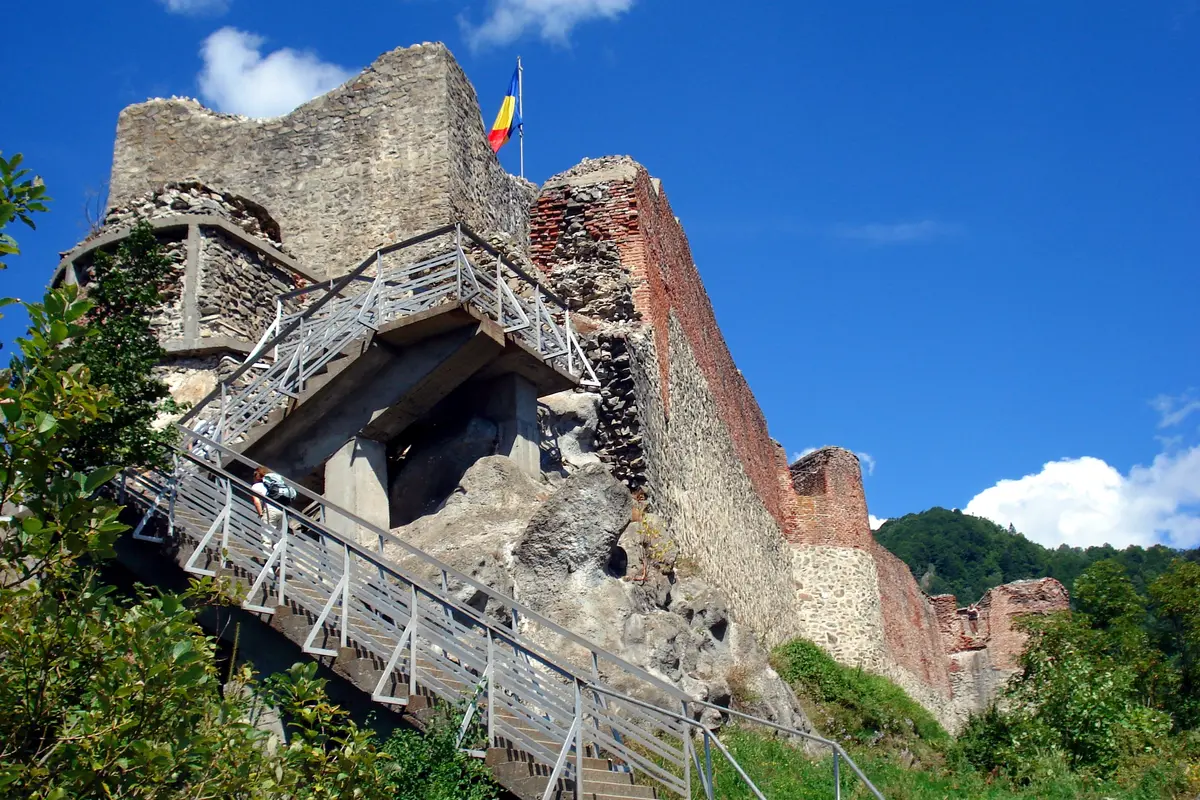
Perched on a rocky spur above the Argeș river and reachable only by climbing 1,480 concrete steps — poured in the 1970s along with the Transfăgărășan road — Poenari Castle was the mountain stronghold that Vlad III, the Wallachian prince known as the Impaler, actually used, with a far more genuine claim to "Dracula's castle" than the famous Bran.
Where is Poenari Castle?
- Location
- Argeș, Romania
- Type
- Castle
- Coordinates
- 45.354, 24.635
- Last updated
LOCATION
Why is Poenari Castle said to be haunted?
The Wallachian chronicles say he rebuilt the fortress with forced labour, but it is worth quoting them as written: not disloyal boyars but orășani, townspeople of Târgoviște, punished in revenge for an insult to one of the prince's brothers. The legend of the wife who leaps from the tower during the Ottoman siege does not appear in the older sources: in the oldest surviving account, Metropolitan Neofit's note of 1747, the Turks shell the fortress and find it empty, because Vlad had shod his horses backwards and fled. And the river below is the Argeș, not the Râul Doamnei, which runs through a different valley.
What is the history of Poenari Castle?
Bran sells the legend; Poenari is the rock Vlad Țepeș actually used. The comparison is fair, and it needs one immediate qualification: the first document showing Poenari in use dates from 1481, five years after his death. What Poenari has is archaeology, a chronicle written two centuries later, and a fortress that plainly grew in the fifteenth century.
It sits on a spur of Mount Cetățuia, 850 metres up, at the mouth of the Argeș gorge in the commune of Arefu, some 25 km above Curtea de Argeș — and it is not named after the village below it. Căpățâneni is two kilometres away; the fortress took the name of Poienari, a village six kilometres off but older, and one it owned, as a charter granted to the men of Arefu by Mircea Ciobanul on 8 April 1546 records. Under that name it appears in the documents of the fifteenth and sixteenth centuries and in the chronicles of the seventeenth and eighteenth.
The core came first, and it was small. Excavations directed by Gheorghe I. Cantacuzino between 1968 and 1970 found a square tower set straight on the bare rock, 8.15 to 8.50 metres a side on the outside and only 4.30 to 4.60 inside — walls, in other words, thicker than the room they enclosed was wide. It was built of rough stone bound with mortar, divided by timber floors into three storeys (four, according to Maria Ciobanu, Nicolae Moisescu and Radu Ștefan Ciobanu) and roofed with shingle. Cantacuzino dated it to the first half of the fourteenth century, contemporary with Basarab I (1324-1351/52), the founder of Wallachia; the other three authors argued for the end of the thirteenth century or the first decade of the fourteenth. Those same three tested what the tower was for by lighting a torch at night in the bell tower of the church of Sân Nicoară in Curtea de Argeș: the signal was visible from the square tower, and the tower's signal from the church, so the tower could pass signals to the town.
The second phase is the one everyone comes for. No later than the fifteenth century, and attributed to Vlad Țepeș, a curtain wall of almost sixty metres was thrown around the old tower, which became the keep; the enclosure it defines is today ten to fifteen metres wide, and three semicircular towers were built against its southern side. The technique is Byzantine: dressed stone faces filled with rubble core and stiffened with a grid of timbers laid lengthwise and across. Inside, partly collapsed, is a chamber of roughly four by three metres cut into the rock — the cistern, coated on walls and floor with a thick red mortar render that made it watertight, again a Byzantine method. The everyday debris from those trenches still serves Romanian archaeology as a dating benchmark: collared cooking-pot rims of the fourteenth and fifteenth centuries, a disc stove-tile of the fifteenth or sixteenth, iron scrapers of the kind used to clean wax off candlesticks.
What Poenari did for a living is better documented than its most famous owner. It sheltered princes, it held the country's treasury, and it was a prison for boyars convicted of hiclenie, treason against the prince. One inmate is known by name: Milea, who had tried to seize the throne from Vlad Călugărul and whose father bought his release by giving half of Topoloveni to the monastery of Nucet — a transaction recorded in a document of Petru cel Tânăr dated 5 April 1567. That monastery's founder was Gherghina, castellan of Poenari from 15 December 1501 to December 1507, brother of Lady Rada and a boyar of Radu cel Mare; that a man of his rank was given the command says what the place was worth. Before him came Ratea, the first castellan on record, in July 1481, and after him Danciu, in May 1510. By then the fortress had reached foreign eyes: Sebastian Compagni of Ferrara, in his Geografia of 1509, listed Poenari among the most important places of Wallachia, raised on a sharp rock, where the money of the prince of the country is kept.
Then it was bargained away. In 1522 Radu de la Afumați, son-in-law and successor of Neagoe Basarab, handed the fortress to John Zápolya, king of Hungary, in exchange for the Transylvanian estates of Vințu de Jos and Vurpăr; the fourteenth of his twenty battles was fought at Poenari itself between June and October of that year. Hungarian castellans followed — Thoma Mysky, Nicolae Thomory, Peter Off — and in 1526, the year of Mohács, the king asked the burghers of Brașov for 400 florins so as not to lose the place. On 2 January 1529 Radu de la Afumați was murdered at Râmnicu Vâlcea by a pro-Ottoman boyar faction; the commander of Poenari died in the same plot, the treaty collapsed and the garrison withdrew.
The end was quiet. Romanian castellans reappear — Diicul and Stan in 1534, Drăghici from December of that year, Milco on 15 September 1560 — but in 1542-43 Radu Paisie gave the villages of Poienari, Cheieni and Căpățâneni away to his treasurer, which is what a ruler does with land he no longer needs to garrison. After that the record falls silent. Archaeological material stops in the second half of the sixteenth century and the documents stop with it: Poenari was abandoned, and possibly slighted, like most Wallachian fortresses once Ottoman control tightened.
It came back four centuries later, and by accident. Cantacuzino's excavations coincided with the preparations for the Transfăgărășan, the strategic mountain road driven through the Făgăraș between 1970 and 1974, which passes at the foot of the crag. The authorities took the opportunity to make the climb possible for visitors and poured a concrete staircase of 1,480 steps up the wooded slope. By 2019 Poenari was taking about 100,000 visitors a year.
Timeline: the documented record of Poenari Castle
- First half of the 14th century A square tower is built directly on the rock — 8.15-8.50 m a side outside, only 4.30-4.60 inside. Gheorghe I. Cantacuzino, who directed the 1968-1970 excavations, dates it to the reign of Basarab I; Maria Ciobanu, Nicolae Moisescu and Radu Ștefan Ciobanu argue for the late 13th or very early 14th century.
- 15th century The fortress is enlarged with a curtain wall of almost 60 m around the old tower, three semicircular towers on the south side and a rock-cut cistern lined with waterproof red mortar. The phase is attributed to Vlad Țepeș by the county museum, which gives it no year; the first document showing the fortress in use names its castellan in 1481.
- July 1481 Ratea is recorded as pârcălab (castellan) of Poenari: the earliest documentary evidence of the fortress in operation, five years after Vlad Țepeș's death.
- 1509 Sebastian Compagni of Ferrara lists Poenari in his Geografia among the most important places of Wallachia, raised on a sharp rock, where the money of the prince of the country is kept.
- 1522 Radu de la Afumați cedes the fortress to John Zápolya, king of Hungary, in exchange for the Transylvanian estates of Vințu de Jos and Vurpăr. The fourteenth of his twenty battles is fought at Poenari between June and October.
- 2 January 1529 Radu de la Afumați is murdered at Râmnicu Vâlcea by a pro-Ottoman boyar faction. The commander of Poenari dies in the same plot; the 1522 treaty is annulled and the Transylvanian garrison withdraws.
- 15 September 1560 Milco is named pârcălab of Poenari, one of the last mentions of a functioning garrison. Archaeological material stops in the second half of the century: the fortress is abandoned as Ottoman control tightens.
- 1747 The metropolitan Neofit the Cretan writes the oldest surviving eyewitness description: the Argeș running in the ravine below, a local tradition that the fortress was built with the men of Târgoviște, a Meșterul Manole echo about a foreman walling his wife into the masonry, and a siege by Tatars and Turks who bombard it from the Posada ridge and find it empty, Vlad having shod his horses backwards and fled to Hungary. There is no leap from the tower.
- 1968-1970 Gheorghe I. Cantacuzino directs the archaeological campaigns that establish the two building phases, the Byzantine wall technique and the cistern. Pottery, a disc stove-tile and iron tools from the dig still serve Argeș archaeologists as dating comparanda.
- 1970-1974 While the Transfăgărășan is driven through the mountains at the foot of the crag, a concrete staircase of 1,480 steps is built up the slope, turning an unreachable ruin into a tourist site.
- End of March 2019 Poenari closes to visitors — staff had reported bears at the foot of the stairs since 2017 — and an EU-funded conservation project begins. A feasibility study for a lift, funicular or cable car, budgeted at 3 million lei, is announced and never built.
- 14 April 2025 The fortress reopens after three years of conservation work run by Argeș County Council. The financing contract totalled 25,668,767.19 lei — 9,647,565 from EU funds and 16,021,201.29 from the county, against the 1.12 million lei the county expected to contribute when the project was announced in 2019.
- 29 April 2025 Two weeks after reopening, the site closes again: a she-bear denning near the fortress with two cubs has broken the protective electric fence. Vice-president Adrian Dumitru Bughiu announces a relocation permit and a trap cage.
- 30 March 2026 Less than a year after the restoration, an inspection by the county council, the contractor, the designer and museum specialists confirms about thirty steps needing urgent repair and brickwork crumbling from damp and salts, blamed on an excess of cement in earlier interventions. Deadline: 1 August 2026; the work is under warranty until 2030.
Is there a rational explanation for Poenari Castle?
The most famous thing about Poenari is a story, and the story can be traced.
Its first written appearance is in the Letopisețul cantacuzinesc, a Wallachian chronicle covering the years 1290 to 1690 — compiled, in other words, some two hundred years after Vlad's reign. It reads: "Vlad Voivode the Impaler. He made the fortress at Poenari and he made the holy monastery of Snagov. He did another thing to the townsmen of Târgoviște, for a great wrong they had done to a brother of Vlad Voivode. When the day of Easter came, all the townsmen being at their feasts and the young ones at the dances, thus without warning he seized them all. Those who were great men, old, he impaled them all and ringed the whole market town with them; and those who were young, with their wives and their grown daughters, dressed as they were in their Easter finery, he took them all to Poenari, and they worked at the fortress until all the clothes were torn off them and they were left naked in their bare skins." The chronicler Radu Popescu gives a close variant.
Three details of the tourist version are missing from that text. Its victims are orășani, the townspeople of Târgoviște, and the boyars come later: a Romanian newsletter of 2022, for instance, credits Radu Popescu with sending to Poenari boyars who had plotted to kill Vlad, while the passage the county museum quotes from Popescu speaks only of "a wrong" done "to a brother of Vlad Voivode", and names neither the brother nor the wrong. Nor does either chronicle, as the museum quotes them, give a year; the 1457 found in guidebooks has no source in them.
The attribution itself is thinner than it sounds. The earliest document the county museum cites for the fortress in operation names Ratea as its castellan in July 1481, five years after Vlad's death. The museum attributes the second building phase to Vlad on the archaeological dating of the curtain wall and on a chronicle written two centuries later. Bran can offer less than that; a charter from Vlad's own reign naming Poenari would offer more.
As for the Lady, the oldest surviving description of Poenari by someone who had been near it is a note of 1747 by the metropolitan Neofit the Cretan: "There is a little fortress of Vlad Voivode the Impaler, made a little way from the village, higher up, at the foot of the mountains. And from the little fortress downwards a very great ravine, where the water of the Argeș flows... People say that this fortress was made with the men of Târgoviște, and they say that at the building of the fortress there was a foreman named Manole and, the wall falling down, he would have built his wife into the wall so that it would stand. And in the days of this lord Vlad Voivode the Tatars came with the Turks and battered the fortress with cannon from another mountain to the east where the mountain guards keep watch, which is called Posada. And after they had battered the fortress they found nobody inside it, for the lord had had his horses shod backwards and had fled by another mountain path into the Hungarian country."
In the oldest written version of the siege, then, the fortress is empty. Nobody leaps from a tower. The one woman in the story is walled into the masonry by a foreman called Manole, and the county museum's own note on the passage calls it an echo of the legend of Meșterul Manole, the master builder whom Wallachian tradition sets at the monastery of Curtea de Argeș a few kilometres downstream. The suicide from the battlements, the version everyone now tells, appears in neither chronicle nor in Neofit, and the county museum's account of the site does not mention it.
The place name offered as proof does not help either. Râul Doamnei, the Lady's River, is a different river. The water at the foot of the crag is the Argeș, as Neofit already wrote in 1747 and as the fortress's position at the entrance to the Cheile Argeșului requires; the Doamnei joins the Argeș far downstream, out in the plain. A toponym in another valley cannot corroborate a fall into this one. The fortress itself takes its name from the village of Poienari, which it once owned, as the county museum shows from a charter of 8 April 1546.
Two smaller corrections. The Romanian National Tourist Office dates the fall of part of the northern wall to a landslide in 1888 and an earthquake in 1915; the county museum's archaeological account gives no date for it. And the vertigo on the way up is modern. The 1,480 steps are a concrete staircase poured when the Transfăgărășan was being driven past the foot of the crag, the strategic road built between 1970 and 1974, and that staircase is what turned an unreachable ruin into a tourist site.
Can you visit Poenari Castle?
Poenari stands above Căpățânenii Pământeni, in the commune of Arefu, Argeș county, right beside the DN7C — the Transfăgărășan — a few kilometres below the Vidraru dam, at the entrance to the Argeș gorge and about 25 km above Curtea de Argeș. The monument belongs to Argeș County Council and is run by the Argeș County Museum (0248 212 561, [email protected]).
It opens daily from 10:00 to 18:00, with the last group starting the climb at 17:00. Admission is 30 lei for adults and 20 lei for pupils, students and pensioners; children under three, under-18s with disabilities or in care, war veterans, adults with a severe disability and their companion, and ICOM/ICOMOS members enter free. The panoramic binoculars at the top take a 0.50-lei token for thirty seconds. Tickets are sold on site or online through the ARGES TOURIST PASS.
Then there is the climb, and it is the whole visit: 1,480 concrete steps up a beech slope, about an hour of them. There is no lift and no cable car — a feasibility study for one was announced in 2019, budgeted at 3 million lei, and nothing was built — so the site is not wheelchair accessible and there is no alternative route. When it reopened, the Ministry of Culture advised proper equipment and plenty of enthusiasm, which is the correct advice.
Bears here are not a marketing device. Staff reported them at the foot of the stairs in 2017, and that was part of the reason the fortress closed at the end of March 2019. The restoration installed an electric fence, lighting, CCTV along the access route and acoustic noise generators on the path — and it was still not enough: on 29 April 2025, a fortnight after reopening, a she-bear denning near the fortress with two cubs broke the fence, and the county council shut the site while the animals were trapped and relocated. Take the staff's instructions seriously, keep to opening hours and do not eat on the steps.
Check the state of the works before you travel. On 30 March 2026 an inspection confirmed that about thirty steps needed urgent repair, along with crumbling brickwork in places; the county's vice-president, Marius Nicolaescu, said the fortress would stay open throughout, with 1 August 2026 as the deadline.
What waits at the top is ruins and a view: the keep, the sixty-metre curtain, the three semicircular towers and the rock-cut cistern, above the Argeș valley, the Făgăraș range and the Transfăgărășan, with the Vidraru dam and its lake below. Allow two to three hours including the climb, and go up early — there is no shade at the summit.
Sources consulted
- Muzeul Județean Argeș, «Cetatea Poienari (historical and archaeological account of the monument, with the Letopisețul cantacuzinesc, Radu Popescu and Neofit Cretanul quoted in full)» — Argeș County Museum, official section on the monument, 2026 archive
- Marius Păduraru and Ion Dumitrescu, «O biserică medievală la marginea nordică a Țării Românești (with comparanda from Gh. I. Cantacuzino's Poenari excavations, SCIV 22/2, 1971)» — Argesis. Studii și Comunicări, Seria Istorie, vol. XXI, Muzeul Județean Argeș, 2012 academic
- Redacția, «Cetatea lui Vlad Țepeș de la Poenari, redeschisă pentru public» — Historia, 15 April 2025, 2025 newspaper archive
- Digi24 / Agerpres, «Motivul pentru care cetatea lui Vlad Țepeș de la Poenari a fost închisă vizitatorilor la două săptămâni după redeschidere» — Digi24, 29 April 2025, 2025 newspaper archive
- Ziarul Profit, «Vicele Marius Nicolaescu: Cetatea Poenari intră în reparații minore dar nu va fi închisă — Termen limită, 1 august 2026» — Ziarul Profit (Pitești), 31 March 2026, 2026 newspaper archive
- Redacția, «Poenari, cetatea lui Vlad Țepeș, va fi închisă» — Historia (source: adevărul.ro), 2019, 2019 newspaper archive
- Muzeul Județean Argeș, «Tarife de acces (admission rates, including Cetatea Poienari)» — muzeul-judetean-arges.ro, 2026 web
- Romanian National Tourist Office, «Poenari Fortress» — romaniatourism.com, 2026 web
- Daniel Popescu, «Patru Pereți #24: Povestea Cetății Poenari» — Patru Pereți (newsletter), 6 April 2022, 2022 web
Reviewed by V. Serrano on 2026-07-31 · How we verify our content
💬 Field testimonies (0)
No testimonies yet. Add the first.
Add your testimony
🔒 Log in to add a testimony