👻 HAUNTED PLACE · EXP. Nº9046
ACTIVE
Corvin Castle
Corvin Castle rises on a limestone rock above the Zlasti stream at Hunedoara, and its origins are on parchment: on 18 October 1409 King Sigismund of Luxembourg granted the royal possession of Hunedoara to a knight named Voicu, naming his son Ioan in the deed.
Where is Corvin Castle?
- Location
- Hunedoara, Romania
- Type
- Castle
- Coordinates
- 45.749, 22.888
- Last updated
LOCATION
Why is Corvin Castle said to be haunted?
That son, John Hunyadi, turned the fortress into a castle after 1440, and among his works was the well sunk between the old curtain wall and the new one. Everything visitors are told about the well and its Turkish diggers, and about Vlad the Impaler being held here, is later. The museum's own website tells the well legend and then prints the reading of its Arabic inscription by the Orientalist Mihail Guboglu: not a curse but a signature, Hassan, a prisoner of the giaours in the fortress next to the church. Vlad III was arrested in 1462 by Matthias Corvinus and held at Visegrad and Buda; the castle's director calls the Hunedoara version a legend unsupported by documents. It can be dated: an American wire report of 22 December 1969.
What is the history of Corvin Castle?
The castle at Hunedoara has an unusually well documented birth certificate, and it is not a legend.
On 18 October 1409 King Sigismund of Luxembourg granted "possessionem nostram regalem Hwnyadwar", our royal possession of Hunedoara, to a knight of his court named Voicu and to his family; the deed names Voicu's son Ioan among the beneficiaries. The museum that runs the castle today prints the Latin wording on its own page of documentary mentions, and explains why the parchment survived: the Corvin family archive was carried to Ansbach in Germany by George of Brandenburg, and part of it reached Buda in the late eighteenth century. The fortress itself is first attested in writing in 1443. The stone fortification already standing on the rock, elliptical in plan with walls up to two metres thick, is dated to the fourteenth century.
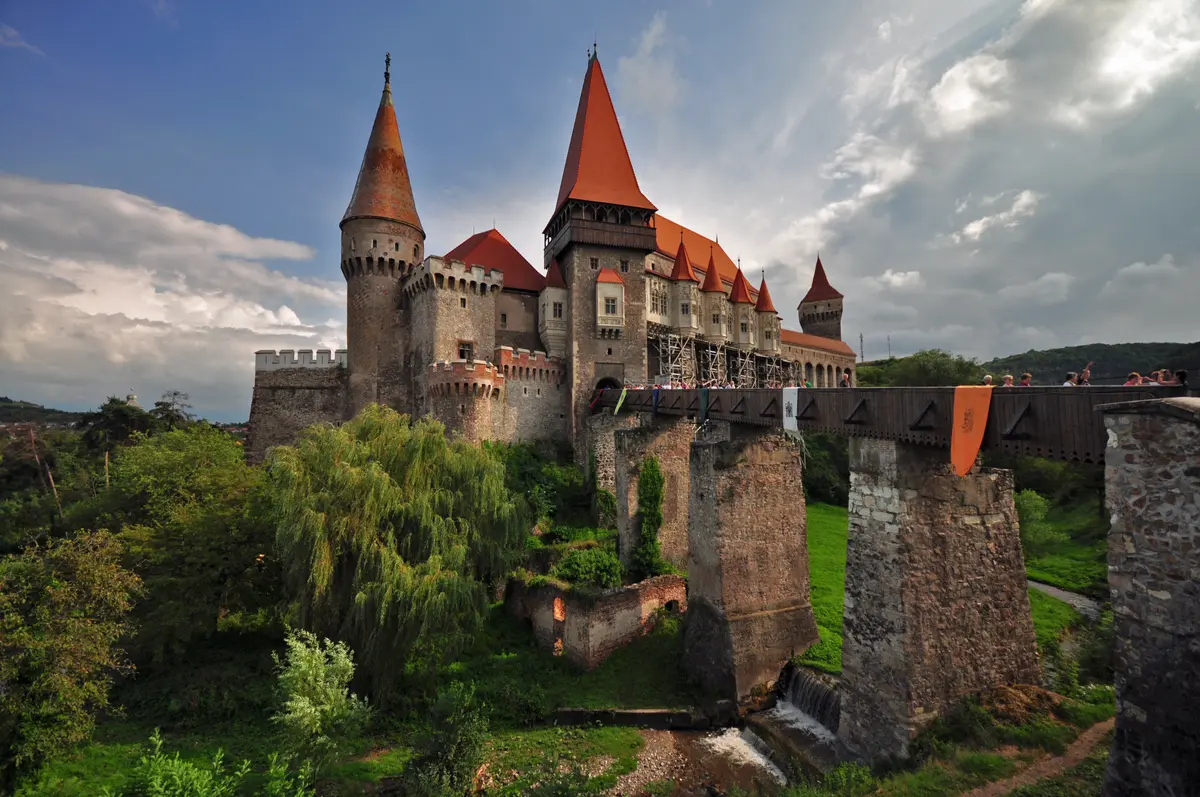
The man who turned it into a castle was that same Ioan, John Hunyadi, Iancu de Hunedoara in Romanian, voivode of Transylvania. After 1440 he threw two curtain walls around the old fortress and flanked them with circular towers, the Capistrano, the Deserted and the Drummers' towers, a novelty in fifteenth-century Transylvanian military architecture, and with rectangular gate towers reached by bridges on stone piers whose last spans could be raised. The well that most of this file turns on was sunk in the space between the old curtain wall and the new one. The first building phase closed before 1446, the year Hunyadi was elected regent-governor of Hungary, and from then on the programme tilted from the military towards the civil: the chapel on the east side, and on the west the Knights' Hall and the Diet Hall, twin rectangular rooms divided by octagonal marble pillars under late Gothic vaulting, the finest civil interiors of their kind in Transylvania. The suspended gallery running out to the Neboisa tower is over 33 metres long; the name is Serbo-Croat for "do not be afraid" and was probably left by the Serbian mercenaries of the garrison.
Hunyadi died in 1456 and the work stalled. His son Matthias Corvinus resumed it after 1458 with the Matia wing and its secular wall painting, and building ceased around 1480. The sixteenth century added little. In 1534 the castle was besieged and partly wrecked in the quarrel between its lord Valentin Torok and the supporters of John Zapolya, and in 1599 part of the castle and of the town burned during Michael the Brave's campaign. Prince Gabriel Bethlen, who took over the estate in the seventeenth century, built the Great Palace facing the town, the White Tower and the artillery bastion; his initials and the years 1624 and 1629 are still legible on a wall of the east wing.
Then came the fire. On the night of 13 April 1854 flames broke out in the north-facing rooms, a strong north wind carried them, and the whole building burned. Between that fire and earlier ones the ruin became known locally as the Black Castle.
What visitors photograph today is in large part what nineteenth-century architects made of the wreck, and the museum's own account of the restorations is unusually frank about it. Ferenc Schulcz, working from Lajos Aranyi's drawings but by the canons of his century, under which a monument had to be restored into a single unified style, demolished the interior fittings of the Knights' Hall and stripped its plaster, destroying the surviving traces of painting along with it. Imre Steindl, later the architect of the Hungarian Parliament in Budapest, carried on from a premise the museum calls mistaken: that Hunedoara was to become a royal castle, a summer residence for the imperial court. He raised the north palace, the west tower and the south palace, altered the crenellations, dismounted and standardised every window frame in neo-Gothic, and designed the roofs the castle wears today. He resigned in 1874 when the budget would not stretch to his plans. His successor Iuliu Piaczek plastered every surface inside and out and did away with the old carved decoration, most of it thrown away or reused as masonry, an episode the museum describes as ending the works sadly. Antal Khuen took over in 1876, and only in 1907 did Istvan Moller resume on scientific principles, with excavation and wall analysis, explicitly trying to undo his predecessors.
The journalist Ion Mehedinteanu, visiting in 1928, found the last pre-war campaign abandoned in mid-course: the Knights' Hall complete, the roof replaced, the stone facade nearly repaired, and the rest, he wrote, "threatened with collapse in places". A further restoration phase began in 1956, the castle museum opened in 1974, and since 2018 the monument has been going through the first complete restoration since the nineteenth-century one.
Timeline: the documented record of Corvin Castle
- 18 October 1409 King Sigismund of Luxembourg grants the royal possession of Hunedoara, "possessionem nostram regalem Hwnyadwar", to the knight Voicu and his family; the deed names his son Ioan, the future John Hunyadi. The museum publishes the Latin wording and the archival route by which the document survived.
- 1443 First documentary attestation of the fortress itself, in a document issued by John Hunyadi. The earlier stone fortification on the rock is dated to the fourteenth century.
- before 1446 The first building phase closes, with two curtain walls, circular and rectangular towers and the well sunk between the old wall and the new one. Hunyadi is elected regent-governor of Hungary and the programme turns towards civil architecture: the chapel, the Knights' Hall and the Diet Hall.
- Late autumn 1462 Vlad III of Wallachia is arrested on the orders of King Matthias Corvinus. His captivity is documented at Visegrad and Buda and later relaxes into a supervised residence, with a house in Pest, a conversion to Catholicism and a marriage into the Szilagyi family; he is released in 1475. No document places him at Hunedoara, whose builder had died in 1456.
- 13 April 1854 Fire breaks out at night in the north-facing rooms and, driven by a strong north wind, consumes the whole building. Between this fire and earlier ones the ruin becomes known locally as the Black Castle.
- 1868-1874 Ferenc Schulcz demolishes the interior of the Knights' Hall and strips its plaster; Imre Steindl, later architect of the Hungarian Parliament, continues from what the museum calls the mistaken premise that Hunedoara was to become an imperial summer residence, and designs the roofs the castle wears today. He resigns in 1874 over the budget.
- 1907 Istvan Moller is appointed chief architect and resumes work on scientific principles, with archaeological excavation and wall analysis, expressly to undo the distortions of his predecessors.
- 1928 The journalist Ion Mehedinteanu publishes a report in the newspaper Dimineata: the well is twenty-five metres deep, finished in sixteen years, with no execution in the story; the bear pit is fed with the corpses of prisoners; and the caretaker Vasile Cozma, asked point blank about the castle's strigoi, replies that he has lived there for ages and never seen one, and that it is all nonsense.
- 22 December 1969 The UPI correspondent Aline Mosby publishes "Transylvania, where the real Dracula lived?", identifying Hunedoara rather than Bran as the castle behind Bram Stoker. It is the earliest datable printed appearance found for the Corvin-as-Dracula's-castle claim.
- 1974 The Corvin Castle Museum opens, initially with medieval pieces and later with archaeology, ethnology, decorative arts and old books.
- 23 February 2007 Most Haunted Live broadcasts from Corvin Castle, hunting the ghost of Vlad the Impaler through the guards' passage, the old gate tower, the White Tower and the Bethlen wing.
- 31 October 2013 Ghost Adventures airs its Halloween special filmed at the castle the previous summer, describing it as full of torture chambers. The haunted reputation dates from television rather than from local tradition.
- 2022 Sorin Tincu, archaeologist and director of the Corvin Castle Museum, tells Adevarul that the imprisonment of Vlad the Impaler in the cellar under the Knights' Hall is a legend unsupported by documents, and that the room may simply have been a passage linking other spaces.
- May 2026 Work in the well shaft shows that it is not a storage cistern but a live spring, sealed under debris and the coins thrown in by visitors, which are recovered and studied to date the coin-tossing habit.
Is there a rational explanation for Corvin Castle?
Start with the claim everyone repeats, because it is the one that does not survive contact with the sources.
Vlad III of Wallachia was arrested in the late autumn of 1462 on the orders of King Matthias Corvinus, not of John Hunyadi, who had died six years earlier in 1456. His captivity is documented at Visegrad and Buda, and it softened over time into something closer to a supervised residence: he was granted a house in Pest, converted to Catholicism, and married a noblewoman from the Szilagyi circle, the king's own kin, before being released in 1475. No document places him in the cellar under the Knights' Hall at Hunedoara. Sorin Tincu, the archaeologist who directs the Corvin Castle Museum, put it plainly to the newspaper Adevarul in 2022: the story that Vlad was imprisoned in that room, a space of some fifteen square metres reached by a wooden trapdoor in the floor of the hall above, is "a legend, unsupported by documents", and the passage may simply have linked other rooms and towers. This is not a live dispute among historians. It is an absence of evidence, and saying that scholars argue over how long he was held there quietly grants the premise.
The story can be dated. On 22 December 1969 the American wire reporter Aline Mosby, then a United Press International correspondent who spent six months living in Bucharest, filed a piece headlined "Transylvania, where the real Dracula lived?" and answered her own question with Hunedoara: "the fifteenth-century castle rises from the abyss and pierces the grey winter sky. It is as Stoker wrote: a place of shadows." She also recorded what the townspeople actually told her, which was not a castle legend at all: a tunnel under the rock full of stakes, and the local practice of driving a stake through the hearts of the dead. A frequently repeated claim that Mosby later confessed, in her 1991 oral history for the Washington Press Club Foundation, that Romanian tourism took the Dracula idea from her reports could not be confirmed for this file: the four sessions of that interview run to some 72,000 words and contain no occurrence of Dracula, Transylvania, vampire or castle, with Moscow and UPI appearing more than a hundred times each as controls. What the transcript does confirm is that she was posted to Eastern Europe from 1968 and lived six months in Bucharest.
The well legend is the clearest case, because the institution that sells the tickets debunks it on its own website. The museum tells the story in full: three Turkish prisoners promised their freedom by John Hunyadi if they dug down to good water, fifteen years of digging, water at twenty-eight metres, Hunyadi dead by then and his widow Elisabeta Szilagyi refusing to honour her husband's word and having the three killed, and the inscription they asked to carve as a last wish, "you have water, but no heart". And then the same page adds that the inscription, read by the Orientalist Mihail Guboglu, actually says: "the one who wrote it is Hassan, a prisoner of the giaours in the fortress next to the church." Its old Arabic characters date it to the middle of the fifteenth century, and it is not at the bottom of the well or on its rim: it sits on one of the buttresses of the chapel. The legend has also visibly grown. In 1928 Ion Mehedinteanu recorded it in the newspaper Dimineata as a well twenty-five metres deep, finished in sixteen years, dug by Turkish prisoners whose number he does not give, and with no execution in it at all. The killing, the count of three and the depth of twenty-eight metres are later. Work on the shaft in May 2026 established something else: it is not a cistern but a live spring, sealed under debris and the coins tourists throw in.
The bear pit has the same shape. Mehedinteanu described it in 1928 as a pit between the chapel and the Bethlen wing where bears were fed with the corpses of prisoners thrown down from the Knights' Hall into an adjoining cellar, reaching them through an underground passage. The modern version, in which living prisoners are lowered to be torn apart, is an escalation of a story that was already about bodies.
As for the ghosts, the oldest testimony available is a denial by a man with a name. Asked in 1928, on the spot, whether the strigoi stories about the Hunyadi castle were true, its caretaker Vasile Cozma answered: "I have lived here for ages and I have never seen a single strigoi. Everything they say is nonsense." The museum's own pages carry no ghosts either: its tour describes the well as thirty metres deep and says nothing of hauntings, and its page of legends holds only three, the raven of the family arms, the well, and a folk poem about three fairies who built the fortresses of the region. The haunted reputation is traceable to television rather than to tradition. Most Haunted Live broadcast from Corvin Castle on 23 February 2007 hunting the ghost of Vlad the Impaler through the guards' passage, the old gate tower, the White Tower and the Bethlen wing; Ghost Adventures filmed its Halloween special there in the summer of 2013 and aired it on 31 October. Both arrived at a building whose famous silhouette, red conical roofs included, was designed in the 1870s by an architect who thought he was building a summer palace for an emperor.
Can you visit Corvin Castle?
Corvin Castle is a state-owned museum in the middle of a working town, and it is open to the public with an ordinary ticket. There is no ghost tour and no night-time paranormal programme on sale.
The address is Curtea Corvinestilor 1-3, Hunedoara, in Hunedoara county, on a limestone rock at the south-western edge of the town; the museum also gives its address as Strada Castelului 1-3. By road the approach is the DN7 to Santuhalm and then the DJ687 into Hunedoara. For the 2026 summer season, from 1 April to 30 September, the castle opens Monday from 12:00 to 20:00 and Tuesday to Sunday from 9:00 to 20:00. Adult admission is 55 lei, pensioners 30 lei and pupils and students 15 lei with valid identification; groups of twenty or more pay 45, 25 and 10 lei respectively. Photography costs 15 lei and video 30 lei. A guided tour in Romanian is 60 lei and in English or Hungarian 100 lei. Preschool children, people with severe disabilities and their companions enter free. The ticket also covers the Guild House and the archaeology exhibition. Allow at least an hour and a half to two hours for the full circuit.
The museum warns visitors not to lean over the parapets and notes that the architecture is awkward for small children, for elderly visitors and for anyone with reduced mobility: stairs are steep and uneven, several towers are reached by narrow spiral flights, and the suspended gallery and bridges are long and exposed.
Anyone visiting in 2026 should check what is open before travelling. The monument has been under restoration since 2018 in two publicly funded phases, five million euros between 2018 and 2023 through the regional operational programme and about 6.6 million more under Romania's national recovery and resilience plan, some 11.6 million euros in all; the works were due to be finished by 31 August 2026 and are the first complete restoration of the castle since the nineteenth-century campaign of 1868 to 1914. The castle has stayed open while they proceed, but individual spaces close in rotation. Three areas are being added to the visiting circuit for the first time: the chapel bridge, the space between the walls, between the Old Gate Tower and the Deserted Tower, and the bear pit itself, which until now could only be looked down into from the terrace of the artillery bastion.
Sources consulted
- Muzeul Castelul Corvinilor, «Mentiuni documentare: actul de donatie din 18 octombrie 1409» — Official site of the Corvin Castle Museum, 2026 archive
- Muzeul Castelul Corvinilor, «Scurta istorie: fazele de constructie ale castelului» — Official site of the Corvin Castle Museum, 2026 web
- Muzeul Castelul Corvinilor, «Restaurarea castelului: istoricul lucrarilor de restaurare» — Official site of the Corvin Castle Museum, 2026 web
- Muzeul Castelul Corvinilor, «Legendele castelului: legenda fantanii si traducerea inscriptiei de Mihail Guboglu» — Official site of the Corvin Castle Museum, 2026 web
- Muzeul Castelul Corvinilor, «Info vizitatori: program si tarife 2026» — Official site of the Corvin Castle Museum, 2026 web
- Daniel Guta, «Castelul Corvinilor, plin de secrete intunecate. Legendele uitate care ii infiorau pe oaspeti» — Adevarul, quoting at length Ion Mehedinteanu's 1928 report in the newspaper Dimineata, 2023 newspaper archive
- Daniel Guta, «Adevaratul castel al lui Dracula. Cum a schimbat reportajul celebrei Aline Mosby istoria castelului din Hunedoara» — Adevarul, quoting Aline Mosby's UPI report of 22 December 1969, 2013 newspaper archive
- Washington Press Club Foundation, «Women in Journalism oral history project: Aline Mosby, four sessions, interviewed by Kathleen Currie» — Washington Press Club Foundation (consulted through the Internet Archive), 1991 interview
- Daniel Guta, «Adevarata temnita a lui Dracula. Beciul interzis din Castelul Corvinilor ascunde un secret infiorator» — Adevarul, quoting Sorin Tincu, director of the Corvin Castle Museum, 2022 newspaper archive
- Daniel Guta, «Descoperirea care spulbera legenda fantanii cu apa vie din Castelul Corvinilor» — Adevarul, 2026 newspaper archive
- Daniel Guta, «Mit sau realitate. Cum a devenit Castelul Corvinilor bantuit» — Ziarul Hunedoreanului, 2015 newspaper archive
- Mediafax, «Restaurarea Castelului Corvinilor se apropie de final. Noi zone vor fi deschise vizitatorilor» — Mediafax, 2026 newspaper archive
- Wikipedia in Romanian, «Castelul Corvinilor» — Wikipedia, article consulted in its wikitext source, 2026 web
Reviewed by V. Serrano on 2026-08-17 · How we verify our content
💬 Field testimonies (0)
No testimonies yet. Add the first.
Add your testimony
🔒 Log in to add a testimony