👻 HAUNTED PLACE · EXP. Nº9475
ACTIVE
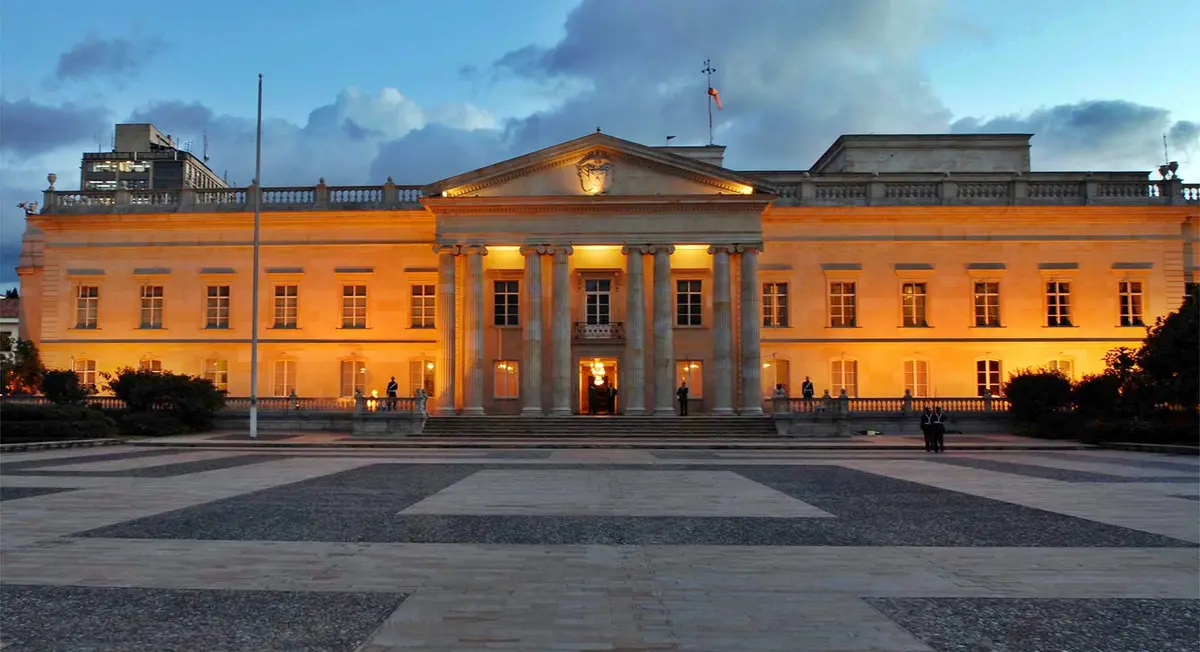
Casa de Nariño
Colombia's presidential palace is the rare haunted building where every witness has a name, a face and a dated press appearance.
Where is Casa de Nariño?
- Location
- Bogotá, Colombia
- Type
- House / mansion
- Coordinates
- 4.596, -74.078
- Last updated
LOCATION
Why is Casa de Nariño said to be haunted?
There is no anonymous night guard and no former employee: the accounts come from presidents and their children, on the record. César Gaviria told Semana in November 2024 that the palace is full of ghosts and that he saw them in his time; two weeks earlier Andrea Petro, daughter of President Gustavo Petro, had said she has never slept a single night there, placing the frights in the corridor hung with the presidents' photographs. In February 2025 Petro himself told the Spanish daily El País he would like to bring in a paranormal expert. The building takes its name from Antonio Nariño, born on this plot on 9 April 1765 — but his mother was forced to sell the house in 1784 and he was arrested ten years later, elsewhere, so the palace was never his prison. The Presidency's own 40-page visitor booklet does not contain a single word for ghost. Entry is free, and nobody here sells the story.
What is the history of Casa de Nariño?
Colombia's presidential palace is named after a man whose family had sold the house ten years before he became famous.
The plot lies in Bogotá's historic centre, between carreras 7 and 8 and calles 7 and 9. The Presidency's own visitor booklet records that Don Vicente Nariño bought the house there in 1751; the Presidency's website gives 1754 and adds a price of 5,200 patacones. The two official sources disagree by three years and neither cites a deed. What both agree on is what happened next: Antonio Nariño was born in that house on 9 April 1765, and he lived in it for roughly the first nineteen or twenty years of his life. On 19 January 1784 his mother, doña Catalina Álvarez, was obliged to sell it.
That date matters more than it looks. Nariño printed his clandestine translation of the Declaration of the Rights of Man in Santa Fe in December 1793 and was arrested at his residence in late August 1794 — ten years after his family had parted with the house where he was born. He was held in Santa Fe for some seventeen months, then shipped towards Africa by way of Cartagena, escaping at Cádiz in March 1796. The official booklet summarises his punishment as "prisión durante diez años en Cádiz y Cartagena de Indias". None of it happened on this plot.
The house passed through several owners until the national government acquired it in 1888, the year given by the booklet and by El Tiempo, which places the purchase under President Carlos Holguín; the Presidency's website gives 1885 and credits Rafael Núñez with making it the presidential residence. Before it became a presidential residence the old casona held, according to the same booklet, the ministries of War and of Government, the offices of Statistics, Street Cleaning, Lighting and Watch, the Ministries' Archive, the Faculty of Mathematics of the Universidad Nacional and the Supreme Court of Justice — a building that had been almost everything except a prison.
President Rafael Reyes, who wanted a modern palace, had most of the old structure demolished and commissioned the reconstruction from the French architect Gastón Lelarge; the Archivo de Bogotá's finding aid files the commission under 1903, and the Presidency's website, which dates the transformation to 1904, names the Colombian Julián Lombana as the second architect. The palace was inaugurated in 1908 as the Palacio de la Carrera; Jorge Emilio Sierra Montoya's history of the building in El Tiempo (2018) gives the date as 10 July 1908. The Presidency's 2008 booklet prints the year of the inauguration as 1918.
Lelarge (Rouen 1861 – Cartagena de Indias 1934) is tied to Charles Garnier, the architect of the Paris Opera, by the Archivo de Bogotá's own finding aid for the Lelarge collection, which lists under "Experiencia Profesional" the line "1861-1875. Ayudante de Charles Garnier": the dates run from the year of his birth to his fourteenth year.
The building then accumulated its surroundings. A sculpture of Nariño by the French sculptor Gerber was placed in the Plaza de Armas in 1910 for the independence centenary; an oil portrait of Nariño painted by Ricardo Acevedo Bernal in 1917 hangs, according to the booklet, in the President's own office. In 1921 the architect Pablo Cruz proposed the open space that became the Plaza de Armas, linking the palace to the National Capitol.
After the Bogotázo of 9 April 1948 the heads of state moved out to the Palacio de San Carlos and the Foreign Ministry took over Nariño's birthplace. A new remodelling was carried out under Alfonso López Michelsen (1974-1978), who, according to the Presidency's website, extended the palace to the west, north and south; the booklet records that in 1979, under Julio César Turbay, the move back into the restored building was completed. The Petro family moved in during August 2022.
Timeline: the documented record of Casa de Nariño
- 1751 Don Vicente Nariño buys the house on the Calle de la Carrera. The Presidency's official visitor booklet gives this year; the Presidency's own website gives 1754 and a price of 5,200 patacones. Neither cites a deed.
- 9 April 1765 Antonio Nariño is born in the house. He will live there for roughly his first nineteen or twenty years; the palace takes its name from this fact and from nothing else.
- 19 January 1784 Nariño's mother, doña Catalina Álvarez, is obliged to sell the house. From this date the family has no connection to the plot, ten years before Nariño's arrest.
- August 1794 Nariño is arrested at his residence in Santa Fe for printing his translation of the Declaration of the Rights of Man. He is held in Santa Fe for some seventeen months and then shipped towards Africa via Cartagena. The official booklet places his ten-year sentence in Cádiz and Cartagena de Indias, not in Bogotá.
- 1888 After passing through several private owners, the property is acquired by the national government. Over the years the old casona houses the ministries of War and Government, several municipal offices, the Faculty of Mathematics and the Supreme Court of Justice.
- 1903 President Rafael Reyes commissions the reconstruction of the Palacio Presidencial de la Carrera from the French architect Gastón Lelarge, who works with the Colombian Julián Lombana. Most of the colonial structure is demolished. The date comes from the Archivo de Bogotá's finding aid for the Lelarge collection.
- 1908 The Palacio de la Carrera is inaugurated under Rafael Reyes; El Tiempo's 2018 history of the building gives the date as 10 July 1908. The Presidency's 2008 visitor booklet misprints the year as 1918.
- 1917 Ricardo Acevedo Bernal paints the oil portrait of Antonio Nariño that hangs, according to the Presidency's 2008 booklet, in the President's own office.
- 9 April 1948 After the Bogotázo the heads of state move out to the Palacio de San Carlos and the Foreign Ministry occupies Nariño's birthplace.
- 1979 After a remodelling carried out under Alfonso López Michelsen, the presidential residence returns for good under Julio César Turbay, once the building has been restored.
- 6 August 2018 Father Jesús Hernán Orjuela, 'Padre Chucho', says publicly that he has been asked to exorcise the places where the incoming rulers will live. El Colombiano reports him retracting the statement within days.
- 27 February 2024 Infobae reports the revelations in Felipe Zuleta Lleras's book Las primeras damas: several presidents' wives say they found objects of brujería in the palace. Zuleta is quoted saying 'Casi todas tienen en común el tema de haber encontrado vainas de brujería'. The claim is about people planting objects, not about ghosts.
- 17 November 2024 Semana publishes an interview with Andrea Petro, daughter of President Gustavo Petro, in which she says she has not slept a single night in the palace: 'asustan de noche y no me gusta'. She locates the frights in the corridor holding the photographs of the presidents, and describes the atmosphere as 'muy frío y muy pesado'.
- 30 November 2024 Semana, Infobae and the Cali daily El País each publish round-ups in which former presidents answer the same question. César Gaviria: 'Uy claro, allá hay fantasmas y en todos los alrededores. Se sienten en las noches y hacen ruidos. No me dan miedo, pero Palacio está lleno de fantasmas, en mi época los vi'. Álvaro Uribe deflects it: 'los espantos dicen que el espanto soy yo'.
- 26 February 2025 In an interview with the Spanish daily El País, President Gustavo Petro calls the palace a bad French imitation and says: 'Debe estar lleno de fantasmas. Tengo ganas de traer a un experto en estas materias'. No follow-up is recorded.
Is there a rational explanation for Casa de Nariño?
Nobody sells the ghosts of the Casa de Nariño. The guided tour is a free public service of the Presidency, booked through a government form for groups of at most 20 people, according to the DAPRE page that describes it (consulted on 6 October 2026). When Andrea Petro told Semana in November 2024 that "deberían hacer como unas visitas nocturnas en el Palacio de Nariño porque asustan de noche", she was suggesting that the palace should start opening at night. The usual sceptical explanation for a famous haunting, that somebody has tickets to sell, has nothing to work on here.
The institution is also silent in print. The Presidency's 40-page visitor booklet, first edition March 2008, runs to about 4,100 words. A count made on 6 October 2026 on the text extracted from the PDF finds no occurrence of fantasma, espanto, espectro, aparición, embrujo or paranormal; the same count finds "Nariño" 52 times, so the text is being read. The booklet's single "espíritu" is Nariño's "combativo espíritu patriótico". The Presidency's history page and the DAPRE page on the guided visits do not contain the word fantasma either.
The people who have lived in the palace talk about it on the record. In an interview with the Spanish daily El País, reported by Semana on 26 February 2025, the sitting president Gustavo Petro called the building a bad French imitation and said: "Debe estar lleno de fantasmas. Tengo ganas de traer a un experto en estas materias." The institution prints nothing on the subject, and its residents give quotes.
Most of the testimony now in circulation was published within two weeks. On 17 November 2024 Semana ran its interview with Andrea Petro; on 30 November it published a round-up in which former presidents, their children and priests were asked the same question, and Infobae and the Cali daily El País published their own round-ups the same day. The earlier items are of a different kind: Padre Chucho's talk of an exorcism in August 2018, the report in February 2024 on Felipe Zuleta Lleras's book about the first ladies, and Padre Chucho's interview with Semana in March 2024.
The reports also mix two different claims. Zuleta's book Las primeras damas, as Infobae reported it, is about brujería: "Casi todas tienen en común el tema de haber encontrado vainas de brujería", objects that someone would have had to bring into the palace. The accusation is aimed at whoever planted them, and Semana's round-up of 30 November 2024 places it beside the ghost stories. The two most quoted witnesses also name different places: Andrea Petro puts the frights in the corridor with the photographs of the presidents, and Simón Gaviria, who lived in the palace as a child from 1990 to 1994, recalls that "había muchos cuentos en el salón de retratos de los presidentes".
The clerical testimony has changed more than any other. Father Jesús Hernán Orjuela, "Padre Chucho", told Semana in March 2024 that he had visited a route leading from the palace to an old house where "se sentía la infestación", and described what he did there as a blessing and a recommendation: "lo bendije, hice una recomendación y no sé qué pasó". In August 2018, after he had said publicly that he was being asked to exorcise the places where the incoming rulers would live, El Colombiano reported him withdrawing the statement within days.
Finally, the mundane reading. The Casa de Nariño is the working seat of the government, guarded by the Batallón Guardia Presidencial, whose changing of the guard the 2008 booklet places on Mondays, Wednesdays, Fridays and Sundays. In the same Semana interview Andrea Petro said that "los policías y la seguridad cuentan que te prenden luces, se apagan luces". A palace that is occupied and patrolled around the clock produces footsteps, doors and lights at night, and the place most often named is a corridor hung with the photographs of every president.
Can you visit Casa de Nariño?
The Casa de Nariño can be visited, free of charge, and the ghost stories have nothing to do with it: the tour is a public service run by the Presidency, not an attraction.
Booking is done online through the official form at formulariovisitas.presidencia.gov.co, which is where the schedule and the current conditions are published. The group coordinator who fills in the form must be over 18 and has to supply the full name and identity-document number of every person attending; confirmation arrives by email. Groups are capped at 20 people per time slot, and larger parties have to be split across slots because the booking system will not accept more. The tour is offered in Spanish or English, chosen on the form, and any visitor with a disability should be declared there.
Reported time slots are Monday to Saturday at 09:00, 10:30, 14:00, 15:30 and 16:00, and Sunday and public holidays at 14:00, 15:30 and 16:00, with the walk-through lasting about 45 minutes. Confirm these against the form before travelling, as they change.
Entry is through the door at Carrera 8 No. 7-26, in the historic centre, and visitors are asked to arrive 20 minutes early with the identity document they registered. Security restrictions are strict for a tourist visit: bags and briefcases, cameras, video equipment and mobile phones are not admitted, sportswear such as shorts and sandals is not accepted, and food, drink and animals are not allowed. Minors must be accompanied by an adult.
Two things are worth setting expectations about. First, the route covers defined areas of the building — the state rooms, the Plaza de Armas, the ceremonial spaces — and not the family's private quarters, which is precisely where the accounts in this file are set. Second, there is no night visit and no paranormal component of any kind: nobody at the palace offers, sells or acknowledges one, and President Petro's stated wish to bring in a paranormal expert has no recorded follow-up.
Visitors who want the ceremonial set piece rather than the interior can watch the changing of the presidential guard for free and without booking. It is held at the Plaza de Armas, also known as the Plaza Núñez, on Wednesdays, Fridays and Sundays at 15:00, performed by Infantry Battalion 37. The Astronomical Observatory built in 1803 at the instigation of José Celestino Mutis, to a design by fray Domingo de Petrés and described as the first in South America, stands within the grounds and is visible from the plaza.
Sources consulted
- Presidencia de la República de Colombia, Secretaría de Prensa, «La Casa de Nariño (folleto oficial de visitas guiadas)» — Imprenta Nacional de Colombia (ISBN 978-958-18-0342-2), 2008 report
- Archivo de Bogotá, «Guía colección Gastón Lelarge» — Secretaría General, Alcaldía Mayor de Bogotá, 2015 archive
- Redacción Semana, «Fantasmas en la Casa de Nariño: expresidentes, hijos de exmandatarios y sacerdotes confirman que en Palacio asustan; estas son las historias» — Semana, 2024 newspaper archive
- Redacción Semana, «¿Fantasmas en la Casa de Nariño? Andrea Petro reveló insólita historia del palacio presidencial» — Semana, 2024 newspaper archive
- Iván Gaitán, «Fantasmas en la Casa de Nariño: estas son las historias de espanto de la residencia presidencial según algunos exhabitantes» — Infobae, 2024 newspaper archive
- Fernando José Bejarano Zorrilla, «Así son las historias de los presuntos fantasmas que atemorizan en la Casa de Nariño, según expresidentes y sus familiares» — El País (Cali), 2024 newspaper archive
- Redacción Semana, «El padre Chucho cuenta experiencia espiritual con Álvaro Uribe, habla de expresidentes y recuerda infestación en la Casa de Nariño» — Semana, 2024 newspaper archive
- Juan Sánchez Romero, «Casi todas las primeras damas encontraron «brujería» en la Casa de Nariño: las revelaciones del periodista Felipe Zuleta» — Infobae, 2024 newspaper archive
- Redacción Semana, «¿Cazafantasmas para la Casa de Nariño? Petro habló de su deseo de llevar un experto en actividad paranormal» — Semana, 2025 newspaper archive
- Helena Cortés Gómez, «Que sí y ahora que no al exorcismo del Padre Chucho a la Casa de Nariño» — El Colombiano, 2018 newspaper archive
- Presidencia de la República de Colombia, «Historia de la Casa de Nariño» — casanarino.presidencia.gov.co, 2024 web
- Departamento Administrativo de la Presidencia de la República (DAPRE), «Visitas Guiadas a la Casa de Nariño» — dapre.presidencia.gov.co, 2025 web
- Jorge Emilio Sierra Montoya, «La historia de la Casa de Nariño, el palacio presidencial de Colombia» — El Tiempo, 2018 newspaper archive
Reviewed by V. Serrano on 2026-08-17 · How we verify our content
💬 Field testimonies (0)
No testimonies yet. Add the first.
Add your testimony
🔒 Log in to add a testimony