📜 LEGEND · EXP. Nº0270
ACTIVE
El Dorado
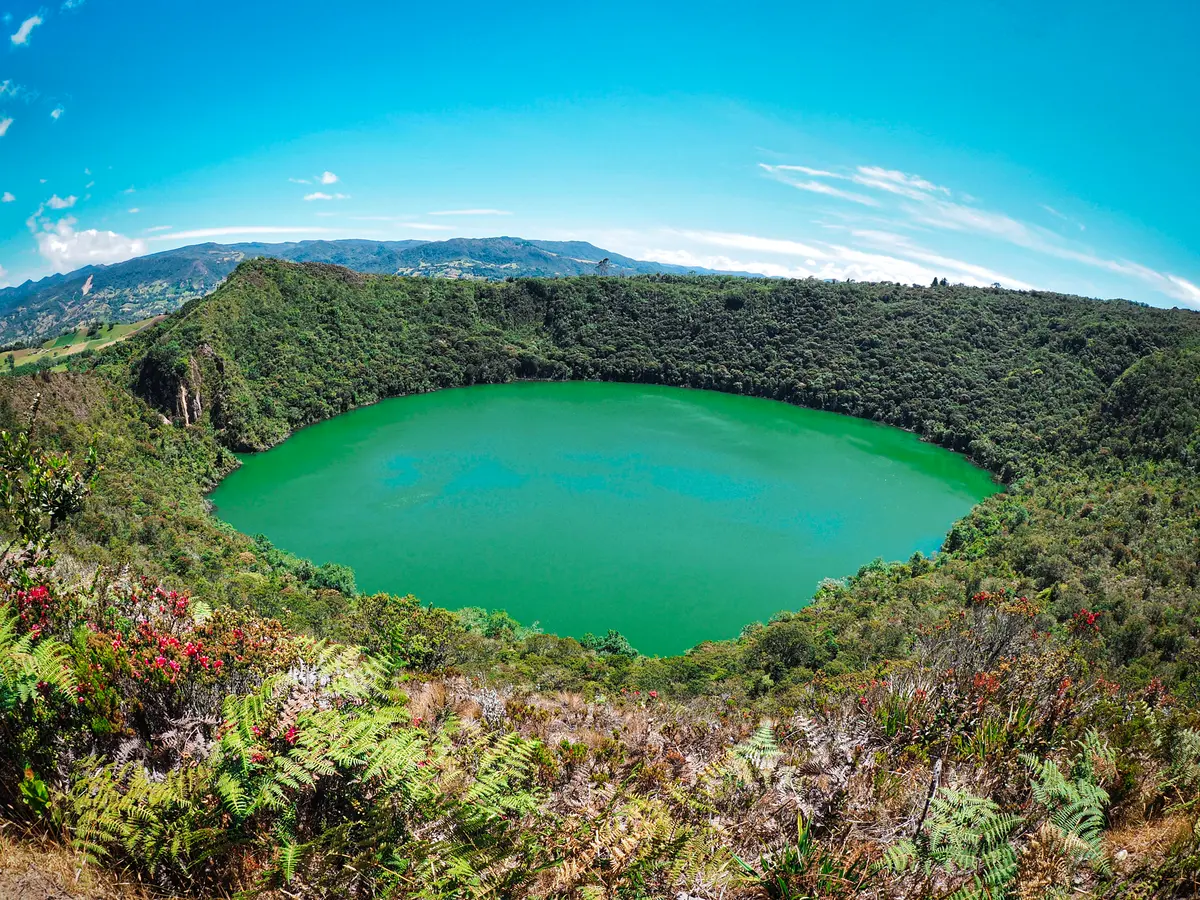
El Dorado — Spanish for "the golden one" — began not as a city but as a man: a Muisca ritual in which a newly chosen chief was covered in gold dust and, on a raft, cast offerings of gold and emeralds into the sacred waters of Lake Guatavita in the highlands of present-day Colombia.
Where does the legend of El Dorado come from?
- Location
- Lake Guatavita, Cundinamarca, Colombia
- Kind of legend
- Lost treasure
- Coordinates
- 4.978, -73.777
- Last updated
LOCATION
What is the legend of El Dorado?
Spanish conquistadors who heard fragments of the rite transformed it, over the sixteenth century, into the myth of a whole kingdom of gold hidden somewhere in the interior of South America. The legend launched some of the most disastrous expeditions of the colonial era, drawing men like Gonzalo Jiménez de Quesada and, later, Sir Walter Raleigh deep into the Amazon and the Andes in search of a city that never existed. Repeated attempts were even made to drain Lake Guatavita to reach the treasure believed to lie on its bottom. Though no golden city was ever found, the offerings recovered from Andean lakes are real, and El Dorado endures as the archetype of the unreachable treasure — a symbol of greed, obsession and the lengths to which people will go chasing a rumor of gold.
What is the history of El Dorado?
El Dorado was never a city. It was a man.
On the high plateau of what is now central Colombia lived the Muisca: farmers, weavers, traders in salt and emeralds, and superb goldsmiths who had no gold mines of their own. The metal reached them through barter from the lowlands, which is exactly why giving it to a lake was the most expensive gesture they could make. The mountain lakes were not scenery; they were points of contact with other levels of the cosmos.
The most detailed description of the rite was written around 1636 by Juan Rodríguez Freyle in the book known as El Carnero, which was not printed until 1859. Freyle did not witness it: he says the story came from the nephew of the last cacique of Guatavita. In his account the heir had to fast six years "metido en una cueva" — shut in a cave — with no women and no meat, salt or chilli. On the day of the investiture a great raft of rushes was built, four braziers burned moque incense aboard it, and the heir was smeared with sticky earth and dusted with powdered gold. At his feet they piled gold and emeralds to offer. Then Freyle writes the sentence that explains four centuries of destruction: from this ceremony, he says, came that celebrated name of El Dorado, which has cost so many lives and fortunes.
Before him, around 1541, a story was already circulating among the Spaniards in Quito about a lord who covered himself in gold dust each morning and washed it off each night; Gonzalo Fernández de Oviedo recorded it in his Historia general y natural de las Indias. At that point "el dorado" still meant a person.
The turn from man to city was European and simple. As the critic Jonathan McAloon put it reviewing the British Museum's 2013 exhibition, the conquistadors heard these tales and convinced themselves that people with that much gold to throw away must have built a city out of it. From then on El Dorado migrated across the map. Jiménez de Quesada, who had reached the Muisca highlands in 1537, set out again in 1569 into the eastern plains and failed. Gonzalo Pizarro and Francisco de Orellana looked for it from Quito in 1541 and ended up descending the Amazon by accident. The German Philipp von Hutten was beheaded in Venezuela in 1546 on his way back from the search. Walter Raleigh called it Manoa, chased it in 1595 and again in 1617, and was executed in London in 1618. No expedition moved under its own power: every one ran on thousands of Indigenous people forced to carry, guide and die in them.
Timeline: the documented record of El Dorado
- 1537 Gonzalo Jiménez de Quesada reaches the Muisca highlands on an expedition in search of gold and comes upon Lake Guatavita.
- c. 1541 A story circulates among the Spaniards in Quito about a lord who covers himself daily in gold dust. Gonzalo Fernández de Oviedo records it in his Historia general y natural de las Indias: at this stage "el dorado" is still a man, not a place.
- c. 1580 Antonio de Sepúlveda cuts into the rim of the crater to drain Lake Guatavita. Some gold objects appear along the exposed edge, but a landslide blocks the cut before the lake empties.
- c. 1636 Juan Rodríguez Freyle writes El Carnero in Santa Fe, giving the first detailed account of the investiture rite — the six-year fast, the raft of rushes, the sticky earth and gold dust — and stating plainly that the celebrated name of El Dorado came from that ceremony. The book is not printed until 1859.
- 1898 The English engineer Hartley Knowles forms a company to exploit the lagoon, using a steam pump. The haul is eventually sold at Sotheby's in London for 500 guineas.
- 1909 Contractor Limited drives a tunnel to drain the lake. The bed is exposed, but the mud bakes hard as cement in the sun and the work is abandoned; the lake fills again.
- 1965 The Colombian authorities protect the lake and put an end to treasure hunting on the site.
- 1969 Cruz María Dimaté finds the Muisca raft inside a ceramic vessel in a cave at Pasca, south of Bogotá — not at Guatavita. Cast in a single piece by the lost-wax method, 19.5 cm long, it shows a central cacique surrounded by ten figures on a raft. The Banco de la República acquires it that same year.
- 2024 Juan Pablo Quintero-Guzmán publishes the results of a 2009 survey around Lake Guatavita in Latin American Antiquity, concluding that the site was a shrine for small-scale ritual offerings rather than the setting of the spectacular ceremonies described by the chroniclers.
Is there a rational explanation for El Dorado?
What archaeology supports is more modest — and more interesting — than what the chronicles describe.
Juan Pablo Quintero-Guzmán's survey around Lake Guatavita, published in Latin American Antiquity (vol. 35, no. 2, pp. 483-499; online in August 2023), concludes that "the type and distribution of the material culture suggest that there was a shrine where small-scale ritual offerings took place, rather than conspicuous celebrations". The same abstract says the lake's fame as the great Muisca shrine "was fueled by Spanish chronicles during the sixteenth and seventeenth centuries".
The fullest of those chronicles was written by a man who had not seen the rite. Juan Rodríguez Freyle dates the chapter to 25 April 1636, the night he turned seventy, and names his source: his friend Don Juan, cacique of Guatavita, nephew of the lord the conquistadors found in office, who told him he was in the six-year fast for the succession when the Spaniards entered the kingdom by Vélez. The ceremony of El Carnero is a successor's account of the rite he was preparing for, set down by Freyle about a century after the conquest.
Of the golden city there is nothing: no wall, no plan, no find.
The lake itself is the best evidence. According to The City Paper Bogotá, the Spaniards made their first attempt in 1545 with relays of Muisca labourers scooping out water in clay pots; a few decades later 8,000 labourers cut a notch in the crater rim and drained some twenty metres of water before the workings collapsed, "killing many". The World History Encyclopedia puts that cut, Antonio de Sepúlveda's, in the 1580s, with some gold objects found along the exposed edge before a landslide blocked it. In 1898 Hartley Knowles formed a company to exploit the lagoon, later called Contractors Limited, which drove a tunnel from the centre of the lake; the bed was left almost dry and the mud baked in the sun until it set like cement. The City Paper dates the draining to 1904 and the encyclopedia to 1909. What the company recovered fetched 500 guineas at Sotheby's in London.
The Muisca raft in the Gold Museum was found at Pasca. The Banco de la República's encyclopedia records that Cruz María Dimaté found it in 1969 inside a ceramic vessel in a small cave in the páramo of Pasca, south of Bogotá, and that it "no se encontró en la laguna de Guatavita"; for the bank, the find confirmed that the ceremony was real.
Can you visit El Dorado?
Lake Guatavita lies in the municipality of Sesquilé, Cundinamarca, inside the forest reserve that the regional environmental authority, the Corporación Autónoma Regional de Cundinamarca (CAR), runs as the Reserva Forestal Protectora Laguna del Cacique Guatavita y Cuchilla de Peña Blanca. The CAR's page for the reserve, in the version archived by the Internet Archive on 4 March 2024, put it 57 km from Bogotá at 3,100 metres above sea level. Visits are guided: the same page said that walks set off every 15 to 20 minutes and last about two hours on average, and that visitors must stay with their group and a CAR guide; it noted that the reserve has no car park and recommended leaving cars in guarded car parks in Sesquilé or Guatavita, and that the only toilets are at the start of the path. The Banco de la República's encyclopaedia records a find on the lake's own ground: in 2006 a worker building the path around it turned up a ceramic vessel holding four gold pieces, which were handed to the Colombian Institute of Anthropology and History.
The Muisca raft is in Bogotá, in the permanent exhibition of the Banco de la República's Gold Museum on Parque Santander, at the corner of Carrera 6 and Calle 16. The museum's visitor page, last updated on 18 March 2026 and read on 24 September 2026, gives opening hours of 9:00 to 19:00 from Tuesday to Saturday and 10:00 to 17:00 on Sundays and holidays, with last entry an hour before closing; it is closed on Mondays, holiday Mondays included. From Tuesday to Saturday a ticket costs COP 21,000 for foreigners, COP 10,000 for Colombians and for resident foreigners and COP 5,000 for students, and on Sundays entry is free for everyone. The nearest TransMilenio station is the one named Museo del Oro.
The raft itself was found far from Guatavita. The encyclopaedia records that Cruz María Dimaté came across it in 1969 in a small cave in the páramo of Pasca, south of Bogotá, and that the Banco de la República acquired it in April of that year. It measures 19.5 cm in length, 10.1 cm in width and 10.2 cm in height, and according to the same entry it has stayed in Colombia through all of the museum's some 200 temporary exhibitions.
Sources consulted
- Juan Rodríguez Freyle, «Conquista i descubrimiento del nuevo reino de Granada… (El Carnero)» — Imprenta de Pizano i Pérez, Bogotá, 1859 book
- Juan Pablo Quintero-Guzmán, «El Dorado Offerings in Lake Guatavita: A Muisca Ritual Archaeological Site» — Latin American Antiquity, vol. 35, n.º 2, 2024 academic
- Museo del Oro / Enciclopedia del Banco de la República, «Balsa muisca» — Banco de la República de Colombia, 2026 archive
- Stephen Hide, «A legend that lives on» — The City Paper Bogotá, 2014 newspaper archive
- Jonathan McAloon, «Lost Gold: Beyond El Dorado at the British Museum» — Apollo Magazine, 2013 newspaper archive
- Mark Cartwright, «El Dorado» — World History Encyclopedia, 2014 web
- Corporación Autónoma Regional de Cundinamarca (CAR), «¿Qué hacer? — Reserva Forestal Protectora Laguna del Cacique Guatavita y Cuchilla de Peña Blanca: 57 km from Bogotá, 3,100 m, guided walks every 15-20 minutes lasting about two hours, no car park (capture of 4 March 2024)» — parques.car.gov.co, via the Internet Archive, 2024 web
- Banco de la República, «Programa tu visita al Museo del Oro de Bogotá — address, opening hours, 2026 prices and free Sundays (last updated 18 March 2026)» — banrepcultural.org (read 24 September 2026), 2026 web
Reviewed by V. Serrano on 2026-07-29 · How we verify our content
📎 Source: Enigma Atlas
💬 Field testimonies (0)
No testimonies yet. Add the first.
Add your testimony
🔒 Log in to add a testimony