📜 LEGEND · EXP. Nº3657
ACTIVE
The Maiden's Tower of Istanbul (Kız Kulesi)
On a rock two hundred metres off the Uskudar shore, Istanbul's Maiden's Tower carries a story everyone in the city can tell: a ruler was warned that his daughter would die of a snakebite, shut her in a tower ringed by water, and a snake hidden in a basket killed her anyway.
Where does the legend of The Maiden's Tower of Istanbul (Kız Kulesi) come from?
- Location
- Üsküdar, Istanbul, Turkey
- Kind of legend
- Folk tale
- Coordinates
- 41.021, 29.004
- Last updated
LOCATION
What is the legend of The Maiden's Tower of Istanbul (Kız Kulesi)?
Line the printed tellings up by date, though, and the familiar version turns out to be the youngest of them. The seventeenth-century Ottoman explanation of the name, in Evliya Celebi, is a different legend altogether — the lord of Uskudar hiding his daughter from the frontier hero Battal Gazi — and it has no prophecy and no snake in it. The oldest full snake story we could read is French, printed in 1811: there the father is a sultan, the warning comes from a dervish in a dream, the girl has a name and is fourteen, the basket holds flowers carried in by her lover, and she survives — he sucks out the venom and marries her. The death, the eighteenth birthday and the fruit arrive in the 1830s. The tower itself has a better-documented life: toll post, fortress, lighthouse, quarantine hospital, radar station, cyanide store, and since 2023 a museum.
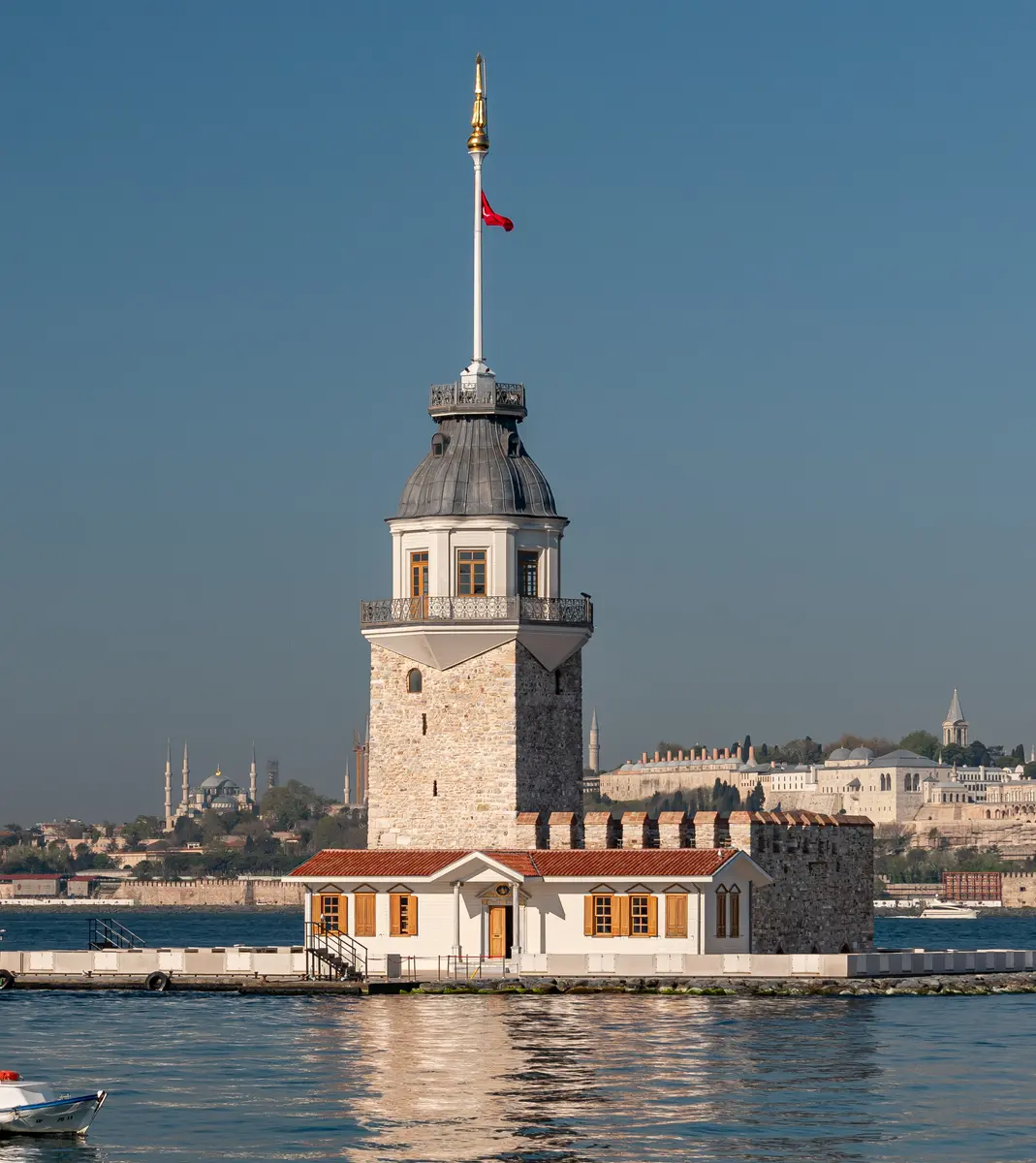
What is the history of The Maiden's Tower of Istanbul (Kız Kulesi)?
The rock is small and its paper trail is long. What follows is the history of the building; the story told about it has a history of its own, set out separately.
The Athenian toll-house stood in the town. Xenophon is the earliest witness and he is precise. After the victory at Cyzicus the Athenian squadron "reached Chrysopolis in Chalcedonia, where they built a fort, and established a custom-house to collect the tithe dues which they levied on all merchantmen passing through the Straits from the Black Sea", leaving thirty ships there under Theramenes and Eubulus (Hellenica I.1.22). Chrysopolis is Üsküdar. Xenophon puts the fort in the town and does not mention the islet. Modern accounts that plant Alcibiades' custom-house on this rock are extrapolating, and they do not even agree on the year: 411, 410 and 408 BC all circulate in print.
Damalis is a headland and a woman. Pierre Gilles surveyed the Bosphorus in person in the 1540s and printed the result as De Bosporo Thracio. Reading Polybius, Arrian, Dionysius of Byzantium and Georgios Kodinos against each other, he concluded that Scutari is Chrysopolis and that the place Polybius calls Bous (the Cow) and Arrian calls Damalis (the Heifer) is the Scutari promontory. There Chares the Athenian raised an altar and a column bearing a statue in white stone of Damalis, his wife; Gilles corrects Kodinos on several details of it. On Gilles's reading, the ancient monument stood on the cape.
The tower itself is twelfth-century. The Ministry of Culture and Tourism, following the standard literature, credits the first tower on the islet to the emperor Manuel I Komnenos (1143-1180), who paired it with a tower on the European side near the Mangana monastery so that a chain could be drawn between them and close the mouth of the strait. Byzantine texts call the rock Arkla, from the Latin arcula, a little castle. After 1453 Mehmed II rebuilt it as a fort with a garrison; Evliya Çelebi, writing in the 1640s, found a four-square tower "an arrow's flight from land", eighty zirâ high and two hundred paces round, with seven storeys of chambers, a rainwater cistern, an iron door, a warden named Çelebi Cüce, a hundred men and forty balyemez cannon.
Then the tower became a lighthouse, and the archive begins. A lantern was added under Ahmed III; in 1720-21 a spark from its oil lamp burned out the wooden interior, and in 1725-26 the grand vizier Nevşehirli Damat İbrahim Paşa rebuilt it with a lead dome and the lantern stage in masonry and glass. The secondary literature disagrees on those two dates: Mazlum notes that one standard account dates the fire to 1719 and another to 1720, and that the second one's Hijri and Gregorian dates do not match each other. The Ministry's own repairs page, as it stood in August 2026, prints the rebuild in 1725 and the fire it repaired in 1729. Deniz Mazlum's study of the Ottoman archives shows what the eighteenth century actually looks like from the inside, and it looks like maintenance. The oldest document she found is an account of 11 June 1731: the chief court architect Mehmed Ağa of Kayseri surveyed the lantern and the gun embrasures, estimated 215 kuruş and was paid 180. On 20 June 1734, 350 kuruş. On 8 April 1761 the chief architect Elhac Ahmed Ağa filed a 37-item survey — lead sheets torn off by the wind, the warden's and soldiers' rooms falling in, the oil room by the lantern, the cistern to be replastered, quay stones washed away by the sea — costing 2,526 kuruş 3 akçe; the work was signed off and 2,400 kuruş paid on 1 September 1762. Three years later his successor Mehmed Tahir Ağa found that two iron courtyard gates had been paid for and never fitted, so the seven cannon lay buried in sand and rubble; he had the 99 kuruş recovered from the dead architect's estate. In these papers the tower is not called Kız Kulesi but Kule-i Duhter, "the daughter's tower", or "the sea tower near Üsküdar". After the great earthquake of 22 May 1766 Mehmed Tahir Ağa surveyed it again; the repair cost 440 kuruş and was finished about six months later. Around 1790-91 Selim III wrote to his deputy in his own hand: "I have just been to the Maiden's Tower. There is not a single soul there. Let it be reported how many men the warden has." The answer, filed with it, was one warden and seven daily-paid soldiers, whose duties included firing a gun each time the sultan passed.
The silhouette we know is 1832-33. The last great Ottoman restoration, under Mahmud II, gave the tower its present form (an Ottoman-baroque segmented dome and a flagpole) and set over the door a marble inscription bearing the sultan's tughra in the hand of the calligrapher Mustafa Râkım. In 1830-31 the tower was turned into a quarantine hospital against cholera; it served the same purpose during the plague of 1836-37 and in 1847; Julia Pardoe, who saw it in 1836, calls it flatly "the plague-hospital of the Turks". In 1857 a French company installed a new lantern. In the twentieth century it was a lighthouse, a gas store, a radar station of the Bosphorus Command from 1966, and — until the city council intervened in 1992 — a cyanide depot; in May 1992 poets briefly occupied it and declared it a "Republic of Poetry". A 1943-44 overhaul had replaced floors, spire and flagpole with reinforced concrete. That concrete, made with sea sand full of shells and smooth bars that corroded, is what the 2021-2023 restoration removed: more than 500 tonnes of it, rebuilt in masonry and timber, under advisers Zeynep Ahunbay, Feridun Çılı and Han Tümertekin.
Timeline: the documented record of The Maiden's Tower of Istanbul (Kız Kulesi)
- 410 BC After the battle of Cyzicus the Athenian squadron builds a fort at Chrysopolis (Uskudar) with a custom-house levying a tithe on Black Sea shipping, garrisoned by thirty ships under Theramenes and Eubulus. Xenophon places it in the town; the islet is not mentioned.
- 1561 (edition read: Leiden, 1632) Pierre Gilles publishes De Bosporo Thracio, the first systematic survey of the strait. He identifies Scutari with Chrysopolis and the ancient Bous/Damalis with the Scutari headland, where Chares raised a column with a white stone statue of his wife Damalis. The name “Leander” does not occur anywhere in the book.
- c. 1640 Evliya Celebi describes the tower in the Seyahatname — four-square, eighty zira high, seven storeys, a cistern, an iron door, a warden named Celebi Cuce, a hundred men and forty balyemez cannon — and gives the Ottoman explanation of its name: the lord of Uskudar built it to hide his daughter and her treasure from Seydi Battal. No prophecy, no snake.
- 1680 (English translation, 1683) Grelot prints the European name and corrects it in the same sentence: the Turks call it Khes-Calasi, the Virgin's Castle, “the Europeans, though without any ground, Leanders Tower”, since it does not stand where Leander swam.
- 11 June 1731 The oldest eighteenth-century repair document Deniz Mazlum found in the Ottoman archive: the chief court architect Mehmed Aga of Kayseri surveys the lantern and the gun embrasures, estimates 215 kurus and is paid 180 from the imperial treasury.
- 8 April 1761 — 1 September 1762 Chief architect Elhac Ahmed Aga files a 37-item repair survey for “Kule-i Duhter” costing 2,526 kurus 3 akce; the work is signed off seventeen months later and 2,400 kurus are paid.
- 14 April 1764 His successor Mehmed Tahir Aga reports that two iron courtyard gates had been paid for and never fitted, leaving the seven cannon buried in sand and rubble, and has the 99 kurus recovered from the dead architect's estate.
- 22 May 1766 One of the most violent earthquakes in Istanbul's history, half an hour after sunrise, damages the tower. Mehmed Tahir Aga surveys it again; the repair costs 440 kurus and is finished about six months later.
- 1205 AH (1790-91) Selim III writes in his own hand to his deputy: “I have just been to the Maiden's Tower. There is not a single soul there. Let it be reported how many men the warden has.” The reply, filed with the note, is one warden and seven daily-paid soldiers.
- 1797 Dallaway sails past and records the tower “by some strange misapplication called Leander's. It is now a light-house; and tradition, more probably, reports it to have been the oblivious prison of a Greek princess.” The imprisonment is there; the snake is not.
- 1811 (2nd ed. 1820, Letter XXXVII) Castellan devotes a whole letter to the tale. The father is a childless Muslim sultan, the warning comes from a dervish in a dream, the girl's own mother chooses the sea rock, the daughter is named Mihir-Schighil and is fourteen, and the basket is a basket of flowers carried in by her lover, a Persian prince in disguise.
- 1822 Von Hammer summarises the same tradition, names Castellan as his source, identifies the lover as Sid al-Battal (Battal Gazi) and gives the ending: he sucks out the venom, the princess lives and he wins her hand. He also states that the first European traveller to call the rock Leander's Tower “mistook the Turkish legend about it for that of Hero and Leander”, and suggests it should rather be called the tower of Danae.
- 1832-33 The last great Ottoman restoration, under Mahmud II, gives the tower its present silhouette — segmented Ottoman-baroque dome and flagpole — and sets a marble inscription with the sultan's tughra, written by the calligrapher Mustafa Rakim, over the door.
- 1837 (visit of 1836) Julia Pardoe prints the fatal version: astrologers foretell death by a serpent “before the completion of her eighteenth year”; an adder “accidentally concealed in a box of figs” bites the princess, who is “found dead on her sofa”. She also records that the tower “is now the plague-hospital of the Turks”.
- 1838 Robert Walsh prints the same fatal ending but keeps the lover and the flowers: an unnamed sultan, an astrologer, a basketful of flowers sent through the language of flowers, and “a treacherous asp concealed among the leaves stung her to death”. In the same year Pardoe records both endings alive at once — storytellers told the death, poets sang the Persian prince who freed her.
- 7 October 2000 After a restoration begun in 1995 the tower opens as a leased tourist facility promising a “360-degree Istanbul”, a day cafe and an evening restaurant. The idea was not new: a Constantinople newspaper reported on 1 April 1880 that an Englishman wanted to lease the tower for twelve years and turn “this Byzantine monument into a hotel with a restaurant and a coffee-house”.
- 11 May 2023 After a restoration begun in September 2021 that stripped out more than 500 tonnes of 1940s reinforced concrete — made with shell-bearing sea sand and smooth bars that had corroded — the tower reopens as a monument-museum of the Ministry of Culture and Tourism, run as a unit of the Galata Tower Museum Directorate. The cafe and restaurant do not return.
- 2025 Ministry of Culture and Tourism figures published in February 2026 give the Maiden's Tower 246,047 visitors for the year — a record for the site, and two orders of magnitude below the “millions each year” repeated online.
Is there a rational explanation for The Maiden's Tower of Istanbul (Kız Kulesi)?
The snake story now told of this rock can be dated work by work, and the chain is short. It runs from European visitors and a French letter of 1811 to the English-language web, and the Ottoman sources stand outside it.
Evliya Çelebi explains the name with a different legend. "For fear of Seydi Battal, the ruler of Üsküdar built a great tower in the sea, put his daughter and her precious goods in that tower... in Turkish it means Maiden's Tower." That is Battal Gazi, the Arab frontier hero of the eighth century whose deeds, as von Hammer noted in 1822, Turkish romance had spun into chivalric novels. The passage has no oracle and no snake. The eighteenth-century Ottoman papers that Deniz Mazlum published call the building Kule-i Duhter, "the daughter's tower".
"Leander's Tower" is a European name, and Europeans said so at the time. Pierre Gilles, who wrote the first systematic Latin survey of the Bosphorus, does not use it: the text of the 1632 Elzevir edition of De Bosporo Thracio on the Internet Archive has no occurrence of "Leand-", while the same text names the Bosphorus 488 times, Chrysopolis 22 times and Damalis 28, counting the long-s spellings that the scan reads as f. Grelot used the name in 1680 and corrected it in the same breath: "The Turks call this Castle, or rather Tower, Khes-Calasi, or the Virgin's Castle; the Europeans, though without any ground, Leanders Tower. In regard it does not stand in that part where Leander wont to exercise his Armes for the sake of his Mistress Hero." Dallaway in 1797 calls the name "some strange misapplication". Von Hammer in 1822 writes that the so-called Tower of Ovid on the European shore usurped the Roman poet's name "with no less injustice than the Leander tower that of the Greek martyr of daring love", and offers the mechanism: the first European traveller to give the rock that name "mistook the Turkish legend about it for that of Hero and Leander". Pardoe in 1838 describes European travellers "full of old associations" who "without hesitation christen it 'Leander's Tower.'" Four writers over 158 years say the same thing: the name was carried to the rock by European visitors.
Castellan's version, printed in 1811, is French and ends happily. He devotes a whole letter to it, Tradition musulmane sur la tour dite de Léandre, ou Kiz-Koullessy. In it the father is a sultan without an heir; the warning comes to him in a dream, from a dervish wearing the green turban of the Prophet's family; it is the sultan's favourite slave, the girl's own mother, who solves the riddle and proposes a rock always covered by the sea off Scutari; the daughter has a name, Mihir-Schighil, "sun of beauties"; the trouble starts in her fourteenth spring; and the basket is a basket of flowers, carried in by her lover, a Persian prince disguised as the gardener's daughter. The telling now on English Wikipedia has an emperor, an oracle and an eighteenth birthday, and the mother has dropped out of it. The Google scan of the 1820 edition on the Internet Archive breaks off at the foot of page 277, with pages 278 and 279 missing, but the rescue is already set up on page 276: the princess's attendant, Zahr Alrabi, tells the sultan that a volunteer must "sucer le poison de la plaie". Von Hammer, summarising the tradition in 1822 with Castellan's letter in his footnote, gives the ending: the lover sucks the venom out, the princess lives, and he wins her hand. In von Hammer's summary the princess is Greek and the lover is Sid al-Battal.
The death appears in the English books of the 1830s, and the fruit keeps changing. Evliya has no snake, Dallaway has only "the oblivious prison of a Greek princess", and Castellan's princess is saved. Julia Pardoe prints the fatal version in 1837: astrologers, "before the completion of her eighteenth year", an adder "accidentally concealed in a box of figs", the princess "found dead on her sofa". Robert Walsh prints it in 1838 with a basket of flowers from the lover and "a treacherous asp concealed among the leaves" that "stung her to death". In 1838 Pardoe records both endings alive at once: professional storytellers told the death, poets sang the Persian prince who freed her. By the time the story reaches the Ministry of Culture and Tourism's page for Kızkalesi in Mersin, the fruit is grapes and the father sends the basket; on English Wikipedia it is "exotic fruits" and the father is an emperor. The Ministry's Kız Kulesi site, as consulted in August 2026, told "The King's Daughter" and "Battal Gazi" as two separate legends, which in von Hammer's summary of 1822 were one.
The motif is international, and it travels with the name. Stith Thompson catalogues M370 (vain attempts to escape fulfilment of prophecy), M372 (confinement in a tower to avoid fulfilment of prophecy) and M341.2.21 (prophecy: death from snakebite), citing Irish, Greek, Russian, Spanish, Italian, Jewish, Arabic and Indian material; M341.2.10 is the same trick with a scorpion hidden in a stone lion. His M chapter cites no Turkish collection at all: in the online text of the chapter "Turk" does not occur and "India" occurs 201 times, which measures the sources Thompson drew on. The tale does follow the name. Kızkalesi, "the maiden's castle", at ancient Korykos in Mersin, about 675 km from Istanbul in a straight line, has the same story, and the Ministry's own page for that castle tells it with a king, a fortune-teller, a castle built in the sea and a snake hidden in a basket of grapes. Von Hammer saw the pattern in 1822 and drew the obvious conclusion: if the tower had to be named after a Greek legend, "it would be far more fitting to call it the tower of Danaë than that of Leander."
Where the version in circulation comes from. The telling most often met in English (an emperor, an oracle, an eighteenth birthday, an asp hidden in a basket of exotic fruits) is, as of 25 September 2026, the "Origin of the name" section of the English Wikipedia article, which cites the website The Byzantine Legacy for it.
Can you visit The Maiden's Tower of Istanbul (Kız Kulesi)?
The tower stands on a rock some 200 metres off the Salacak shore of Üsküdar, on the Asian side of the Bosphorus; a boat is the only way in. The museum portal of the Ministry of Culture and Tourism, consulted on 9 September 2026, lists its status as "Açık" — open — with opening at 09:00, closing at 21:00, the ticket office closing at 20:00, and "Her gün açık", open every day.
Boats leave from two piers, both named on that page: Salacak Mahallesi, Harem Sahil Yolu Caddesi No: 26/1, in Üsküdar; and Kemankeş Karamustafa Paşa Mahallesi, Rıhtım Caddesi, in Beyoğlu, at Karaköy. The published timetable puts the first Salacak crossing at 09:30 and the last return at 20:45; from Karaköy the first crossing is also 09:30 and the last return 19:45. The portal warns that "Ferry schedules may be subject to change depending on weather conditions", and it sets one condition of entry: "18 yaş altı çocukların ebeveynleri ile ziyaret etmeleri zorunludur", children under eighteen have to come with a parent.
Prices are on the tower's own site, kizkulesi.gov.tr, on the same date: 27 euros for the museum ticket with the audio guide included, plus 8 euros for the boat, transport excluded from the first figure. Holders of the Museum Pass Türkiye enter free and pay only the 110-lira transport fee; the ministry portal adds that the MüzeKart is valid for citizens of the Republic of Türkiye.
What the ticket buys is a monument rather than a restaurant. The ministry's own account has the tower transferred to it in 2020 and reopened to visitors after restoration work carried out between 2021 and 2023, which stripped the additions that did not match the original building. The arrangement that ran here as a day café and evening restaurant under a private lease belongs to the years before that transfer. The ministry's attendance figure for 2025, reported by Karar on 18 February 2026, is 246,047.
Sources consulted
- Xenophon, trans. H. G. Dakyns, «Hellenica, Book I, chapter 1, §22 (the fort and custom-house at Chrysopolis)» — The Works of Xenophon, -400 book
- Petrus Gyllius (Pierre Gilles), «De Bosporo Thracio libri III (Bous / Damalis, Chares and his wife; the Scutari promontory), pp. 346-348» — Leiden: Elzevir, 1632 (work first published 1561), 1632 book
- Mustafa Akkaya, «Evliya Celebi'nin Seyahatnamesi'nde “Uskudar” (quotes the Seyahatname on the tower, ed. 1999, pp. 204 and 228)» — Kesit Akademi Dergisi 3(11), pp. 321-338, 2017 academic
- Guillaume-Joseph Grelot, «A late voyage to Constantinople, p. 58 (“Khes-Calasi… the Europeans, though without any ground, Leanders Tower”)» — London (French original, Paris, 1680), 1683 book
- James Dallaway, «Constantinople Ancient and Modern, p. 154 (“by some strange misapplication called Leander's… the oblivious prison of a Greek princess”)» — London: T. Bensley, 1797 book
- Antoine-Laurent Castellan, «Lettres sur la Moree, l'Hellespont et Constantinople, 2nd ed., vol. II, Lettre XXXVII: “Tradition musulmane sur la tour dite de Leandre, ou Kiz-Koullessy”, pp. 253-279» — Paris: A. Nepveu (1st ed. Paris, 1811, lettre XXIV), 1820 book
- Joseph von Hammer-Purgstall, «Constantinopolis und der Bosporos, vol. I (the Turkish legend of Sid al-Battal; “the tower of Danae rather than that of Leander”)» — Vienna: Hartleben, 1822 book
- Julia Pardoe, «The City of the Sultan, and Domestic Manners of the Turks in 1836, vol. I, pp. 143-144» — London: Henry Colburn, 1837 book
- Robert Walsh and Thomas Allom, «Constantinople and the Scenery of the Seven Churches of Asia Minor, vol. I, pp. 83-84 (“Kiz-Koulasi — Leander's, or the Maiden's Tower”)» — London: Fisher, Son & Co., 1839 book
- Julia Pardoe, «The Beauties of the Bosphorus, p. 134 (“The Guz-Couli, or Maiden's Tower”)» — London: George Virtue, 1838 book
- Deniz Mazlum, «Kız Kulesi'nin Uzun Tarihinden Bir Kesit: 18. Yüzyılda “Kule-i Duhter” (Ottoman archive documents: BOA MAD 8947, MAD 10331, Cevdet Maliye 28211 and 23596, Cevdet Belediye 4117, Cevdet Saray 689, HAT 7989 and 8118)» — METU Journal of the Faculty of Architecture 24(1), pp. 35-47, 2007 academic
- Stith Thompson, «Motif-Index of Folk-Literature, chapter M (M341.2.10, M341.2.21, M370, M372)» — 2nd ed., Copenhagen and Bloomington, 1958 book
- T.C. Kültür ve Turizm Bakanlığı, «Kız Kulesi — Tarihçe, Tarihteki Onarımlar, Efsaneler, Restorasyon Kapsamı and Ziyaret (official site)» — kizkulesi.gov.tr (consulted 16 August 2026), 2026 web
- T.C. Kültür ve Turizm Bakanlığı, «Istanbul Kız Kulesi Müzesi — visiting hours and admission» — turkishmuseums.com (consulted 16 August 2026), 2026 web
- Karar, «Galata Kulesi ve Kız Kulesi'ni kaç kişi ziyaret etti? (2025 visitor figures from the Ministry of Culture and Tourism)» — Karar, 18 February 2026, 2026 newspaper archive
- T.C. Kültür ve Turizm Bakanlığı, «Mersin Kız Kalesi — history and legend (the king, the fortune-teller, the sea castle and the snake in the basket of grapes)» — turkishmuseums.com (consulted 25 September 2026), 2026 web
- English Wikipedia contributors, «Maiden's Tower — "Origin of the name" (emperor, oracle, eighteenth birthday, asp in a basket of exotic fruits), as read 25 September 2026» — en.wikipedia.org, 2026 web
Reviewed by V. Serrano on 2026-08-16 · How we verify our content
📎 Source: Enigma Atlas
💬 Field testimonies (0)
No testimonies yet. Add the first.
Add your testimony
🔒 Log in to add a testimony