📜 LEGEND · EXP. Nº3657
ACTIVE
Shahmaran, the Queen of Serpents
Shahmaran, the half-woman half-serpent queen of an underground kingdom of snakes, is one of the most reproduced images in southern Turkey, and one of the least documented.
Where does the legend of Shahmaran, the Queen of Serpents come from?
- Location
- Tarsus, Mersin, Turkey
- Kind of legend
- Creature legend
- Coordinates
- 36.917, 34.894
- Last updated
LOCATION
What is the legend of Shahmaran, the Queen of Serpents?
Her story can be traced book by book. The oldest telling that can be dated is Ottoman: the Câmasbnâme that Mûsâ Abdi finished in 833 AH (1429-30) for Sultan Murad II, 5,122 couplets whose oldest surviving copy sits in the Vatican Library. Its hero is Câmasb, son of the prophet Daniel, abandoned in a well of honey by his fellow woodcutters. The Arabic version printed as The Queen of the Serpents in the Thousand and One Nights calls him Hasib Karim al-Din and adds the scheming vizier; Edward Lane cut all fifty-three nights of it out of his English edition as extravagant absurdity. Tarsus supplies the place: an Ottoman bathhouse where the queen is said to have been killed, fifty metres from a tomb venerated as the prophet Daniel's. The name means shah of the snakes, a masculine title, and the town's own 1986 statue of her is a man.
What is the history of Shahmaran, the Queen of Serpents?
Every version of this story reached us through a named book, and the books do not agree. Laying them side by side — work, passage, date, and what each one adds — is the only way to see where Shahmaran actually comes from, and it produces a chain that is more interesting than the vague antiquity usually claimed for her.
The name is a masculine title. Persian shāh-i mārān means "shah of the snakes". The title is a king's, and the figure it names is not consistently female. In the fieldwork Nilgün Çıblak collected in Tarsus, some variants describe the upper half as a man and others as a woman; Neşe Yıldıran's survey of Near Eastern serpent symbolism, which Çıblak follows, records that outside Anatolia the figure is male, and reads the Anatolian feminisation as the pull of the region's mother-goddess imagery. The Shahmaran that has stood in a Tarsus square since 1986, by Emine Berika İpekbayrak, is a man: no crown, wavy hair, twelve snakes coiled around him.
The first link is a name. The hero is called Câmasb in Ottoman Turkish, Djamasp in the first French printing and Jamasp in Burton's notes — that is Jāmāsp, the sage and minister of the Kayanian king Vishtāspa, and the Zoroastrian book attributed to him is the Jāmāsp-nāmag. Jivanji Jamshedji Modi printed the Pahlavi, Pāzend and Persian texts together in Bombay in 1903, so the book can be read rather than invoked. It is a question-and-answer apocalypse: Vishtāspa asks Jāmāsp about creation and about the end of the world, and the last chapters deal with the coming saviour. There is no serpent queen in it, and no Shahmaran. In the Internet Archive's text of Modi's edition, read on 8 October 2026, Jamasp in its various forms occurs 310 times, Vishtasp and Gushtasp 50 times and Zoroaster or Zarathushtra 67 times — the controls — against none for "queen" and none for any spelling of Shahmaran. The three occurrences of "serpent" are a passing reference to the Mār-nāmeh, a separate Persian booklet for taking omens from snakes; Gōčihr, the astronomical dragon burnt by molten metal at the end of time; and the two serpents on Zahhāk's neck. So the Zoroastrian layer is real and it is a dead end: what the Ottoman poem shares with that famous book of wisdom is its title and the name of its sage.
The oldest datable telling is Ottoman and it is dated to the year. Mûsâ Abdi, a poet of Murad II's court, wrote his Câmasbnâme at Aydıncık near Bandırma in the space of a year and finished it in 833 AH (1429-30), at the sultan's request. It runs to 5,122 couplets in the fâilâtün fâilâtün fâilün metre, with fourteen ghazals, a tevhid, a na't, panegyrics for Murad II and for the grand vizier Hoca Mehmed Paşa, and an elegy. Copies survive in Istanbul, Ankara, Erzurum and Konya, and abroad in Paris (BnF 1363), London (British Museum Add. 24962), Oxford (Bodleian 2086), Leiden (1558) and the Vatican, where Barberini Orientale 103, copied by Mevlânâ Mahmud, is the oldest known manuscript of the poem. Abdi says only that he versified "a book of the same name" and never names its language; in Mustafa Erkan's summary of the scholarship, E. J. W. Gibb took it for a verse translation of the Arabian Nights tale and Mélikoff traced it to Ṭabarī instead.
Abdi's plot is the familiar one, with two things missing that everybody now repeats. Daniel the prophet dies leaving his book of wisdom for the son his wife is carrying; the boy, Câmasb, learns nothing at school and no trade, and ends up cutting firewood; sheltering from rain in a cave he and his companions find a well full of honey, they lower him in, take the honey and abandon him; he widens a hole and comes out in the kingdom of the snakes, where Shahmaran treats him as a guest and tells him the story of Bulkıya. Shahmaran lets him go on his oath of silence. The ruler, here Keyhusrev, falls ill, learns that only Shahmaran's flesh will cure him, and Câmasb — in fear for his life — gives up the secret. Shahmaran is taken by a talisman, killed, and the king is cured by the medicine made from her flesh. There is no scheming vizier in this version, no old woman, no bathhouse and no poison.
The Arabic version has a different hero's name and a different villain. In Richard Burton's translation of 1885, the tale of "The Queen of the Serpents" occupies Nights 482 to 536 of volume five. The hero is Hasib Karim al-Din, son of the Greek sage Daniel; the queen is never called Shahmaran, only "Queen of the Serpents and their Sultānah"; the sick man is King Karazdan of Persia and the Seven Countries, and his disease is leprosy. The villain is the grand wazir Shamhur, "a crafty magician and diviner", who works out from a book that whoever has spent two years with the queen will come out of a bathhouse with a blackened belly, and posts three mamelukes at the door of every bath in the city until Hasib is dragged into one. And the poison is not a body part: Shamhur boils the queen's flesh in a brass cauldron, and it is the first skimming of the broth that kills him and the second that fills Hasib's heart with wisdom, exactly as the queen had told him privately on the road.
The tale was printed in Europe before Burton and then deleted. In 1828 G.-S. Trébutien published in Paris the Contes inédits des Mille et une Nuits from Joseph von Hammer-Purgstall's manuscript; volume one carries "Histoire de Djamasp et de la Reine des Serpens", nights 479 to 536. Von Hammer's own preface notes that the Prophet's mission is announced inside it, calls it "one of the oldest Persian stories", and argues that the prophecy should cast no doubt on its antiquity, since modern translators and compilers had allowed themselves far greater anachronisms. That sentence is a dated, signed claim of antiquity for this story, and the argument it offers is that the anachronism is a later addition. His version differs from Burton's in three details: the king is Gouserdan, the vizier proves his case with a letter rather than a book, and the remedy prescribed is not the queen's flesh but her milk. Eleven years later Edward Lane left the whole story out of his celebrated English Nights. We know why because Burton records it in a footnote: Lane dropped it "because 'it is a compound of the most extravagant absurdities'. He should have enabled his readers to form their own judgment." Fifty-three nights of narrative vanished from the version of the Arabian Nights that the English-speaking world read for two generations, which is a large part of why Shahmaran is a household image in Anatolia and almost unknown outside it.
Tarsus enters last, and for a reason that is on the map. Nothing in Abdi, in Trébutien or in Burton happens in Tarsus. What Tarsus has is a building and a grave. The Şahmeran Hamamı stands on Şahmeran Sokak in the Kızılmurat quarter, fifty metres north of the Makam-ı Şerif mosque, which holds the tomb venerated as that of the prophet Daniel — the father of the hero in every literary version of the tale. The bath is thought to have been built by the Ramazanoğulları in the fifteenth century on Roman foundations; in 1651 it was attached to the Softa Mahmut Paşa endowment, and it was repaired in 1873. Local tradition holds that Shahmaran was killed inside it, and that the reddish tinge on the navel stone and the inner walls is her blood. The Tarsus versions Çıblak recorded in 2007 from four named informants supply everything the Ottoman poem lacks: the vizier who dabbles in magic, the scaly back, the order that the whole town be washed, the three boilings — first water to the vizier, who dies; second to the sultan, who is cured; third to Câmasb, who becomes chief vizier — and a variant in which the hero is not Câmasb at all but Lokman Hekim, the patron of physicians, who learns medicine at Shahmaran's side. Çıblak also records a belief about the snakes: they do not yet know their queen is dead. She told them she was going to the bath and then to a wedding, and they mistake the sound of drums for the wedding still going on. On the day the drums stop, they will come down into Tarsus.
Timeline: the documented record of Shahmaran, the Queen of Serpents
- 833 AH / 1429-30 Mûsâ Abdi finishes the Câmasbnâme at Aydıncık near Bandırma, written in one year at the request of Sultan Murad II: 5,122 couplets, the oldest datable telling of the Shahmaran story. In it the sick ruler is Keyhusrev; there is no vizier, no old woman, no bathhouse and no poison.
- 1651 The Tarsus bath later known as the Şahmeran Hamamı is attached as a pious endowment to the Softa Mahmut Paşa vakıf. It is believed to have been built by the Ramazanoğulları in the fifteenth century on Roman foundations.
- 1159 AH / 1746 Date of the prose Câmasbnâme copied as İstanbul University Library TY 9542 — evidence that by the eighteenth century the verse romance was circulating in prose retellings partly lifted from Abdi.
- 1828 G.-S. Trébutien prints the tale in Europe for the first time, from von Hammer-Purgstall's manuscript: 'Histoire de Djamasp et de la Reine des Serpens', nights 479-536. Von Hammer's preface calls it 'one of the oldest Persian stories' and argues that the Prophet's mission announced inside it should cast no doubt on that antiquity, since compilers had permitted themselves far greater anachronisms. In this version the remedy is the queen's milk, not her flesh.
- 1839-1841 Edward Lane leaves the entire tale out of his English Thousand and One Nights. Burton later records the reason from Lane's own note (ii. 643): 'it is a compound of the most extravagant absurdities'. Fifty-three nights disappear from the version of the Nights that the English-speaking world read.
- 1873 The Şahmeran Hamamı in Tarsus is repaired; an inscription by the entrance records the work (1290 AH).
- 1885 Richard Burton publishes the complete tale as 'The Queen of the Serpents' in volume five, Nights 482-536. His footnote 508 records that Trébutien and others working from von Hammer called the hero Jamasp, which is the thread linking the Arabic text to the Ottoman poem.
- 1903 Jivanji Jamshedji Modi publishes the Pahlavi, Pāzend and Persian Jāmāspi together in Bombay. The book that gave the hero his name turns out to be an apocalypse with no serpent queen in it: zero occurrences of 'queen' or Shahmaran against 310 of Jamasp in its various forms.
- 1911 A folk poet named Ahmed compiles Müntâzetü'l-emâsîl / Şahmaran Hikâyesi, an abridgement of Abdi's poem. Cheap printed Şahmaran booklets follow in Istanbul, among them S. Abdullah Himmetzâde's of 1333 AH (1915).
- 1972 Rahmi Kafadar directs the first Turkish Shahmaran film. Zülfü Livaneli follows in 1993 and Yavuz Figenli in 2004.
- 1986 Emine Berika İpekbayrak's Shahmaran statue is installed in a Tarsus square. Against the familiar image, this Shahmaran is male, wears no crown, has wavy hair and is ringed by twelve snakes.
- 2007 Nilgün Çıblak publishes the Tarsus fieldwork: three legends and a set of bath beliefs collected from four named informants, Şehriban Çelik (b. 1919), Ramazan Öztürk (b. 1948), Ömer Özcan (b. 1960) and Rüksan Özsezeroğlu (b. 1965). This is where the version most people now tell — vizier, scaly back, three boilings — is actually documented.
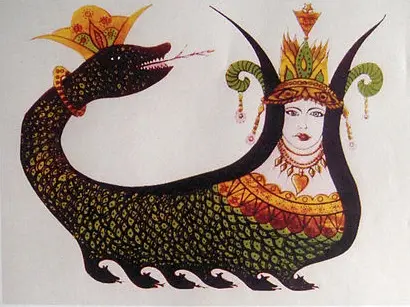
- 1 November 2011 The image that illustrates most online Shahmaran pages, this file included, is uploaded to Wikimedia Commons by the user Gomada as a derivative of a scan posted to Kurdish Wikipedia in 2008 under the name 'Salname 2004'. Neither record names the painter; the credit line 'MikaelF / Gomada' names the uploaders, not the artist.
- 2016 Excavations at Ani (Kars) recover a stone relief carved with a Shahmaran figure, now displayed in the Kars Museum. The published account dates the excavation, not the stone.
- November 2023 The second International Tarsus Festival, run by Mersin Metropolitan Municipality, takes Shahmaran as its theme and opens with a show called Şahmeran Tarsus'ta. The first edition, in 2022, had been themed on Cleopatra; the fourth ran on 7-9 November 2025. There is no separate annual Shahmaran festival.
Is there a rational explanation for Shahmaran, the Queen of Serpents?
Shahmaran's story can be followed, book by book, back to Mûsâ Abdi's Câmasbnâme, finished in 833 AH (1429-30).
About the "older Zoroastrian layers". The hero's name really is that of a Zoroastrian sage, and the Ottoman romance really is titled after a Zoroastrian book. The book itself does not tell the story. Mustafa Erkan, summarising the scholarship for the TDV İslâm Ansiklopedisi, describes the Persian Câmâsbnâmes as the answers of the vizier Câmasb to King Güştâsb on the universe and creation. In his account Abdi's poem and the Persian books are far apart in subject. Modi's 1903 edition of the Jāmāspi, which prints the Pahlavi, Pāzend and Persian texts together, can be searched word by word: in the Internet Archive's text of it, read on 8 October 2026, Jamasp in its various forms occurs 310 times, Vishtasp and Gushtasp 50 times and Zoroaster or Zarathushtra 67 times; "queen" and every spelling of Shahmaran occur none. What survives of the connection is onomastic: the hero's name and the poem's title.
About the antiquity claim. It has a dated, signed source. In the preface to the 1828 French edition, Joseph von Hammer-Purgstall notes that the Prophet's mission is announced inside the tale, calls it "one of the oldest Persian stories", and argues that the prophecy should cast no doubt on that antiquity, since modern translators and compilers had allowed themselves far greater anachronisms. The argument explains an anachronism away; it does not produce an older text. Nilgün Çıblak writes that, according to the sources, Tarsus coins two thousand years old show the snakes attacking the city to avenge Shahmaran, and cites page 314 of Mustafa Necati Çıplak's İçel Tarihi (2003). She gives no coin type, mint, collection or catalogue number. On the visual side Sultan Sökmen and Zeynep Balkanal, in a passage citing Neşe Yıldıran, write that known depictions of Shahmaran do not reach back to the symbol's early periods and that the common image developed in the shape given it by a verse tale of the early sixteenth century. They also illustrate a stone relief with a Shahmaran figure recovered in the 2016 excavations at Ani and displayed in the Kars Museum; caption and text give the year of the excavation and no date for the carving.
About the plot as it is usually told. The vizier who plots, the old woman who informs, the bathhouse and the poison are not in the oldest telling. Abdi's 1429 poem, as Erkan summarises it, has a sick king called Keyhusrev and no villain at all. Burton's Arabic version has a villainous vizier called Shamhur and no old woman: the informer is a book the vizier reads and three mamelukes he has posted in the baths to look for a man with a black belly, and the poison is the first scum skimmed off the broth. The division of the body into three belongs to the Tarsus versions. In the Lokman Hekim variant that Çıblak recorded from Ramazan Öztürk, Lokman cuts the body in three, gives the water of the tail to the vizier, who dies, the water of the head to the sultan, and drinks the water of the body himself; in the Camsab variant recorded from Şehriban Çelik, the first boiling goes to the vizier, the second to the sultan and the third to Camsab. Her other two informants were Ömer Özcan and Rüksan Özsezeroğlu, all four from Tarsus. The hero is Câmasb in Erkan's summary, Camsab or Camasb in Çıblak, Djamasp in Trébutien, Jamasp in Burton's footnote and Hasib Karim al-Din in Burton's text; the form "Cemşit" — Jamshid, a different Iranian king altogether — occurs in none of the five.
About the bath. Çıblak records the belief that the faint reddish colour on the navel stone and on the inner walls is the blood of Shahmaran, killed there. Reddish staining in damp limestone and marble commonly comes from iron oxides, and her article reports no analysis of this stone. She also lists the practices built on the belief: rubbing oneself three times against the navel stone to be cured of every illness, and reading what the walls shed each year on the anniversary of her death as proof that she changes her skin and has never died.
And one figure who turns up in the wrong book. Zahhāk, the Iranian tyrant with serpents growing from his shoulders, has his own line of texts from the Avesta to Ferdowsi; in Modi's Jāmāspi he is the king who fed the two serpents on his neck with human brains every day. Neither Abdi's poem as Erkan summarises it nor Burton's Arabic version mentions him, and he is absent from Trébutien's French text and from the Tarsus legends that Çıblak collected.
Can you visit Shahmaran, the Queen of Serpents?
Tarsus, in Mersin province, holds the building at the centre of the local tradition: the Şahmeran Hamamı, on Şahmeran Sokak in the Kızılmurat quarter of the old town, roughly fifty metres north of the Makam-ı Şerif mosque and its tomb of the prophet Daniel. Road works over the years left the bath below street level. It is now entered down seven or eight steps, which is also how it is told apart from outside. Nilgün Çıblak recorded it as a working bathhouse in 2007, with the dressing room raised to two floors and an octagonal pool added.
The Mersin city guide, consulted on 11 September 2026, places the bath inside the protected historic quarter, within walking distance of the Cleopatra Gate and the old bazaar, among streets too narrow to drive, with municipal car parks or street parking for vehicles. That page publishes no opening hours and no statement of whether the bath still works. Travel and visitor reporting through 2025 describes it shut and awaiting restoration, visible from the street. No municipal source consulted here sets a schedule or a ticket price.
A Shahmaran statue by Emine Berika İpekbayrak has stood in one of the town squares since 1986. İpekbayrak's figure is male and wears no crown; the printed and reverse-glass Shahmaran sold across the region is a crowned woman. Tarsus also holds St Paul's Well and, north of the town, the Eshâb-ı Kehf cave sanctuary.
There is no annual Shahmaran festival. Mersin Metropolitan Municipality has run the Uluslararası Tarsus Festivali in early November since 2022, and Shahmaran was the theme of a single edition: the first took Cleopatra, the second in November 2023 took Shahmaran and opened with a show called Şahmeran Tarsus'ta, the third followed in 2024, and the fourth ran from 7 to 9 November 2025. The fifth was announced for 6 to 8 November 2026, reported in the Turkish press on 6 July 2026 as "6-7-8 Kasım 2026 tarihlerinde".
Tarsus is about 25 kilometres east of Mersin and 40 kilometres west of Adana, on the road and rail corridor between them; the nearest airport is Adana Şakirpaşa. The old town is walkable and the places above stand within a few hundred metres of each other.
Mardin, roughly 600 kilometres east, is the other place that claims the tradition, and its bazaar workshops still paint and sell the reverse-glass Shahmaran bought historically as trousseau and wedding pieces. Sökmen and Balkanal record that the under-glass technique has almost disappeared in Turkey, so most of what is on sale in either town is printed or painted on another support.
Sources consulted
- Jivanji Jamshedji Modi (ed.), «Jâmâspi: Pahlavi, Pâzend and Persian Texts, with English translation and notes» — Bombay, 1903 book
- Mustafa Erkan, «CÂMASBNÂME» — TDV İslâm Ansiklopedisi, vol. 7, pp. 43-45, 1993 academic
- Joseph von Hammer-Purgstall, trans. G.-S. Trébutien, «Contes inédits des Mille et une Nuits, vol. I: Histoire de Djamasp et de la Reine des Serpens (nights 479-536)» — Paris, Dondey-Dupré, 1828 book
- Richard F. Burton, «The Book of the Thousand Nights and a Night, vol. V: The Queen of the Serpents (Nights 482-536), with footnotes 507-508» — The Kamashastra Society, Benares, 1885 book
- Nilgün Çıblak, «Tarsus Kültürünün Tanıtımında Şahmeran Efsanelerinin Önemi» — Çukurova Üniversitesi Sosyal Bilimler Enstitüsü Dergisi 16(1), pp. 185-196, 2007 academic
- Sultan Sökmen and Zeynep Balkanal, «Anadolu Sanatında Şahmeran Figürlü Örnekler» — Uluslararası İnsan ve Sanat Araştırmaları Dergisi 6(3), pp. 417-447, 2021 academic
- Cumhuriyet, «Tarsus'ta Şahmeran yılı (report on the 2nd International Tarsus Festival)» — Cumhuriyet, 20 November 2023, 2023 newspaper archive
- Wikimedia Commons, «File:Şahmaran.jpg — upload record, licence and source chain» — Wikimedia Commons, 2011 web
Reviewed by V. Serrano on 2026-08-16 · How we verify our content
📎 Source: Enigma Atlas
💬 Field testimonies (0)
No testimonies yet. Add the first.
Add your testimony
🔒 Log in to add a testimony