🦶 CRYPTID SIGHTING · EXP. Nº6501
ACTIVE
Ahuizotl
The ahuizotl is not a monster hunter's quarry but a being of Nahua religion, set down in detail in Book 11 of the Florentine Codex, the encyclopedia written in Nahuatl and Spanish at Tlatelolco and finished in 1577 by Bernardino de Sahagun together with the Nahua scholars Antonio Valeriano, Alonso Vegerano, Martin Jacobita and others.
Where and when was Ahuizotl sighted?
- Location
- México central (azteca), Mexico
- Date sighted
- Unknown
- Coordinates
- 19.433, -99.133
- Last updated
LOCATION
What is Ahuizotl?
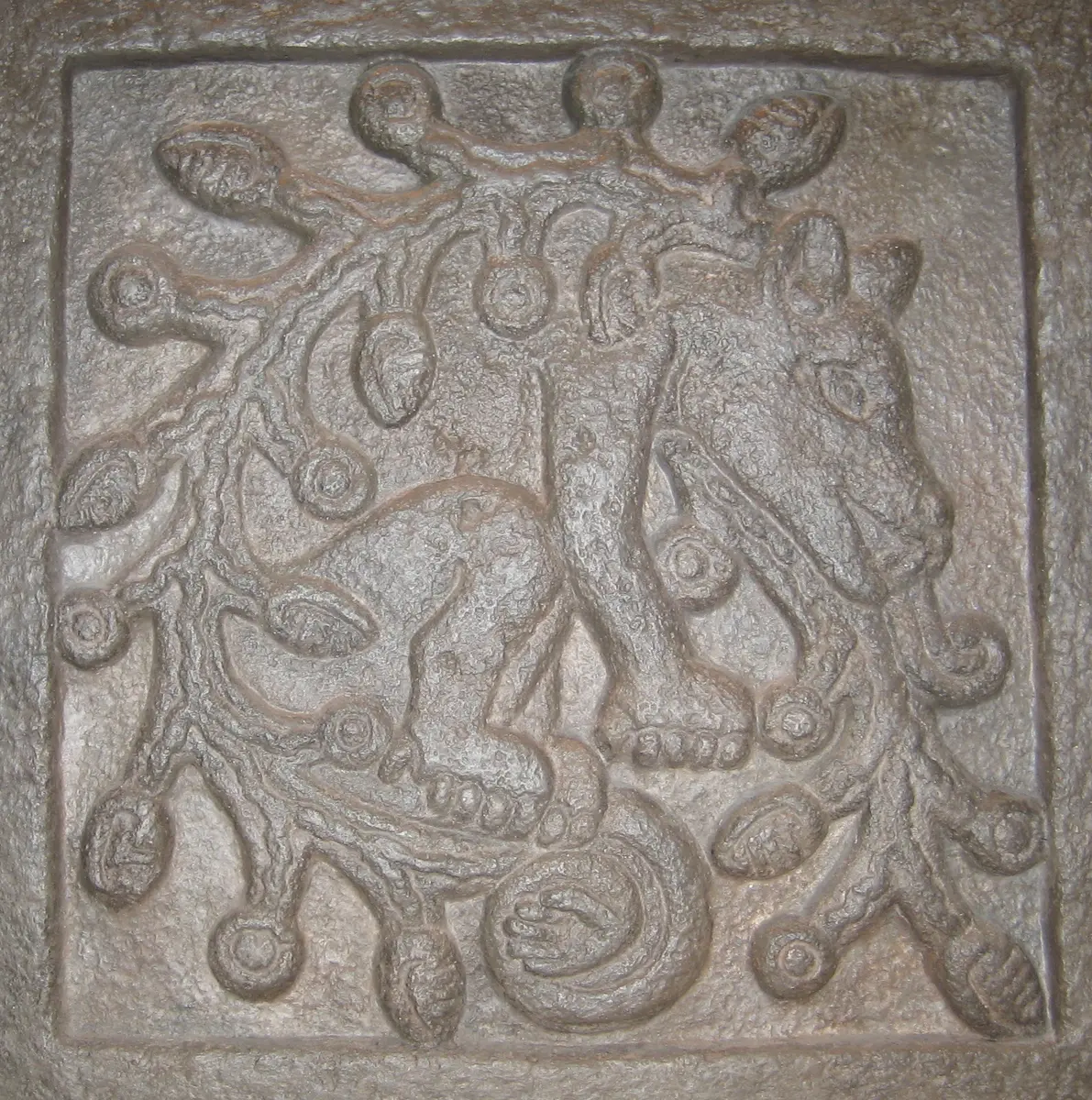
They describe an animal the size of a small dog, black and slick, with small pointed ears, hands like a monkey's, and a long tail ending in a human hand. It lived in springs and deep water. It seized people from the bank with the hand of its tail, or lured them by driving fish and frogs to the surface until fishermen cast their nets, or by crying at the water's edge like an abandoned baby. Its victims came back days later without eyes, teeth or nails, unwounded but covered in bruises. What mattered most was what followed: only priests could touch such a body, because the rain gods had taken the drowned to Tlalocan, and it was carried on a litter dressed with cattails, to flutes, and buried at a shrine called the ayauhcalco.
What is the history of Ahuizotl?
The ahuizotl is not a cryptid, and treating it as one gets almost everything about it wrong. It is a being of Nahua religion, and nearly everything we know about it comes from one document: Book 11 of the Florentine Codex, the encyclopedia of the Nahua world written at the Colegio de Santa Cruz in Tlatelolco and finished in 1577.
That book is usually credited to the Franciscan Bernardino de Sahagun alone. It should not be. The Getty Research Institute's own citation for the manuscript names the Nahua scholars who made it with him: Antonio Valeriano, Alonso Vegerano, Martin Jacobita, Pedro de San Buenaventura, Diego de Grado, Bonifacio Maximiliano and Mateo Severino, trilingual graduates of the college, alongside the painters who illustrated it. The ahuizotl passage is as much theirs as his. It sits in Book 11, "Earthly Things", chapter 4, on the water animals that are not eaten, second paragraph, folios 70v to 73v of the manuscript held today as Ms. Mediceo Palatino 218-20 in the Biblioteca Medicea Laurenziana in Florence.
The description is precise and physical. The animal is the size of a small dog, with short slick fur, small pointed ears "just like a small dog", a body black and smooth "like rubber", and hands and feet like a raccoon's or a monkey's. Then comes the detail everyone remembers: the tail is long, and at the end of it there is a hand. "Just like a human hand is the point of its tail."
Where it lives is usually reported wrongly. The chapter heading places it "in the springs or in the streams of the water sources", and the Nahuatl says it lives in the water, "either in a river or somewhere in a spring", in watery caverns and watery depths. It belongs to deep welling water, not specifically to the lakes around Tenochtitlan.
It hunts in three ways, and the text separates them carefully. If a person comes to the edge of the water where it lives, it seizes them with the hand of its tail and pulls them under. When it has caught nobody for a long time, it drives fish and frogs up to the surface until they thrash and jump, and fishermen, greedy for the catch, cast their nets there, and it takes one of them. And when it has still caught nobody, it comes out to the bank and cries like a child; whoever hears it thinks a baby has been abandoned, goes to look, and is taken.
The body comes back. After a few days the water gives it up, and it surfaces without eyes, without teeth and without nails, all of them taken. There are no open wounds. The corpse is unmarked except that it is covered in bruises.
What happens next is the heart of the matter, and it is what our earlier version of this page left out completely. Nobody dared take the body from the water. Word was sent to the priests, and only they could touch it, because the others "were not worthy". The drowned man had not merely died: the Tlaloque, the rain gods, had sent his soul to Tlalocan. So he was carried on a litter with great honour to be buried at the ayauhcalco, the mist-house shrine, the litter dressed with cattails, flutes played before the body. A layman who tried to lift the corpse out would drown in his turn, or be struck with the sickness they called coacihuiztli, the gout.
Two reasons were given for such a death. Either the man was good of heart and the Tlaloque wanted his company; or he had kept precious green stones, chalchihuitl, which the rain gods did not want people to hold. His relatives were consoled rather than bereaved: their kinsman was with the gods, and through him they would grow prosperous. They also feared that another of them would go the same way or be killed by lightning, and so, the text says, they were careful not to bathe much.
The passage ends not with a moral but with a scene. An old woman on her way to fetch water caught one of these animals, put it in her water jar, covered it with her huipil and carried it to the lords of the town to show them. They looked at it, told her she had sinned in taking it because it belonged to the Tlaloque and was their friend, and ordered her to put it back where she had found it.
The name is Nahuatl, and it does not mean "water dog". The Gran Diccionario Nahuatl of the UNAM analyses it as ahuitzo-tl: a- from atl, water, plus huitzo, "thorny, having spines", from huitztli, a thorn. Molina's Vocabulario of 1571, the first great dictionary of the language, defines auitzotl simply as "a certain little water animal like a small dog", which is a comparison and not a translation. The literal Nahuatl for "water dog" is a different word, aitzcuintli, and Sahagun's collaborators use it in this very chapter, one paragraph earlier, for the otter.
One more thing carried the name. Ahuitzotl was the eighth ruler of Tenochtitlan, and the direction runs from the animal to the man rather than the other way about: in the Tira de Tepechpan the glyph read as ahuitzotl is built from the sign for water and a picture of the beast itself, and Bustamante's 1829 edition notes that the eighth king took his name from the animal, as Nahua names were commonly taken from nature. Book 8 of the same codex says he ruled eighteen years, and records what he is remembered for besides his conquests. On his orders five springs were opened in the lands of Coyoacan and Huitzilopochco, named Acuecuexatl, Tlillatl, Huitzilatl, Xochcaatl and Coaatl, and Mexico was flooded. The ruler who bore the name of the thing that lives in springs was undone by five of them, four years before his death.
Timeline: the documented record of Ahuizotl
- c. 1497 Book 8 of the Florentine Codex records that Mexico was flooded in the reign of Ahuitzotl, the eighth ruler of Tenochtitlan, by his own command, after five springs were opened in the lands of Coyoacan and Huitzilopochco: Acuecuexatl, Tlillatl, Huitzilatl, Xochcaatl and Coaatl. The same passage dates the flood four years before his death and twenty-two years before the Spaniards came, and gives him an eighteen-year reign. Counting from 1519 that yields roughly 1483-1501, which does not reconcile with the 1486-1502 usually cited today; we give the codex's own reckoning and flag the discrepancy rather than choose between them.
- 1559-1561 At Tepepulco, Sahagun and his Nahua collaborators compile the Nahuatl notes with images now known as the Primeros Memoriales, part of the Codices Matritenses. This is the research stage that will eventually produce the Florentine Codex.
- 1571 Alonso de Molina's Vocabulario en lengua castellana y mexicana defines auitzotl, at folio 9r, as "cierto animalejo de agua como perrillo" - a certain little water animal like a small dog. It is the earliest dictionary entry for the word, and it treats it as an animal, not as a spirit.
- 1577 The Florentine Codex is completed at the Colegio de Santa Cruz in Tlatelolco. The ahuizotl passage stands in Book 11, chapter 4, second paragraph, folios 70v-73v, with two paintings: the animal at the water's edge and a canoeist being drowned.
- 26 March 1578 Sahagun writes to King Felipe II that he has just finished making clean copies of the work, "repartidas en doce libros, en cuatro volumenes", and has handed them to fray Rodrigo de Sequera. The letter survives in the Archivo General de Indias in Seville (Audiencia de Mexico, no. 284) and dates the manuscript's departure.
- 1580 Sequera returns to Spain with a separate copy of the Castilian text, later found in the Franciscan house at Tolosa and known ever since as the Tolosa Manuscript. This is where the 1580 date sometimes attached to the codex comes from; it is not the date of the Florentine Codex itself.
- 1829 Carlos Maria de Bustamante prints Sahagun's Spanish text in Mexico. The ahuizotl fills pages 205 to 207 of volume III, and an editorial footnote observes that the eighth Mexica king took his name from the animal, "pues acostumbraban los Indios tomarlo de los animales, plantas, aves". The passage becomes readable outside the archives for the first time.
- 2000 Alfredo Lopez Austin and Josefina Garcia Quintana publish the third edition of their transcription of Sahagun's Spanish column, the text used as the Spanish reading of the passage in the digital edition.
- 26 October 2023 The Getty announces the Digital Florentine Codex, with new and previously published transcriptions of the Nahuatl and Spanish texts, English and Spanish translations, and searchable texts and images. The manuscript had been online through the World Digital Library since 2012; the Getty's release says that for most users it had stayed impenetrable, because reading it requires sixteenth-century Nahuatl and Spanish.
Is there a rational explanation for Ahuizotl?
The honest difficulty with a sceptical section here is that the oldest written source is already hostile. The Florentine Codex was made in part to help friars recognise and uproot Nahua religion, and Sahagun's hand shows in the Nahuatl of this very passage: Anderson and Dibble translate the asides as "thus were they deluded", "behold in what manner they were befuddled" and "the villainy of this little animal!". To set about debunking the ahuizotl now is to repeat a move made in 1577. It is worth doing better than that.
What the account actually does is explain drowning and give it dignity. Tenochtitlan was a city on water, moved about by canoe and supplied by springs piped in from the mainland. Drownings were ordinary. The second painting in the manuscript, on folio 71r, shows exactly that: a man in churning water with one arm raised and his paddle still in his hand, his canoe swamped beside him, and the animal riding the wave towards him. The story does frighten people away from deep water, but it does more than that. It says the drowned were chosen, that they went to Tlalocan, and that their families would prosper. That is not a monster tale. It is a way of surviving a death.
The physical details are the details of a real recovery. A body that has spent days in water comes back without eyes, without the soft tissue of lips and fingertips, unwounded but discoloured. The account gives that condition an author instead of leaving it meaningless.
Whether a real animal lies behind it is genuinely unsettled among specialists, and it would be dishonest to pretend otherwise. Molina in 1571 recorded it as an actual little water animal. Wimmer's modern dictionary of classical Nahuatl glosses ahuitzotl as an otter. Anderson and Dibble's own footnote to this passage holds both positions at once, citing an identification as Lutra felina and, in the same breath, the characterisation "animal legendario, que reviste caracteres fantasticos", a legendary animal with fantastical traits.
The paintings are the best evidence available, and they point one way. There are two, on folios 70v and 71r, and both were examined at full resolution for this page. Both show a naturalistic aquatic mammal, brown and cream, low-slung and otter-like, with a pointed muzzle and small ears. And in neither of them does the tail end in a hand: it tapers to an ordinary point. The painters, working beside a text that describes the hand on the tail in so many words, drew an animal they appear to have known.
Can you visit Ahuizotl?
There is no ahuizotl site to visit, and the honest first thing to say is that its habitat has largely ceased to exist. The lakes and canals that made Tenochtitlan a city on water were drained over four centuries. What survives is worth seeing anyway, and three places in Mexico City between them hold the landscape, the religion and the objects.
Xochimilco, about 28 km south of the centre, is the last of that water. It is inscribed on the UNESCO World Heritage List as part of the "Historic Centre of Mexico City and Xochimilco" (ref. 412, inscribed 1987, criteria ii, iii, iv and v), and UNESCO justifies criterion (v) by saying the lake landscape "constitutes the only reminder of traditional ground occupation in the lagoons of the Mexico City basin before the Spanish conquest". Some 184 km of canals remain. The Xochimilco borough sets an official trajinera fare of 750 pesos per hour per boat, for up to 18 people, from ten landings open every day of the year, among them Nativitas, Zacapa, Cuemanco and Puente de Urrutia. The fare is per boat and per hour, not per person; music and food are negotiated separately. Get there by Metro to Taxqueña (Line 2) and then the Tren Ligero to Xochimilco. UNESCO also records the wetland's condition plainly: the chinampa system "is highly threatened due to the introduction of new agricultural technology, excessive ground-water extraction in the area, abandonment, development pressures and contamination".
The Museo del Templo Mayor, at Seminario 8 in the historic centre, is the most directly relevant. The Great Temple was a double pyramid, half of it dedicated to Tlaloc, the god to whom the ahuizotl's drowned belonged. Museum and excavated site are covered by the same 100-peso ticket, open Tuesday to Sunday 09:00-17:00 and closed Mondays for maintenance; entry is free for under-13s, students, teachers, seniors and pensioners with valid ID, and free on Sundays for nationals and residents. Metro Zocalo, Line 2. Photography is allowed without flash.
The Museo Nacional de Antropologia, on Paseo de la Reforma at Calzada Gandhi in Chapultepec, holds the Mexica hall. It opens Tuesday to Sunday 09:00-18:00; general admission is 210 pesos, or 105 for nationals and foreign residents, free on Sundays for both, and free for under-13s, over-60s with INAPAM, students, teachers and visitors with disabilities. The nearest Metro stations are Auditorio (Line 7) and Chapultepec (Line 1), but the museum warns that it stands about 1.3 km from them; the Metrobus Antropologia stop on Line 7 is closer.
The codex itself is in Florence, in the Biblioteca Medicea Laurenziana, and is not on open display. It does not need to be: the Getty's Digital Florentine Codex publishes every folio free, with the Nahuatl, Sahagun's Spanish and modern English side by side. The ahuizotl is at Book 11, folios 70v to 73v, paintings included.
Sources consulted
- Bernardino de Sahagun, Antonio Valeriano, Alonso Vegerano, Martin Jacobita, Pedro de San Buenaventura, Diego de Grado, Bonifacio Maximiliano, Mateo Severino et al., «Florentine Codex, Book 11 ("Earthly Things"), chapter 4, second paragraph: "Injc vme parrapho... in jtoca Avitzotl", folios 70v-73v» — Ms. Mediceo Palatino 218-20, Biblioteca Medicea Laurenziana, Florence. Read in the Digital Florentine Codex (Getty Research Institute, 2023), which gives the Nahuatl transcription, Sahagun's Spanish, and the Anderson & Dibble and Garcia Garagarza translations, 1577 archive
- Bernardino de Sahagun, Antonio Valeriano, Alonso Vegerano, Martin Jacobita et al., «Florentine Codex, Book 8 ("Kings and Lords"), folio 2r: the eighth ruler of Tenochtitlan, his eighteen-year reign, and the flooding of Mexico after five springs were opened at Coyoacan and Huitzilopochco» — Ms. Mediceo Palatino 218-20, Biblioteca Medicea Laurenziana, Florence. Read in the Digital Florentine Codex (Getty Research Institute, 2023), 1577 archive
- Bernardino de Sahagun; edited by Carlos Maria de Bustamante, «Historia general de las cosas de Nueva Espana, tomo III, libro XI, capitulo IV, parrafo segundo: "De un animalejo llamado avitzotl o Ahuitzotl notablemente monstruoso", pp. 205-207» — Imprenta de Alejandro Valdes, Mexico. Digitised copy consulted in full text, 1829 book
- Alonso de Molina, «Vocabulario en lengua castellana y mexicana, part 2, folio 9r: "Auitzotl: cierto animalejo de agua como perrillo"» — Casa de Antonio de Spinosa, Mexico. Consulted through the Gran Diccionario Nahuatl (UNAM), which also gives the morphological analysis ahuitzo-tl and the entries huitzo ("cosa que tiene espinas") and huitztli ("espina"), 1571 book
- Arthur J. O. Anderson and Charles E. Dibble, «Florentine Codex: General History of the Things of New Spain. Book 11 - Earthly Things (Nahuatl transcription and English translation, with the footnote recording the identification as Lutra felina and as an "animal legendario, que reviste caracteres fantasticos")» — School of American Research / University of Utah Press, Santa Fe, NM; 13 vols., 2nd rev. ed., 1950 book
- Alfredo Lopez Austin and Josefina Garcia Quintana (eds.), «Historia general de las cosas de Nueva Espana (transcription of Sahagun's Spanish column, 3rd ed.)» — Cien de Mexico / Consejo Nacional para la Cultura y las Artes, Mexico City, 2000 book
- Manuel Aguilar-Moreno, «The itinerant life of the Florentine Codex: its completion at Tlatelolco in 1577, Sahagun's letter to Felipe II of 26 March 1578 (Audiencia de Mexico no. 284, Archivo General de Indias, Seville), and the Tolosa Manuscript taken to Spain in 1580» — Digital Florentine Codex, edited by Kim N. Richter, Alicia Maria Houtrouw, Kevin Terraciano, Jeanette Peterson, Diana Magaloni and Lisa Sousa. Getty Research Institute, Los Angeles, 2023 academic
- UNESCO World Heritage Centre, «Historic Centre of Mexico City and Xochimilco - World Heritage List entry, ref. 412 (criteria ii, iii, iv, v; statement on the chinampa system being "highly threatened")» — UNESCO, Paris. Inscribed 1987, 1987 report
- Instituto Nacional de Antropologia e Historia (INAH), «Museo del Templo Mayor - visitor information, opening hours, admission and the archaeological site» — templomayor.inah.gob.mx, 2026 web
- Instituto Nacional de Antropologia e Historia (INAH), «Museo Nacional de Antropologia - visitor information, opening hours and admission» — mna.inah.gob.mx, 2026 web
- Alcaldia Xochimilco, Gobierno de la Ciudad de Mexico, «Turismo - costos oficiales de las trajineras y embarcaderos de Xochimilco» — xochimilco.cdmx.gob.mx (consulted 11 August 2026), 2026 web
- Getty, «A Rare 500-Year-Old Manuscript Gets a Second Life Online: the Digital Florentine Codex unlocks a wealth of Mexica (Aztec) history and culture (press release, 26 October 2023)» — getty.edu/news (read 10 October 2026), 2023 web
Reviewed by V. Serrano on 2026-08-11 · How we verify our content
📎 Source: Enigma Atlas
💬 Field testimonies (0)
No testimonies yet. Add the first.
Add your testimony
🔒 Log in to add a testimony