🦶 CRYPTID SIGHTING · EXP. Nº6501
ACTIVE
Nahual
The nahual (or nagual) reaches popular culture as "a sorcerer who turns into an animal", and that summary flattens what the sources say.
Where and when was Nahual sighted?
- Location
- Mesoamérica, Mexico
- Date sighted
- Unknown
- Coordinates
- 17.073, -96.727
- Last updated
LOCATION
What is Nahual?
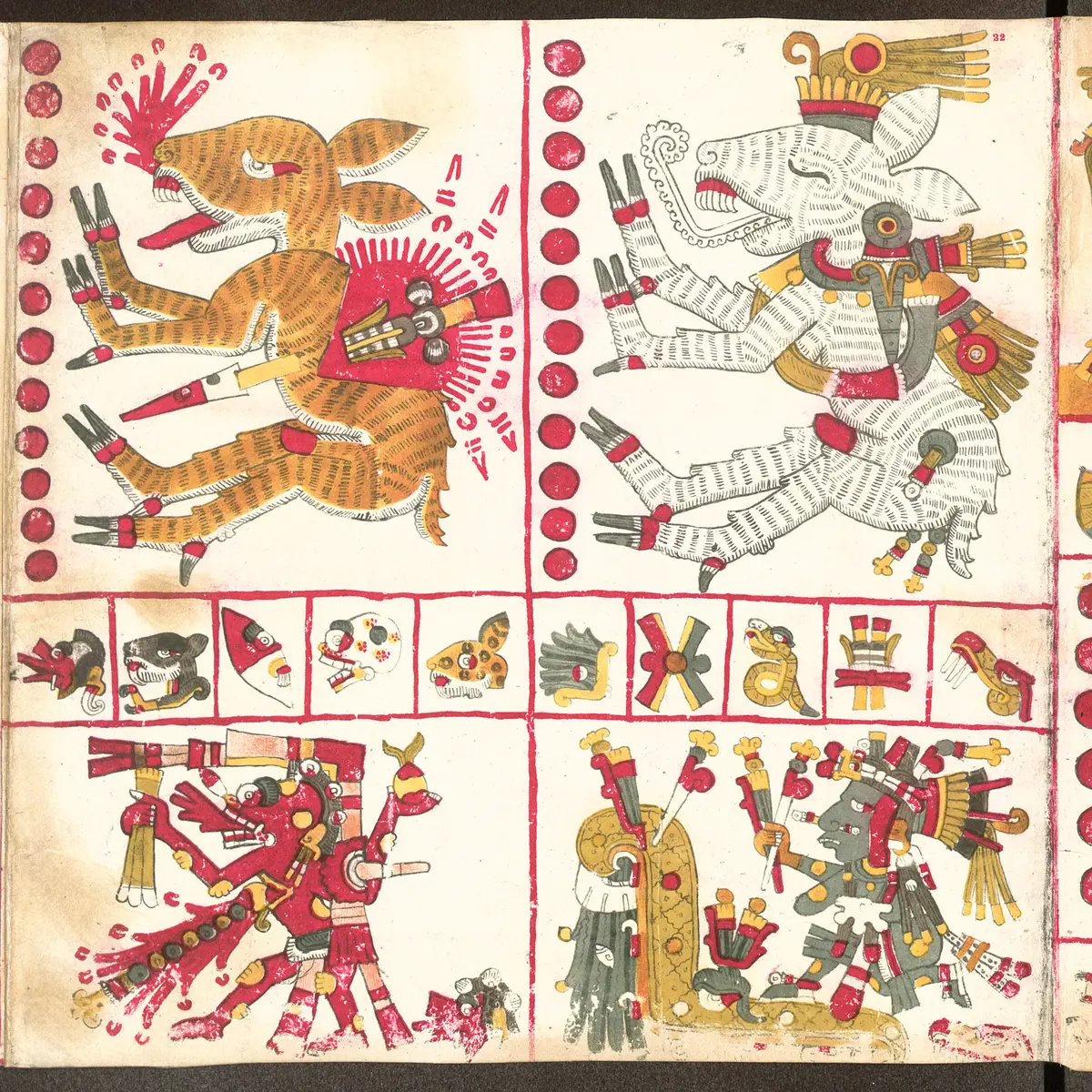
In the oldest Nahuatl definition, in the Florentine Codex, the nahualli is a wise man, a counsellor and a guardian who "never harms people"; in Sahagún's work, the one who transfigures into animals appears under a different heading, that of the necromancer. And Hernando Ruiz de Alarcón, the priest of 1629 whom everyone cites as proof of the jaguar-man, writes the opposite: that the bond is with an animal assigned at birth by the day sign, "and in this way the impossible imagined transformations are ruled out". What is documented is the persecution: in 1536 Bishop Zumárraga tried Martín Ocelotl because "he has made himself into a tiger, a lion and a dog". The textbook distinction between tonal (companion animal) and nahual (shapeshifting sorcerer) is not settled either: the standard monograph on the subject calls it mistaken. This is a living worldview in rural Mexico and Guatemala, not a monster.
What is the history of Nahual?
The nahual is not a monster, and that is the first thing worth setting aside.
What circulates online today — "a sorcerer who turns into an animal" — is the residue of a far more precise Mesoamerican concept, with its own vocabulary, its own social functions and a relationship to the person that looks nothing like a werewolf. And it is still alive: Nahua, Otomí, Tzeltal, Zapotec and K'iche' communities speak of it in the present tense. Calling it "the nahual cryptid" is about as accurate as calling a patron saint a cryptid.
The oldest definition we have in Nahuatl does not describe a monster. It describes a wise man. The Florentine Codex, compiled by the Franciscan Bernardino de Sahagún with Nahua elders and scribes and completed in 1577, devotes a passage of its Book X to the nahualli, and what it says — in the anthropologist Roberto Martínez González's translation — is this: "The nahualli is a tlamatini [wise man], a nonotzale [counsellor], someone who can be trusted. He is serious, respected, not mocked, not overstepped. The good nahualli is a guardian, one who guards something, discreet. He is shrewd, devout, useful. He never harms people."
In Sahagún's Spanish text, chapter IX of Book Ten is headed On sorcerers and tricksters, and there the arrangement is even more revealing. The naoalli entry reads: "The Naoalli is properly called a witch, who by night frightens men and sucks children. One who is skilled in this office understands any matter of spells, and is sharp and shrewd in using them; he profits and does no harm." And the one who turns into an animal is a separate entry altogether, the necromancer: "The man who has a pact with the devil transfigures himself into diverse animals, and out of hatred wishes death upon others." In other words: in the very source everyone cites as the origin of the shapeshifting nahual, the nahualli and the shapeshifter are two different files.
So what did a nahualli actually do? Martínez González, who has worked through the whole corpus, documents a trade. He healed (he was a tlamatini, "one who knows"), he advised, he divined, and above all he handled the weather: the tlaciuhqui forecast it and the teciuhtlazqui drove hail away from the maize fields. In Indigenous chronicles nanahualtin fight in wars on behalf of their lord; the Florentine Codex records that Motecuhzoma sent nanahualtin and diviners to the Veracruz coast to see what kind of men the newcomers were and, if possible, to bewitch them.
Then came the Inquisition, and the distortion begins.
On 21 November 1536, in Mexico City, Fray Juan de Zumárraga opened proceedings against an Indian named Martín Ucelo — Ocelotl — because, according to the warrant, "he has performed many sorceries and divinations, and has made himself into a jaguar, a lion and a dog, and has preached and preaches to the natives of this New Spain things against our faith, and has said that he is immortal". The file survives and was printed in 1912. Read in full, what emerges is not a monster but a man everybody consulted: the Spanish magistrate of Texcoco, Cristóbal de Cisneros, sent for him to cure a mare and to find out where some stolen gold had gone. On 12 January 1537 Ocelotl testified that twenty-seven years earlier Moctezuma had jailed him for a year and twelve days for having sent word "that bearded Spaniards would come to this land, and that it would be theirs". The sentence of 10 February 1537 had him paraded on a donkey through the markets of Mexico and Santiago behind a crier, shipped from Veracruz and handed to the inquisitors of Seville "so that he may be held there in perpetual prison", with all his goods forfeit. According to Torquemada, quoted by Martínez González, the ship was lost near port and nothing more was ever heard of him.
In July 1537 it was the turn of his brother Andrés Mixcoatl and of Cristóbal Papalotl: a hundred lashes each, a public parade, heads shorn, a year shut in the monastery of Tulancingo and confiscation of goods. Between 1536 and 1543 the Inquisition executed only one Indigenous man — don Carlos Chichimecatecolotl, lord of Texcoco — and the scandal cost Zumárraga his post and led to a ban on the Holy Office trying Indians at all.
Nearly a century later the priest Hernando Ruiz de Alarcón, beneficed at Atenango in what is now the state of Guerrero, spent five years investigating on the archbishop's commission and published, in 1629, his Treatise on the heathen superstitions and customs that live today among the native Indians of this New Spain. His first chapter is bluntly titled On nahual witches, and how it can be. There he wrote the sentence he is most quoted for — "of all the cases I have had notice of, of this kind of nahualli witches, who are different from what the witches of Spain are" — and there, too, the conclusion almost nobody quotes: that the devil binds the newborn child "to the animal that the said child is to have as his nahual, which is to say as the lord of his nativity and master of his actions, or what the gentiles called fate", so that the child is subject to everything that happens to the animal. And he closes: "and in this way the impossible imagined transformations are dispensed with." The idolatry-hunter most often cited as evidence for the shapeshifting nahual denied the shapeshifting.
By the end of the seventeenth century the bishop of Chiapas, Núñez de la Vega, ordered a church jail built "with irons and stocks" in every head town, with greater severity for "dogmatising nagualists". With the Enlightenment, nahualism stopped being the devil's work and became the ignorant's: today, Martínez González notes, in Mexico City slang nagual came to function as a class insult and nagualear as a synonym for "to swindle". Since the 1960s a final layer has been added: Carlos Castaneda, nicknamed El nagual, who turned tonal and nagual into two poles of individual consciousness — a sense found in no sixteenth-century source — and opened the way for a "Toltec" self-help industry that now sells nahualism with no Indigenous people inside it.
Timeline: the documented record of Nahual
- 21 November 1536 In Mexico City, Fray Juan de Zumárraga opens Inquisition proceedings against the Indian Martín Ucelo (Ocelotl) because, according to the warrant, "he has performed many sorceries and divinations, and has made himself into a jaguar, a lion and a dog [...] and has said that he is immortal". It is the first documented accusation of animal transformation in the New Spain Holy Office archive.
- 12 January 1537 Under questioning, Ocelotl states that twenty-seven years earlier Moctezuma had held him prisoner "a year and twelve days" for having sent word "that bearded Spaniards would come to this land, and that it would be theirs". The same file records that the Spanish magistrate of Texcoco, Cristóbal de Cisneros, sent for him to cure a mare and trace some stolen gold.
- 10 February 1537 Sentence against Ocelotl: paraded on a donkey through the markets of Mexico and Santiago behind a crier, shipped from Veracruz and handed to the inquisitors of Seville "so that he may be held there in perpetual prison", plus forfeiture of all his goods. According to Torquemada, quoted by Martínez González, the ship was lost near port and nothing more was heard of him.
- 10 July 1537 Don Juan, chief of Xinatepeque, denounces Mixcoatl (Andrés) and another brother of Ocelotl for demanding paper, copal and rubber for ceremonies with which he claimed to stop the rains ruining the maize fields. Mixcoatl and Cristóbal Papalotl will be sentenced to a hundred lashes each, a public parade, shorn heads, a year in the monastery of Tulancingo and confiscation of goods.
- 1577 The Florentine Codex is completed at the Colegio de Santa Cruz in Tlatelolco, compiled by Sahagún with Nahua elders and scribes. Its Book X defines the nahualli as a wise man, counsellor and guardian who "never harms people", and places the man who "transfigures himself into diverse animals" under a separate entry, that of the one with a pact with the devil.
- 1585 The Third Mexican Provincial Council complains of the mildness with which Indians have been treated so far, which in its view "has given them occasion to return to their errors and superstitions with impudence and daring". Ecclesiastical justice hardens.
- 1629 The priest Hernando Ruiz de Alarcón, beneficed at Atenango (today Guerrero), publishes his Treatise on superstitions after five years of enquiries on the archbishop's commission. His chapter I, "On nahual witches, and how it can be", states that these witches "are different from what the witches of Spain are" and concludes that the bond is with an animal assigned at birth: "in this way the impossible imagined transformations are dispensed with".
- 1685 In a court case in Zoque territory, the prosecutor asks an Indigenous man named Pedro Hernández whether, when ill, he was bound "in his natural body or that of another animal which the Indians call tunal or nagual". It is the oldest document Martínez González locates in which tonal and nagual already appear as equivalents.
- Late seventeenth century The bishop of Chiapas, Francisco Núñez de la Vega, orders a church jail built "with irons and stocks" in every head town, at the expense of church funds, to hold superstitious offenders and "with greater severity, dogmatising nagualists".
- 1894 Daniel G. Brinton proposes that nahualli derives from a Maya-K'iche' root na', "to know", and popularises the idea of a nagualist resistance sect. Eduard Seler objects that Nahuatl shows no trace of such a root with that sense; today the loan is held to have gone from Nahuatl into the Mayan languages, not the reverse.
- 1968-1975 Carlos Castaneda, nicknamed El nagual, publishes the series of books about his supposed Yaqui teacher don Juan Matus and redefines tonal and nagual as two poles of individual consciousness, unrelated to animality or to the non-human. No sixteenth-century source records that meaning. From here springs the "Toltec" self-help industry.
- 2024 The ethnohistorian Patricia Gallardo Arias (INAH) publishes in Cuicuilco the results of seventeen years of work with the Otomí of the Sierra Otomí-Tepehua (Hidalgo): everyone is born with a companion animal tied to their vital force, only specialists converse with it at will, and the transformation happens in dream and affects the shadow (xúdi), while "the skin, the bones and the flesh stay where they are".
Is there a rational explanation for Nahual?
Four things need pulling apart here, and the first is not a sceptical matter but one of respect.
This is not a cryptid and it cannot be investigated as one. There is no population of unknown animals to survey and no blurry photograph to analyse. There is a living belief system, with ritual specialists recognised within their own communities, and five centuries of people jailed, flogged, exiled and in some cases executed for practising it. It is also worth naming who did the flattening, because it was not anonymous: first the friars and inquisitors of the sixteenth century, who swept everything non-Catholic into the European sack marked "witch"; then the nineteenth-century Americanists; and over the last half-century the self-help neo-nahualism industry.
Second: the textbook distinction between tonal and nahual is contested, and we are not going to sell it as fact. It is tempting, and serious names signed it: George Foster in 1944 and Gonzalo Aguirre Beltrán between 1955 and 1978, who put it this way: "Nagualism refers to the capacity certain persons acquire to abandon their human form and transform into an animal, whereas in tonalism the animal and the individual coexist separately and are joined only by a common destiny." The problem is that the author of the standard monograph on the subject, Roberto Martínez González (El nahualismo, UNAM, 2011, 650 pages), dismantles it point by point and concludes that "the hypothesis of a confusion between the concepts of tonal and nahual is completely erroneous in each and every one of its foundations". His hardest argument to rebut is empirical: if the companion-animal idea were a colonial invention, it should be commonest where mestizo culture pressed hardest and absent in isolated Indigenous regions, and precisely the opposite is the case. The honest position is that we do not know whether tonalli was already applied to the animal counterpart before the conquest; the earliest documentation Martínez González finds is a court case in Zoque territory in 1685, in which the prosecutor asks an Indigenous man whether he was bound "in his natural body or that of another animal which the Indians call tunal or nagual".
Third: when you ask the people who actually hold the belief, they do not describe a physical transformation. This is the finding that jars hardest with the internet version. The ethnohistorian Patricia Gallardo Arias (INAH) has spent seventeen years working with the Otomí of the Sierra Otomí-Tepehua in Hidalgo, and in a 2024 article in Cuicuilco she puts it without ambiguity: what travels is the shadow, the xúdi, and it happens in dreams, while "the skin, the bones and the flesh stay where they are". In that community everyone is born with a companion animal tied to their vital force (nzáki); only some — the bä̌di, the specialists — can converse with it at will, and what separates the healer from the pǔni (nahual) is not the power but the use made of it. An account like that is not a failed zoological claim: it is a theory of dreaming, of knowledge and of moral responsibility. There is nothing a camera could refute.
Fourth: the spectacular colonial cases are all second-hand. Ruiz de Alarcón is the source of the stories still repeated today: the fox run down by cowhands that dies at the same moment, and with the same wounds, as an Indian man; the bat that flies into two Dominicans' cell and the old woman who turns up the next day saying "well, the bat was me, and I was left very tired"; the caiman Simón Gómez shot near Acapulco while a woman fell dead leagues away. He witnessed none of them. Every one opens with "trustworthy persons have related to me" or "the father master fray Andrés Ximénez related to me". He knew this was a weakness, which is why he kept piling on witnesses "who are beyond reproach". Add the setting: these were the enquiries of an idolatry-hunter holding an archbishop's commission, and the people answering had a great deal to lose. In the secular courts the outcome was the usual one: over a case of ashes buried beneath an altar at Coyuca, Dr Joan Cano sentenced several of the accused to death.
Three widely circulated claims are not in this file, because they could not be sustained.
That nahualli derives from Maya-K'iche' na', "to know". Daniel Brinton proposed it in 1894 and several writers repeated it, but Eduard Seler had already objected that Nahuatl shows no trace of such a root with that sense, and Martínez González adds that the peoples who most use the word are precisely those who dealt with the Mexica: the loan ran the other way. The reconstruction he accepts puts nahualli close to the notions of "disguise" and "covering", the same sense present in nahualtocaitl, the metaphorical names that, according to Ruiz de Alarcón, sorcerers used for seeds in their incantations.
That there existed a coordinated "revolutionary sect" of nagualists against colonial rule. It is a nineteenth-century idea; Martínez González dismisses it by pointing out that ritual specialists lead revolts everywhere, and that had there been coordination, the Tzeltal rising at Cancuc in 1712 would not have been an isolated case.
And anything that begins with "don Juan Matus". Castaneda's work is, in Martínez González's assessment, "the invention of a new mysticism that takes up native terms and places them in an original context". That his categories have become the popular definition of nagual says a good deal about who has held the microphone.
Can you visit Nahual?
The nahual is a figure of belief with no single place attached to it, and its record is kept in museums, in archives and in ethnographies of the peoples who still speak of it.
In Mexico City the Museo Nacional de Antropología, run by the Instituto Nacional de Antropología e Historia (INAH), has an ethnography collection whose halls include one devoted to Los Nahuas. Its visitor page, consulted on 24 September 2026, gives the address as Avenida Paseo de la Reforma and Calzada Gandhi s/n, Colonia Chapultepec Polanco, CP 11560, and opening hours of 09:00 to 18:00 from Tuesday to Sunday. General admission is 210 pesos, or 105 for Mexican nationals and foreign residents. Entry is free for Mexican nationals over 60 with an INAPAM card, for children under 13, for people with disabilities and for teachers and students with a current card, and on Sundays it is free for nationals and for foreign residents holding a valid FM document. The page lists free wheelchairs in the lobby, a lift and a stairlift, a free cloakroom from 09:00 to 17:00, and entry with a small bag only. For public transport it names Metro Auditorio (line 7), Metro Chapultepec (line 1) and Metrobús Antropología (line 7), and puts the museum about 1.3 km from the metro stations. The museum's agenda announces the temporary exhibition Los nahuas. Entre la huasteca y la sierra from 28 July to 30 November 2026, in the room next to Textiles.
The Florentine Codex, whose Book X defines the nahualli, is published in full by the J. Paul Getty Trust at florentinecodex.getty.edu, with its "parallel columns of Nahuatl and Spanish texts" and "nearly 2,500 images". The site says the manuscript was completed in 1577 at the Imperial Colegio de la Santa Cruz in Tlatelolco and was then sent to Europe, where it entered the Medici family's library in Florence. The 1536-1537 Inquisition proceedings against Martín Ucelo (Ocelotl) and his brother Andrés Mixcoatl, printed in 1912 as Procesos de indios idólatras y hechiceros, and Hernando Ruiz de Alarcón's 1629 treatise, printed in 1892 in volume VI of the Anales del Museo Nacional de México, can both be downloaded free from the Internet Archive.
Ruiz de Alarcón held the benefice of Atenango, in the present-day state of Guerrero. The Spanish Foreign Ministry's travel advice for Mexico, last updated on 24 July 2026 and still current on 24 September 2026, lists the State of Guerrero among its "zonas de riesgo (deben ser evitadas)", areas where it advises against staying except for personal or work reasons. It adds that in Acapulco organised crime has committed violent attacks on Spanish tourists, and that dengue is most frequent in the rainy season, from May to November, especially in Chiapas, Oaxaca, Guerrero, Tabasco and Veracruz.
Among the eastern Otomí of the Sierra Otomí-Tepehua in Hidalgo, where the INAH ethnohistorian Patricia Gallardo Arias has worked for seventeen years, the power of turning into an animal is "un atributo de los brujos", and those who transform are believed to do so "con el propósito de dañar". In communities where the belief is held in that form, calling a neighbour a nahual is an accusation of witchcraft.
Sources consulted
- Bernardino de Sahagún (ed. Carlos María de Bustamante), «Historia general de las cosas de Nueva España, tomo III, libro X, cap. IX, «De los hechiceros y trampistas» (p. 22) — la definición del naoalli y la entrada separada del nigromántico que se transfigura en animales» — México, Imprenta del ciudadano Alejandro Valdés, 1830 book
- Archivo General de la Nación / Publicaciones del Museo Nacional de México, «Procesos de indios idólatras y hechiceros — procesos inquisitoriales de Zumárraga contra Martín Ucelo (Ocelotl), 1536-1537, y contra Mixcoatl y Papalotl, 1537» — Tip. Guerrero Hnos., México (vol. III de las Publicaciones del AGN), 1912 archive
- Hernando Ruiz de Alarcón, «Tratado de las supersticiones y costumbres gentílicas que oy viuen entre los indios naturales desta Nueua España (1629), cap. I: «De los brujos nahuales y como puede ser» — en Anales del Museo Nacional de México, tomo VI, primera edición» — Imprenta del Museo Nacional, México, 1892 book
- Roberto Martínez González, «El nahualismo — monografía de referencia; etimología de nahualli, crítica de la tesis tonalista de Foster y Aguirre Beltrán, y el capítulo «El nahualismo en evolución» sobre la brujería europea, la Inquisición, Brinton, Castaneda y el neonahualismo» — Instituto de Investigaciones Históricas, UNAM (Serie Antropológica 19), 650 pp., 2011 book
- Roberto Martínez González, «Sobre la función social del buen nahualli — la definición náhuatl del Códice florentino X 31 y las funciones documentadas: tlamatini, curandero, tlaciuhqui y teciuhtlazqui» — Revista Española de Antropología Americana, vol. 36, núm. 2, pp. 39-63, Universidad Complutense de Madrid, 2006 academic
- Patricia Gallardo Arias (Dirección de Etnohistoria, INAH), «Sueño, nahualismo y conocimiento entre los otomíes orientales — etnografía de diecisiete años en la Sierra Otomí-Tepehua (Hidalgo)» — Cuicuilco. Revista de ciencias antropológicas, vol. 31, núm. 90, pp. 115-138, 2024 academic
- The J. Paul Getty Trust, «Digital Florentine Codex — edición digital libre del manuscrito de 1577, náhuatl y castellano en paralelo, con el libro X» — florentinecodex.getty.edu, 2026 web
- Instituto Nacional de Antropología e Historia (INAH), «Museo Nacional de Antropología — información al visitante (horarios, tarifas, accesibilidad) y sala Los Nahuas en la planta de etnografía» — mna.inah.gob.mx, 2026 web
- Ministerio de Asuntos Exteriores, Unión Europea y Cooperación, «Recomendaciones de viaje: México — advertencias sobre el estado de Guerrero y el dengue en temporada de lluvias (actualizado 24-07-2026)» — exteriores.gob.es, 2026 web
Reviewed by V. Serrano on 2026-07-31 · How we verify our content
📎 Source: Enigma Atlas
💬 Field testimonies (0)
No testimonies yet. Add the first.
Add your testimony
🔒 Log in to add a testimony