👻 HAUNTED PLACE · EXP. Nº9475
ACTIVE
Panteón de Belén
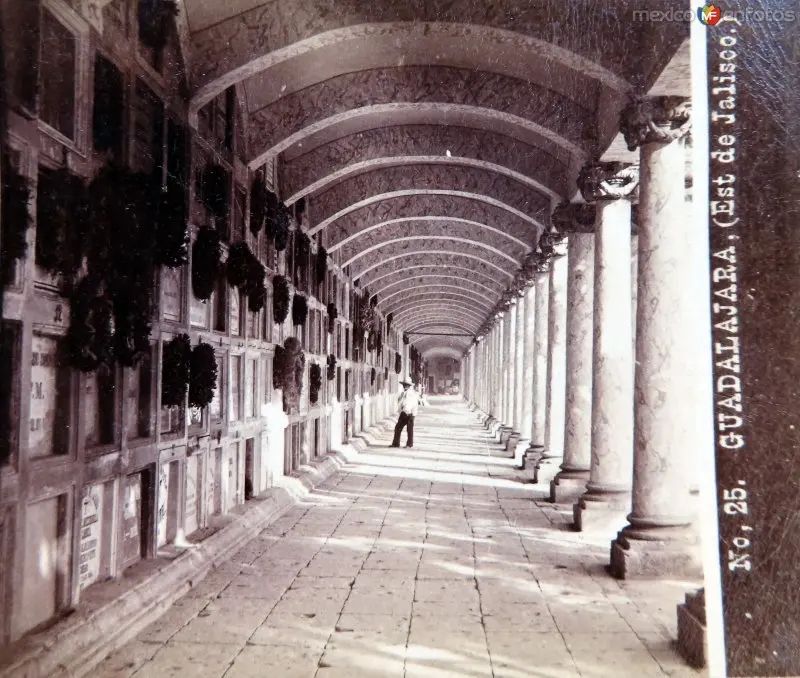
Opened in 1848 under its official name, Panteón de Santa Paula, to a design by the architect Manuel Gómez Ibarra, and closed to new burials in 1896 once full, Belén cemetery was the resting place of Guadalajara's elite and is today among Mexico's most storied.
Where is Panteón de Belén?
- Location
- Jalisco, Mexico
- Type
- Cemetery
- Coordinates
- 20.688, -103.345
- Last updated
LOCATION
Why is Panteón de Belén said to be haunted?
Its best-known grave belongs to the so-called Vampire of Guadalajara, from whose chest, the story goes, sprouted the tree that now grows over the plot. The repertoire of legends — the vampire, the child afraid of the dark, the monk — began circulating around 1965 according to the museum's own director: precisely the years when the central mausoleum was being emptied and the plan to turn the cemetery into a tourist attraction was getting under way. It has been a municipal museum since 2010, run by the city of Guadalajara, and is visited on guided tours, including after dark.
What is the history of Panteón de Belén?
Panteón de Belén was not built to frighten anybody. It was built by a public-health reform.
Under colonial rule, in Guadalajara as across New Spain, the dead were buried inside churches and in their forecourts, and the exact spot depended on birth and money: clergy beneath the presbytery, nobles and the wealthy in the church floor according to the fee paid, the poor at the doorways. The Enlightenment imposed a different idea — get the bodies out of the city, away from the living — and civil cemeteries were the result. Belén is one of them.
It was built in 1848 by the architect Manuel Gómez Ibarra, at the request of Bishop Diego de Aranda y Carpinteiro. Its correct name is Panteón de Santa Paula; "Belén" is the name of the street and of the neighbouring hospital, and it eventually swallowed the official one. The site is protected by Mexico's National Institute of Anthropology and History and listed as a national architectural treasure.
The first thing to grasp is that this cemetery was a class map drawn in stone. At its centre stood the Central Mausoleum, the canons' crypt, reserved for clergy and the powerful; around it the courtyard and the wall niches for the rich; and at the far end, through an east archway now sealed, the Patio of the Poor. "Everything was stratified: the rich here, the less rich on this side, the almost-not-rich over there. Each in their place, they did not mix, that was the custom of the time," says the architect David Zárate Weber, a University of Guadalajara researcher who led the restoration of the site from 2006.
In the poor people's yard there were no headstones and no names. Bodies were stacked naked in successive layers under lime and earth, and locals named the practice after a regional dessert: capirotada. The historian Isabel Eugenia Méndez Fausto, quoted by the University of Guadalajara's gazette, describes it as "a natural or improvised trench where several superimposed columns of corpses piled up side by side, with the strangest mixture of sexes, ages and causes of death". The specialty tower of the Antiguo Hospital Civil stands over that trench today. The cemetery of the legends rests, quite literally, on the city's anonymous dead.
The social comedy reached as far as the headstone. Zárate Weber noticed that many monuments simulated a wealth the families did not have: when the money ran short, relatives came to an arrangement with the gravediggers and had their dead man's name carved on the back of a second-hand slab. "It reflects a way of being and of living," he says. "We often see how some figures gave the appearance of being rich, but very often that is all it was — appearance."
And yet the people buried here have verifiable histories. Belén received Archbishop José de Jesús Ortiz y Rodríguez, the composer José Rolón, the poets Alfonso Gutiérrez Hermosillo and Alfredo R. Plascencia, the educator Aurelio Ortega, General Ramón Corona, the public-instruction reformer Manuel López Cotilla, the revolutionary Manuel Macario Diéguez, and Jacobo Gálvez, architect of the Teatro Degollado. It is the who's who of nineteenth-century Guadalajara, and that — not the vampire — is why the place matters.
It did not last long. On 1 November 1896, fewer than fifty years after opening, the government of Mariano Escobedo closed it for overcrowding; the researcher Juan Madrigal, also quoted by the gazette, specifies that the recommendation came from the board of the Higher Health Council and that what was saturated was not only the space but the ground itself, with germs.
The closure was more nominal than real. The press went on reporting burials, gardening work and looting between 1926 and 1940, and holders of perpetual plots were still being interred as late as 1983. Robbery was a trade: in the twentieth century a pair of thieves were caught decapitating skeletons to pull out their gold teeth.
The decisive moment is the 1960s. Between 1964 and 1967 the state exhumed the notables from the Central Mausoleum and moved their remains to the Rotonda de los Jaliscienses Ilustres — Diéguez in 1964, Jacobo Gálvez in 1965, Ramón Corona in 1967 — with street closures, ceremony and interminable speeches. Emptied of its famous dead, the cemetery needed a reason to exist, and politicians proposed restoring and promoting it "to instil a clear, defined tourist consciousness". Between 1969 and 1985, 104 columns were cleaned or replaced, the chapel was refurbished, leaflets were printed, two books were published — El Panteón Romántico de Guadalajara by Víctor Manuel Villegas and Epigrafía del Panteón de Belén by Ramiro Villaseñor y Villaseñor — and a "sound and light" show was staged in the manner of the one at the Teotihuacán pyramids. Keep that date in mind: it returns in the sceptical section.
Then came forty years of intermittent neglect. In August 1996 the press described collapsed tombs, damp and moss. At the end of 2006 a storm flooded the roofs of the north columbarium, blocked with dead leaves, and the wall came down onto the car park; before anyone reacted, at least four exposed coffins were broken open with hammers and looted by people looking for a watch or a piece of jewellery. That collapse brought in Zárate Weber and his restoration.
What came out of those excavations is the best argument for the place. Children's coffins were lined with sky-blue tulle for boys and pink for girls; one of wood lined in water-green silk turned out to be a teenager's. In Archbishop Ortiz y Rodríguez's crypt — empty, his remains having gone to the Sagrario decades earlier — there remained horn buttons, fragments of purple silk ribbon and the remnants of an olive wreath embossed in zinc sheet and painted dark green. The courtyard yielded copper coins, a sheet of embossed gold, buttons of ivory, mother-of-pearl and tortoiseshell. A section that had been used as a rubbish dump gave up old syringes, glass bottles, medicines, sheets, patients' clothing and sawn bones. And behind a prickly pear, next to the gateway that once led to the poor people's yard, they found seven cloth dolls stuck with needles, plastic bags containing beheaded chickens, and black cushions pinned with photographs: witchcraft depositions left there by living people, in the twentieth century. Everything was catalogued and handed to the city council, with copies of the records to INAH.
The old Lepers' Chapel, a space five metres by fourteen, had already been fitted out in 1970 on the orders of mayor Efraín Urzúa Macías "so that exhibitions of all kinds, recitals, concerts and lectures can be staged there". In 2007 it again served as a site museum for the finds, and on 1 January 2010 the whole was formally inaugurated as the Museo Panteón de Belén, run by the Culture Department of Guadalajara City Council.
Timeline: the documented record of Panteón de Belén
- 1848 The Panteón de Santa Paula is built by the architect Manuel Gómez Ibarra at the request of Bishop Diego de Aranda y Carpinteiro. It is founded as a civil cemetery, a product of the public-health reform that moved burials out of churches.
- 24 May 1882 The date carved on "Nachito's" headstone, the only inscription besides the name. The obituary in the Gaceta Médica de México records the death that same day, at nine in the morning in Guadalajara, of Dr Ignacio Torres Altamirano, aged 38, a corresponding member of the Academy of Medicine.
- 1 November 1896 The government of Mariano Escobedo closes the cemetery for overcrowding, fewer than fifty years after it opened. According to the researcher Juan Madrigal, the recommendation came from the board of the Higher Health Council.
- 1926-1940 Despite the closure, the press reports burials, gardening work and looting — the activity of a working cemetery. Holders of perpetual plots went on being interred until 1983.
- 1964-1967 The state exhumes the notables from the Central Mausoleum and moves them to the Rotonda de los Jaliscienses Ilustres: Manuel Macario Diéguez in 1964, the architect Jacobo Gálvez in 1965 and former governor Ramón Corona in 1967, with street closures and speeches.
- 1965 Francisco Palacios, director of the Panteón de Belén museum, dates to this year the moment when the legends — Nachito's included — began to be told among the neighbours, in the middle of the campaign to restore, research and commercially exploit the site.
- 1969-1985 Successive city administrations fund restoration and tourist promotion: 104 columns are cleaned or replaced, leaflets are printed, Víctor Manuel Villegas's El Panteón Romántico de Guadalajara and Ramiro Villaseñor y Villaseñor's Epigrafía del Panteón de Belén are published, and a sound-and-light show is staged in the manner of Teotihuacán.
- November 1970 Mayor Efraín Urzúa Macías orders the north chapel-hall — the old Lepers' Chapel, five metres by fourteen — to be fitted out "so that exhibitions of all kinds, recitals, concerts and lectures can be staged there".
- 8 August 1996 The press documents the neglect: tombs and statues damp and mossy, graves collapsed for want of maintenance, and water seeping into the mausoleum.
- Late 2006 A storm floods the roofs of the north columbarium, choked with dead leaves, and the wall collapses onto the car park. Before the watchman notices, at least four exposed coffins are broken open with hammers and looted.
- 2007 The architect David Zárate Weber leads the restoration. Among the finds: blue and pink tulle linings from children's coffins, buttons of ivory, mother-of-pearl and tortoiseshell, an olive wreath in zinc sheet, syringes and sawn bones from a section used as a dump, and seven cloth dolls stuck with needles hidden behind a prickly pear beside the gateway to the Patio of the Poor.
- 1 January 2010 Founding date of the Museo Panteón de Belén according to the federal Culture Ministry's cultural information system. It comes under the Culture Department of Guadalajara City Council.
- October 2025 The night tours run Wednesday to Saturday at 20:00, 21:00, 22:00 and 23:00, lasting 50 minutes, in groups of up to ninety, paid in cash on the day, with photography and filming forbidden. Night admission costs 106 pesos.
Is there a rational explanation for Panteón de Belén?
The star legend of Panteón de Belén is called Nachito, and it is a case study in how a ghost gets manufactured.
The version told on the tours has Nachito as a small boy — or a baby — terrified of the dark. His parents kept lamps burning for him; one night they went out to a party, a gale blew the lights out, the child woke in darkness and his heart gave way with fright. Buried at Belén, he was heard screaming by the night watchmen until one morning they found his coffin sitting on top of the grave. His parents, understanding that their son was still afraid after death, placed him in a stone sarcophagus with cracks to let the daylight in and set four torches around it for the night.
What the headstone actually carries is a full name and a date: "Mayo 24 de 1882". Nothing else. No age, no epitaph, no hint of childhood.
The architect David Zárate Weber, who restored the site, makes two points. The first is that the small stone sarcophagus is not a child's coffin: it is a funerary symbol imported from Europe and the United States, representing the ancient burial mound, with broken obelisks at the corners standing for death — a Greco-Roman element made fashionable by neoclassicism, as Manuel Aguilar-Moreno explains in La perfección del silencio. In other words, the object that "proves" a child lies there is a standard nineteenth-century monument type. The second is that a person of that name did exist and was not a child, and that in the late nineteenth century older men were routinely addressed with diminutives: "go and see don Nachito".
From there the versions contradict one another, and the contradiction is the most revealing datum of all.
Zárate Weber speaks of an adult of 45. The bookseller José René Gutiérrez Bravo, who sells copies of Panteones de Belén y Mezquitán, sus leyendas at the cemetery gate, tells it as a man who died at 28 of a condition that left him with childlike features. The museum's director, Francisco Palacios, recounts the legend of the frightened child on camera but argues that the monument says something else: that the dead man was a children's doctor, and that in funerary art the small coffin means he healed children. And the genealogical research published by the University of Guadalajara's gazette, cross-checking baptism, marriage and death records, finds a Dr Ignacio Torres Altamirano baptised in Guadalajara on 27 December 1843, professor of external pathology at the medical school, corresponding member number 88 of the National Academy of Medicine from 11 June 1873, married in 1869, father of four — two daughters dead in early childhood — who died "on 24 May… at nine in the morning", aged 38, according to the obituary in the Gaceta Médica de México.
Four different ages for the same dead man. None of them is a child.
The vampire behaves the same way. In the version circulated by the Guadalajara press, a wealthy European called Don Jorge attacked people at night, was captured and had a stake driven through his heart; a tree grew from the stake and cracked his headstone, and if the tree falls the vampire wakes. In another published version the character called himself the Count of Valdorck, appeared around 1880, and what turned up were animals drained of blood. The name changes, the date changes, the victims change: this is folklore, not biography. The staking motif, moreover, is European and reached Mexico through literature, not through a court file.
And then there is the date. The cemetery's own director, talking informally after a tour, places the moment these stories began to circulate among the neighbours: 1965. That is precisely the year the state was emptying the Central Mausoleum to carry its notables off to the Rotonda and launching the plan to turn the cemetery into a tourist attraction, complete with leaflets, two books of legends and epigraphy, and a sound-and-light show. The legendary repertoire and the tourism campaign are contemporaries. There is no colonial archive, no nineteenth-century chronicle, no case file: there is a cultural operation of the 1960s to 1980s that is still running.
That does not make the stories worthless, and it is worth saying so. The anthropologist Marco Antonio Molina defines the urban legend as "a story with real referents (people, places)" that "narrates an event with supernatural or extraordinary elements and carries a truth value", and observes that legends about children who die violently work as reminders of the care children are owed. The historian Graciela de Garay adds that oral tradition exists to give a community cohesion and self-awareness. Translated: Nachito explains no Ignacio Torres Altamirano at all — he explains the fears of the people who lived around the cemetery.
One last methodological detail. Photography and video are forbidden on the night tours. Whatever the reason — conservation, crowd control in groups of up to ninety — the practical effect is that the "evidence" ghost-hunting depends on cannot be produced inside. What can be checked at Belén, in broad daylight, is the other story: a paupers' mass grave under a hospital, a courtyard stratified by social class, and headstones carved on their reverse side.
Can you visit Panteón de Belén?
The Museo Panteón de Belén is at Calle Belén 684 (between Hospital and Eulogio Parra streets) in central Guadalajara, CP 44100, next to the Antiguo Hospital Civil. Mexico's Sistema de Información Cultural, in a record last updated on 4 July 2023, gives it as run by the Culture Department of Guadalajara City Council, with telephones 33 1001 5299 and 33 1374 0134 and the email [email protected]. The council's procedure sheet for fiscal 2024 adds 33 1594 3652, and the city tourism office's page for the museum, read on 23 September 2026, gives 33 3837 4400, extension 4150.
Visits are always guided and leave at fixed times. Day tours run Tuesday to Saturday at 10:00, 11:00, 13:00 and 14:00, the same four departures in the cultural record of 2023 and in Milenio's guide of October 2025. Night tours run Wednesday to Saturday at 20:00, 21:00, 22:00 and 23:00; Milenio gave them as lasting 50 minutes, in groups of up to 90 people.
Prices are set each year in the municipal revenue law. The council's procedure sheet for fiscal 2024 put general admission at 39 pesos and the night tour at 101, with a reduced day ticket of 19 pesos for students and teachers with ID, children up to 12, people with disabilities and over-60s. Milenio gave 41 pesos by day and 106 at night in October 2025. For 2026 the local guide Guadalajara Secreta, writing on 3 February, gave 43 pesos by day and 111 at night; its reduced tickets were 21 pesos by day and 56 at night, and taking photographs on a day visit cost 107 pesos.
According to Milenio, night tickets go on sale on the day of the tour from 19:30, in cash only, with a limit of four per person. Photography is not allowed on the night tour, and Milenio lists fancy dress, large bags and food or drink among the prohibited items; torches are permitted.
The cemetery was the funerary annex of the hospital next door, the Antiguo Hospital Civil Fray Antonio Alcalde. The Gaceta of the University of Guadalajara describes the Patio of the Poor, where unidentified bodies were buried in layers covered with lime and earth, the method known as capirotada, and the hospital's specialty tower now stands over it. The notables exhumed from Belén's Central Mausoleum, among them the revolutionary Manuel M. Diéguez and the architect Jacobo Gálvez, were moved to the Rotonda de los Jaliscienses Ilustres, beside the cathedral, a little over a kilometre south.
The same Gaceta reported in 2023 that Belén is more deteriorated than the Panteón de Mezquitán, which is larger and better guarded and has not gone through closures like Belén's, and it records the looting of at least four coffins after a wall collapsed in 2006. The two galleries of wall niches and the spire of Manuel Gómez Ibarra's Central Mausoleum still stand.
Sources consulted
- Adrián Montiel, «Los «Nachitos» del Panteón de Belén» — Gaceta de la Universidad de Guadalajara, 2023 newspaper archive
- Adrián Montiel, «Panteón de Belén, rumbo a su segundo centenario» — Gaceta de la Universidad de Guadalajara, 2023 newspaper archive
- Red Nacional de Información Cultural, «Museo Panteón de Belén (ficha del Sistema de Información Cultural)» — Sistema de Información Cultural, Secretaría de Cultura de México, 2023 report
- Ayuntamiento de Guadalajara, «Admisión al Panteón de Belén (ficha de trámite; Ley de Ingresos del Municipio de Guadalajara, ejercicio fiscal 2024, art. 66 fr. IX)» — Trámites y servicios, Gobierno de Guadalajara, 2024 report
- Salvador Romero, «Precios y horarios del Panteón de Belén: todo de recorridos nocturnos» — Milenio, 2025 newspaper archive
- Milenio Digital, «Panteón de Belén: leyendas más conocidas en Guadalajara» — Milenio, 2019 newspaper archive
- Daniela Rodríguez, «Panteón de Belén, sitio de historia y leyendas» — El Diario NTR Guadalajara, 2018 newspaper archive
- Carmen Ríos, «Las almas del Panteón de Belén, leyendas que aún rondan Guadalajara» — México Desconocido, 2025 web
- Dirección de Turismo, «Museo Panteón de Belén (ficha de lugar)» — Gobierno de Guadalajara, 2026 web
Reviewed by V. Serrano on 2026-07-31 · How we verify our content
💬 Field testimonies (0)
No testimonies yet. Add the first.
Add your testimony
🔒 Log in to add a testimony