📜 LEGEND · EXP. Nº3657
ACTIVE
The Alley of the Kiss
The Alley of the Kiss is a legend from Guanajuato, MX — a folk story passed down over generations. This file collects its origins, its meaning and how it has been retold.
Where does the legend of The Alley of the Kiss come from?
- Location
- Guanajuato, MX
- Kind of legend
- Folk tale
- Coordinates
- 21.016, -101.257
- Testimonies
- 0
- Last updated
LOCATION
What is the legend of The Alley of the Kiss?
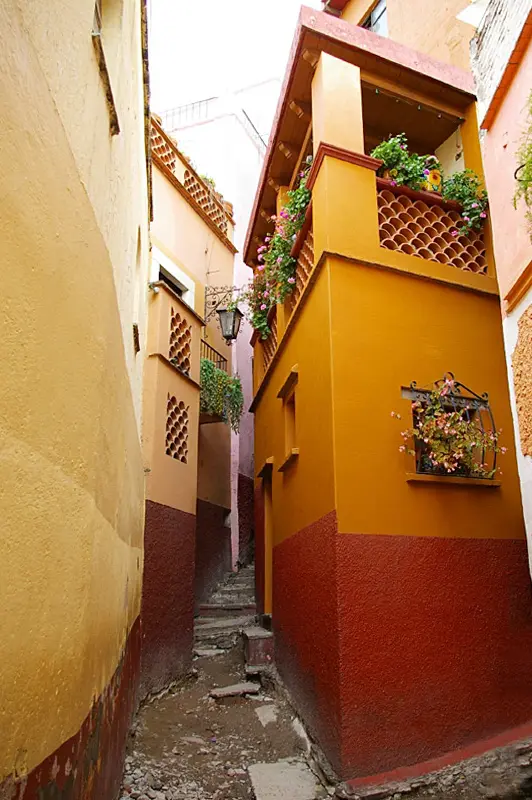
The Alley of the Kiss is a flight of steps about 68 centimetres wide climbing from the Plaza de los Ángeles in the historic centre of Guanajuato. The story told there — a rich family's daughter, a poor miner, two balconies that almost touch, and a father who stabs her — is presented as colonial, yet not even the names hold still: depending on who is telling it, she is Ana or Carmen and he is Carlos or Luis. No document about those people is known, and the legend does not appear in the contents of Agustín Lanuza's Romances, tradiciones y leyendas guanajuatenses (1908), the first major gathering of the city's folklore, which does include traditions tied to specific streets and squares. The custom of kissing on the third step, painted red, promises seven years of luck according to the guides and fifteen according to the city's official page. What is firmly dated is the legend's loudspeaker: the callejoneadas of the university estudiantina, founded in 1962, in a city declared a Zone of Historic Monuments in 1982.
What is the history of The Alley of the Kiss?
The Alley of the Kiss is real, as narrow as they say, and it climbs where they say it climbs. The only thing missing is the paperwork.
Start with the city, because it explains the stage set without any love story at all. Guanajuato was built inside a ravine, on top of a silver vein, and grew upwards because there was nowhere else to grow. In 1908 an American traveller, Cora Bosworth Glasier Myers, published a whole book about the city in Milwaukee — A City of Dreams (Guanajuato) — and put it plainly: as the town grew it "had of necessity to climb the steep hills, and economise in room even to inches, compelling narrowest streets and flat roofs". Her hotel, she wrote, faced "what seemed to be an alley, but was really one of the widest streets": eighteen feet at the corner, down to nine, back up to sixteen. In a city like that, a passage sixty-odd centimetres wide is not an anomaly demanding an explanation. It is the ordinary fabric of the place.
The alley itself is a short flight of steps rising from the Plaza de los Ángeles, on Avenida Benito Juárez, branching off the Callejón del Patrocinio a few metres above the square. The city government gives its width as 68 cm, and the name is old: the municipal division of 1879, printed by Lucio Marmolejo in 1883, already lists a "callejón del Beso" beside the Plazuela de los Ángeles and the callejón del Patrocinio. The third step is painted red.
The story told there runs roughly like this. A wealthy family's daughter leans out onto her balcony at night. A poor miner sees her from the balcony opposite, an arm's length away. The father — a man of arms, of honour and of business — had other plans: marriage to an old nobleman in Spain. He finds them, comes in with a dagger and kills her. The miner gets one last kiss, and the alley its name.
The trouble is that not even the names hold still. In 2023 the reporter Velio Ortega transcribed, for the Guanajuato paper Notus, the literal opening of the guides' script: "This is the love story of doña Ana (although last week's teller said she was doña Carmen)…". In some versions she is Ana and he is Carlos; in others she is Carmen and he is Luis; the father turns up as "don Emiliano". The dates drift just as freely: some outlets place the killing in 1705, others leave it at "colonial times", and the city's own visitor page gives none at all. Nor is the reward agreed: guides promise seven years of good luck to couples who kiss on the third step — and seven years of bad luck to those who do not — while the municipal page offers fifteen.
There is one book where the paperwork ought to be.
In 1908 the Guanajuato writer Agustín Lanuza (1870-1936) published, in Mexico City with E. Gómez de la Fuente, Romances, tradiciones y leyendas guanajuatenses, 328 pages: the first major gathering of his city's folklore, made by a man of the city. The copy digitised by the Universidad Autónoma de Nuevo León lets anyone read its full table of contents. It holds La ciudad encantada, El cerro del Meco, El cantador, Pípila, El milagro del padre Serenito, El conde de la Cadena, El pachón, El coche de don Melchor, Albino García, La plazuela de los Carcamanes, El giro, Nuestra Señora de Guanajuato, Las cabezas de los héroes, Las velas del padre, El diablo en los ejercicios, Los hospitales, El señor de Villaseca, El Colegio del Estado, La laguna de sangre, Fray Antonio, La calle del Truco and El clarín de órdenes, among others. More than twenty pieces, several of them anchored to one specific street or square: "The Street of the Trick", "The Little Square of the Carcamanes". This was exactly Lanuza's genre. The Alley of the Kiss does not appear in his contents.
Myers's book, from the same year, points the same way. It is the account of a foreigner who stayed a while, walked the alleys, described the balconies, went down into the mummy vaults and paused over the city's "stories and traditions". Her text never uses kiss, beso or callejón, and alley appears only for streets she describes, among them the one outside her hotel, which "seemed to be an alley, but was really one of the widest streets". Two books from 1908 — one local, one foreign; one of legends, one of travel — and neither has an alley of the kiss in it.
There is more. Ortega adds a material detail which, if accurate, is devastating: he states that photographs from the late nineteenth and early twentieth centuries show the right-hand house with a terrace full of flowerpots and no balcony at all, and that the balcony was built in the 1950s. In the same piece he notes that the traditional prints put the man in the left-hand house and the girl in the right-hand one, and that today the guides tell it the other way round. The scenery of the legend, in other words, is younger than the legend — and the legend is far younger than the period it claims.
That leaves the vehicle. What carries the story to thousands of people every night is the callejoneada, the sung night walk, and its origin is dated: the Estudiantina de la Universidad de Guanajuato came together in March 1962 and made its official debut on Friday 13 April 1963 in the Plazuela de San Roque, according to the university itself. From there came the nightly musical tours that now stop at the Alley of the Kiss. The city was declared a Zone of Historic Monuments on 28 July 1982, and the alley has been one of its fixed postcards ever since.
Timeline: the documented record of The Alley of the Kiss
- 1879 Guanajuato's new municipal division, later reproduced by the priest Lucio Marmolejo in his Efemérides guanajuatenses (1883), lists a 'callejón del Beso' in the ninth block of the second ward, beside the Plazuela de los Angeles and the callejón del Patrocinio: the name is in official use three decades before Lanuza's book.
- 1908 — the anthology Agustín Lanuza publishes Romances, tradiciones y leyendas guanajuatenses (Mexico, E. Gómez de la Fuente, 328 pp.), the first major gathering of the city's folklore. Its table of contents holds more than twenty pieces, several tied to a named street or square, and no Alley of the Kiss.
- 1908 — the traveller Cora Bosworth Glasier Myers publishes A City of Dreams (Guanajuato) in Milwaukee. She explains the narrow streets as a consequence of the ravine, where the town had to "economise in room even to inches". Her book never mentions a kissing alley or the legend.
- 1950s — the balcony Reporter Velio Ortega states that photographs from the late 19th and early 20th centuries show the right-hand house with a terrace of flowerpots and no balcony, and that the balcony was built only in the 1950s.
- March 1962 The Estudiantina de la Universidad de Guanajuato comes together among architecture students; the group that will spread the legend nightly through the callejoneadas does not yet exist.
- Friday 13 April 1963 The Estudiantina makes its official debut in the Plazuela de San Roque, according to the university's own account. The sung night walks grow out of it, and the Alley of the Kiss becomes one of their fixed stops.
- 28 July 1982 Guanajuato is declared a Zone of Historic Monuments, consolidating the historic centre — and the alley with it — as a mass tourist destination.
- 8 October 2022 After three days shut over a dispute between the balcony owners and the photographers, mayor Alejandro Navarro reopens the alley following an agreement. Neighbours protest at a metal bench and a post that narrow the passage further.
- 17 August 2023 Notus transcribes the guides' script and records its instability: "the love story of dona Ana (although last week's teller said she was dona Carmen)". It also reports 50 pesos' entry to the balcony plus 100 for the photograph.
- 13 February 2025 La Silla Rota reports the conflict at its worst: fist fights between photographers and the balcony's owner, harassment complaints, boarded-up closure notices and signs reading "The law has died".
Is there a rational explanation for The Alley of the Kiss?
The question the alley raises is documentary: in what paper do Ana, her father and her miner appear?
The names are the strongest argument, and they run against the legend. A tradition anchored in real people tends to keep the names even when it loses everything else; here the opposite happens. She is Ana or Carmen, he is Carlos or Luis, the father is "don Emiliano" or nameless, and both versions coexist in the same alley, told by different guides in consecutive weeks — which is precisely what Velio Ortega documented in Notus in 2023. None of the accounts cited here, from the guides' script to the city's own page, names a document for any of them.
The silence of 1908 is the cleanest piece of evidence. Agustín Lanuza gathered more than twenty Guanajuato traditions, several of them tied to a named street or square — "The Street of the Trick", "The Little Square of the Carcamanes". If a romantic legend attached to a famous alley had been circulating in Guanajuato in 1908, his leaving it out would be extraordinary. The evidence is the book's complete table of contents, legible in the copy digitised by the Universidad Autónoma de Nuevo León: no piece in it takes its title from the legend. The table of contents cannot show whether the alley is mentioned inside another piece. In parallel, Cora Myers's travel book about the same city in the same year does not mention it either.
The name is older than any printed telling of the legend cited here. The municipal division of Guanajuato drawn up in 1879, which the priest Lucio Marmolejo reproduced in the first volume of his Efemérides guanajuatenses (1883), already lists a "callejón del Beso" in the ninth block of the second ward, alongside the "Plazuela de los Angeles" and the "callejón del Patrocinio", the same neighbours the alley has today. The same list has a second "callejón del Beso" in another part of the city, beside the callejón de los Canarios. Nor was the name peculiar to Guanajuato. José María Marroqui's La ciudad de México (1900) describes a long, badly lit passage in the capital "cuya estrechez le ha valido el nombre de callejón del Beso": its narrowness alone had earned it the name.
The numbers contradict each other, and that is a symptom. The city's page gives the width as 68 centimetres; Notus puts the two balconies 65 centimetres apart. The date of the killing runs from 1705 to "colonial times", or is simply omitted. The reward for the kiss is seven years according to the guides and fifteen according to the city's own page, and both add seven years of bad luck for couples who do not kiss on the third step. Every one of these variants is sourced to a guide, a newspaper or the city's page of the last few years.
The ritual has visibly grown more expensive. Ortega describes the escalation: the kiss on the third step "was part of Guanajuato romanticism, until somebody decided it had to be more immersive and they moved it indoors, balcony to balcony", at 50 pesos' entry per person plus 100 more for the printed photograph. What followed is in the papers: in October 2022 the city council closed the alley for three days over a dispute between the balcony owners and the photographers, and mayor Alejandro Navarro reopened it on the 8th after an agreement; in February 2025 La Silla Rota reported fist fights, harassment complaints, boarded-up closure notices and the balcony's owner hanging up signs reading "The law has died". A legend with a price list and a dispute over a balcony attached to it has a commercial reason to exist and to grow.
The narrowness has a dull and sufficient explanation. Guanajuato wedged itself into a ravine and, in Myers's 1908 words, had to "economise in room even to inches, compelling narrowest streets and flat roofs"; the street outside her hotel, which she took for an alley, narrowed from eighteen feet to nine.
And now the other side. None of this makes the custom a fraud, or the people of Guanajuato accomplices in a deception. A legend does not need a corpse to be true as a legend; it needs people to tell it, and this one has been told, sung and handed on in the callejoneadas for at least three generations. Recent, anonymous legends make up much of the world's urban folklore. What the sources allow is a living tradition, probably of the late nineteenth or the twentieth century, attached to an alley that already bore the name of the Kiss in 1879.
Can you visit The Alley of the Kiss?
Where it is. The alley climbs from the Plaza de los Ángeles, on Avenida Benito Juárez, in the Zona Centro of Guanajuato city. The state government's attractions listing gives the address as Belén 22, Zona Centro, 36000 Guanajuato, Gto. Milenio describes the approach as a dozen paces up the Callejón del Patrocinio from the plaza, with the steps dropping away on the left. Approximate coordinates of the steps: 21.0164 N, 101.2565 W, some fifty metres from the plaza. The Mercado Hidalgo lies about 200 metres to the north-west and the Jardín de la Unión about 380 metres to the east.
What it costs. Milenio states that entering the alley costs nothing; it is a public street, with no opening hours. The third step is painted red, and the state listing promises a couple who kiss on it fifteen years of good fortune. What is charged for is the photograph. Milenio reported in October 2023 that couples buying the official set pay 200 pesos for one portrait in a frame and two more on paper. Notus reported in August 2023 a charge of 50 pesos per person to go up to the balcony, plus 100 pesos for the printed photograph.
The balcony opens and closes. Access to the interiors has been shut for long stretches by a dispute between the owner of Doña Ana's balcony and the photographers who work the alley. In October 2022 the city council closed the alley altogether and reopened it on the 8th, after an agreement between the two sides. On 13 February 2025 La Silla Rota found the entrance shut again, under a municipal suspension order, with signs on the door reading "Murió la ley". The steps themselves stayed open through both episodes.
The passage. The state listing gives the alley as 68 centimetres wide, the measurement on which the whole legend turns, and Milenio gives the same figure for the gap between the two balconies. These are stone steps without a continuous handrail, so a wheelchair cannot use them and two people cannot pass abreast.
The callejoneada. Guanajuato's sung night walks are led by an estudiantina in costume. Milenio reported in January 2023 that they leave from the atrium of the Templo de San Diego, facing the Jardín de la Unión, at 21:15 from Monday to Thursday and at 19:45 and 21:15 at weekends, for 185 pesos an adult and 130 a child. Those were the figures published in January 2023.
Around it. The Mercado Hidalgo opened in 1910. The whole of the old city was declared a Zone of Historic Monuments on 28 July 1982.
Sources consulted
- Agustín Lanuza, «Romances, tradiciones y leyendas guanajuatenses — ejemplar digitalizado con la tabla de contenido completa; la obra reúne más de veinte tradiciones de Guanajuato, entre ellas «La calle del Truco» y «La plazuela de los Carcamanes», y no incluye el Callejón del Beso» — México, E. Gómez de la Fuente; Colección Digital, Universidad Autónoma de Nuevo León, 1908 book
- Cora Bosworth Glasier Myers, «A City of Dreams (Guanajuato) — libro de viaje sobre la ciudad: la barranca, las calles más estrechas y los balcones, sin mención alguna del callejón ni de la leyenda» — Milwaukee, Press of Gillett & Company; Internet Archive, 1908 book
- Velio Ortega, «Callejón del Beso: la leyenda inventada para el turismo — transcripción del relato de los guías, las variantes de nombres, las fotografías antiguas sin balcón y los precios del balcón y la foto» — Notus, Guanajuato, 2023 newspaper archive
- David Santiago, «Autoridades reabren el Callejón del Beso en Guanajuato tras conflicto — cierre de tres días y reapertura el 8 de octubre de 2022 tras el acuerdo entre propietarios de los balcones y fotógrafos» — Expansión Política, 2022 newspaper archive
- Universidad de Guanajuato, «Estudiantina de la UG marca historia con 53 aniversario — la agrupación se gesta en marzo de 1962 y debuta oficialmente el viernes 13 de abril de 1963 en la plazuela de San Roque» — ugto.mx, comunicación institucional, 2016 web
- Eloy Esquivel, «El Callejón del beso: ya no es por amor, ahora es por dinero — el pleito entre la propietaria del balcón y los fotógrafos, la clausura municipal y los carteles de «Murió la ley»» — La Silla Rota Guanajuato, 2025 newspaper archive
- Gobierno de Guanajuato, «Callejón del Beso — ficha oficial de atractivos del gobierno de Guanajuato: 68 cm de anchura, tercer escalón pintado de rojo y quince años de buena fortuna» — guanajuato.mx, 2026 web
- Yair Hernández, «Así es el emblemático Callejón del Beso en Guanajuato — cómo se llega desde la plaza de los Ángeles por el callejón del Patrocinio, precios de los fotógrafos y la datación en 1705 que ofrecen algunas versiones» — Milenio, 2023 newspaper archive
- Instituto Mexicano de la Radio, «28 de julio de 1982: la ciudad de Guanajuato es declarada Zona de Monumentos Históricos (efeméride, consultada en 2026)» — imer.mx, 2026 web
- Redacción, «Callejoneadas en Guanajuato: ¿qué son y cuánto cuestan? — salida del atrio del Templo de San Diego, horarios de lunes a jueves y fin de semana, duración y precios de 185 y 130 pesos» — Milenio, 2023 newspaper archive
- Lucio Marmolejo, «Efemérides guanajuatenses, ó datos para formar la historia de la ciudad de Guanajuato, tomo I — reproduce la división municipal de 1879: cuartel 2, manzana 9, «Plazuela de los Angeles, callejón del Patrocinio, callejón del Beso por ambas aceras», y un segundo callejón del Beso junto al de los Canarios» — Guanajuato, Imprenta del Colegio de Artes y Oficios; Internet Archive, 1883 book
- José María Marroqui, «La ciudad de México, tomo III — un callejón del centro de la capital «largo y mal alumbrado, cuya estrechez le ha valido el nombre de callejón del Beso»» — México, Tip. y Lit. «La Europea» de J. Aguilar Vera y Cía.; Internet Archive, 1900 book
Reviewed by V. Serrano on 2026-08-01 · How we verify our content
📎 Source: Enigma Atlas
💬 Field testimonies (0)
No testimonies yet. Add the first.
Add your testimony
🔒 Log in to add a testimony