🦶 CRYPTID SIGHTING · EXP. Nº6501
ACTIVE
Camahueto
The camahueto belongs to the folklore of Chiloé, the rain-soaked archipelago off southern Chile, and to the mainland shore around the Río Maullín.
Where and when was Camahueto sighted?
- Location
- Chiloé, Chile
- Date sighted
- Unknown
- Coordinates
- -42.6, -73.85
- Last updated
LOCATION
What is Camahueto?
Most retellings today describe a calf with a single horn on its forehead that grows buried inland and gouges its way to the sea. The oldest printed sources say something else. When the Chilean navy hydrographer Francisco Vidal Gormaz first put the name in print in 1874, it belonged to a man-eating animal that guarded a waterfall and changed the weather at will. In the compilations of Darío Cavada (1896), Rodolfo Lenz (1904-1910), Francisco J. Cavada (1914) and Julio Vicuña Cifuentes (1910 and 1915) the camahueto is born in rivers, not underground, and carries two small horns that spark like gold, not one. It can be caught only with cables of kelp. And in the court file of the 1880 prosecution of the Chilote brujos of La Recta Provincia, the camahueto is not a beast at all: it is the name of a scarce, valuable bone, said to come from a sea animal, which healers gathered in the rivers and scraped into a poultice for broken bones. Three of them gave their names to the record.
What is the history of Camahueto?
The camahueto reaches us on paper, and for a piece of oral folklore the paper is unusually good.
The earliest printed mention found for this entry is not a folklore book but a hydrographic survey. In 1874 Francisco Vidal Gormaz, a Chilean navy officer charting the Río Maullín on the mainland opposite Chiloé, filed his reconnaissance in the Anales de la Universidad de Chile. On page 628 he noted, with an officer's irritation, that "the superstitious, of whom there are some, spoke in awe of an animal they call camahueto, which eats people and has the singular power of changing the weather at will and of making it rain or thunder as it pleases, in order to intimidate the bold who attempt to reach its resting place, the Salto" — the falls of the Maullín. There is no horn in that paragraph, no calf and no burrowing.
Six years later the word entered a courtroom. In 1880 the intendant of Chiloé, Luis Martiniano Rodríguez, ordered his subordinate authorities to round up every brujo in the archipelago on a single appointed day and send them to Ancud along with their instruments, herbs and ointments, to serve as evidence. What the round-up exposed was La Recta Provincia, a society of healers whom the islanders called "médicos de la tierra" — doctors of the earth — with its own kings, councils, judges and written sentences, and which had renamed the province and its villages after Santiago, Lima, Buenos Aires and Arica. Copies of the case file were taken from the Ancud court by Román Espech, given to the historian Benjamín Vicuña Mackenna, and printed in 1904 by the physician Pedro Lautaro Ferrer in his Historia general de la medicina en Chile.
In those depositions the camahueto is not a monster at all. Questioned in Ancud on 26 March 1880, Mateo Coñuecar — seventy years old, a farmer from Teman who could neither read nor write — explained that the healers "use certain bones, which they designate by the name of camahuetos, which serve to rub oneself with when one has some pain; the bones, according to tradition, come from a marine animal; they are very scarce and have some value." Aurora Quinchén Anguil described the preparation: the bone is gathered in the rivers by those who know, scraped, mixed with egg and wheat flour into a poultice and laid on the injured part over a sheet of paper, after a cut has first been made where the injury is. A third deponent, Cristino Quinchén, said that a bone he called "unicorn bone" improved the breathing.
The animal itself entered print along a separate line. Darío Cavada's Chiloé (Ancud, 1896) supplied Rodolfo Lenz with the version that went into his Diccionario etimolójico: a fabulous creature that lives in the water, can be hunted only with cables of kelp, and "has two pretty little horns" whose scrapings, boiled in seawater with salt and vinegar, give strength and health. Francisco J. Cavada printed the fullest account in Chiloé y los chilotes (1914, pp. 105-106): a young calf living in the deep rivers, strong enough to tear half a hill from its foundations and drag it to the sea, with two horns "that spark like gold". It favours the Río Bravo between Nercón and Rauco, where the brujos wash; when the river swells they shout "¡Calma, Thraiguén!" and the waters go down. Julio Vicuña Cifuentes gathered the lot — his own oral informants from Chiloé and Puerto Montt, plus every printed version he could find — first in 1910 and again, expanded, in 1915.
Timeline: the documented record of Camahueto
- 1874 Navy hydrographer Francisco Vidal Gormaz publishes his reconnaissance of the Río Maullín in the Anales de la Universidad de Chile. On page 628 he records local talk of an animal called camahueto that eats people and changes the weather at will, guarding its resting place at the Salto. It is the oldest printed mention traced for this entry — and it mentions no horn.
- 1880 Intendant Luis Martiniano Rodríguez orders every brujo in Chiloé rounded up on a single day and sent to Ancud with their herbs and instruments as evidence. The prosecution exposes La Recta Provincia, a healers' society the islanders called "médicos de la tierra".
- 26 March 1880 Mateo Coñuecar, a seventy-year-old farmer from Teman who could neither read nor write, deposes in Ancud that healers use bones they call camahuetos to rub where it hurts, that tradition holds the bones come from a marine animal, and that they are very scarce and worth something. Aurora Quinchén Anguil describes the preparation and Cristino Quinchén calls one of his own pieces a "unicorn bone".
- March 1882 Travelling from Castro to Achao, Román Espech notes that since the intendant's crackdown the brujos of Chiloé heal only in hiding. He had copied pieces of the 1880 court file from the Ancud court and gave them to the historian Benjamín Vicuña Mackenna.
- 1896 Darío Cavada's Chiloé, published in Ancud, gives the version Lenz would quote: a water-dwelling creature caught only with kelp cables, with two small horns whose scrapings are boiled in seawater with salt and vinegar.
- 1904 The physician Pedro Lautaro Ferrer prints the Ancud depositions in his Historia general de la medicina en Chile, and separately lists deer horn and unicorn horn among the universal remedies still kept in Chilean pharmacies for healers and brujos.
- 1904-1910 Rodolfo Lenz's Diccionario etimolójico defines the camahueto in entry 116 and proposes, tentatively, a Mapudungun origin from Febrés's mahuentu, a string of shellfish, so that ca-mahuentu might mean "the other shellfishing". His own Supplement later corrects the entry.
- 1910 Julio Vicuña Cifuentes publishes his camahueto entry for the first time, on pages 14-16 of Estudios de folklore chileno — five years before the 1915 book usually credited with it.
- 1914 Francisco J. Cavada gives the fullest account in Chiloé y los chilotes, pp. 105-106: a young calf of the deep rivers with two horns that spark like gold, favouring the Río Bravo between Nercón and Rauco. He complains that some mythologists confuse it with the sea horse, and compares its horn to the European alicorn.
- 1915 Vicuña Cifuentes reissues the entry, expanded, as chapter VII of Mitos y supersticiones recogidos de la tradición oral chilena, pp. 32-34, assembling every printed variant. He concludes that the etymology of the word is unknown, and that the legend circulates only in Chile's southernmost provinces.
- 22 May 1960 The magnitude 9.5 earthquake off southern Chile, the largest ever measured, permanently lowers coastal land by as much as eight feet. At Maullín, the river of the 1874 report, Ramón Atala's Monterey pine plantation is drowned by the tides and becomes a salt marsh.
- 2005 Marco Cisternas, Brian Atwater and colleagues publish in Nature the buried-soil record of the same estuary, showing that such abrupt subsidence has recurred there over two millennia, with the 1960 earthquake closing an interval that began in 1575.
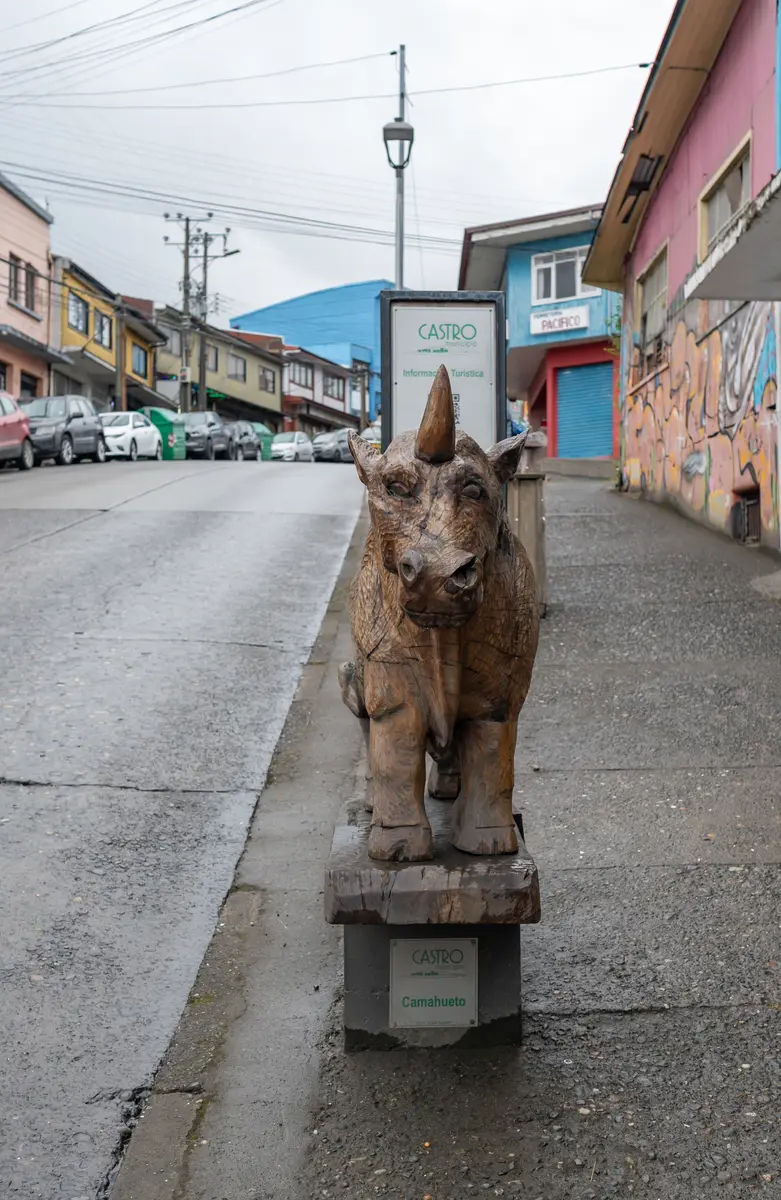
- 5 January 2024 A carved wooden camahueto on a Castro pavement, beside a municipal tourist-information kiosk, is photographed for Wikimedia Commons. It has a single horn — the modern version, not the two-horned animal of the sources.
Is there a rational explanation for Camahueto?
The camahueto is a good test of how much a legend changes while everyone insists it has not.
Start with the horn. Every source between 1896 and 1915 gives the animal two of them. Lenz: "two pretty little horns". Francisco J. Cavada: "its two little horns, which spark like gold". The single horn — and with it the comparison to a unicorn — belongs to the modern retelling, and so does the detail that the creature is born underground far inland and tunnels to the sea. In the nineteenth-century record it is born in rivers, lives there until it is fully grown and only then hurls itself into the sea. The carved camahueto that stands today on a pavement in Castro, on a plinth bearing the municipal tourism logo, has one horn.
The compilers themselves knew the tradition was unstable. Cavada complained in 1914 that "some national mythologists confuse it, without reason, with the sea horse" — the very identification Vicuña Cifuentes was given by an informant in Puerto Montt, who described a colossal marine horse that rammed ships. A third variant, collected in Chiloé, is an aquatic beast armed with claws and sharp teeth that opens great ravines in the coast. Lenz went so far as to correct his own dictionary in its Supplement, downgrading the camahueto from a creature also called cuero or manta to one merely resembling them.
The most useful check is that the physical object exists and is described. In the 1880 depositions the camahueto is a scarce, valuable bone believed to come from a sea animal, gathered in rivers and scraped for fractures and dislocations — a commodity, not an apparition. Both a physician and a folklorist independently placed it in a familiar pharmacological family: Ferrer, writing in 1904 about remedies still kept in Chilean pharmacies, listed "deer horn ... unicorn horn" among the universal cures used by healers; Cavada, in 1914, noted the analogy between "our camahueto horn and the horn of the stag, of the hippopotamus, and the scrapings of the unicorn, used in former times in popular medicine." One of the accused in Ancud simply called his own specimen a unicorn bone.
The landscape does the rest of the work, and it needs no exaggerating. The place where the name was first recorded in print, the Río Maullín, is one of the best-documented sites on Earth for abrupt, permanent land-level change. The magnitude 9.5 earthquake of 22 May 1960 — the largest ever measured — lowered land there by as much as eight feet, turning Ramón Atala's pine plantation outside Maullín into a salt marsh; buried soils in the same estuary record earlier subsidences stretching back two millennia. A country where rivers shift, hillsides slide and forests are taken by the sea is a country that will produce a story about something enormous moving underground toward the water.
But the arithmetic matters, and it cuts against the tidy version. The camahueto was in print in 1874, eighty-six years before the 1960 earthquake, so that earthquake cannot have created it, and no source read for this entry connects the two. What can be said is narrower and truer: the legend was already being used to explain torn hillsides and diverted rivers when Vidal Gormaz and Cavada wrote it down.
Can you visit Camahueto?
The camahueto belongs to the oral tradition of Chiloé and has no site of its own. The pin of this entry, −42.6, −73.85, is a rounded point in the interior of Isla Grande de Chiloé about 15 km south-south-west of Castro, and it stands for the archipelago. What can be visited are the places the sources name and the museum of the town where the 1880 depositions were taken.
The Museo Regional de Ancud, run by Chile's Servicio Nacional del Patrimonio Cultural, is at Libertad 370, Ancud, at the northern end of the island. Its visitor page, consulted on 23 September 2026, gives free admission and these hours: Tuesday to Thursday 10:00-17:30 and Friday 10:00-16:30 all year, with Saturday 10:00-16:00 in January and February and 10:00-14:00 from March to December. The telephone is +56 65 250 4780, and photographs are allowed without flash. The depositions that describe the camahueto as a healing bone were taken in Ancud in March 1880, during the prosecution of La Recta Provincia; the text that can be read today is the one Pedro Lautaro Ferrer printed in 1904 from the copies made for Benjamín Vicuña Mackenna.
In Castro, some 68 km south of Ancud in a straight line, a carved wooden camahueto stands on the pavement of a sloping street in the centre. The plate on its plinth carries the logo of the Castro municipality and the name "Camahueto", and a municipal "Información Turística" panel stands behind it. The Wikimedia Commons photograph of 5 January 2024 records the camera at 42°28'57"S 73°45'37"W, about 300 m east of the point Wikipedia gives for the town centre. The carving has one horn; the versions printed between 1896 and 1915 give the animal two. Nercón, which Francisco J. Cavada named in 1914 as one end of the stretch of the Río Bravo the camahueto favours (Rauco is the other), lies about 3 km south-west of the centre of Castro in a straight line.
The printed sources of this entry are digitised in full on the Internet Archive, at the addresses given in the references: Vicuña Cifuentes (1910 and 1915), Francisco J. Cavada (1914), Lenz's dictionary (1904-1910) and Ferrer's Historia general de la medicina en Chile (1904). The camahueto passages are short. Cavada gives it pages 105-106 and Vicuña Cifuentes pages 32-34 of his 1915 book and 14-16 of the 1910 one, while Ferrer prints the depositions within pages 29-40.
Sources consulted
- Pedro Lautaro Ferrer, «Historia general de la medicina en Chile (documentos inéditos, biografías y bibliografía) — including "Copias de algunas piezas del proceso de los brujos de Chiloé", pp. 29-40» — Imp. Talca de J. Martín Garrido C., tomo I, 1904 book
- Rodolfo Lenz, «Diccionario etimolójico de las voces chilenas derivadas de lenguas indíjenas americanas — entry 116, "Camahueto", and Suplemento II» — Imprenta Cervantes, Santiago (publicado por fascículos, 1904-1910), 1910 book
- Francisco J. Cavada, «Chiloé y los chilotes — "El Camahueto", pp. 105-106, and the vocabulary entry» — Imprenta Universitaria, Santiago, 1914 book
- Julio Vicuña Cifuentes, «Mitos y supersticiones recogidos de la tradición oral chilena — chapter VII, "El Camahueto", pp. 32-34» — Imprenta Universitaria, Santiago, 1915 book
- Julio Vicuña Cifuentes, «Estudios de folk-lore chileno: mitos y supersticiones recogidos de la tradición oral. Primera serie: Mitos — pp. 14-16» — Santiago de Chile, 1910 book
- Francisco Vidal Gormaz, «Hidrografía. Reconocimiento del río Maullín por la comisión exploradora de Chiloé i Llanquihue — camahueto passage on p. 628» — Anales de la Universidad de Chile, vol. 45, pp. 567-660, 1874 report
- Brian F. Atwater, Marco Cisternas, Joanne Bourgeois, Walter C. Dudley, James W. Hendley II and Peter H. Stauffer, «Surviving a Tsunami — Lessons from Chile, Hawaii, and Japan (USGS Circular 1187)» — U.S. Geological Survey, 1999 report
- Marco Cisternas, Brian F. Atwater, Fernando Torrejón et al., «Predecessors of the giant 1960 Chile earthquake» — Nature, vol. 437, pp. 404-407, 2005 academic
- Servicio Nacional del Patrimonio Cultural, «Planifica tu visita — Museo Regional de Ancud» — Museo Regional de Ancud, 2026 web
- Rjcastillo, «File:Camahueto A74067320240105.jpg — carved camahueto in Castro, Chiloé, photographed 5 January 2024 (CC BY 4.0)» — Wikimedia Commons, 2024 web
Reviewed by V. Serrano on 2026-08-11 · How we verify our content
📎 Source: Enigma Atlas
💬 Field testimonies (0)
No testimonies yet. Add the first.
Add your testimony
🔒 Log in to add a testimony