🦶 CRYPTID SIGHTING · EXP. Nº6501
ACTIVE
Peuchen
The Mapuche pihuicheñ — printed as pihuychen, piguchén, piuchén and, only late and rarely, peuchén — is a winged serpent that whistles as it flies and drinks the blood of sleeping people and animals.
Where and when was Peuchen sighted?
- Location
- Chile (Mapuche), Chile
- Date sighted
- Unknown
- Coordinates
- -38.7, -72.6
- Last updated
LOCATION
What is Peuchen?
Its oldest datable mention is a dictionary entry of 1765; the oldest surviving doubt is a joke Bernardo Havestadt made in Latin in 1777, when he added that whoever does not see the creature dies as well, since nobody ever has. The first naturalist to describe it, Juan Ignacio Molina, filed it in 1788 among animals lacking sufficient authenticity to be classified, and said it harms nobody and eats insects. The vampire bat explanation is neither modern nor anonymous: Claudio Gay printed it in 1847, and in the same paragraph put the bat's southern limit at 32 and 33 degrees — some five hundred kilometres north of Araucanía, where the Mapuche version was collected. Tomás Guevara recorded the pihuicheñ as a forest being that it was taboo to look at, and as the claimed ancestor of a lineage at Cholchol.
What is the history of Peuchen?
The creature this page files under Peuchén has been in print since 1765, and for almost all of that time nobody called it Peuchén.
The oldest fixed point is a dictionary entry. Andrés Febrés, in his Arte de la lengua general del Reyno de Chile (Lima, 1765), lists pihuychen and disposes of it in one line: a snake that they say flies when it whistles, and whoever sees it dies. The entry is misprinted, set alphabetically between pihuen and pilon with its letters scrambled — Rodolfo Lenz pointed this out in 1910 and corrected the reading — but it is there, and it is where the record begins.
Twelve years later the Westphalian Jesuit Bernardo Havestadt copied the gloss into his Chilidúgú (1777) and then did something none of his successors did: he answered it. "Pihuichen, coluber, anguis, serpens volatilis, quem qui videt, vel audit sibilare, moritur; addo et qui non videt, uti visus est nemini" — a flying serpent, whoever sees it or hears it whistle dies; and, he adds, so does whoever does not see it, since nobody ever has. The oldest surviving scepticism about the pihuichén is a joke made by a missionary in Latin in 1777.
The first naturalist to describe it did not describe a monster. Juan Ignacio Molina put the Piguchén in the Spanish edition of his Compendio (Madrid, 1788, pp. 306-307) inside an explicit list of animals he had only heard named and which "lack sufficient authenticity to be placed in the orders of the animal kingdom". His creature is a winged quadruped the size and shape of a house rabbit, covered in fine cinnamon fur, with a pointed muzzle, large round shining eyes, ears barely visible, membranous wings and a tail broad at the tip like a fish's; it hisses like a snake, takes off like a partridge, lives in tree holes, comes out only at night — and "does harm to nobody except the insects it feeds on". Molina's piguchén is an insectivorous bat with a rumour attached.
The blood came in through the popular record, not the learned one, and the learned record answered it fast. In 1838 George Waterhouse named Desmodus d'orbignyi from a specimen taken at Coquimbo; the man who caught it was travelling with Charles Darwin, who told the story in his Journal of Researches (1845) — a horse grew restive at a bivouac near Coquimbo, his servant put a hand on its withers in the dark "and secured the vampire". Nine years later Claudio Gay, in volume I of the Zoología of his Historia física y política de Chile (1847), drew the conclusion that everyone since has repeated without knowing whose it was: the vampire bat's "nocturnal life and bloodthirsty character have doubtless given rise to the fabulous history of the famous Piuchén". In the same paragraph Gay stated where the bat lives — "the northern provinces and particularly that of Coquimbo" — and added the limit that matters: "we believe it does not pass south of 32 and 33 degrees".
By then the word was drifting away from the animal. Zorobabel Rodríguez's Diccionario de chilenismos (1875) records piguchén in central Chile as slang for a squalid tavern. In February 1904 a correspondent signing José Silvestre published in El Obrero of Ovalle a description of the Piuchén with parrot's beak and wings, toad's body and a serpent's tail, announcing itself with three whistles, warded off with white flags hoisted high or by whistling into a bottle, and harmless to herds of white goats.
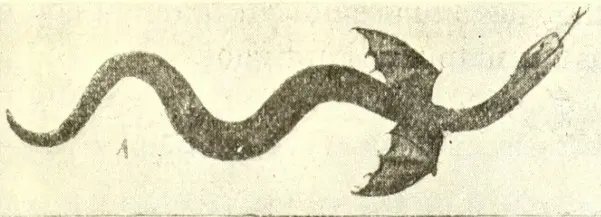
The Mapuche record is a different document. Tomás Guevara, in Psicolojía del pueblo araucano (1908), places the pihuicheñ first among the forest myths of totemic origin: a winged serpent that whistles and flies at night, clings to tree bark on very hot days and leaves a trail of blood on it, drinks the blood of sleeping people and animals, and in old age turns into a bird the size of a cock. Two details in Guevara are worth more than the description. He records that a lineage at Cholchol claimed descent from the pihuicheñ, and he lists it under taboo: nobody would try to look at it when it was suspected of being nearby. Guevara also drew it — figure 42, number 1, the wide, wingless-feathered snake reproduced on this page.
Julio Vicuña Cifuentes collected the rest. His six informant versions were already printed in 1910, in the Estudios de folk-lore chileno he carried to the American Scientific Congress in Buenos Aires; the 1915 Mitos y supersticiones reprints them verbatim as chapter XXIX and adds the comparative notes. The six versions come from Talagante, Melipilla, Coinco, Vichuquén, Quella and Coihueco de Chillán — every one of them in central Chile, hundreds of kilometres north of Araucanía. Lenz's dictionary (art. 1077) catalogues the spellings — pihuichén, piuchén in the centre, piruchén in the north, piguchén — and his supplement adds peuchén, with a query, for Ñuble. Francisco J. Cavada found in Chiloé (1914) that the word had stopped naming an animal at all: there piguchén is a state, the degeneration a being falls into, and the failed apprentice witch thrown into a river by the coven comes out of it a piguchén. Finally Félix José de Augusta's Diccionario araucano-español (1916) supplied the etymology that the popular ones never do: piwichen, probably compounded of piwn, to dry up, and che, person — the thing that dries people out.
Timeline: the documented record of Peuchen
- 1765 Andrés Febrés prints the oldest datable mention of the creature, in the vocabulary of his Arte de la lengua general del Reyno de Chile (Lima): pihuychen, a snake that they say flies when it whistles, and whoever sees it dies. The entry is misprinted; Lenz identified and corrected the error in 1910.
- 1777 Bernardo Havestadt repeats the gloss in his Chilidugu and adds the first recorded doubt: whoever sees it or hears it whistle dies, «addo et qui non videt, uti visus est nemini» — and so does whoever does not see it, since nobody ever has.
- 1788 The Spanish edition of Molina's Compendio appears in Madrid. He places the Piguchén among animals that «lack sufficient authenticity to be placed in the orders of the animal kingdom», describes a furred, membranous-winged creature the size of a rabbit that lives in tree holes, and states that it «does harm to nobody except the insects it feeds on».
- 1838 George Waterhouse describes Desmodus d'orbignyi in the Mammalia volume of the Zoology of the Voyage of the Beagle, with Coquimbo, Chile as the type locality. Osgood's Mammals of Chile records the citation and the locality a century later.
- 1845 Charles Darwin publishes the capture in his Journal of Researches: bivouacking near Coquimbo, his servant noticed a restive horse, put a hand on its withers in the dark «and secured the vampire». The bite was slightly swollen the next morning; three days later they rode the horse without ill effects.
- 1847 Claudio Gay publishes volume I of the Zoología of his Historia física y política de Chile. He proposes the explanation still repeated today — the vampire bat's «nocturnal life and bloodthirsty character have doubtless given rise to the fabulous history of the famous Piuchén» — and in the same paragraph fixes the bat's southern limit at «32 and 33 degrees».
- 1875 Zorobabel Rodríguez records in his Diccionario de chilenismos that in central Chile piguchen is what people call a squalid tavern — the same sense that timbunche has in the north. The name has begun to detach itself from the animal.
- 19 February 1904 El Obrero, of Ovalle, publishes José Silvestre's «Algo de mitología zoológica en Ovalle»: the Piuchén has a parrot's beak and wings, a toad's body and a serpent's tail, announces itself with three whistles, is driven off with white flags hoisted high or by whistling into a bottle, and spares herds of white goats. Vicuña Cifuentes reprinted the passage in 1915.
- 1908 Tomás Guevara publishes Psicolojía del pueblo araucano. He describes the pihuicheñ as a winged serpent of totemic origin (p. 321), draws it as figure 42 number 1, records that it was taboo to look at (p. 228), and notes that a lineage at Cholchol claimed descent from it (pp. 15-16).
- June 1910 Vicuña Cifuentes's six informant versions of the Piguchén are already in print, in the Estudios de folk-lore chileno he took to the American Scientific Congress in Buenos Aires (§ 12, pp. 29-31). All six informants are from central Chile: Talagante, Melipilla, Coinco, Vichuquén, Quella and Coihueco de Chillán.
- 1910 Rodolfo Lenz closes his Diccionario etimolójico. Article 1077 catalogues the spellings — pihuichén, piuchén in the centre, piruchén in the north, piguchén — corrects Febrés's misprint, calls Molina's claim of harmlessness a pia fraus, and refers the real basis of the myth to Gay. The supplement adds peuchén, with a question mark, for Ñuble.
- 1914 Francisco J. Cavada reports from Chiloé that piguchén there names no animal at all but a state — the degeneration a being falls into. A rooster that has laid the basilisk's egg is left piguchén; so is the apprentice witch whom the coven, judging him useless, throws into a fast river. His glossary heads the entry Peuchen.
- 1915 Mitos y supersticiones reprints the six 1910 versions verbatim as chapter XXIX (pp. 80-82) and adds the comparative apparatus. In the notes on page 339 Ricardo E. Latcham states that the Piuchén is a vampire bat, that Darwin obtained the specimen at Coquimbo and that Waterhouse described it — the same identification Gay had published sixty-eight years earlier.
- 1916 Félix José de Augusta's Diccionario araucano-español gives the etymology: piwichen, probably compounded of piwn, to dry up, and che, person. He ties the being to the visions of the machi rather than to the kalku, and his entry for kalku itself lists kalkuln, to label somebody a witch.
- 1943 Wilfred H. Osgood publishes The Mammals of Chile for the Field Museum. His account of Desmodus rotundus d'orbignyi gives the range in nine words: «known only from central Chile from Coquimbo to the vicinity of Valparaiso».
- 11 August 2026 Checked against GBIF for this rewrite: 49 records of Desmodus rotundus in Chile, the southernmost georeferenced one at 33.97° S, and none at all between 37° S and 45° S. Control run on the same query for bats that do occur in that band: Myotis chiloensis 88, Histiotus montanus 50, Lasiurus varius 35, Tadarida brasiliensis 29.
Is there a rational explanation for Peuchen?
The sentence this page used to carry — that modern sceptics blame vampire bat bites — is wrong twice, and both errors are worth more than the claim.
It is not modern, and it has an author. The identification is Claudio Gay's, printed in 1847 in volume I of the Zoología of his Historia física y política de Chile. Gay built it on Waterhouse's 1838 description of a bat taken at Coquimbo during the Beagle voyage, and he wrote it as plainly as anyone could: the animal's "nocturnal life and bloodthirsty character have doubtless given rise to the fabulous history of the famous Piuchén". Lenz repeated it in 1910 with the reference to Gay in hand; Ricardo E. Latcham repeated it in 1915, invoking Darwin by name; Augusta repeated it in 1916 as a supposition. Attributing it to unnamed "modern sceptics" is a century and three quarters of misdating, and it erases the four people who actually said it.
And it is in the wrong place. Gay, in the very paragraph in which he proposed the explanation, drew the bat's southern limit: "we believe it does not pass south of 32 and 33 degrees". Osgood's The Mammals of Chile (1943) is blunter still: Desmodus rotundus d'orbignyi is "known only from central Chile from Coquimbo to the vicinity of Valparaiso". We checked it against current occurrence data. GBIF holds 49 records of Desmodus rotundus for Chile; the southernmost with coordinates sits at 33.97° S, and there are none at all between 37° S and 45° S — the band that contains Araucanía. That zero means something only next to a control, so we ran the same query for four bats that do live there: Myotis chiloensis returns 88 records in that band, Histiotus montanus 50, Lasiurus varius 35, Tadarida brasiliensis 29. The vampire bat is the only one missing, and it is missing by roughly 500 kilometres.
Both facts fit together once you notice where Vicuña Cifuentes's informants lived. His six versions come from Talagante, Melipilla, Coinco, Vichuquén, Quella and Coihueco de Chillán — central Chile, inside the range Gay drew. Gay's explanation was made for that piguchén, the one of the huaso countryside, and for that one it is reasonable: he reported seeing large bloodstains on the backs of horses and mules there. It stops working the moment the creature is moved south to the Mapuche pihuicheñ. What our page had done, without noticing, was import an explanation across six degrees of latitude.
Two older objections survive as well. Molina, the first naturalist to print the beast, said in 1788 that it harms nobody and eats insects — and filed it among the animals that "lack sufficient authenticity" to be classified at all; Lenz, reading the same passage in 1910, called the harmlessness a pia fraus of Molina's. Havestadt got there first and shortest, in 1777: whoever does not see it dies too, since nobody has ever seen it. And Cavada's Chiloé material dissolves the question from another side: there piguchén is not an animal but a condition, what a rooster becomes after laying the basilisk's egg, or what a failed apprentice witch becomes after being thrown in a river.
We have not found any published identification of the two physical signs the sources record — the red excrement dripping from leafy trees (Melipilla, in Vicuña) and the trail of blood left on bark in hot weather (Guevara). We are leaving them unexplained rather than guessing.
One further correction. Calling the kalku "sorcerers who control the Peuchén" is not supported by the classic record. Guevara does describe the calcu as owners of harmful spirits, able to bend the wekufe to their will, but he classifies the pihuicheñ elsewhere — as a totemic forest being, taboo to look at, and the claimed ancestor of a Cholchol lineage; Augusta ties it instead to the visions of the machi. Augusta's own dictionary entry shows what kind of word kalku is: alongside "brujo, hechicero" he lists kalkuln, to label somebody a witch, and kalkuluwn, to call each other witches. Oriol Ambrogio's study of colonial sorcery accusations (Ethnohistory, 2021) reaches the same conclusion from the archives: kalku was a charge levelled at neighbours and used as a political instrument, not a guild that kept monsters.
Can you visit Peuchen?
The sources on this page attach the pihuichén to no cave, lake or monument. The pin, at -38.7, -72.6, is a rounded coordinate about 4.5 km north of the centre of Temuco and inside the comuna of Temuco. It stands for central Araucanía, where Tomás Guevara became rector of the Temuco liceo in 1899 and began his research on the Mapuche with students from nearby communities, and it marks no sighting. The six versions Vicuña Cifuentes collected come from central Chile, hundreds of kilometres to the north.
Most of the file can be read online. Vicuña Cifuentes's Mitos y supersticiones (1915) is catalogued and downloadable from Memoria Chilena, the digital library of the Biblioteca Nacional de Chile; chapter XXIX runs from page 80 to page 82 and the comparative notes are on page 339. His 1910 first printing, Guevara's Psicolojía del pueblo araucano with its figure 42, Lenz's dictionary, Cavada's Chiloé y los chilotes, Augusta's Diccionario araucano-español, Molina's Compendio of 1788, Havestadt's Chilidúgú and Gay's Zoología are scanned on archive.org, each with its link in the references.
Two public museums of Chile's Servicio Nacional del Patrimonio Cultural deal with Mapuche culture. The Museo Regional de La Araucanía is at Alemania 084, Temuco, in a house built in 1924 for the Thiers family. The Registro de Museos de Chile, consulted on 23 September 2026, lists free entry and hours of 9:30 to 17:30 from Tuesday to Friday and 11:00 to 18:00 on Saturday, and the museum publishes a virtual tour on its website. The Museo Mapuche de Cañete Juan Cayupi Huechicura stands on nine hectares on the road to Contulmo, about three kilometres from the centre of Cañete, in the Biobío Region. Its website describes permanent rooms on the ruka, the palin and the piedras de poder, and a wampo, a dugout canoe 4.85 metres long found in Lake Lanalhue in December 1995, exhibited in room 5. The same Registro page lists the Cañete museum as temporarily closed to the public for infrastructure repairs and a new museographic script; in July 2024 Diario Concepción reported a conservation project of more than 1,031 million pesos that included the roofs and a perimeter fence.
Cholchol, where Guevara recorded a lineage that claimed descent from the pihuicheñ, has been a comuna of La Araucanía in its own right since Law 19.944 of 22 April 2004 separated it from Nueva Imperial. Its centre is about 27 km north-west of Temuco; it had 11,611 inhabitants at the 2017 census and has a municipal website, municholchol.cl. Guevara's line in the 1908 book lists, among the clans whose members believed they descended from a mythical spirit, "el de Pihuicheñ (en Cholchol)", on the strength of reports gathered in several reducciones; it names no spot in the comuna.
Sources consulted
- Andrés Febrés, «Arte de la lengua general del Reyno de Chile, con un diálogo chileno-hispano muy curioso — entrada «pihuychen» del vocabulario, impresa con errata entre «pihuen» y «pilon»» — Calle de la Encarnación, Lima, 1765 book
- Bernardo Havestadt, «Chilidúgú sive Tractatus linguae Chilensis — entrada «Pihuichen», p. 745, y § 376 «Serpentes» («anguis alatus, pihuichen»)» — Münster, 1777; edición de Julius Platzmann, B. G. Teubner, Lipsiae, 1883, vol. I, 1777 book
- Juan Ignacio Molina (trad. Domingo Joseph de Arquellada Mendoza), «Compendio de la historia geográfica, natural y civil del Reyno de Chile, primera parte — el Piguchén entre las especies que «carecen de la autenticidad suficiente», pp. 306-307» — Don Antonio de Sancha, Madrid, 1788 book
- Charles Darwin, «Journal of Researches into the Natural History and Geology of the Countries Visited during the Voyage of H.M.S. Beagle — captura del vampiro «(Desmodus d'orbignyi, Wat.)» en un vivac cerca de Coquimbo» — John Murray, Londres (2.ª ed.), 1845 book
- Claudio Gay, «Historia física y política de Chile. Zoología, tomo I — género Desmodo y «Desmodus Dorbignyi», pp. 32-34: límite austral en «los 32 y 33 grados» y origen del «famoso Piuchen»» — En casa del autor, París / Museo de Historia Natural de Santiago, 1847 book
- Zorobabel Rodríguez, «Diccionario de chilenismos — s. v. «Boliche», p. 64: «También se dice por el Norte en el mismo sentido timbunche, i por acá piguchen»» — Imprenta de «El Independiente», Santiago, 1875 book
- José Silvestre, «Algo de mitología zoológica en Ovalle — descripción del Piuchén y remedios contra él (banderas blancas, silbar en una botella); reproducido en Vicuña Cifuentes, Mitos y supersticiones, 1915, p. 339» — El Obrero (Ovalle), 19 de febrero de 1904, 1904 newspaper archive
- Tomás Guevara, «Psicolojía del pueblo araucano — pihuicheñ, p. 321 y fig. 42 n.º 1 (p. 323); tabú de no mirarlo, p. 228; clan de Cholchol que decía descender de él, pp. 15-16; los calcu como dueños de espíritus dañinos, pp. 255 y 299-300» — Imprenta Cervantes, Santiago, 1908 book
- Julio Vicuña Cifuentes, «Estudios de folk-lore chileno. Mitos y supersticiones recogidos de la tradición oral. Primera serie: Mitos — § 12 «El piguchén», pp. 29-31, con las seis versiones de informantes» — Imprenta Universitaria, Santiago, 1910 book
- Rodolfo Lenz, «Diccionario etimolójico de las voces chilenas derivadas de lenguas indíjenas americanas — art. 1077 «Pihuichen», pp. 590-591, y Suplemento II, art. 1077 (variante «peuchén», Ñuble)» — Imprenta Cervantes, Santiago (publicado por fascículos, 1904-1910), 1910 book
- Francisco J. Cavada, «Chiloé y los chilotes — «El Piuchén o Piguchén», pp. 102-103; glosario s. v. «Peuchen», p. 386; la laguna de Huillinco y el candidato a brujo arrojado al río» — Imprenta Universitaria, Santiago, 1914 book
- Julio Vicuña Cifuentes, «Mitos y supersticiones recogidos de la tradición oral chilena — cap. XXIX «El Piguchén», pp. 80-82, y notas del apéndice, p. 339» — Imprenta Universitaria, Santiago, 1915 book
- Ricardo E. Latcham, «Sobre algunos mitos zoológicos chilenos — identificación del Piuchén con el vampiro obtenido por Darwin en Coquimbo; reproducido en Vicuña Cifuentes, Mitos y supersticiones, 1915, p. 339» — Sociedad Chilena de Historia y Geografía, Santiago, 1915 academic
- Félix José de Augusta, «Diccionario araucano-español, tomo I — s. v. «piwichen», pp. 185-186 (etimología «probabl. comp. de piwn y de che»); s. v. «kalku», p. 75 («brujo, hechicero», kalkuln «calificar de brujo»)» — Imprenta Universitaria, Santiago, 1916 book
- Wilfred H. Osgood, «The Mammals of Chile — Desmodus rotundus d'orbignyi, pp. 61-62: «Range. Known only from central Chile from Coquimbo to the vicinity of Valparaiso»» — Field Museum of Natural History, Zoological Series, vol. 30, 1943 academic
- GBIF Secretariat, «Occurrence search: Desmodus rotundus en Chile — 49 registros, ninguno al sur de los 34° S (consultado el 11 de agosto de 2026)» — Global Biodiversity Information Facility, 2026 web
- Oriol Ambrogio, «Accusing and Identifying the Kalku: The Perception of Sorcery in Mapuche Society (Seventeenth to Eighteenth Centuries)» — Ethnohistory, vol. 68, n.º 3, pp. 385-405, 2021 academic
- Servicio Nacional del Patrimonio Cultural, «Museo Regional de La Araucanía — sitio oficial (dirección: Alemania 084, Temuco; recorrido virtual)» — museoregionalaraucania.gob.cl, 2026 web
- Servicio Nacional del Patrimonio Cultural, «Museo Mapuche de Cañete Juan Cayupi Huechicura — sitio oficial (Camino Contulmo s/n, a tres kilómetros al sur de Cañete, Región del Biobío)» — museomapuchecanete.gob.cl, 2026 web
- Biblioteca Nacional de Chile, «Mitos y supersticiones recogidos de la tradición oral chilena — ficha y descarga del libro completo» — Memoria Chilena / Biblioteca Nacional Digital, 2026 web
Reviewed by V. Serrano on 2026-08-11 · How we verify our content
📎 Source: Enigma Atlas
💬 Field testimonies (0)
No testimonies yet. Add the first.
Add your testimony
🔒 Log in to add a testimony