🦶 CRYPTID SIGHTING · EXP. Nº6501
ACTIVE
Imbunche
The imbunche is the deformed being that Chilote tradition places inside the caves of the brujos, above all the Cueva de Quicaví.
Where and when was Imbunche sighted?
- Location
- Quicaví, Chiloé, Chile
- Date sighted
- Unknown
- Coordinates
- -42.26, -73.35
- Last updated
LOCATION
What is Imbunche?
Its written record is long and it does not agree with itself. The Jesuit Andrés Febrés glossed the word in Lima in 1765 as the being the sorcerers rear from small in their caves in order to consult it, and Bernhard Havestadt added in 1777 that the child's eyes, mouth and anus were sewn shut while still at the breast. Francisco J. Cavada, in 1914, gave the Chiloé version instead: a face turned towards its back and one leg fixed behind at the neck, and, against the received account, a consultant to the brujos rather than the chief of the coven. Other informants of the period called it a goat, a dwarf, or the camahueto. In 1880 the intendant of Chiloé had the archipelago's brujos rounded up and tried at Ancud, and one defendant, the farmer Mateo Coñuecar, testified to having seen an Ibunche in the cave at Quicaví — a grown man taken there by force. Every defendant was acquitted on appeal in 1881. José Donoso built El obsceno pájaro de la noche on the figure in 1970, and that is how the word reached the world.
What is the history of Imbunche?
For an oral legend the imbunche has an unusually long paper trail, and the oldest documents in it are dictionaries written by missionaries.
The Jesuit Andrés Febrés, whose Arte de la lengua general del reyno de Chile was printed in Lima in 1765, glossed the word in his vocabulary: ivumche, "los que consultan los brujos en sus cuevas, donde los crían desde chiquitos para sus hechicerías o encantos" — the ones the sorcerers consult in their caves, where they rear them from small for their spells. The element he built it from, ivüm, he defined as "animales pequeños cuadrúpedos, o monstruos": small four-footed animals, or monsters. Twelve years later the German Jesuit Bernhard Havestadt printed his Chilidúgu at Münster and set down the fuller version, in Latin: it is reported among the Indians that their sorcerers rear in a certain cave a kind of human whose eyes, mouth and anus they sew shut while the child is still at the breast, so that as it grows it degenerates into another shape and appearance; and that these are their Counsellors and Consultants, whose advice they seek when they gather in their caves, "which are called renu". I have not handled the 1765 and 1777 originals; both passages are transcribed verbatim, with page and paragraph, by Rodolfo Lenz in article 667 of his etymological dictionary and by Julio Vicuña Cifuentes, working independently.
Two details in Havestadt's sentence keep being confirmed by the later record. The first is the word renu: when Félix José de Augusta published his Mapudungun dictionary in 1916 he entered renü as "cueva subterránea en que se forman los hechiceros" and renü-ruka as "casa subterránea, guarida de los hechiceros" — an underground house. The second is what the creature is for. In the eighteenth-century sources it is a consultant, not a doorkeeper.
Then the word turned up in a criminal file, and that is where this entry changes shape.
In 1880 the intendant of Chiloé, Luis Martiniano Rodríguez, ordered the subordinate authorities of the archipelago to round up every brujo on a single appointed day and send them to Ancud with their herbs and instruments to serve as evidence. What the prosecution exposed was La Recta Provincia, a society of healers whom the islanders called "médicos de la tierra", with its own kings, councils, judges and written sentences. Copies of the file were taken from the Ancud court by Román Espech, given to the historian Benjamín Vicuña Mackenna, and printed in 1904 by the physician Pedro Lautaro Ferrer in his Historia general de la medicina en Chile.
Questioned in Ancud on 26 March 1880, Mateo Coñuecar — seventy years old, a farmer from Teman who could neither read nor write — described the cave of Quicaví as "una casa subterránea" built by the islanders themselves, timber-lined, furnished with a table, four principal chairs and three wooden benches, its door hidden under a layer of turf and locked with a key of "alquimia". Twenty years earlier he had been sent there with goat meat. When the door was opened, he said, two completely disfigured beings came out: one resembled a chivato because it also crawled, and the other "era un hombre desnudo y con barba y pelo completamente blancos y que le llegaban a la mitad del cuerpo". The second was called the Ibunche and the first the Chivato. They looked about fifty years old. According to him they were not born into the role: the council met and decided which people were to be the Ibunche and the Chivato, "y aun cuando ellos no quisieran, los tomaban por la fuerza y los encerraban en la cueva" — and even if they did not want to, they took them by force and shut them in the cave. He said they were fed goat and kid and the bodies of children stolen from the graveyard, given picochihuín water to drink, and, once their captors were satisfied they would not run, allowed out at night to leap and shout in the open. At the council he attended they "estaban ahí sin tomar parte en nada" and were placed at the entrance. He never saw them again and did not know what became of them.
The familiar Chiloé description came from a different line. Darío Cavada's Chiloé (Ancud, 1896) made the imbunche the brujo who presides over the coven. Francisco J. Cavada, in Chiloé y los chilotes (1914, pp. 99-100), contradicted him: a deformed being with its face turned towards its back, walking on one leg because the other is fixed behind at the neck; and "no es el jefe del aquelarre como ordinariamente se cree", but a consultant to the other brujos and an instrument of their revenge, kept shut in the "Casa Grande", the cave of Quicaví, and taken out under the whip when they need it, howling as it goes. Cavada also records that it is made from a child, deformed from its first months by dislocations and twistings, and that it is also called Vuta or Vuta-macho.
On the mainland the same word meant something else. Vicuña Cifuentes's own informants gave him three versions: at Talagante the brujos steal boys of six months to a year and stop up every natural opening of the body, and the imbunches serve to guard entierros — buried treasure whose dead owners left it hidden; at Melipilla they close them up "dejándolos parejos"; at Coihueco de Chillán they sew them and then throw them naked into the reed beds. Neither informant knew of any cave.
Timeline: the documented record of Imbunche
- 1765 The Jesuit Andrés Febrés prints his Arte de la lengua general del reyno de Chile in Lima. His vocabulary defines ivumche as "los que consultan los brujos en sus cuevas, donde los crían desde chiquitos para sus hechicerías o encantos", and ivüm as "animales pequeños cuadrúpedos, o monstruos". It is the oldest mention traced for this entry, and it has no cave-guarding and no mutilated child.
- 1777 Bernhard Havestadt's Chilidúgu is printed at Münster in Westphalia. In a Latin paragraph he reports that the sorcerers rear in a cave a kind of human whose eyes, mouth and anus are sewn shut while still nursing, so that they degenerate into another shape as they grow, and that these are the counsellors consulted in the caves "which are called renu". Lenz and Vicuña Cifuentes each transcribe the passage in full.
- 23 March 1880 The intendant of Chiloé, Luis Martiniano Rodríguez, has the brujos of the archipelago rounded up on a single day and sent to Ancud with their herbs and instruments as evidence. Mateo Coñuecar's imprisonment is later counted from this date. In a letter to President Domingo Santa María, Rodríguez writes that he is pursuing "cerca de 100 personas en la provincia".
- 26 March 1880 Mateo Coñuecar deposes in Ancud. He describes the cave of Quicaví as an underground house with a table, four principal chairs and three benches, and says that twenty years earlier he saw inside it two disfigured beings, the Ibunche and the Chivato — grown men of about fifty, chosen by the council and taken by force, fed on goat and on children's bodies stolen from the graveyard. It is the only first-hand account of an imbunche in the whole file.
- 2 March 1881 The letrado judge of Ancud, Beytía, sentences nine defendants for unlawful association and fraud — Mateo Coñuecar to three years, Cristino and Aurora Quinchén and Juan Esteban Carimonei to 541 days, Domingo Coñuecar and Juan Ignacio Uribe to a year, and three others to time served — and acquits them of homicide by poisoning for want of a corpus delicti.
- 24 May 1881 The Court of Appeal of Concepción revokes the Ancud sentence and absolves every defendant: the association was not shown to have been formed against the social order, no corpus delicti was established for the poisonings, and the small sums taken by Aurora Quinchén and others were payment for healing. Justice Escobar dissents. The ruling is printed in the Gaceta de los Tribunales for 1881.
- 1896 Darío Cavada's Chiloé, published in Ancud, describes the Imbunche or Buta as the brujo who presides over the coven, with his face turned backwards and one leg fixed to his back, and calls his voice formidable and terrifying. Vicuña Cifuentes reprints this version as the Chilote tradition in 1910.
- 1904 The physician Pedro Lautaro Ferrer prints the Ancud depositions in his Historia general de la medicina en Chile, from copies taken out of the court by Román Espech and given to Benjamín Vicuña Mackenna. Without this book the imbunche would have no primary documentation at all.
- 1904-1910 Article 667 of Rodolfo Lenz's Diccionario etimolójico gives four senses of imbunche, of which the Chiloé creature is only the third; the first is simply "maleficio, encantamiento diabólico". Lenz traces the word to Febrés's ivüm plus che, "man", and quotes Havestadt's Latin in full.
- 1910 Julio Vicuña Cifuentes prints his imbunche entry for the first time, on pages 26-29 of Estudios de folk-lore chileno — five years before the book usually credited with it. It already carries his three mainland informants, the Havestadt passage and the extract from the 1880 depositions, together with his verdict that neither Ferrer nor the 1908 pamphlet Los brujos de Chiloé specifies what role the imbunche played.
- 1914 Francisco J. Cavada, in Chiloé y los chilotes (pp. 99-100), corrects the received account: the Invunche "no es el jefe del aquelarre como ordinariamente se cree", but a consultant to the brujos and an instrument of their revenge, shut in the Casa Grande — the cave of Quicaví — and taken out under the whip. He spells the word with a v on etymological grounds, against other authors.
- 1915 The expanded Mitos y supersticiones devotes chapter XXIII to the imbunche, pp. 68-72. Among the versions Vicuña Cifuentes now adds is the Vocabulario of Cañas, which records that some hold the ivunche to be a deformed dwarf, others a flesh-eating goat, and others "que es el Camahueto, y que tiene, en consecuencia, figura de ternero".
- 1916 Fray Félix José de Augusta's Diccionario araucano-español enters renü as "cueva subterránea en que se forman los hechiceros" and renü-ruka as "casa subterránea, guarida de los hechiceros" — the exact phrase Mateo Coñuecar had used in Ancud thirty-six years earlier for the cave of Quicaví. The dictionary has no entry for ivumche.
- 1970 José Donoso publishes El obsceno pájaro de la noche with Seix Barral in Barcelona. The imbunche is the novel's governing image — "Todo cosido, los ojos, la boca, el culo, el sexo cosido" — and the version he uses is the eighteenth-century missionaries', not the Chilote one. Translated into English in 1973 and in print ever since, the book is why the word travelled beyond Chile.
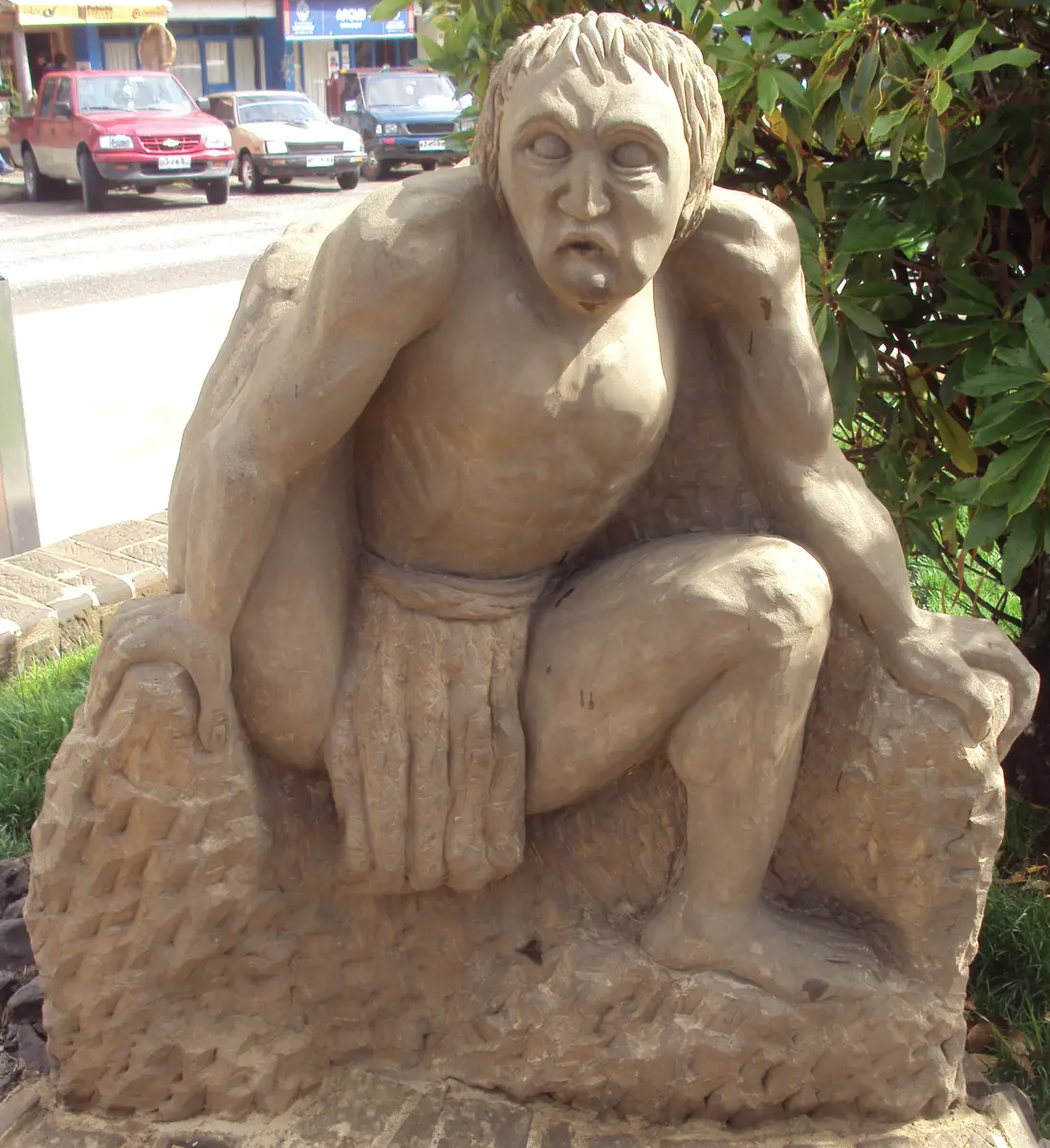
- 22 February 2012 A public sculpture of the Invunche standing in the Plaza de Armas of Ancud is photographed for Wikimedia Commons. It shows the modern composite version of the creature, not the being described in the 1880 file.
Is there a rational explanation for Imbunche?
The most useful thing about this legend is that it can be checked against a court file, and the court file does not say what the popular version says.
Vicuña Cifuentes put it in print himself, twice. Having read both Ferrer's edition of the 1880 depositions and a pamphlet titled Los brujos de Chiloé (Santiago, 1908) that seemed to carry the statements of the principal defendants more or less complete, he concluded flatly: "En ninguna de estas publicaciones se encuentra especificado el papel que desempeña el Imbunche." The Ibunche of the record is not a mutilated infant. He is an adult, apparently about fifty, chosen by a council and taken by force, kept in an underground room and let out at night. That is a story about captivity, and it is grim enough without the surgery.
The surgery belongs to the tradition, and the tradition disagrees with itself at almost every point. Is the imbunche the chief of the coven? Darío Cavada said yes in 1896 and Vicuña Cifuentes repeated it in 1910; Francisco J. Cavada said no in 1914 and named the belief he was correcting. Does it guard a cave? Only in Chiloé; the mainland versions have it guarding buried treasure, or nothing at all. Is it even human? The Vocabulario of Cañas, quoted by Vicuña Cifuentes in 1915, records three readings side by side: a deformed dwarf man, a goat that eats human flesh, and — "Afirman, por otra parte, que es el Camahueto, y que tiene, en consecuencia, figura de ternero" — the camahueto, and therefore shaped like a calf. Three incompatible creatures under one name, printed on the same page.
Against that, the modern composite is remarkably fixed: the first-born child, the right leg broken and folded over the back, the tongue split at three months, the ointment that raises hair, the skin turning blue, the milk of a black cat. I could not source that list. Febrés and Havestadt describe the openings of the body being sewn shut, and nothing else. Francisco J. Cavada gives the twisted leg and the reversed face, and no tongue. Lenz's article 667 gives four senses of the word, of which the Chiloé creature is only the third. The full modern recipe appears in encyclopaedia articles and mythology sites that cite no source at all, and this entry previously carried its own variant of it — a split tongue, an arm fused to the shoulder, a body sealed with animal fat — which is not in any of the works read here. Where it entered print I could not establish; what can be said is that it is not in the nineteenth-century compilers.
One strand of it can be dated, and it is literary. José Donoso's El obsceno pájaro de la noche (Seix Barral, Barcelona, 1970) is built on the imbunche: the narrator's nightmare of being wrapped, bound and closed up runs through the book, and the form the novel uses is the eighteenth-century missionaries' one — "El imbunche. Todo cosido, los ojos, la boca, el culo, el sexo cosido" — not the Chilote broken leg. Translated into English in 1973 and steadily reprinted since, the novel carried the word to readers who will never open Cavada, and it is the reason a piece of Chiloé folklore has an entry in general literary reference works. It is the pattern this site keeps running into: a twentieth-century book becomes the channel through which an old story is transmitted, and the book's version starts being reported as the immemorial one.
As for the trial, the arithmetic is worth doing, because the loose figures repeated online do not survive it. Rodríguez told President Domingo Santa María in a letter that he was pursuing "cerca de 100 personas en la provincia"; the round-up swept up Recta Provincia officers, machis and curanderos indiscriminately, and most were released before the end. On 2 March 1881 the letrado judge of Ancud, Beytía, convicted nine men and women of unlawful association and fraud — Mateo Coñuecar to three years counted from his arrest on 23 March 1880, Cristino and Aurora Quinchén and Juan Esteban Carimonei to 541 days, Domingo Coñuecar and Juan Ignacio Uribe to a year, and Desiderio Quinchén, José María Chiguai and Santiago Rain to time served — while acquitting them of homicide by poisoning for want of a body. On 24 May 1881 the Court of Appeal of Concepción revoked that sentence and absolved all of them: the association was not proved to have been formed to attack the social order, no corpus delicti was established for the poisonings, and the small payments Aurora Quinchén and others had taken were remuneration for their work as healers. One judge, Escobar, dissented. Nobody, in the end, was convicted of anything.
Can you visit Imbunche?
Quicaví is a coastal village in the commune of Quemchi, in the province of Chiloé, on the north-eastern shore of the Isla Grande. The Spanish Wikipedia article on Quemchi names it as the place that Chilote mythology gives for the cave of the Brujos de Chiloé; the commune calls itself "la comuna de los mil paisajes", a name given by the writer Francisco Coloane, who was born there in 1910. In his deposition of 26 March 1880 Mateo Coñuecar described the cave as "una casa subterránea" whose door was hidden under turf. The people tried in 1880 were islanders of the archipelago: the letrado judge of Ancud convicted nine of them on 2 March 1881, and the Court of Appeal of Concepción absolved all of them on 24 May 1881.
The trial was held in Ancud, at the northern end of the island. The Museo Regional de Ancud, run by the Servicio Nacional del Patrimonio Cultural, is at Libertad 370; its visit page, read on 24 September 2026, gives free admission and opening from Tuesday to Saturday. All year it opens from 10:00 to 17:30 from Tuesday to Thursday and from 10:00 to 16:30 on Friday; on Saturday it opens from 10:00 to 16:00 in January and February and from 10:00 to 14:00 from March to December. The page gives the telephone as +56 65 250 4780 and the email address as [email protected]. A statue of the Invunche stands in the Plaza de Armas of Ancud; the photograph of it on Wikimedia Commons was taken on 22 February 2012.
The copies of the court file that Román Espech took for Benjamín Vicuña Mackenna were printed in 1904 by Pedro Lautaro Ferrer, at pages 29 to 40 of the first volume of his Historia general de la medicina en Chile, including Coñuecar's deposition. The Internet Archive holds complete scans of that volume and of the other early works on which this file rests: Lenz's etymological dictionary (1904-1910), Vicuña Cifuentes's collections of 1910 and 1915, Francisco J. Cavada's Chiloé y los chilotes (1914) and Augusta's Araucanian dictionary (1916).
Sources consulted
- Pedro Lautaro Ferrer, «Historia general de la medicina en Chile (documentos inéditos, biografías y bibliografía), tomo I — «Copias de algunas piezas del proceso de los brujos de Chiloé», pp. 29-40, con la declaración de Mateo Coñuecar de 26 de marzo de 1880» — Imp. Talca de J. Martín Garrido C., Talca, 1904 book
- Julio Vicuña Cifuentes, «Estudios de folk-lore chileno. Mitos y supersticiones recogidos de la tradición oral. Primera serie: Mitos — § 10 «El Imbunche», pp. 26-29» — Imprenta Universitaria, Santiago de Chile, 1910 book
- Julio Vicuña Cifuentes, «Mitos y supersticiones recogidos de la tradición oral chilena — cap. XXIII «El Imbunche», pp. 68-72, con las versiones de Talagante, Melipilla y Coihueco de Chillán, la cita del Vocabulario de Cañas y el extracto del proceso de 1880» — Imprenta Universitaria, Santiago de Chile, 1915 book
- Francisco J. Cavada, «Chiloé y los chilotes — «El Invunche», pp. 99-100, y glosario s. v. «Invunche» y «Vutamacho»» — Imprenta Universitaria, Santiago de Chile, 1914 book
- Rodolfo Lenz, «Diccionario etimolójico de las voces chilenas derivadas de lenguas indíjenas americanas — art. 667 «Imbunche», con las citas de Febrés 523 y Havestadt 686» — Imprenta Cervantes, Santiago de Chile (publicado por fascículos, 1904-1910), 1910 book
- Félix José de Augusta, «Diccionario araucano-español, tomo I — entradas «renü», «renü-pülli», «renü-tu» y «renü-ruka»» — Imprenta Universitaria, Santiago de Chile, 1916 book
- Bernhard Havestadt, «Chilidúgu sive res chilenses — II, 686, § 753; el pasaje se cita aquí por las transcripciones literales de Lenz (art. 667) y Vicuña Cifuentes (1910 y 1915), no por el original» — Monasterii Westphaliae [Münster], Typis Aschendorffianis, 1777 book
- Andrés Febrés, «Arte de la lengua general del reyno de Chile, con un diálogo chileno-hispano muy curioso, y un vocabulario hispano-chileno — s. v. «ivüm» e «ivumche», p. 523; citado aquí por las transcripciones de Lenz y de Francisco J. Cavada» — Calle de la Encarnación, Lima, 1765 book
- Joaquín Ignacio Hernández Aracena, «Enfrentando saberes: los brujos de Chiloé y el discurso ilustrado (1849-1900) — transcribe la carta del intendente Rodríguez al presidente Santa María, la vista fiscal, la sentencia de primera instancia y el fallo de la Corte de Apelaciones de Concepción de 24 de mayo de 1881 (Gaceta de los Tribunales, 1881, n.º 1964, p. 457)» — Tesis de Magíster en Estudios Latinoamericanos, Universidad de Chile, Santiago, 2013 academic
- José Donoso, «El obsceno pájaro de la noche» — Seix Barral, Barcelona, 1970 book
- Servicio Nacional del Patrimonio Cultural, «Planifica tu visita — Museo Regional de Ancud (dirección, horarios y entrada liberada)» — Museo Regional de Ancud, 2026 web
- Lufke, «File:Invunche Ancud.png — escultura del Invunche en la Plaza de Armas de Ancud, fotografiada el 22 de febrero de 2012 (CC BY-SA 3.0)» — Wikimedia Commons, 2012 web
Reviewed by V. Serrano on 2026-08-11 · How we verify our content
📎 Source: Enigma Atlas
💬 Field testimonies (0)
No testimonies yet. Add the first.
Add your testimony
🔒 Log in to add a testimony