🦶 CRYPTID SIGHTING · EXP. Nº6501
ACTIVE
Trauco
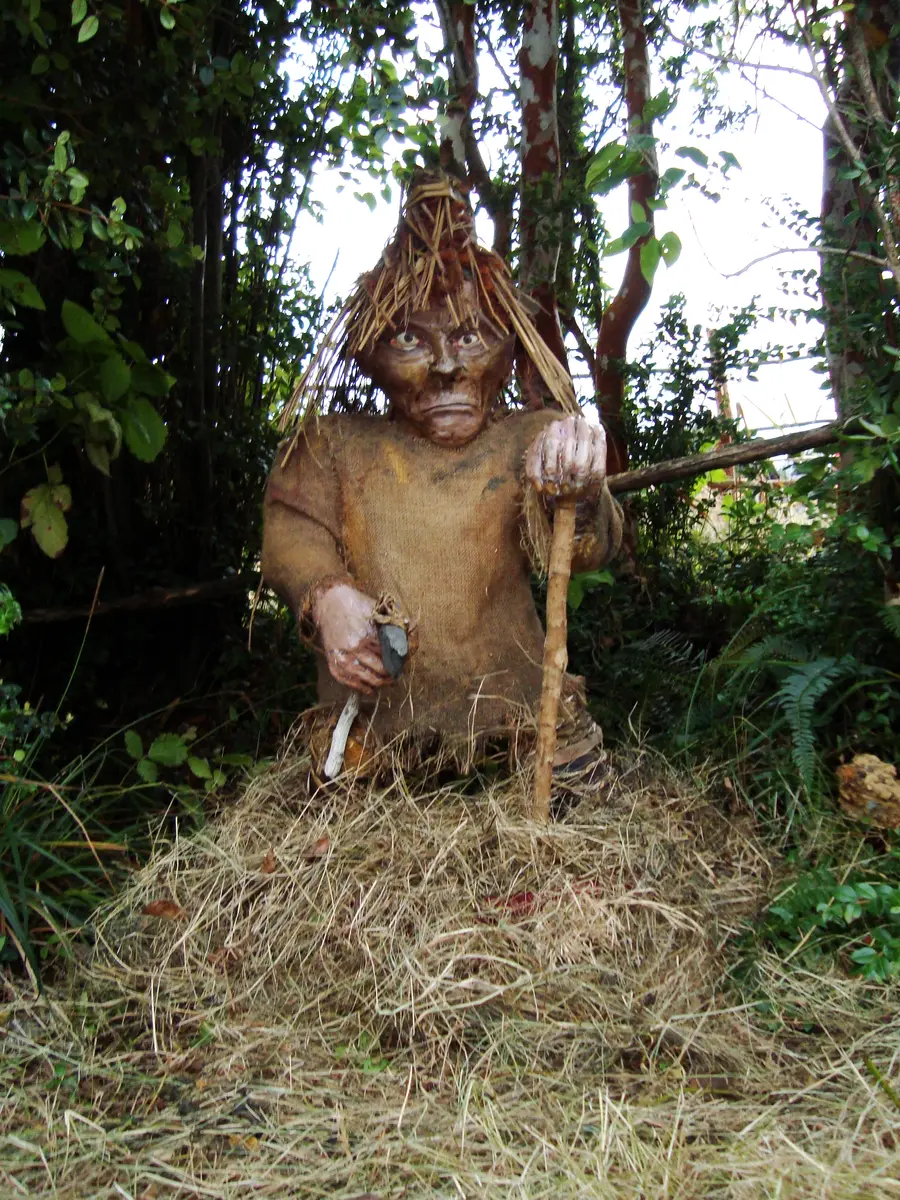
The trauco is a forest being of the Chiloé Archipelago in southern Chile: small, misshapen, dressed in quilineja creeper, his feet shapeless stumps, his face turned backwards, and his gaze able to leave a person with a twisted neck.
Where and when was Trauco sighted?
- Location
- Chiloé, Chile
- Date sighted
- Unknown
- Coordinates
- -42.45, -73.75
- Last updated
LOCATION
What is Trauco?
He reaches print late. The oldest mention traced is a paragraph in Darío Cavada's Chiloé (Ancud, 1896), which describes no seduction and no stone axe, and says the trauco is also called Fiura — not that Fiura is his wife. The fullest account is the priest Francisco J. Cavada's, in Chiloé y los chilotes (1914), who wrote the sexual material in Latin and blamed the girls for inventing it. On page 97 he also wrote the sentence the whole modern legend rests on: the superstition, he says, secures the impunity of the guilty. That is not a euphemism worth keeping. Chilean clinicians and researchers who have studied it since — at the hospital in Ancud, and in fieldwork in 2025 — argue that what the story covered was incest and rape, and that it protected the abuser.
What is the history of Trauco?
The trauco arrives on paper late, through a very short chain of men, and almost everything famous about him can be dated.
The oldest printed mention traced for this entry is a single paragraph in Darío Cavada's Chiloé, published in Ancud in 1896. It is known today because two people copied it: Rodolfo Lenz, who cites "Cavad. 65" in article 1376 of his Diccionario etimolójico, and Julio Vicuña Cifuentes, who reprints it with the tag "(D. Cavada, Chiloé)". That paragraph is the seed of the modern picture and it is worth quoting for what it does not contain: "El Trauco es un monstruo de figura repugnante y perversa índole: se le llama también Fiura (figura) por su horrible fealdad. Vive en los árboles y viste de quilineja... Tiene el rostro vuelto hacia la espalda, y el poder de su fatídica mirada es tanto, que basta a producir la deformación del cuerpo del individuo en quien se fija." No seduction, no pregnancies, no stone axe. A being who lives in trees, dresses in a creeper the islanders weave baskets from, and twists the body of whoever he looks at.
He is also, in that first text, the same creature as the Fiura. Not her husband: her.
The absence next door is as informative as the presence. Tomás Guevara's Psicolojía del pueblo araucano (1908) devotes a whole chapter to Mapuche mythical beings — chonchón, colocolo, invunche, pihuichén, trelquehuecufe — and never mentions the trauco. Neither does Félix José de Augusta's Diccionario araucano-español (1916), which does record añchimallen, wekufü and chonchón. Lenz's only mainland sense, from the Araucanian frontier, is disarmingly mild: "personaje mítico, especie del duende del bosque que ayuda a recojer frutillas a la niñas que le gustan." The forest goblin of the tourist posters is Chilote, and specifically Chilote.
The full portrait comes from one man in one book. Francisco J. Cavada, a Chilote priest and philologist, opened his chapter in Chiloé y los chilotes (Santiago, 1914, pp. 96-99) with a complaint: "Son bien deficientes las noticias que de este mito nos dan los mitólogos nacionales. Ninguno de ellos nos dice nada sobre sus instintos lascivos... Mucho nos servirán para llenar esos vacíos las siguientes informaciones que a fuerza de paciencia y constancia hemos podido recoger entre nuestros campesinos." What he then set down is still, a century later, the fullest description in print: the conical quilineja hat, the feet "sin talón ni dedos" that are shapeless stumps, the gaze that kills or leaves the victim "con el cuello torcido y sentenciada a morir antes del año", the names Fiura, Huelli and Pompón del monte which "más propiamente son insultos de que se vale el vulgo para alejar al monstruo", and fourteen charms against him, from a scapular with goat's beards to throwing him a handful of sand so he stops to count the grains.
And then Cavada switched to Latin, as writers of his time did when the subject was sex. Two sentences carry almost the whole modern legend of the trauco, and one of them is his verdict on the women: "Sunt feminae quae noctu a monstro opprimuntur: quis vero usque adeo insaniat ut tam vafris puellis fidem habeat? Nonne talia fingunt ut parentum iram effugiant?" — There are women set upon by the monster at night; but who would be mad enough to believe such cunning girls? Do they not invent such things to escape their parents' anger? Of the Thrauca, "llamada también huella", he says only that a man who dreams of her will lie with a man; his own glossary defines huelli as an insult meaning a sodomite, so the female counterpart enters the record as a slur before she is a character.
Vicuña Cifuentes gathered the rest. His entry appeared first in 1910 (Estudios de folk-lore chileno, § 14, p. 32) and again, expanded, as chapter XXXVI of the 1915 book, pp. 87-92. He was frank about how little oral material he had: "No he logrado recoger sobre este mito otras informaciones orales que las precedentes." There were two. From Valdivia, an old man with the appearance of a child. And from Castro, the sentence that everything since has been built on: "¡Cuidado con el Trauco!, dicen las madres a sus hijas cuando las envían a la compra, lejos de casa, y con el Trauco se disculpan ellas siempre que les ocurre alguna novedad, de esas que no pueden quedar ocultas."
Timeline: the documented record of Trauco
- 1896 Darío Cavada publishes Chiloé in Ancud. Page 65 carries the paragraph that founds the modern picture: a repugnant monster "also called Fiura (figura) for his horrible ugliness", living in trees, dressed in quilineja, his face turned backwards, his gaze deforming the body of whoever he fixes on. It is the oldest printed mention traced for this entry, and it contains no seduction, no pregnancies and no axe. It survives because Lenz and Vicuña Cifuentes both copied it.
- 1908 Tomás Guevara devotes chapter XIV of Psicolojía del pueblo araucano to Mapuche mythical beings — chonchón, colocolo, invunche, pihuichén, trelquehuecufe — and does not mention the trauco once. A word search of the whole volume returns no occurrence, against twenty-nine hits for the other beings, so the silence is real and not a failed search.
- 1904-1910 Rodolfo Lenz files the trauco in article 1376 of his Diccionario etimolójico, together with trauque and trauquinto, the words for barter and a trading partner, and derives the whole article from Febrés's thavcüun, "el contrato de permuta". He also records a second, mainland sense from the Araucanian frontier: a forest goblin "que ayuda a recojer frutillas a la niñas que le gustan".
- 1910 Julio Vicuña Cifuentes prints his trauco entry for the first time, as § 14 on page 32 of Estudios de folk-lore chileno — five years before the 1915 book usually credited with it. It consists of Darío Cavada's paragraph, Lenz's frontier gloss, and one informant from Valdivia who described an old man with the appearance of a child and thought he might be a brujo.
- 1914 Francisco J. Cavada publishes the fullest account ever printed, in Chiloé y los chilotes, pp. 96-99, gathered "a fuerza de paciencia y constancia" among Chilote country people because, he complains, the national mythologists had said nothing about the creature's lascivious instincts. He gives the quilineja hat, the toeless stumps for feet, the basilisk-like gaze, fourteen charms against him, and, in Latin, his own opinion that the girls are lying.
- 1914 (p. 97) On the same pages Cavada writes the sentence that the whole modern legend rests on: "El Thrauco desflora a las doncellas que vagan por la montaña: superstición funesta que no pocas veces asegura la impunidad de las culpables, dando así alas al vicio y a la licencia." The reading has been checked here against the page image. He also explains the trauco's axe-blows himself, as the echo of woodcutters' axes.
- 1915 Vicuña Cifuentes reissues the entry, expanded, as chapter XXXVI of Mitos y supersticiones recogidos de la tradición oral chilena, pp. 87-92. He admits he could collect no oral material beyond two informants, and prints the one from Castro that everything since rests on: mothers warn their daughters about the Trauco, "y con el Trauco se disculpan ellas siempre que les ocurre alguna novedad, de esas que no pueden quedar ocultas". Reprinting Cavada, he prints "la impunidad de los culpables" where Cavada had written las.
- 1916 Félix José de Augusta's Diccionario araucano-español is printed at Santiago. It has no entry for trauco, though it records añchimallen, wekufü and chonchón; the closest forms are trawən, "juntarse, reunirse", and trawa, "la piel". Any Mapudungun etymology has to be built from roots like these, which is why Lenz's guess and the modern reading "meeting of the waters" both remain guesses.
- 1998 Renato Cárdenas Álvarez publishes El libro de la mitología, a lexicon of Chilote oral tradition. His trauco entry adds the detail nobody printed before 1914 or 1915: "un hombre pequeño, de rasgos grotescos y figura contrahecha que porta una hachita de piedra en sus manos". His Fiura is now a separate being, "mujer pequeña, de extraordinaria fealdad, que aparece como acompañante del Trauco", collected in Huillinco and Cucao.
- 2001 Jacobo Numhauser, a psychiatrist heading the mental health unit of the Hospital de Ancud, publishes "Cultura e integración: vigencia del mito del trauco a propósito de una casuística clínica por incestos en Chiloé" in the Revista de Psiquiatría y Salud Mental, 18(4), pp. 208-217. The article itself could not be obtained for this file; the reference is given as he himself cites it in 2006.
- 2006 Numhauser and the clinical psychologist Paula Soto publish in the Revista Chilena de Neuro-Psiquiatría the series behind that article: fifty-nine women seen over five years at the Hospital de Ancud in whom the sexual abuse suffered had been incestuous. The paper is about the therapists, not the myth, but it is what puts a number on the ground the trauco stood on.
- 23 February 2009 The figure that heads this file is photographed in the "Rincón mitológico" of the Parque Municipal de Castro: a modern mannequin in sackcloth and a straw hat, holding a small stone axe in one hand and a thick stick in the other. Both objects arrive from the twentieth-century oral record; neither is in Cavada or Vicuña Cifuentes.
- 9 January 2024 A carved Trauco in the Plaza de Armas de Ancud is photographed for Wikimedia Commons and credited to the Ancud sculptor Ramón Pérez, "Moncho". Earlier photographs place the same statue there in July 2009 and February 2012. Two more carved traucos are recorded the same month, on a Castro pavement and at the Cascadas de Tocoihue in Dalcahue.
- 3 July 2025 The musical Trauko, el encuentro de las aguas premieres at the Centro Cultural CEINA in Santiago. Its producer, Gabriel Troncoso, dates the idea to a university theatre group in 1998 and says the script was rebuilt after repeated trips to Chiloé and work with the anthropologist Renato Cárdenas.
- 2026 Dominique González Zamora and Gloria Baigorrotegui publish in Pucara a comparison of the Trauco with the Brazilian Boto, built on oral testimony gathered in Ancud in September 2025. They report that the male-voiced accounts describe "un poder de sujeción en las mujeres para violarlas y dejarlas embarazadas", and quote an islander who says the figure served to justify the abuses.
Is there a rational explanation for Trauco?
There is no sighting here to explain away and nobody claims a photograph. What needs explaining is what the story was for, and on that the oldest sources are unusually blunt.
Start with the harmless part. Cavada lists among the trauco's manifestations one that he explains himself, in the same sentence: sometimes the creature "se muestra repitiendo, en son de fisga, las voces o gritos o golpes de hacha de los labradores, a quienes es difícil convencer de la verdadera causa de estas repercusiones del sonido". The mocking echo of an axe in the forest is the trauco. Cavada, in 1914, is already telling his readers it is an echo and that they will not believe him. The gaze is borrowed goods too: he says the trauco's stare kills "como la del basilisco" and that he dies if seen first, which is the basilisk's rule exactly, and he devotes a whole section of the book to such classical parallels. The trauco's other business is medical. His maleficios, in Cavada's own list, are hunchbacks, facial paralysis, dislocations, torticollis and waking up stiff and listless. Before he was a seducer he was an explanation for the crooked body and the face that stops working overnight.
Now the difficult part, and it should be said without euphemism because the sources say it without euphemism. The idea that the trauco was a cover story for pregnancies outside marriage is not modern folklore criticism; it is on page 97 of Cavada, 1914: "El Thrauco desflora a las doncellas que vagan por la montaña: superstición funesta que no pocas veces asegura la impunidad de las culpables, dando así alas al vicio y a la licencia." Read that with the Latin sentence beside it and Cavada's position is clear: the women are lying, and the belief lets them get away with it. He blames the girls.
One detail of transmission is worth recording because it changes the sentence. Vicuña Cifuentes reprints that same line in 1915, p. 90, with one letter different: "la impunidad de los culpables". Both readings have been checked here against the page images, not the OCR. Cavada wrote las, feminine; Vicuña printed los. Whether it was a compositor or an editor, the effect is that from 1915 onward the guilty party in the most quoted sentence about the trauco is grammatically unmarked, and can be read as the man.
That reading is the one Chilean researchers have pursued, and it is documented. Jacobo Numhauser, head of the mental health unit at the Hospital de Ancud, assembled a series of fifty-nine women who had suffered incestuous sexual abuse over five years of practice in Chiloé, published with Paula Soto in the Revista Chilena de Neuro-Psiquiatría in 2006; four years earlier he had published the case series under a title that says the rest: "Cultura e integración: vigencia del mito del trauco a propósito de una casuística clínica por incestos en Chiloé". I have read the 2006 paper; the 2001 one I have only been able to verify as a citation in it, so I report the title and not its argument. More recently Dominique González Zamora and Gloria Baigorrotegui, working with oral testimony collected in Ancud in September 2025, write that in the Trauco material "aparecen cosmovivencias de voces masculinas que aluden a un poder de sujeción en las mujeres para violarlas y dejarlas embarazadas", and quote an islander saying the story served "pah justificar los abusos".
The honest limit is that none of this is a measurement. There is no published historical series of rape or incest in Chiloé against which the belief could be tested; there is a clinical case series from one hospital and two qualitative studies. What can be said with the documents in hand is narrower and quite damning enough: a Chilote priest wrote in 1914 that the superstition secured somebody's impunity, and the people who have looked at it since with clinical and ethnographic method say the somebody was the abuser.
Can you visit Trauco?
The pin on this file, at 42.45° S, 73.75° W, falls on the northern edge of Castro, about 3.7 km (2.3 miles) north-north-east of its Plaza de Armas, and the region field reads Chiloé. The trauco has no place of sighting, so the point stands for the island rather than for any event in the file.
The written tradition comes from two towns on the Isla Grande. Vicuña Cifuentes took the sentence on which the modern legend rests from Castro. The clinical series of 59 women published by Jacobo Numhauser and Paula Soto in 2006 was assembled at the mental-health unit of the Hospital de Ancud, and the oral testimony used by Dominique González Zamora and Gloria Baigorrotegui was collected in Ancud in September 2025. Ancud lies about 68 km (42 miles) north of Castro in a straight line; Ruta 5 links the two and reaches the island from Puerto Montt across the Chacao channel.
The state museum in the north of the island is the Museo Regional de Ancud, run by the Servicio Nacional del Patrimonio Cultural at Libertad 370, Ancud. Its visitor page, consulted on 23 September 2026, gives free admission and opening from Tuesday to Thursday 10:00 to 17:30 and on Friday 10:00 to 16:30 all year; on Saturday it opens 10:00 to 16:00 in January and February and 10:00 to 14:00 from March to December. The telephone is +56 65 250 4780. Photography without flash is allowed; food and drink are not, and pets are admitted only as service animals.
On public view the figure exists as carved wood, contemporary Chilote work. In the Plaza de Armas of Ancud stands a Trauco by the Ancud sculptor Ramón Pérez, known as Moncho, photographed there on 9 January 2024. In Castro a Trauco occupies the "Rincón mitológico" of the Parque Municipal, photographed on 23 February 2009. Another was photographed on 7 January 2024 at the Cascadas de Tocoihue, in the commune of Dalcahue, at 42°18'20"S 73°26'08"W.
The clinical and ethnographic work cited in this file reads the belief as a cover for sexual abuse within island families, and the communities it describes are still living there. The primary texts are free to read: Cavada 1914, Vicuña Cifuentes 1910 and 1915 and Lenz's dictionary are on the Internet Archive, and Renato Cárdenas's 1998 collection is catalogued by the Biblioteca Nacional de Chile under MC0008652. The figure has also reached the stage. Trauko, el encuentro de las aguas, a musical by Gabriel Troncoso first conceived in 1998 as a university theatre project, opened at the Centro Cultural CEINA in Santiago on 3 July 2025, according to Hoy Teatro's interview with its creator.
Sources consulted
- Francisco J. Cavada, «Chiloé y los chilotes — «El Thrauco», pp. 96-99; analogías con la mitología clásica, pp. 85-86; glosario, arts. Thrauco, Fiura, Huelli, Culme» — Imprenta Universitaria, Santiago de Chile, 1914 book
- Julio Vicuña Cifuentes, «Mitos y supersticiones recogidos de la tradición oral chilena — cap. XXXVI «El Trauco», pp. 87-92» — Imprenta Universitaria, Santiago de Chile, 1915 book
- Julio Vicuña Cifuentes, «Estudios de folk-lore chileno: mitos y supersticiones recogidos de la tradición oral. Primera serie: Mitos — § 14 «El Trauco», p. 32» — Santiago de Chile, 1910 book
- Rodolfo Lenz, «Diccionario etimolójico de las voces chilenas derivadas de lenguas indíjenas americanas — art. 1376 «Trauque, trauquinto, trauco» y Suplemento art. 1376» — Imprenta Cervantes, Santiago (publicado por fascículos, 1904-1910), 1910 book
- Félix José de Augusta, «Diccionario araucano-español — sin entrada para «trauco»; arts. trawən «juntarse, reunirse», trawa «la piel», añchimallen, wekufü» — Imprenta Universitaria, Santiago de Chile, 1916 book
- Tomás Guevara, «Psicolojía del pueblo araucano — cap. XIV «Concepciones míticas»; el trauco no figura en el volumen» — Imprenta Cervantes, Santiago de Chile, 1908 book
- Renato Cárdenas Álvarez, «El libro de la mitología: historias, leyendas y creencias mágicas obtenidas de la tradición oral — arts. Trauco (p. 133), Fiura (p. 65), Pahueldún, Huelli, Cusme» — Editorial Ateli, Punta Arenas (Biblioteca Nacional de Chile, MC0008652), 1998 book
- Jacobo Numhauser Tognola, «Cultura e integración: vigencia del mito del trauco a propósito de una casuística clínica por incestos en Chiloé (no consultado directamente; referencia tomada de la cita del propio autor en 2006)» — Revista de Psiquiatría y Salud Mental, 18(4), pp. 208-217, 2001 academic
- Jacobo Numhauser y Paula Soto, «Consejos en la psicoterapia de mujeres víctimas de incesto. Revisión de 59 casos — serie de 59 mujeres atendidas en la Unidad de Salud Mental del Hospital de Ancud» — Revista Chilena de Neuro-Psiquiatría, 44(4), pp. 271-281, 2006 academic
- Dominique González Zamora y Gloria Baigorrotegui, «Cosmovivencias en el fango: el mito del boto en Brasil y el Trauco en Chile como existencias anfibias» — Pucara, 1(37), pp. 14-28, Universidad de Cuenca, 2026 academic
- Isabel Agurto, «Gabriel Troncoso, creador y productor del musical «Trauko, el encuentro de las aguas» — entrevista sobre el estreno del 3 de julio y los treinta años de gestación de la obra» — Hoy Teatro, 2025 interview
- Servicio Nacional del Patrimonio Cultural, «Planifica tu visita — Museo Regional de Ancud (dirección, horarios, entrada liberada y normas)» — Museo Regional de Ancud, 2026 web
- Rjcastillo, «File:El Trauco A74129820240109.jpg — Trauco tallado en la Plaza de Armas de Ancud, obra del escultor Ramón Pérez «Moncho», fotografiado el 9 de enero de 2024 (CC BY 4.0)» — Wikimedia Commons, 2024 web
- Seo2 (Cristian), «File:Trauco.jpg — figura del Trauco en el «Rincón mitológico» del Parque Municipal de Castro, fotografiada el 23 de febrero de 2009 (CC BY 2.0)» — Wikimedia Commons, 2009 web
Reviewed by V. Serrano on 2026-08-11 · How we verify our content
📎 Source: Enigma Atlas
💬 Field testimonies (0)
No testimonies yet. Add the first.
Add your testimony
🔒 Log in to add a testimony