🦶 CRYPTID SIGHTING · EXP. Nº6501
ACTIVE
Lobizón
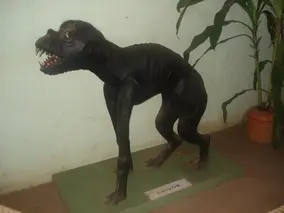
The lobisón — also lobizón, and luisõ in Guaraní — is the River Plate werewolf, and its defining rule is a birth order: the seventh consecutive son is said to change shape on Friday nights and prowl graveyards and open country.
Where and when was Lobizón sighted?
- Location
- Argentina
- Date sighted
- Unknown
- Coordinates
- -27.8, -64.3
- Last updated
LOCATION
What is Lobizón?
The name is a loanword from Portuguese lobisomem; Daniel Granada's Vocabulario rioplatense razonado (1890), the standard nineteenth-century dictionary of River Plate speech, does not carry it at all. An early field account is Juan B. Ambrosetti's, collected in Misiones in the 1890s and printed in 1917: his informants described a creature 'resembling a dog and a pig, with great ears', and pointed out the neighbour they suspected, making of him 'a kind of pariah'. Argentina's presidents really do stand godfather to seventh sons, under Decree 848/73, Law 20,843 and Decree 1416/2009, and none of those texts mentions the werewolf; the 1973 decree gives no motive beyond a first applicant of Russian nationality in 1907. The link to the lobizón is made by the local press of Coronel Pringles, where that first godson was baptised.
What is the history of Lobizón?
The Spanish American Academies' dictionary registers the word as lobisón, for Paraguay and Argentina, with the variants lobizón and luisón and a one-line etymology: from Portuguese lobisomem, 'wolf man'. In 2022 the Paraguayan philologist Domingo Aguilera Jiménez placed it among the 67 Portuguese loanwords he traced in Paraguayan Guaraní, and filled in the route: it comes from Brazilian Portuguese lobishomem, as Germán de Granda had already recorded; the Royal Spanish Academy did not admit lobisón until the 1984 edition of its dictionary, marked for Argentina, Paraguay and Uruguay; and the living Guaraní form is not lobisón but luisõ. The name, in short, arrives through Portuguese, and it reaches the record books late: Daniel Granada's Vocabulario rioplatense razonado (1890), the reference work on River Plate speech in the nineteenth century, does not carry the word in any spelling, while it does carry gaucho, mate, tapera and ñandubay.
The oldest field account among the sources of this file is by Juan Bautista Ambrosetti, director of the Ethnographic Museum in Buenos Aires. In Supersticiones y leyendas (1917), which gathers travel notebooks from the 1890s that he had begun publishing in 1893, Ambrosetti says he first heard the word in Rio Grande do Sul, sung in Portuguese by a countryman at a dance: 'Ando comprindo o meu fado / En trages de Lobisomé'. When he asked what it meant in the Misiones country, his informants gave him the rule that still governs the belief: being a lobisome is the fatal condition of the seventh consecutive son, and the seventh consecutive daughter becomes a witch instead. The creature they described was not a wolf but 'an animal resembling a dog and a pig, with great ears that cover its face'; it changed on Fridays at midnight, fed on filth and on unbaptised infants, and was released from the spell if someone wounded it without knowing who it was. Ambrosetti added a flat footnote: 'this legend is of European origin; it is what in France is called Loup Garou'.
The Guaraní layer is real, but it is not the one usually told. The luisõ is the seventh son of Tau and Keraná in the cycle of the seven cursed offspring of Guaraní mythology, and the version in circulation today owes much to the ethnogenetic poem Ñande Ypy Kuéra by Narciso R. Colmán (Rosicrán). In his own etymological glossary Colmán heads the entry 'Huiso, huicho, Luisón o Lobisón' and describes a lord of the night who feeds on corpses in graveyards: pale, foul- smelling, with long dirty hair. There is no wolf and no full moon. Aguilera explains why: in the Guaraní-speaking area the European figure was adapted by swapping the animal, so that 'instead of turning into a wolf-man, the possessed person here turns into a dog-man, the European canid being replaced by the dog, its commonest relative in these lands'.
Argentina's presidential godparenthood, by contrast, exists and is in the official gazette. It was created by Decree 848 of 24 December 1973, signed by Juan Domingo Perón, after the provincial government of Tucumán asked that girls be included too — so the extension to seventh daughters dates from 1973. A 1965 bill to the same effect had lapsed without a vote when Congress was closed in 1966, according to a letter printed in El Litoral of Santa Fe in 1968. Its preamble is the key document in this whole story: 'that in the year 1907 the then President of the Nation, Doctor José Figueroa Alcorta, granted the first request for godparenthood, made by a resident of the country of Russian nationality'. No names, no town, and not one word about werewolves. Decree 143 of 1974 adapted the ceremony for a female president; Law 20,843, passed on 28 September 1974 and published on 10 December, does not mention seventh sons at all — it only guarantees free schooling to anyone the president has sponsored — and Decree 964/76 set out the scholarship rules. Decree 1416, of October 2009, modernised the requirements (cohabiting couples, single mothers or fathers, adoption, non-Catholic faiths) and dated the custom again: 'invariably since 1907'.
The proper names come from the local press of Coronel Pringles, and they were in print by 1968, when that letter in El Litoral named Enrique Brost as the Russian resident with seven sons. According to the Pringles newspaper El Orden, José Brost was born there on 8 October 1907, seventh son of the Volga German farmer Enrique Brost and of Apolonia Holmann, and was baptised on 20 October — a Sunday — in the parish of Santa Rosa de Lima, which had existed since 1890. A priest surnamed Alfonsín officiated, the godmother was Berta Sieder, and the president was represented by the municipal commissioner Manuel Gascón; the party was held in the old town hall. The same paper gives the reason the father put forward: to continue "the Russian tradition whereby the tsar stood godfather to seventh sons". The Russian nationality fits the 1973 decree — Volga Germans reached Argentina on Russian passports. The same article also says the tsar's sponsorship protected seventh sons from turning into lobizones, and it is the one source in this file that joins the werewolf to the godparenthood.
Timeline: the documented record of Lobizón
- 1890 Daniel Granada's Vocabulario rioplatense razonado, the standard nineteenth-century dictionary of River Plate speech, carries no entry for lobisón, lobizón or luisón in its second edition. The scanned text is searchable: gaucho, mate and tapera all return hits, the werewolf does not.
- from 1893 Juan Bautista Ambrosetti begins publishing his folklore notes in the Revista del Jardín Zoológico de Buenos Aires. He later explains that the Misiones material came from travel notebooks written some twenty-five years before 1917 and had remained largely unpublished.
- 8 and 20 October 1907 According to the Coronel Pringles newspaper El Orden, José Brost is born on 8 October, seventh son of Enrique Brost and Apolonia Holmann, and is baptised on 20 October — a Sunday — in the Santa Rosa de Lima parish, with municipal commissioner Manuel Gascón standing in for President Figueroa Alcorta. The same account says the father asked for it in order to continue the Russian tsarist custom.
- 1917 Ambrosetti prints 'El Lobisomé' in Supersticiones y leyendas. He records the seventh-consecutive-son rule, the dog-and-pig shape with huge ears, the Friday midnight change, and the fact that neighbours pointed out the accused man and made of him 'a kind of pariah'. His footnote calls the legend European, the French loup-garou.
- 1929 Narciso R. Colmán (Rosicrán) fixes the Guaraní cycle in Ñande Ypy Kuéra: the luisõ is the seventh son of Tau and Keraná, lord of the night who eats the dead in graveyards. His own glossary heads the entry 'Huiso, huicho, Luisón o Lobisón', joining the Guaraní figure to the Portuguese name. The digitised Spanish version by the author is later — its front matter cites the author's honours up to 1936.
- January 1964 L. Illis publishes 'On porphyria and the aetiology of werwolves' in the Proceedings of the Royal Society of Medicine (57:23-26), the origin of the porphyria explanation that press coverage still attaches to the lobizón.
- 24 December 1973 Decree 848/73, signed by Juan Domingo Perón, creates the Padrinazgo Presidencial after a request from the province of Tucumán to include girls — so seventh daughters are covered from the start. Its preamble states that in 1907 President José Figueroa Alcorta granted the first such request, made by 'a resident of the country of Russian nationality'. Neither the werewolf nor any name appears.
- 28 September / 10 December 1974 Congress passes Law 20,843, promulgated on 4 December and published in the Boletín Oficial on 10 December (issue 23,053, p. 2). Contrary to what is often written, it says nothing about seventh sons or werewolves: it guarantees free primary, secondary, university or special education to anyone sponsored by the head of the executive.
- 12 March 1976 Decree 964/76, signed by María Estela Martínez de Perón days before the coup, regulates the scholarships: amounts indexed to the cost of living, renewal conditional on school performance, applications through the Presidency's protocol office.
- 1984 The Royal Spanish Academy admits lobisón into its main dictionary for the first time, marked for Argentina, Paraguay and Uruguay, according to Aguilera's review of the Academy's historical lexicographic record. The belief is centuries older than its dictionary entry.
- 1990-2016 The porphyria route is dismantled in the medical literature: Winkler and Anderson describe the 'medicalization of a myth' (1990), Cox writes of 'another myth in the making' (1995) and Maranda and colleagues return to it in JAMA Dermatology (2016).
- 6 October 2009 Decree 1416/2009 modernises the scheme — cohabiting couples, single parents, adopted children, non-Catholic faiths, and the name Padrinazgo/Madrinazgo — and repeats the official dating: the tradition has been granted 'invariably since 1907'.
- 2022 Domingo Aguilera Jiménez lists lobisón/luisón among 67 Portuguese loanwords in Paraguayan Guaraní and notes the key adaptation: in the Guaraní area the possessed person becomes a dog-man, not a wolf-man, 'the European canid being replaced by the dog'.
Is there a rational explanation for Lobizón?
The medical explanation everyone repeats has an author and a date: in January 1964 the neurologist L. Illis published 'On porphyria and the aetiology of werwolves' in the Proceedings of the Royal Society of Medicine, proposing congenital porphyria as the root of European werewolf legends. The idea escaped into popular writing, the same move was later made with vampires, and the medical literature turned on it: Winkler and Anderson called it the 'medicalization of a myth' (1990), Cox titled his note 'another myth in the making' (1995), and Maranda and colleagues returned to it in JAMA Dermatology (2016) as 'a myth, sensationalized'. Nils Metzger (History of Psychiatry, 2013) has studied precisely this reflex of rationalising werewolf belief by medical authority, from the early modern trials onwards.
For the River Plate version there is a further problem, and it needs only arithmetic: the rule that defines the lobisón is a birth order. Congenital erythropoietic porphyria, the only form that produces the spectacular skin damage usually invoked, is inherited in an autosomal recessive pattern; in a carrier couple the risk is identical for the first child and for the seventh. No porphyria distinguishes positions within a sibship, so it cannot explain the single clause that defines the lobisón. The same holds for rabies: Juan Gómez-Alonso argued in Neurology (1998) that rabies lay behind the eighteenth-century Balkan vampire legend, a reasonable hypothesis for attacks and agitation but silent on seventh sons.
What is documented is the social cost, and Ambrosetti documented it himself in 1917: the belief was so entrenched that people “not only claim to have seen him, but also, with great mystery, point out the individual accused of being a lobisome, showing him with mistrust, and make of that man a kind of pariah”. The harm that can be verified in this myth is a marked neighbour.
Then there is the bridge between the werewolf and the presidency. The presidential godparenthood is real and legislated, and its official texts leave the werewolf out: lobizón and lobisón appear neither in Decree 848/73 nor in Law 20,843, Decree 964/76 or Decree 1416/2009, in the InfoLEG texts read on 28 September 2026. The 1973 preamble gives no motive at all, only that the first request came from “a resident of the country of Russian nationality”. The link is made by the Coronel Pringles press. El Orden's anniversary piece of 20 October 2020, the source of the names, opens with the Russia of the tsars as “one of the several cradles” of the tradition by which the seventh son “turns into a lobizón on full-moon nights”, and says the tsar stood godfather to seventh sons “not only to protect them from the curse but also as a reward to those who gave seven children to the fatherland”; it gives no source for the tsarist custom. The names are older than that article. A letter in El Litoral of Santa Fe on 24 January 1968 already gives Enrique Brost, his seven sons and Figueroa Alcorta's consent, citing a note in the same paper of June 1967 and the explanatory memorandum of a 1965 bill, and it rests the story on “records that would exist in the newspaper archives of that time”. The five issues of Caras y Caretas from 19 October to 16 November 1907, searched in the Internet Archive's text on 28 September 2026, contain no Brost and no baptism at Pringles, although Figueroa Alcorta appears in every one; La Prensa for 17 to 29 October 1907 is missing from that archive's run.
Can you visit Lobizón?
The lobisón has no site, and the Argentine place tied to its legal history is Coronel Pringles, in Buenos Aires province, about 460 km south-west of the city of Buenos Aires in a straight line. The town paper El Orden, in an article of 20 October 2020, places the first presidential godparenthood there: José Brost, born on 8 October 1907, seventh son of Enrique Brost and Apolonia Holmann, was baptised on 20 October 1907 in the church of Santa Rosa de Lima, and the celebration was held in the old municipal building, "hoy auditorio Dardo Rocha". Santa Rosa de Lima is a working parish church.
Decree 848/73, in the wording given to it by Decree 1416/2009, lets spouses, cohabiting partners or a single mother or father with seven sons or seven daughters request the godparenthood, allows a child of the other sex born in between, counts adopted children, and sends the request to the Secretaría General of the Presidency. Its article 3 defines the godparenthood as the award of a commemorative medal, and article 5 states that it creates no rights or benefits of any kind for the godchild or relatives "salvo los establecidos en el marco legal" of the institution. That framework includes Law 20,843 of 1974, which guarantees godchildren free study; under Decree 964/76 as amended in 2009, grant applications are due before the last working day of October. The page on the grant at argentina.gob.ar, under the Ministry of Human Capital, read on 24 September 2026, has new applicants post the form free of charge through Correo Argentino to "Apartado especial respuesta postal paga N° 1" and renewals sent by email.
The law is under review in Congress. The Chamber of Deputies passed the government's bill known as the Ley Hojarasca on 20 May 2026 by 138 votes to 96, and Ámbito reported on 17 June that Senate committees had signed it off; the bill repeals Law 20,843 while letting current godchildren choose to keep their benefits. On 26 August Letra P reported that the Senate had left it off its agenda, with no date set for debate.
The legal texts are free to read in full on InfoLEG and argentina.gob.ar, and the books of Ambrosetti (1917), Granada (1890) and Colmán are digitised at the Internet Archive.
Sources consulted
- Poder Ejecutivo Nacional (Argentina), «Decreto 848/1973, «Padrinazgo Presidencial. Institúyese» (texto completo)» — InfoLEG / Boletín Oficial, 18-ene-1974, 1973 archive
- Congreso de la Nación Argentina, «Ley 20.843, Padrinazgo Presidencial. Otorgamiento de becas (texto completo)» — InfoLEG / Boletín Oficial n.º 23.053, 10-dic-1974, p. 2, 1974 archive
- Poder Ejecutivo Nacional (Argentina), «Decreto 1416/2009, modificación de los requisitos y alcances del Padrinazgo/Madrinazgo Presidencial» — InfoLEG / Boletín Oficial n.º 31.753, 7-oct-2009, p. 1, 2009 archive
- Juan B. Ambrosetti, «Supersticiones y leyendas: región misionera, valles calchaquíes, las Pampas, cap. VIII «El Lobisomé», pp. 103-105» — La Cultura Argentina, Buenos Aires, 1917 book
- Domingo Adolfo Aguilera Jiménez, «Lusismos en el guaraní paraguayo (en situación de contacto con el español), pp. 94-119 (entrada «lobisón/luisón», p. 106)» — Revista de la Sociedad Científica del Paraguay 27(1), 2022 academic
- Asociación de Academias de la Lengua Española, «Diccionario de americanismos, entrada «lobisón»» — ASALE / Santillana, 2010 web
- Narciso R. Colmán (Rosicrán), «Ñande Ypy Kuéra (Nuestros antepasados). Poema etnogenético y mitológico, cap. VII y nota etimológica 49» — Versión castellana del autor; ejemplar de la Biblioteca Virtual del Paraguay, 1929 book
- Rogelio Gómez, «Un día como hoy, se celebraba el primer padrinazgo presidencial» — El Orden, Coronel Pringles, 20 de octubre de 2020, 2020 newspaper archive
- L. Illis, «On Porphyria and the Aetiology of Werwolves, Proc R Soc Med 57(1):23-26 (PMID 14114172)» — Proceedings of the Royal Society of Medicine, 1964 academic
- A. M. Cox, «Porphyria and vampirism: another myth in the making, Postgrad Med J 71(841):643-644 (PMID 7494765); con Winkler y Anderson, «Vampires, porphyria, and the media: medicalization of a myth», Perspect Biol Med, 1990» — Postgraduate Medical Journal, 1995 academic
- Daniel Granada, «Vocabulario rioplatense razonado (2.ª ed.) — comprobación por texto completo: sin entrada de lobisón/lobizón/luisón» — Imprenta Rural, Montevideo, 1890 book
- MedlinePlus Genetics, «Porphyria (Frequency, Causes, Inheritance): la porfiria eritropoyética congénita se hereda de forma autosómica recesiva» — U.S. National Library of Medicine, 2020 web
- Poder Ejecutivo Nacional (Argentina), «Decreto 964/1976, reglamentación del régimen de becas de la Ley 20.843 (texto actualizado)» — InfoLEG / Boletín Oficial n.º 23.366, 18-mar-1976, p. 2, 1976 archive
- Nils Metzger, «Battling demons with medical authority: werewolves, physicians and rationalization, History of Psychiatry 24(3) (PMID 24573449)» — History of Psychiatry, 2013 academic
- Ministerio de Capital Humano (Argentina), «Ahijados Presidenciales – Ley N° 20.843 «Padrinazgo Presidencial» (requisitos y envío de la solicitud de beca; consultada el 24 de septiembre de 2026)» — argentina.gob.ar, 2026 web
- Honorable Cámara de Diputados de la Nación, «Diputados dio media sanción al proyecto de «Ley Hojarasca» y los cambios al régimen de Zonas Frías (138 votos afirmativos, 96 negativos y 9 abstenciones)» — hcdn.gob.ar, 20 de mayo de 2026, 2026 web
- Ámbito, «El Senado consiguió dictaminar la ley Hojarasca, que elimina más de 60 leyes consideradas en desuso (excepción para los ahijados de la Ley 20.843)» — ambito.com, 17 de junio de 2026, 2026 newspaper archive
- Letra P, «Patricia Bullrich armó una sesión para completar el tribunal del caso $LIBRA y congela el proyecto hojarasca» — letrap.com.ar, 26 de agosto de 2026, 2026 newspaper archive
- Atanasio Roca, «Letter by Atanasio Roca on the presidential godparenthood: first sponsorship in 1907 at Pringles, «el residente ruso Enrique Brost», citing El Litoral of June 1967 and the explanatory memorandum of a 1965 bill» — El Litoral, Santa Fe, 24 January 1968, 1968 newspaper archive
Reviewed by V. Serrano on 2026-08-11 · How we verify our content
📎 Source: Enigma Atlas
💬 Field testimonies (0)
No testimonies yet. Add the first.
Add your testimony
🔒 Log in to add a testimony