👻 HAUNTED PLACE · EXP. Nº9474
ACTIVE
Cinco Saltos
Cinco Saltos is a fruit-growing town in the Alto Valle of Río Negro that the internet has spent nearly twenty years calling one of the most haunted places on earth.
Where is Cinco Saltos?
- Location
- Río Negro, Argentina
- Type
- Cemetery
- Coordinates
- -38.817, -68.058
- Last updated
LOCATION
Why is Cinco Saltos said to be haunted?
The story most often told there — a girl found perfectly preserved in the municipal cemetery — is real, and the earliest account of it is a piece in the provincial daily Río Negro of 1 October 2003. It describes a girl of about eight to twelve, dead some seventy-two years, moved to the common ossuary the year before, still with her skin, her tights and her shoes; and it quotes specialists in legal medicine explaining that certain soils mummify a body naturally. There is no name in that report, no embalming and no shrine. The witch city can be dated too: the version everybody repeats was written on a blog in September 2008, and the massacre at the centre of it is a documented battle of 1882 with the outcome turned upside down. This is what the archives, the town's own family history and the local press actually say.
What is the history of Cinco Saltos?
For a town of its size, Cinco Saltos has an unusually complete paper trail. That is what makes its ghost stories easy to test: almost everything the legend asserts about the town's past can be checked against decrees, land registers and a 194-page family-by-family history written by a local, Francisco José Dehais, and published in 2001.
The land was sold by national decree in 1896 to Colonel Manuel Fernández Oro, changed hands twice more and was bought in 1909 by the Compañía de Tierras del Sud, which cut it into irrigable smallholdings. The settlement was known as Colonia La Picasa. Dehais gives two independent accounts of where that name came from — one from José Segundo Sifuentes, repeating what his father had told him, and one from Celestino Luchetti, who wrote the first history of the town — and both say the same thing: a piebald wild mare, a yegua picaza, that grazed on the dark flats north-east of the settlement and led a band of loose horses down to the Neuquén river to drink. A roadside inn on the cart track to Chos Malal and Catriel took her name. The present name of the town is administrative and comes from Buenos Aires: the five drops of the main irrigation canal gave national decree 415 of 24 May 1928 its wording, which named the town Cinco Saltos and assigned it 5,900 hectares; a second decree of 25 July 1932 finally fixed its boundaries. The first Comisión de Fomento had been created by decree on 16 September 1925. An earlier proposal, Milla Có — "golden water" — was dropped.
The cemetery enters that record as an ordinary municipal headache rather than as a place of dread. Dehais names Juan B. Bolo as one of its first gravediggers, paid fifty pesos a month by the Comisión de Fomento, and notes that Germán Da Ponte Ribeiro, the land company's local agent, was buried just inside the gate on the right when he died in 1925. When Teodoro Muller was handed the Comisión in 1929 he remembered the access road — today's calle Blumetti — as the first serious problem he had to solve: seepage from the main canal had turned it into a bog, and in the rainy season the coffin sometimes had to be carried part of the way by hand.
The other half of the town's twentieth century is industrial. Indupa, Industrias Químicas Patagónicas Argentinas, started up in Cinco Saltos in 1948 and made chlorine, caustic soda and later PVC. Lilian Pascal's study for the Universidad Nacional del Comahue reconstructs what that meant: mercury, monomer, methanol, chlorine and HCH handled with very little protection, and a workforce that later reported skin damage, deformed finger joints, tremors, respiratory and nervous disorders and cancers. The plant closed in 1996 and the city was declared in social and economic emergency. A residual firm, Imextrade, dismantled it: more than nine tonnes of mercury and other hazardous waste were encapsulated under an asphalt cap on an island in the main canal, solid waste went into a 53-hectare secure landfill in the bardas, and the works were signed off in 2001. In 2002 the provincial water authority detected mercury on adjoining land the municipality had earmarked for social housing plots; in 2006 a lorry carrying activated carbon with mercury residues was stopped, and residents formed a standing environmental committee.
The mummified girl belongs to that same window. On 1 October 2003 the provincial daily Río Negro reported, under the headline "Polémica por una momia de Cinco Saltos", that a girl of about eight to twelve who had died seventy-two years earlier — so around 1931 — had been moved to the cemetery's common ossuary a little over a year before, and that the state of the body had startled the cemetery workers. She still had skin, bone and part of her clothing, including her tights and her shoes. The remark had circulated quietly for a year; that week it broke open on the local radio stations. Listeners argued that someone should try to establish who she was — by her age, they reasoned, she could be a pionera of La Picasa — and some proposed setting aside a place where she could be seen, or moving her to the town museum, which the museum's friends association was reported to oppose. No name has ever been attached to her in any source I have been able to read.
Timeline: the documented record of Cinco Saltos
- June 1879 Fortín Vidal is built in the Cuenca Vidal — the basin that later becomes Lago Pellegrini — and abandoned in 1881. Dehais takes the dates from Raone and adds Luchetti's account that when the surrounding land was levelled for smallholdings, human skeletal remains, jacket buttons and sabres came to the surface.
- 16 January 1882 Fortín Primera División, on the Neuquén river at what is now the edge of Cipolletti, is attacked at dawn by the allied contingents of Sayhueque, Ñancucheo, Reuquecurá and Namuncurá, put at 800 to 1,000 men. The brigade's official report states that the garrison of sixteen soldiers of the 7th Cavalry under Captain Juan G. Gómez, helped by fourteen carters, held the fort; the attackers left twenty-one dead and Gómez was promoted for it. This is the documented event the modern legend reverses into a massacre of the garrison.
- 1909 The Compañía de Tierras del Sud buys the lands of Colonia La Picasa from the heirs of Cosme Llames Massini and subdivides them into irrigable smallholdings, which is what brings the first settler families in.
- 16 September 1925 A national decree creates the first Comisión de Fomento of Cinco Saltos. The same year Germán Da Ponte Ribeiro, the land company's local agent, dies and is buried just inside the cemetery gate, on the right.
- 24 May 1928 National decree 415 names the town Cinco Saltos, after the five drops of the main irrigation canal, and assigns it 5,900 hectares. A second decree of 25 July 1932 finally fixes its boundaries.
- 1929 Teodoro Muller takes charge of the Comisión de Fomento and records in his memoirs that the first serious problem he had to solve was the access to the cemetery — today's calle Blumetti — turned into a bog by seepage from the main canal, so that coffins sometimes had to be carried part of the way by hand.
- c. 1931 Approximate year of death of the girl later found preserved. It is not documented directly: it is arithmetic from the 2003 press report, which says she had died seventy-two years earlier and was aged about eight to twelve. No source gives her a name.
- 1948 Indupa, Industrias Químicas Patagónicas Argentinas, starts up in Cinco Saltos, producing chlorine, caustic soda and later PVC. For half a century it is the town's other economy alongside fruit growing.
- 1996 Indupa shuts down for good and Cinco Saltos is declared in social and economic emergency. Its private debt is absorbed by the state and it leaves behind a substantial environmental liability.
- 2001 Imextrade completes the dismantling and remediation, supervised by the national and provincial environment authorities: more than nine tonnes of mercury and other hazardous waste encapsulated under an asphalt cap on an island in the main canal, and solid waste in a 53-hectare secure landfill in the bardas. The same year, Francisco José Dehais publishes El viejo Cinco Saltos y sus familias, the family-by-family register of the town's founders.
- 2002 The girl's remains are moved to the cemetery's common ossuary, and their state of preservation startles the workers. In the same year the provincial water authority detects mercury on land adjoining the former plant that the municipality had earmarked for social housing plots.
- 1 October 2003 The provincial daily Río Negro publishes "Polémica por una momia de Cinco Saltos", the earliest datable account of the case. It reports that the talk had been circulating for a year and had just exploded on local radio, quotes unnamed forensic specialists explaining natural mummification by soil conditions, and records listeners proposing to identify the girl as a pionera of La Picasa or to move her to the town museum, which the museum's friends association would resist.
- 2006 A lorry carrying activated carbon with mercury residues is stopped on its way to the bardas, and residents set up a standing Comisión de Vecinos Autoconvocados en defensa del Medio Ambiente, later recognised by the municipal council.
- 11 September 2008 Danilo Miocevic publishes "CINCO SALTOS: la ciudad de las brujas" on the blog El modelo de Pickman. It is the earliest text I have been able to date that carries the full modern legend — the world ranking of sorcerers, the expelled television crew, the massacre at the bajo de las ánimas, the Barcelona historians, the sterile ground. It does not mention the mummified girl.
- 15 February 2014 The nickname "ciudad de las brujas" is added to the Spanish Wikipedia article on Cinco Saltos by an anonymous IP, in the demographics section and with no source, attributing it not to witchcraft but to families in the town practising Umbanda. A later editor renames the section "Esoterismo" on 14 December 2020 to give, in his words, a more objective view.
- 3 May 2020 The mummified girl is added to the same Wikipedia article, dated to 2017 and to a home video, with a YouTube link as its only source — seventeen years after the press account and with a different date.
- 30 August 2022 Río Negro reports that more than 600 commemorative plaques have been stolen from the cemetery, along with taps and electrical cabling, flooding some sections and cutting power to others. Prosecutor Leandro López leads the investigation and the municipality discusses paying for a night watchman.
- 3 August 2023 In an interview with LM Cipolletti, the regional practitioner who trades as Brujo Atahualpa recites the whole legend — blood-soaked ground, the sunless black hollow, the mummified girl, Lago Pellegrini as an amplifier of spells — as the setting for a farm he says he was called to cleanse. It is the clearest example of a private business built on the reputation.
- 24 January 2025 Río Negro previews the sixth Festival Internacional de Cine La Picasa (20-23 March, 750 shorts from more than 55 countries). Organiser Iván Iannamico explains the horror category by saying that Cinco Saltos is known as the city with the most witches in the world — the clearest case of the town itself putting the reputation to work, and it is a film festival rather than a ghost tour.
- 3 May 2025 LM Neuquén revisits the oldest piece of the legend — the television crew supposedly driven out of town — and prints Gastón Pauls's own answer: "I never went, it's true, they've asked me many times, like a kind of myth." Telefé told the paper there had been an initial contact and that the channel itself dropped the trip. The article otherwise reproduces the 2008 blog post almost word for word, and credits it.
Is there a rational explanation for Cinco Saltos?
The version of Cinco Saltos that circulates online can be dated, and it is younger than most of the people who repeat it assume.
The text that fixed it is a blog post, "CINCO SALTOS: la ciudad de las brujas", published by Danilo Miocevic on the site El modelo de Pickman on 11 September 2008. It contains the whole package: the town ranked "among the four points with the greatest concentration of sorcerers in the world", the Gastón Pauls television crew driven out under threats, the Bajo de las Ánimas where a patrol of twenty or thirty soldiers was wiped out to the last man, the two University of Barcelona historians who dug there and "felt" a malign energy, and the ground where nothing grows. It is worth noting what is not in it: the mummified girl, which had already been in the provincial press for five years, is absent. The two stories were fused later. In February 2025 the regional daily LM Neuquén ran the tale again, paragraph for paragraph and almost word for word from the 2008 post, crediting the blog.
Three of its claims can be checked, and all three fail.
The massacre is the documented event turned inside out. The fortín the story names, Primera División, stood by the Neuquén river on what is now the edge of Cipolletti, and it was attacked at dawn on 16 January 1882 by the allied contingents of Sayhueque, Ñancucheo, Reuquecurá and Namuncurá, put at 800 to 1,000 men. The official report of the brigade says the garrison — sixteen soldiers of the 7th Cavalry under Captain Juan G. Gómez, joined by fourteen carters passing through — held the position, that the attackers left twenty-one dead in the ditches, and that Gómez was lightly wounded and promoted to sargento mayor for it. The legend inverts the outcome, moves the event to an unnamed hollow and dates it "almost a century ago". The real skeletal remains in the area belong to somewhere else again: Dehais, citing Raone, places Fortín Vidal in the Cuenca Vidal, built in June 1879 and abandoned in 1881, and quotes Luchetti's account that when the surrounding land was levelled for smallholdings "human skeletal remains, jacket buttons and some sabres appeared".
The dead ground is not a mystery either. The bardas and the canal island north-east of town are where more than nine tonnes of mercury and a 53-hectare load of solid industrial waste were buried between 1996 and 2001, and where mercury has been detected since. A place that is fenced, sterile, avoided and officially unbuildable is exactly the kind of place a town explains to itself with a story.
And the mummy has a contemporary forensic explanation, printed in the same 2003 article that made her famous. The paper quoted specialists in legal medicine — it did not name them — to the effect that there are "abnormal forms in which the corpse alters very little", that this has nothing to do with the cause of death and everything to do with the ground: cool, very damp conditions, or hot dry ones, where resins and sodium carbonates in the soil favour natural mummification. Nothing in that report describes an embalming, a shrine, an unmarked tomb opened in secret, an order to keep quiet, or prayers being answered. Those details appear later, in blogs and viral videos. The Spanish Wikipedia article dates the case to 2017 and cites, as its only source, a YouTube video; the edit that added it is from 3 May 2020. The nickname "city of witches" entered that same article on 15 February 2014, added by an anonymous IP which attributed it not to witchcraft but to families in the town practising Umbanda; the section was renamed "Esoterismo" on 14 December 2020 by an editor who wrote in the edit summary that he was changing it "to give a more objective view". The world ranking the article invokes rests on a dead link to a Mexican newspaper listicle that is not preserved in the Wayback Machine.
Nobody official sells any of this. The provincial tourism board's page for Cinco Saltos promotes the fruit farms, the dam and Lago Pellegrini and does not mention witches, the cemetery or the mummy; neither does the municipal website. There is no ghost tour and no ticket. Who does earn from it is easier to name: practitioners such as the regional media personality who trades as Brujo Atahualpa, who in an interview of 3 August 2023 recited the cursed ground, the black hollow and the mummified girl as the credentials of a farm he had been called out to cleanse; nightclubs advertising Halloween parties; YouTube channels; and, more benignly, the La Picasa international film festival, whose organiser Iván Iannamico told Río Negro in January 2025 that since "Cinco Saltos is known as the city with the most witches in the world", a horror category was unavoidable. Guido Riccono — a historian, CONICET researcher and former director of the town museum, who grew up there — describes the ritual practice as real, popular, discreet and mostly about love, work and money, and calls the world ranking "supposed and unverifiable". He also records something the ghost sites never mention: that the argument about witchcraft in Cinco Saltos is a class argument, and that the campaign to "clean up" the town's reputation is aimed at its poorest residents.
Can you visit Cinco Saltos?
Cinco Saltos is a working fruit-growing town in the Alto Valle — 27,566 people in the 2022 national census, a figure the mayor, Enrique Rossi, publicly disputed as roughly half the real total — about 20 km north-west of the city of Neuquén and 15 km from Cipolletti, reached by provincial route 151 and served by regional buses. There is nothing to buy here connected with the legend and no organised paranormal visit of any kind.
The Cementerio Municipal is on the Parque Industrial side of town, roughly 800 m east of the centre (OpenStreetMap places the enclosure at about -38.8166, -68.0577). A regional business directory lists it as open every day, 08:00-12:00 and 15:00-19:00; there is no municipal page confirming that, so check locally before travelling. It is an ordinary municipal cemetery and it is not staffed at night. Note that the site has been repeatedly robbed: Río Negro reported in June 2022 that taps and lengths of electrical cable had been stripped out, flooding some sections and cutting power to others, and in August 2022 that more than 600 commemorative plaques had been taken, with the case in the hands of prosecutor Leandro López and the municipality discussing hiring a night watchman. Turning up after dark is disrespectful to families who are already losing their relatives' plaques, and there is nothing to see: the remains at the centre of the story are in the common ossuary, not on display.
The Bajo Negro, or Bajo de las Ánimas, is not a signposted destination and should not be treated as one. Riccono, who grew up in the town and looked for it repeatedly, writes that plenty of people claim to know where it is and almost none can explain how to get there. The bardas north-east of town also contain the sealed industrial waste of the former Indupa plant, including a 53-hectare secure landfill and more than nine tonnes of encapsulated mercury. Whatever else it is, it is not a place to go digging or picnicking.
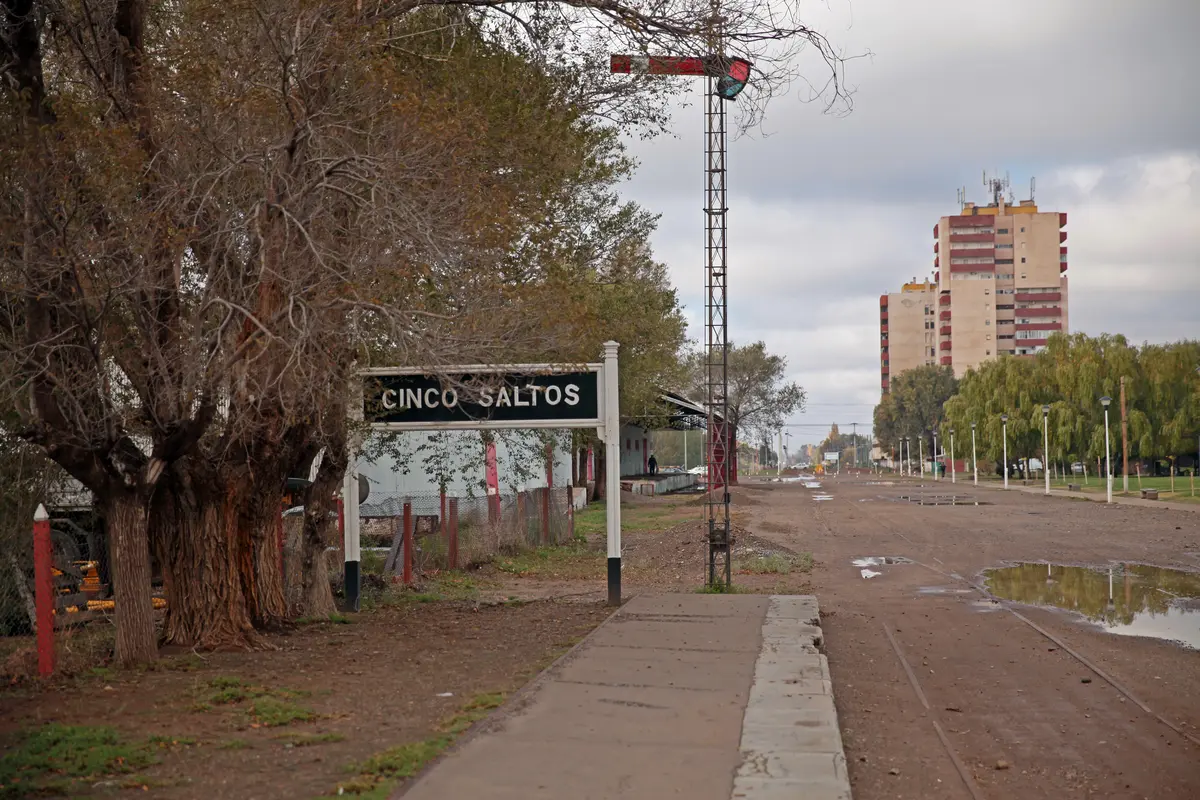
What is worth the trip is above ground. The old railway station is the town's landmark: the line from Cipolletti to Cordero opened to goods and passengers on 25 June 1910, and the railway built the station building and platform at the km 1206 halt in 1934, which is when the stop took the name Cinco Saltos. It still carries its enamel nameplate and a semaphore signal and doubles as a venue during the Festival Internacional de Cine La Picasa, held each March; the 2025 edition, its sixth, ran from 20 to 23 March with 750 short films from more than 55 countries and included fiction, documentary, animation, music video, erotic and horror categories. The regional museum on calle Belgrano keeps the town's own history. Lago Pellegrini and the Península Ruca Có, 12 km from the centre, are the local water resort, and the Ingeniero Ballester dam upstream is the reason the Alto Valle exists at all.
Sources consulted
- Diario Río Negro (agencia Cinco Saltos), «Polémica por una momia de Cinco Saltos» — Diario Río Negro (General Roca), edición del 1 de octubre de 2003, recuperada de la Wayback Machine, 2003 newspaper archive
- Francisco José Dehais, «El viejo Cinco Saltos y sus familias» — Edición del autor, Río Negro, 194 pp., ISBN 987-43-2685-9, 2001 book
- Lilian Pascal, «Historia de Indupa y su impacto económico, social y ambiental en Cinco Saltos (1948-2010)» — Cuadernos de Investigación. Serie Economía, n.º 8, pp. 104-118, Universidad Nacional del Comahue, 2019 academic
- Ejército Argentino, 1.ª Brigada, «Combate del Fortín Primera División (informe oficial de la brigada y relatos del capitán Gómez y del capitán Zabala publicados en El Expedicionario)» — Informe oficial del 16 de enero de 1882, reproducido en Revisionistas, 1882 report
- Guido Riccono, «Cinco Saltos: creer o reventar» — Árida Revista Cultural, Instituto Universitario Patagónico de las Artes, 2023 web
- Danilo Miocevic, «CINCO SALTOS: la ciudad de las brujas» — El modelo de Pickman (blog), entrada del 11 de septiembre de 2008, 2008 web
- Wikipedia en español, «Historial de ediciones del artículo «Cinco Saltos»» — Revisiones 72597001 (15-feb-2014), 125724695 (3-may-2020) y 131707699 (14-dic-2020), 2020 archive
- Martina Sehmsdorf, «Terror, ficción y videoclips en Cinco Saltos: llega el festival de cine internacional a la ciudad de las brujas» — Diario Río Negro, 24 de enero de 2025, 2025 newspaper archive
- Diario Río Negro, «Se robaron más de 600 placas en el cementerio de Cinco Saltos» — Diario Río Negro, 30 de agosto de 2022, 2022 newspaper archive
- Diario Río Negro, «Robaron y provocaron daños en el cementerio de Cinco Saltos» — Diario Río Negro, 17 de junio de 2022; declaraciones de Dante Arriola, secretario de Gobierno y Hacienda, 2022 newspaper archive
- LM Cipolletti, «Magia negra en Cinco Saltos: el caso del Brujo Atahualpa» — LM Cipolletti, 3 de agosto de 2023, 2023 newspaper archive
- LM Neuquén, «Historias paranormales en la región: ¿Qué pasó con Gastón Pauls en Cinco Saltos, la ciudad de las brujerías?» — LM Neuquén, 3 de mayo de 2025, 2025 newspaper archive
- Federico Witkowski, «Colonia «La Picasa» 1914-2014. Centenario de una promisoria tierra de viñedos, bodegas y vinos» — EDUCO, Editorial de la Universidad Nacional del Comahue, Neuquén, 134 pp., ISBN 978-987-604-507-0, 2018 book
- Ministerio de Turismo y Cultura de Río Negro, «Cinco Saltos — ficha de localidad» — Portal oficial de turismo de la provincia de Río Negro, 2026 web
- Guía Cores, «Cementerio — Parque Industrial, Cinco Saltos (horarios de atención)» — Directorio comercial regional, ficha actualizada el 17 de febrero de 2026, 2026 web
- LM Cipolletti, «Censo 2022: en Cinco Saltos aseguran tener el doble de habitantes» — LM Cipolletti; datos definitivos del Censo Nacional 2022 (INDEC) y declaraciones del intendente Enrique Rossi, 2024 newspaper archive
Reviewed by V. Serrano on 2026-08-17 · How we verify our content
💬 Field testimonies (0)
No testimonies yet. Add the first.
Add your testimony
🔒 Log in to add a testimony