📜 LEGEND · EXP. Nº0270
ACTIVE
La Difunta Correa
In Vallecito, San Juan Province, Argentina, people venerate the Difunta Correa, one of the country's most massive folk devotions even though the Church does not officially recognize it.
Where does the legend of La Difunta Correa come from?
- Location
- Vallecito, San Juan, Argentina
- Kind of legend
- Folk tale
- Coordinates
- -31.617, -68.017
- Last updated
LOCATION
What is the legend of La Difunta Correa?
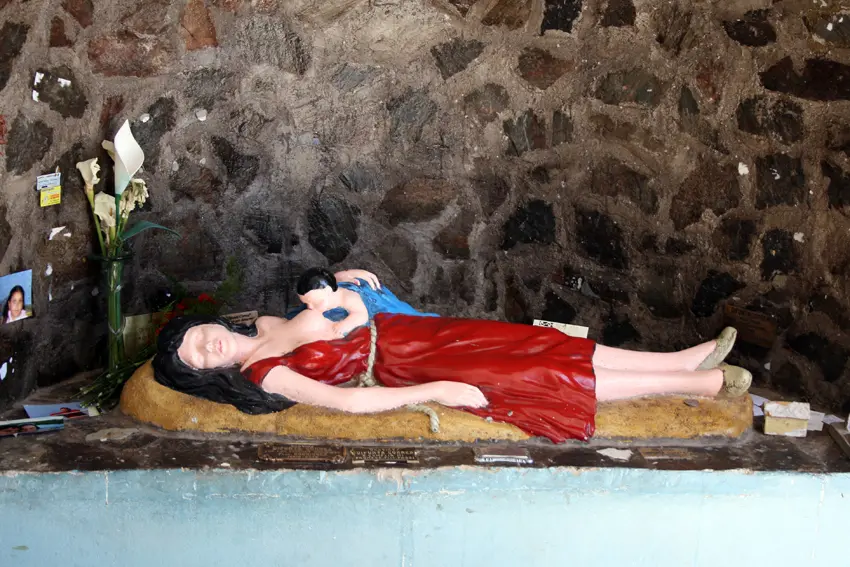
Legend says that around the mid-19th century, during the civil wars, Deolinda Correa set off on foot across the desert following the army that had taken away her sick husband, carrying her nursing baby. Her water and strength ran out and she died of thirst under the merciless sun. Days later some muleteers found her body and, to their astonishment, the baby was still alive, feeding at the dead mother's breast. The 'miracle' made her a popular saint, protector of travelers and truck drivers. Along Argentine highways one sees small red shrines surrounded by water bottles that drivers leave to quench her eternal thirst. In Vallecito her sanctuary draws hundreds of thousands of pilgrims each year giving thanks for favors. It is folk faith born of the desert and of compassion.
What is the history of La Difunta Correa?
Vallecito is a place of pilgrimage. The 2013 Atlas of religious belief in Argentina, as cited by the historian Mariano Fabris, found that 32 % of its national sample believed in the Difunta Correa, rising to 58 % in Cuyo, where the devotion began.
The story has passed by word of mouth since the nineteenth century. Deolinda Correa crossed the San Juan desert on foot with her nursing baby in her arms, following the husband whom the militias had taken away during the wars between Unitarians and Federalists. Her water ran out and she died of thirst. When muleteers found the body, the baby was still alive, feeding at his dead mother's breast.
The historical setting is plausible even though the woman appears in no document. In the version recorded by Frank Graziano, professor of Hispanic studies at Connecticut College, Baudilio Bustos was conscripted despite pleading illness; in another he was taken away in chains towards La Rioja. Which militia it was, Facundo Quiroga's or that of the La Rioja caudillo Ángel Vicente "Chacho" Peñaloza, is one of the questions that Fr. José Juan García, of the team searching the archives in 2026, listed as open.
What is dated is the devotion. By 1865 a text already describes travellers stopping at the grave, praying and dropping a coin into the alms box. The spot was then called Las Peñas and had such a reputation for hold-ups that in San Juan people answered an overcharging shopkeeper with "if you want to rob someone, go to Las Peñas". That the grave stood exactly there explains almost everything: the dead woman protected the traveller precisely where the road was dangerous. By 1883 the parish books of Caucete record masses in her honour, and a stone of June 1895 gives thanks to "the charitable soul of the Difunta Correa".
The muleteer Flavio Zevallos, who lost his herd in a storm and recovered every head after promising her a chapel, put up the first building around 1890. From the single room with an altar and a padlocked alms box that folklore surveyors described in 1921 grew, in little more than a century, a complex that Graziano describes with several chapels, a museum, shops, a small hotel, restaurants, a police station, a health centre and a post office; a provincial government tribute of 2022 to the priest who promoted them adds the school building and a chapel for donated wedding dresses. The ex-votos include water bottles, photographs, plaques and car number plates and, on the slopes below the grotto, scale models of the houses and businesses obtained through her intercession. The muleteers carried her fame along the tracks; then the lorry drivers carried it across the country, "Visit the Difunta Correa" painted on the cab and one roadside shrine after another along the highways.
Timeline: the documented record of La Difunta Correa
- c. 1865 The earliest known written notice of the devotion. A text of this date, later cited by the folklorists Susana Chertudi and Sara Newbery, records that travellers "have complete faith in her miracles" and never pass the grave without saying a prayer or dropping a silver coin into the alms box. The spot, called Las Peñas, was then notorious for ambushes on the road.
- 1883 Parish records of Caucete document several masses said in honour of the Difunta Correa — the first sign that the local Catholic clergy were already dealing with the devotion rather than ignoring it.
- 1921 The National Folklore Survey records the site as a small room with an altar and a padlocked alms box, and notes that locals "show more devotion and faith in her than in many of the saints of the Catholic religion". Crucially, none of the 1921 versions contains the miraculous nursing: there is a child at the breast, or no child at all.
- 1948 San Juan provincial law 1.300 creates the Fundación Cementerio de Vallecito to receive the offerings and administer the site. The parish priest is written into its board alongside the mayor and the justice of the peace — the Church's first formal foothold inside the sanctuary.
- 1966 The chapel of Our Lady of Carmen is built inside the Difunta Correa grounds, driven by the parish priest of Caucete, Ricardo Báez Laspiur, appointed in 1963 and remembered as the "builder priest". His works also included the inn, the shopping arcade, the chapel for donated wedding dresses, the school, the access road, mains electricity and the water tankers.
- 1976 In March the Argentine Episcopal Conference issues a declaration on the cult of the saints and the souls in purgatory calling the devotion "illegitimate" and asking "true Catholics" to abstain from it. In April, weeks after the coup, the military government takes over the Fundación Cementerio de Vallecito alleging "serious irregularities"; Báez Laspiur and the rest of the board are removed.
- 1982 On 24 March the military governor of San Luis decrees the demolition of the roadside Difunta Correa shrines, arguing that the cult "lacks historical foundation" and is not entered in the National Register of Religions, and gives thirty days before the security forces do it. The bishop of San Luis publicly welcomes the measure.
- 2002 The Fundación Cementerio de Vallecito is wound up for good and the running of the complex passes to a department of the San Juan provincial government. Its declared priority is to develop and promote the sanctuary as a centre of religious tourism.
- 2026 The Archdiocese of San Juan, under Archbishop Jorge Lozano, and the Héctor Arias Institute of Regional Argentine History at the National University of San Juan launch the first systematic attempt to document Deolinda Correa: a team of twenty collaborators, among them lecturers, students, priests and assistants, going through the registers. Fr. José Juan García, a member of the team, states plainly: "The truth is we do not know whether Deolinda existed, nor where she was born, nor whether she really had a son."
Is there a rational explanation for La Difunta Correa?
The search for documents on Deolinda Correa has a history of its own. The Fundación Cementerio de Vallecito, which administered the sanctuary, acknowledged in its report and balance sheet for September 1960 to September 1961 that the search for historical proof of her existence had so far come to nothing, as the historian Mariano Fabris records. In May 2026 El Litoral reported that the Archdiocese of San Juan and the Héctor Arias Institute of Regional Argentine History, at the National University of San Juan, had a team of twenty collaborators working through the registers. Fr. José Juan García, one of them, told the press that "we do not know whether Deolinda existed, nor where she was born, nor whether she really had a son", that many studies, films and documentaries exist, and that none has been able to present reliable documentation. "We have to go archive by archive," he said, adding that baptism and marriage certificates might turn up in parishes.
The versions do not agree with one another. In the account summarised by Frank Graziano, professor of Hispanic studies at Connecticut College, Baudilio Bustos was conscripted around 1841 by the troops of Facundo Quiroga; García places the story between 1820 and 1830. In some versions the husband is recruited, in others he is taken away in chains towards La Rioja. A San Juan folklore report of 1946 tells of a woman who had to leave home because of "a great mistake", gave birth on the road and died of thirst and exhaustion; a chapel was built in the belief that she "must be miraculous because she lost her life in search of what was indispensable for living: water".
The detail that now defines the story is the latest of all. Graziano read the versions collected by the folklore survey of 1921: some mention a child at the breast or sheltered by it, one a child feeding, and none the miraculous nourishment from the dead mother's body. He places the arrival of the miraculous breast somewhere between 1920 and 1940, "more or less a century" after her death, with the warning that these dates are flexible; once it entered the myth, he writes, it gradually became the essential feature of her identity.
The money is documented too. In April 1976 the bulletin of the Catholic news agency AICA published a document of the bishops that called the cult "illegitimate" and asked "true Catholics" to abstain from it, and reported that the military government had taken over the Foundation over "serious irregularities". In 2002 the Foundation was dissolved and the complex passed to a department of the provincial government, whose priority, in Graziano's words, was to develop and promote the sanctuary as a major site of religious tourism. Graziano also recorded that an excavation some decades earlier had shown that her remains are not in Chapel 1, although a sign still announced that they were; the priest Ricardo Báez Laspiur believed that she was buried at Villa Independencia, the cemetery nearest to the place where she died.
Can you visit La Difunta Correa?
Vallecito lies in open desert in the department of Caucete. The national tourism office gives it as 64 km from the city of San Juan; the road in is National Route 141, and the site stands about 34 km south-east of Caucete town. Entry is free and the grounds are open all year. The provincial government's note of 20 March 2026 states that "cerca de un millón y medio de personas visitan cada año a la Difunta Correa".
The crowds come at Holy Week, with Good Friday the heaviest day; at the Fiesta Nacional del Camionero, which falls in the July winter holidays; on 2 November, the day of the dead; and for the Cabalgata de la Fe, which arrives on horseback from San Juan. Promesantes walk the 34 km from Caucete or the 64 from the capital, and many of them set off at night.
The grounds hold the church of Our Lady of Carmen and some seventeen chapels counted in 2005, most of them donated by devotees, along with a museum of faith, an inn, shops, restaurants, a health post and a police station. The first stage of a full refurbishment was inaugurated on Friday 20 March 2026. The same note counts "22 mesas nuevas y la restauración de 108 parrilleros que ya existían en el lugar", with 30 further stands, four fire pits, 11 new waste bins and over a thousand square metres of new paths. The master plan still to be executed covers accessible toilets, the food sector, a rural unit, a primary health centre, an enlargement of the Escuela Paraguay and a stage for large events.
What people bring is a bottle of water, and it is the offering that defines her. Until the Vallecito aqueduct on Route 141 came into service the hamlet was supplied by water tanker; in April 2025 the provincial government connected 101 houses to the new network. In summer there is little shade over the grounds.
Sources consulted
- Mariano Fabris, «La Iglesia católica y el culto a la Difunta Correa en los años de la dictadura» — Hermeneutic, n.º 29, pp. 86-101 (Universidad Nacional de la Patagonia Austral), 2026 academic
- Frank Graziano, «La Difunta Correa» — Revista Sans Soleil — Estudios de la Imagen, vol. 5, n.º 2, pp. 52-68 (traducción del capítulo de Cultures of Devotion, Oxford University Press, 2007), 2013 academic
- Ana Laura Cotignola y Paola Sabrina Belén, «Exvotos: símbolos artísticos del hacer popular contemporáneo. Disquisiciones sobre la artisticidad de las ofrendas casitas en el santuario Difunta Correa (San Juan, Argentina)» — De Prácticas y Discursos, vol. 13, n.º 21 (Universidad Nacional del Nordeste), 2024 academic
- Redacción, «La Iglesia busca pruebas de la existencia de la Difunta Correa» — El Litoral (Santa Fe), 2026 newspaper archive
- Prensa del Gobierno de San Juan, «Homenaje a monseñor Báez Laspiur, gran impulsor del paraje Difunta Correa» — SI San Juan — Gobierno de la Provincia de San Juan, 2022 report
- Prensa del Gobierno de San Juan, «Una transformación histórica: Orrego inauguró obras de remodelación de la Difunta Correa, uno de los sitios más icónicos de San Juan» — SI San Juan — Gobierno de la Provincia de San Juan, 2026 report
Reviewed by V. Serrano on 2026-07-29 · How we verify our content
📎 Source: Enigma Atlas
💬 Field testimonies (0)
No testimonies yet. Add the first.
Add your testimony
🔒 Log in to add a testimony