🦶 CRYPTID SIGHTING · EXP. Nº6501
ACTIVE
Nahuelito
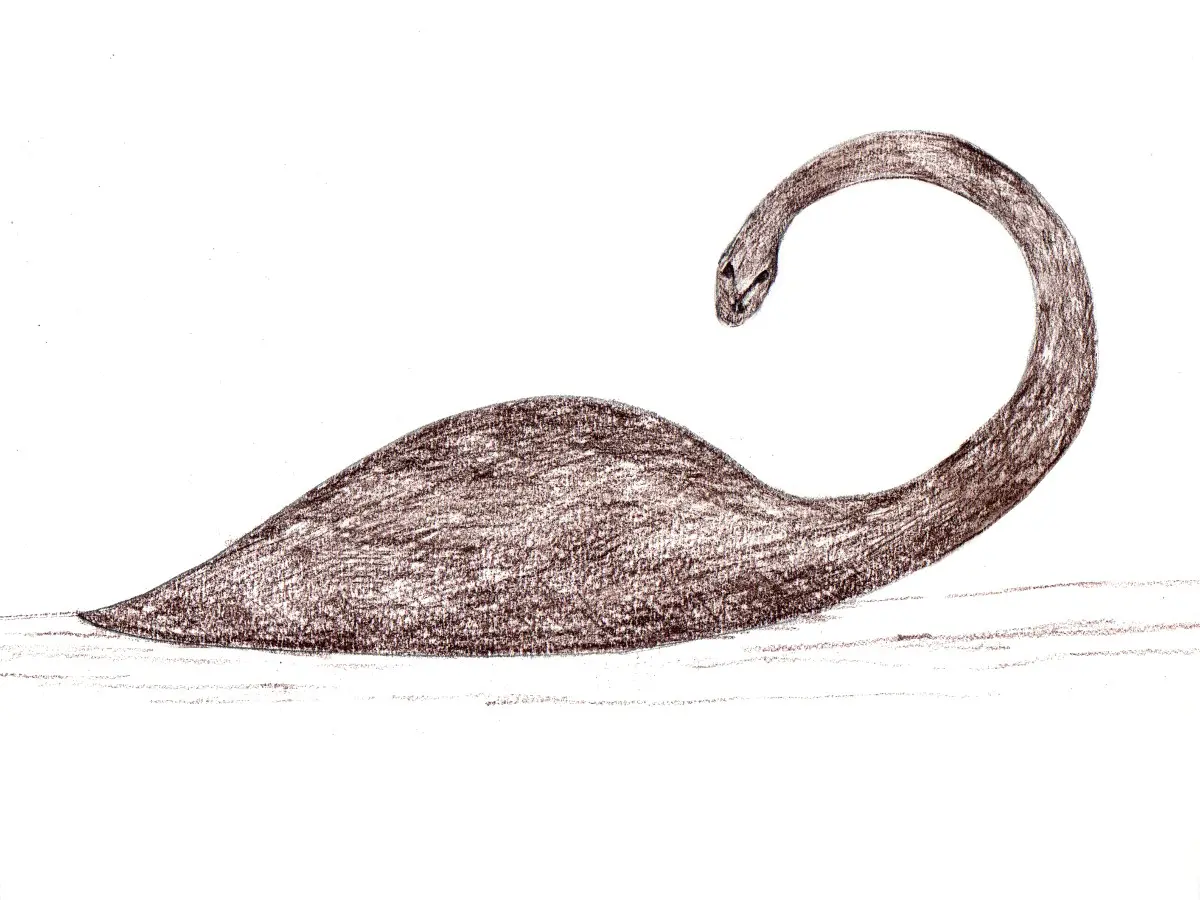
Nahuelito is the supposed long-necked animal of Lake Nahuel Huapi, in the Argentine Andes, and one of the few cryptids whose entire biography can be dated.
Where and when was Nahuelito sighted?
- Location
- Río Negro / Neuquén, Argentina
- Date sighted
- Unknown
- Coordinates
- -40.92, -71.521
- Last updated
LOCATION
What is Nahuelito?
The name is not old: it was attached to the lake's plesiosaur by the Bariloche journalist Carlos Bustos around the 1970s, and it is a Spanish diminutive of the lake itself — nahuel is Mapudungun for jaguar — not of an indigenous creature. The plesiosaur did not come from a witness either: when Clemente Onelli, director of the Buenos Aires zoo, announced in 1922 that he would hunt a mysterious animal in Patagonia, he was after Florentino Ameghino's surviving giant ground sloth, and on 15 March he told the Associated Press that plesiosaurus was "a pseudonym the newspapers have given it and which has stuck". Nor did the sighting happen here: Martin Sheffield placed it in a shallow lagoon at Hoyo de Epuyén, in Chubut, hundreds of kilometres to the south. Nahuel Huapi inherited the monster because the expedition spent three weeks based in Bariloche, and Bariloche sealed it at the February 1923 carnival with a mechanical float. The Mapuche water tradition is real and older, but it is a different one: it is called el Cuero.
What is the history of Nahuelito?
Lake Nahuel Huapi had no monster until one was brought to it. To see where it came from you have to start twenty-four years earlier and fifteen hundred kilometres away.
In 1898 Francisco P. Moreno brought to La Plata a fragment of mummified mylodon hide recovered from the Cueva del Milodón, in Última Esperanza. The piece sat in the museum barely a week on its way to the Zoological Society of London, and in that gap Florentino Ameghino — by then at odds with Moreno — obtained a scrap and rushed into print. The apparent freshness of the hide struck him as evidence that the animal had died recently: he named it Neomylodon listai and argued that the giant ground sloth was still alive in Patagonia. Europe and Buenos Aires were electrified, and expeditions set out to catch it. None found anything. Ameghino meanwhile kept feeding the story: he wrote of the Jemmich, "which the Tehuelche know very well, but whose accounts have always been taken for fables", and placed it in burrows along the shores of Patagonian lakes. That is where the mutation that explains everything began: blended with indigenous mythology, the land sloth of 1898 gradually became, in the public imagination, an animal with aquatic habits.
The second push came in 1922. Clemente Onelli, director of the Buenos Aires Zoological Garden, received a letter from Martin Sheffield, an American settled in the Epuyén area, who said he had seen an animal with a swan-like neck. Onelli was hunting Ameghino's edentate — in the instructions La Nación printed on 24 March he asked his men to look for "an edentate very close to, if not the same as, the Criptoterio doméstico" — but a newspaper subheading did the rest. On 15 March, speaking to the Associated Press, Onelli said it outright: "Plesiosaurus is a pseudonym the newspapers have given it and which has stuck", adding that he believed it was an edentate related to the one Ramón Lista had shot at in 1890.
The expedition left Buenos Aires on 23 March. The main party drove out of Neuquén on the 26th and reached Lake Nahuel Huapi on 30 March. And there it stayed for almost three weeks, working sites near Bariloche, among them Lake Correntoso. On 8 April the engineer Emilio Frey was in Buenos Aires on business concerning the creation of the Parque Nacional del Sud, the seed of the future Nahuel Huapi National Park. Only on 17 April did the full commission set out for Hoyo de Epuyén to find Sheffield; it reached the sighting spot on the 20th and met his wife and children, since Sheffield himself was convalescing in a town near Esquel. They searched the shallow lagoon beside the family's hunting post, even using a raft. On Sunday 23 April Frey set off eleven cartridges of dynamite in the water. Nothing surfaced. On the 25th the wire reported from Cholila that the expedition was returning empty-handed, and that same night Onelli explained in Buenos Aires that the lake they had searched was not the one Sheffield had pointed to.
Meanwhile the wire services were doing their work. In April 1922 a National Geographic Society bulletin reprinted in dozens of American papers introduced "one of the best known of the Andean Lakes of Argentina, Nahuel Huapi", and closed: "It is in this inter-mountain lake region that scientific expeditions will search for the strange creatures reported to have been seen there." That same month Charles Wellington Furlong published a long feature in Washington's Sunday Star that set the band of Patagonian sightings between 52 degrees south and Lake Nahuel Huapi. The hunt was in Chubut; the name being printed was the lake with hotels. Nor was that an accident: in January 1924 a dispatch datelined Buenos Aires announced that Nahuel Huapi "soon will be opened to comfortable tourist travel", with two Bariloche hotels being improved and weekly excursions about to begin.
The monster stayed in Bariloche anyway, for two reasons. First: on 6 April 1922, with the story already circling the globe, the Toronto Globe ran an unsigned piece headed "Local Man Lays Claim To Having Caught Sight Of Gigantic Plesiosaur", in which a Canadian employee recalled that in 1910 he and his son, then living at Nahuel Huapi, had seen a strange animal while sailing on the lake. Second: at the carnival of Monday 12 and Tuesday 13 February 1923 the troupe "El Plesiosauro" paraded through Bariloche. Its ringleader was Primo Capraro, a wealthy sawmill owner, a friend of Onelli's and a member of the same Italian community. On the chassis of a Ford truck, using timber and hessian, they built a giant plesiosaur with mechanical movement; walking alongside were aviators, journalists and "Don Clemente" carrying a syringe, escorted by Capraro himself dressed as Martín Fierro on horseback. Rafael Soriani photographed it on Calle Mitre at the corner of Villegas, opposite the Banco Nación. The Italian-language press in Buenos Aires ran the headline "Il plesiosauro e' catturato". It was mockery, and it worked as advertising. The float was reused at later carnivals until it burned in a fire at the sheds of Capraro's sawmill.
Onelli died on 20 October 1924 and the affair went quiet. The name came much later: "Nahuelito" was attached to the lake's plesiosaur by the Bariloche journalist Carlos Bustos, around the 1970s. Forty-eight years after the hunt.
Timeline: the documented record of Nahuelito
- 1898 A fragment of mummified mylodon hide from the Cueva del Milodón reaches the Museo de La Plata. Florentino Ameghino obtains a scrap, names it Neomylodon listai and argues the giant ground sloth is still alive in Patagonia, launching two decades of failed hunts.
- 1916 Félix José de Augusta publishes his Araucanian-Spanish dictionary, recording nawel as 'the jaguar', wapi as 'the island', and mythological water beings such as the kaikai filu, half serpent and half horse. None of them is a long-necked lake reptile.
- 9 March 1922 Frederic B. Loomis, geologist at Amherst College, tells the Associated Press that a plesiosaur 'could not exist in fresh water', that any sighting was probably an anaconda, and that in the Patagonian lake region he 'never heard a hint' of such an animal from local traders and travellers.
- 15 March 1922 Clemente Onelli tells the Associated Press in Buenos Aires that 'plesiosaurus is a pseudonym the newspapers have given it and which has stuck'. He was in fact hunting Ameghino's surviving edentate, not a marine reptile.
- 22 March 1922 Emilio Frey writes to Onelli from Bariloche that people around Lake Correntoso have repeatedly seen a large animal in the water which they call 'el Cuero' and compare to a sea octopus. It is the earliest dated record of a lake creature at Nahuel Huapi, and it is not a plesiosaur.
- 30 March – 17 April 1922 The expedition reaches Lake Nahuel Huapi and spends almost three weeks working sites near Bariloche before setting out for Sheffield's lagoon in Chubut. This is how the lake acquired a monster it was never reported at.
- 6 April 1922 The Toronto Globe publishes an unsigned piece, 'Local Man Lays Claim To Having Caught Sight Of Gigantic Plesiosaur', in which a Canadian employee recalls that in 1910 he and his son, living at Nahuel Huapi, saw a strange animal from the lake. It came after the news, not before it.
- 23–25 April 1922 On Sunday 23 April, Emilio Frey explodes eleven cartridges of dynamite in the lagoon near Esquel. Nothing surfaces. On the 25th the wire reports from Cholila that the hunt is over; that night Onelli says the lake searched was not the one Sheffield had indicated.
- 12–13 February 1923 At the Bariloche carnival the troupe 'El Plesiosauro' parades a mechanical plesiosaur built on a Ford truck chassis, led by sawmill owner Primo Capraro and mocking Onelli. Rafael Soriani photographs it on Calle Mitre. The joke fixed the creature to this lake for good.
- 20 October 1924 Clemente Onelli dies and the search for Patagonia's 'mysterious quadruped' is abandoned. The original story is forgotten; what survives is the plesiosaur the press invented.
- 8 April 1934 Nahuel Huapi National Park is created on land donated by Francisco P. Moreno in 1903, building on the Parque Nacional del Sud that Frey was arranging in Buenos Aires in April 1922. The first train reaches Bariloche on 5 May 1934 and mass tourism begins.
- c. 1970s The Bariloche journalist Carlos Bustos coins the name 'Nahuelito' for the lake's plesiosaur — a Spanish diminutive of the lake, forty-eight years after the hunt. The name is the youngest part of the whole story.
- August 2023 A video of a dark shape filmed from the Piedras Blancas access goes viral in Bariloche. The most widely discussed explanation locally is not a monster but a man on a stand-up paddleboard.
Is there a rational explanation for Nahuelito?
The scientific objection is contemporary with the case and it has a name. On 9 March 1922, in an Associated Press dispatch datelined Amherst, Frederic B. Loomis, geologist at Amherst College, who had led that institution's last fossil expedition to Patagonia in 1911, said the plesiosaur was a marine form and "could not exist in fresh water", that its remains have been found almost entirely in Europe and none in Patagonia, and that "if anything was seen it must have been the head and long neck of some water snake, probably the anaconda, common in that region". Loomis added the detail that matters most here: he had talked with the many traders and travellers of that lake region and "never heard a hint" of the animal's existence, and the book in which John Bell Hatcher described three years of exploration around lakes Argentino, San Martín and Viedma does not mention it once.
That counts against the plesiosaur, not against the tradition, and the two should not be confused. The tradition exists and it is older. On 22 March 1922, before any newspaper reported it, Emilio Frey himself wrote to Onelli from Bariloche that residents of Lake Correntoso had several times seen a large animal in the water that would vanish, that they called it "el Cuero", and that it resembled a sea octopus. The anthropologist Ana Albornoz described it in 2023 as a cow hide floating in lakes and rivers, fitted with hooks it uses to drag people and livestock under, a being whose root lies in the huecufes, the malevolent spirits of Mapuche cosmology. And in the dictionary Félix José de Augusta published in 1916, six years before any of this, well-documented water beings are already recorded: the kaikai filu, "a mythological animal, half serpent and half horse, supposed to live at the bottom of the sea, whose voice resembles the neighing of a horse", and the piwichen, with a cylindrical snake-like body that grows wings. Neither is a long-necked reptile in a lake. The conclusion is not that the tradition is false but that it is a different one: there is a water being in that culture, and this is not it.
Even the name gives it away. In the same 1916 dictionary, nawel is "the jaguar" and wapi "the island": Nahuel Huapi means jaguar island, and "Nahuelito" is a diminutive of the lake, exactly as Nessie is of the Ness. The Scottish comparison, incidentally, runs the opposite way from how it is usually told: the Patagonian freshwater plesiosaur dates from 1922, and the Loch Ness monster did not become famous until 1933.
There is no material evidence. As of 14 August 2026 there is no bone, tissue or photograph that has undergone a published analysis, and the only peer-reviewed study devoted to the legend's origin, by Perez and colleagues in 2024, records none. The pattern repeats: an image appears with no identifiable author and no examinable original, and then fades. In August 2023, when a video shot from the Piedras Blancas access showed a dark shape in the water and went viral, the most discussed explanation in Bariloche was not a monster: it was a man on a stand-up paddleboard.
Can you visit Nahuelito?
The pin on this file, at 40.9203° S, 71.521° W, lies in the Isla Victoria sector of Lake Nahuel Huapi, 5.8 km (3.6 miles) due north of Puerto Anchorena and about 30 km (18 miles) north-west of the Centro Cívico of Bariloche, inside the Los Lagos department of Neuquén. No sighting in this file is tied to that point: it stands for the lake, which the two provinces of the region field, Río Negro and Neuquén, share.
The lake lies inside Nahuel Huapi National Park. Its forerunner, the Parque Nacional del Sud, was created on 8 April 1922 on the land Francisco P. Moreno had offered in 1903, while Emilio Frey was in Buenos Aires on that business and the press had him out hunting a plesiosaur; Law 12,103 of 29 September 1934 made it the Nahuel Huapi National Park. The base town is San Carlos de Bariloche, in Río Negro, and the gateway on the northern shore is Villa La Angostura, in Neuquén.
The animal itself now has a public image on the shore. El Cordillerano reported on 18 July 2026 that a Nahuelito carved from one of the pines felled along Bariloche's Costanera, in a municipal project to turn the trunks into sculptures, was finished.
The park's fare page, consulted on 23 September 2026, gives 35,000 pesos general admission, 15,000 for Argentine residents, 12,000 for students and 8,000 for residents of the province. Pensioners, children up to six, disabled visitors with a companion and Malvinas veterans are among those who enter free. The fee is collected at the Mascardi area on the road to Cerro Tronador, at Puerto Pañuelo for the boat excursions to the arrayán forest, Isla Victoria and Puerto Blest, and at the entrance to the Quetrihué peninsula. A second day at the same gate costs half, and the pass can be bought in advance online.
The boat trips from Puerto Pañuelo to Isla Victoria and the arrayán forest at Quetrihué are run by private operators and charged on top of park admission. It is the lake on which Frey's party spent almost three weeks from 30 March 1922, working sites near Bariloche and Lake Correntoso, before leaving for Epuyén.
The Museo de la Patagonia "Francisco P. Moreno", in Bariloche's Centro Cívico, belongs to the national park. The park's page for it, consulted on 23 September 2026, gives opening Monday to Friday from 9:00 to 12:00 and 14:00 to 17:00 and the telephone +54 294 442-2309, and describes a library, the Biblioteca Perito Moreno, with about 3,500 books and an online catalogue. The original negative of Rafael Soriani's photograph of the 1923 plesiosaur float was, according to El Cordillerano in November 2019, kept by the photographer's grandson, Carlos Soriani. Park headquarters is at Avenida San Martín 24, Bariloche, telephone +54 294 442-3111, and the park website posts weather warnings and trail closures.
Sources consulted
- Associated Press (dispatch from Amherst, Mass., 9 March 1922), «Good Liquor There, But No Plesiosaur: Best Drinks in the World, Says Professor Who Hunted Monster in Patagonia» — The New York Herald, 10 March 1922, p. 2, 1922 newspaper archive
- Associated Press (dispatch from Buenos Aires, 15 March 1922), «Says Plesiosaurus Was a Glyptodon» — The New York Herald, 16 March 1922, p. 2, 1922 newspaper archive
- Associated Press (dispatches from Cholila, Chubut, and Buenos Aires, 25 April 1922), «Even Dynamite Fails to Rouse That Plesiosaurus: Lake Blasted, but He Doesn't So Much as Show His Tail and Hunt Is Abandoned» — New-York Tribune, 26 April 1922, p. 1, 1922 newspaper archive
- Perez, L. M.; Toledo, N.; Vizcaíno, S. F. y Tonni, E. P., «La Patagonia fantástica: el pangolín de Ramón Lista, el mamífero misterioso de Florentino Ameghino, y la comparsa del plesiosaurio de madera» — Revista del Museo de La Plata 9(2), pp. 212-248, 2024 academic
- Augusta, Félix José de, «Diccionario araucano-español y español-araucano, tomo I» — Imprenta Universitaria, Santiago de Chile, 1916 book
- Furlong, Charles Wellington, F.R.G.S., «Remarkable Find of Remains of Pampean Ground-Sloth in Cave in Heart of the Andes (feature on reported prehistoric survivors in Patagonia)» — The Sunday Star (Evening Star), Washington D.C., 9 April 1922, p. 65, 1922 newspaper archive
- National Geographic Society (syndicated bulletin), «Patagonia bulletin: 'One of the best known of the Andean Lakes of Argentina is Nahuel Huapi... It is in this inter-mountain lake region that scientific expeditions will search for the strange creatures reported to have been seen there'» — The Daily Star-Mirror, Moscow, Idaho, 28 April 1922, p. 6, 1922 newspaper archive
- Anónimo (despacho de Buenos Aires, 1 de enero de 1924), «Famous Lake in Patagonia Opened to Tourist Travel» — The Union Daily Times, Union, S.C., 2 February 1924, p. 4, 1924 newspaper archive
- Diario El Cordillerano, «¿Cómo es que persisten los mitos del «cuero» y el «Nahuelito» en Bariloche? (entrevista a la antropóloga Ana Albornoz)» — El Cordillerano, Bariloche, 10 de agosto de 2023, 2023 interview
- Diario El Cordillerano, «Histórico relato enriquece el contenido de la película sobre Nahuelito (carroza del plesiosaurio de Primo Capraro y negativo de Rafael Soriani)» — El Cordillerano, Bariloche, 25 de noviembre de 2019, 2019 newspaper archive
- Administración de Parques Nacionales, Intendencia del Parque Nacional Nahuel Huapi, «Tarifas de ingreso al Parque Nacional Nahuel Huapi (consultado el 14 de agosto de 2026)» — nahuelhuapi.gov.ar, 2026 report
Reviewed by V. Serrano on 2026-08-14 · How we verify our content
📎 Source: Enigma Atlas
💬 Field testimonies (0)
No testimonies yet. Add the first.
Add your testimony
🔒 Log in to add a testimony