🦶 CRYPTID SIGHTING · EXP. Nº0555
ACTIVE
Nguruvilu
The Nguruvilu or fox-snake is a water being of Mapuche tradition, tied to the fords, pools and whirlpools of the rivers of La Araucanía and of Neuquén.
Where and when was Nguruvilu sighted?
- Location
- La Araucanía y Neuquén, Chile
- Date sighted
- Unknown
- Coordinates
- -38.7, -72.6
- Last updated
LOCATION
What is Nguruvilu?
Its name compounds ngürü, fox, and vilu, snake — an etymology Rodolfo Lenz takes from the Jesuit grammarian Andrés Febrés (1765), and which Felipe Gómez de Vidaurre had already spelled out himself. The oldest printed mention is not Vidaurre's but Juan Ignacio Molina's, published at Bologna in 1782, which says the descriptions never agree and that the animal probably exists only in the imagination. Three Mapuche narrators put it on record. Melivilu, of Maquehue, told of a rapid where canoes capsized until a swimmer cut off the creature's saw-toothed tail, and of a killing ford where a paid machi dived in and surfaced holding an animal like a small dog. Pichun Viejo, of Galvarino, saw one at dawn on the río Quillén, grooming itself on a shingle bank — cat-headed, long-tailed, blue-eyed — and said plainly what it was: ngen ko, owner of the water. In Argentina, Nahuelpi described a small, white-breasted, long-tailed animal that his people fed and prayed to before crossing, and added that when they name it they do not call it fox-snake but owner of the water.
What is the history of Nguruvilu?
The etymology on this page used to be credited to Rodolfo Lenz. Lenz supplies it, but he does not claim it, and his entry is not even filed where you would look for it: it is number 965, headword ÑIRIVILO, on pp. 534-535 of the Diccionario etimolójico de las voces chilenas derivadas de lenguas indíjenas americanas. The definition runs to a single line — "según la creencia popular un animal fabuloso que vive en las aguas i hace daño a los que se bañan", collected in the centre and south of Chile — and for the word itself Lenz sends the reader back to a Jesuit grammar of 1765. Andrés Febrés glosses gürü as "Zorra mediana" and vilu as "culebra, i las lombrices, víboras i otras cosas así"; both entries are in his vocabulary and can be read there. Lenz's contribution is the filing. The translation itself is older still: Felipe Gómez de Vidaurre had already written "guruvilo — zorra-culebra" in the very sentence Lenz quotes.
Every spelling is a receipt for the route the word travelled. Vidaurre wrote guruvilo; Carvallo — Vicente Carvallo y Goyeneche, whom Lenz cites simply as «Carvallo 96 i 124» — guerovilu; Juan Ignacio Molina, printing in Italian at Bologna, guruvilu; Benjamín Vicuña Mackenna in 1877, curuvilu, which Lenz flags outright as wrong ("Es errónea la forma curuvilu usada por B. Vicuña M."). Lenz's own headword is ñirivílo, with ñirivilu and guruvilo as variants. Tomás Guevara uses ngúrúvilu, guirivilu and — as a story title — ngirifilu, three spellings inside one book. Robert Lehmann-Nitsche, taking dictation from a Mapuche speaker in Argentina, writes nürüfilu with an f. Josef von Siemiradzki, writing in German in 1898, printed Nervelu. Only Julio Vicuña Cifuentes explains his choice: in 1915 he noted that his first edition had used "Guirivilu o Nirivilu", "formas más etimológicas", and that he now preferred "Guirivilo o Nirivilo", "por ser las más populares".
This file used to say the oldest written mention was Vidaurre's, "around 1789", because that is the oldest one Lenz cites. It is not the oldest one there is. Molina printed the word in 1782, seven years earlier; in the English translation of 1808, p. 162: "The Indians pretend that in certain lakes in Chili is to be found an animal of a monstrous size, which they call guruvilu, or the fox-serpent. They believe that it devours men, and on that account never bathe in those lakes. But the descriptions which they give of its size and form scarcely ever agree... It is, however, probable that this animal has no other existence than in the imaginations of these people." Vidaurre's manuscript, written in the same Italian exile, was not published until 1889, when José Toribio Medina issued it in the Colección de historiadores de Chile: a century between writing and print. What Lenz quotes at I:240 is that 1889 book — "animal monstruoso de algunas lagunas del reino. Los araucanos dicen que se traga los hombres. No concuerdan sobre su figura. Quien lo hace largo como una serpiente, con la cabeza de zorra; quien cuasi circular como un cuero de vaca estendido; yo dudo mucho de la existencia de tal animal." Both Jesuits doubted the animal. Their doubt is the first thing later authors dropped.
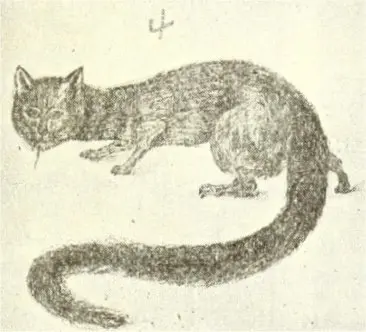
Guevara described the creature twice, and changed his mind between the two. In Historia de la civilización de Araucanía, tomo I, p. 230, it is "otro monstruo semejante en su aspecto a un gato, armado de una uña agudísima en la cola... Para envolverlos, se estira como una culebra", and he adds the sentence that explains the entire belief: "Cualquier accidente desgraciado que le sucede en el agua al indio, lo atribuye a este ser sobrenatural." Eight years later, in Psicolojía del pueblo araucano (1908), p. 322, it has become "de cuerpo delgado i pequeño, cabeza de gato i cola de zorro estremadamente larga. Frecuenta los pasos i remansos de los rios, i con la cola enreda a los hombres i los animales, los arrastra al fondo i les bebe la sangre." Between the two versions the single claw disappears, the serpent disappears, the fox's tail arrives, the blood-drinking arrives, and the explanatory sentence is moved off the ngürüvilu altogether. It was the 1908 version that got a picture — figure 42, number 4, on the plate at p. 323, the drawing reproduced on this page. It shows a four-legged animal with a cat's head and a thick, bushy, fox-like tail. No serpent, no whirlpool, no claw. It matches the 1908 text and contradicts the 1900 one.
What Guevara's Mapuche informants said is not what Guevara summarised, and they should be quoted by name. Melivilu, of Maquehue, gave him two stories. In the first (p. 335) canoes always capsized at a rapid; a strong swimmer was seized, squeezed and pierced by an animal's tail, cut the tail off with his knife and carried it away: "La cola tenia como dos varas... era como serrucho, tenia como clavos, donde tomaba, no largaba; tenia los ganchos para adelante. Por eso ninguno escapaba. Desde entonces no se dio vuelta ninguna canoa." Melivilu then adds, in his own voice, "El animal tiene color de zorro; es chico i la cola, bien larga" — the fox colour is his, not Guevara's, whose printed description says fox tail. In the second (pp. 351-352) a ford drowned almost everyone who used it; a male machi offered, for a high price, to kill the animal in it, was paid two very fat horses and silver stirrups and bit, waded in knee-deep to a whirlpool, went under, surfaced holding "un animalito como perro en los brazos", drew his knife and told it "Si matas mas jente, yo te corto" — and "el remolino antes del año desapareció i quedó el paso mui bajo". Pichun Viejo, of Galvarino, gave the only first-person sighting (p. 358): at dawn on the río Quillén, in fog, on horseback, he saw it asleep on a shingle bank above the bluff — "Tenia la cabeza chica como gato, cola larga, ojos azules" — and it woke, "comenzó a lamerse el cuerpo", saw it was watched and leapt into the water. Then Pichun classifies it: "Estos son ñenco (ngenco; dueño del agua)." Owner of the water. He adds that bathers are taken by a whirlpool, pulled under by the tail, and that it eats their heels and drinks the blood; and that "cuando está afuera no tiene fuerza".
Guevara also recorded, without noticing what it did to his own chapter, that Ngürüvilu was a man's name. At p. 68: "el padre de la familia Vilu de Maquehue, en Temuco, se llamó Melivilu i sus hijos tuvieron los nombres de Ngürüvilu (culebra zorro), Painevilu (culebra celeste), Melivilu (cuatro culebras)". In his opening chapter on totemism (pp. 12-15) he lists "Guirivilu, animal mitolójico" among clan names beside Nahuel (tiger) and Quilquil (owl), says the Vilu family had lived at Maquehue "desde tiempo inmemorial", and notes that some clans believed themselves descended from mythic spirits, "como el de Pihuicheñ (en Cholchol) i Guirivilu (ngürüvilu), diversos lugares de este nombre". The informant who gave him two of the three stories was the head of that lineage, and one of his sons carried the name.
The Argentine record is better still, and it exists only because of a cryptid hunt. In 1899 Florentino Ameghino announced a surviving giant ground sloth in Patagonia, the Neomylodon Listai; the Daily Express sent an expedition; in January 1901 André Tournouër told the Paris Academy he had seen the mystery animal alive in the water. Carlos Ameghino reported that the Indians called a mysterious aquatic animal erefilu. Lehmann-Nitsche, of the Museo de La Plata, put the word to his Mapuche collaborator Nahuelpi, who said at once that it must be ngürüfilu, the zorro-víbora, and explained the phonetics that had produced "ere". Nahuelpi then wrote out everything he knew, in Mapudungun, and translated it himself; Lehmann-Nitsche printed the Spanish "tal cual él la hizo, sin hacer ninguna corrección", under the title Historia del zorro-víbora referida por el indio Nahuelpi (Revista del Museo de La Plata, X, 1902, pp. 277-278). Nahuelpi describes the offering — a paste of fermented wheat flour called chafis, sprinkled by drops with a handful of straw, and a small white bull killed on the shore of a cordilleran lake — the prayer, "¡Padre, dueño del agua, háganos el servicio de no hacernos mal, pecho blanco!", the animal itself, "Es pequeño, el pecho y panza blanco, la cola es larga", and the man called Salva who laughed at the prayer at a ford of the Limay near Fuerte Roca and lost his entire horse herd mid-crossing. And he ends the third text with the sentence that decides this whole file: "Cuando lo quieren nombrar no le dicen zorro-víbora sino dueño del agua." Lehmann-Nitsche's own notes date the lake to Aluminé, in Neuquén, and place Nahuelpi there as a boy of about eight, when his people under the cacique Keupü were driven out of Argentina and had to cross it.
Timeline: the documented record of Nguruvilu
- 1765 Andrés Febrés prints his Arte de la lengua general del reyno de Chile at Lima. Its vocabulary glosses gürü as «Zorra mediana» and vilu as «culebra, i las lombrices, víboras i otras cosas así». These are the two entries every later etymology of the name rests on, including the one this page used to credit to Lenz.
- 1782 Juan Ignacio Molina publishes his natural history of Chile at Bologna. It contains the oldest printed appearance of the word: the Indians say that in certain lakes there is an animal of monstrous size «which they call guruvilu, or the fox-serpent», that they never bathe in those lakes, that the descriptions of its size and form scarcely ever agree, and that the animal probably has «no other existence than in the imaginations of these people». This entry replaces the claim, previously made on this page, that the oldest written mention was Vidaurre's.
- c. 1789 (manuscript) Felipe Gómez de Vidaurre finishes, in Italian exile, the history that contains the sentence most often quoted about this creature: «guruvilo — zorra-culebra... yo dudo mucho de la existencia de tal animal». It is a manuscript date, not a publication date. The book will not be printed for a hundred years.
- 1877 Benjamín Vicuña Mackenna, writing about the marshy lagoon of Viña del Mar, identifies Victor Hugo's giant octopus with a creature «que los indios de Chile llamaban curuvilu». Lenz will record the form only to reject it: «Es errónea la forma curuvilu usada por B. Vicuña M.»
- 1889 José Toribio Medina finally publishes Vidaurre in the Colección de historiadores de Chile. Everything later authors quote as «Vidaurre» reaches them through this edition, a century after it was written; the page reference is disputed, Lenz and Latcham giving I:240 and Vicuña Cifuentes 246.
- 1898 Josef von Siemiradzki, in the Mittheilungen der Anthropologischen Gesellschaft in Wien, prints the name as «Nervelu» and turns the water creature into an evil spirit shaped like a great bird with a steel beak and claws that pursues traitors in war and appears in the desert as a whirlwind. Deniker will repeat it to a wide audience in Paris in 1900. Lehmann-Nitsche cites both in order to disown them.
- June-July 1899 Florentino Ameghino announces in La Pirámide, of La Plata, the Neomylodon Listai, «un sobreviviente actual de los Megaterios de la antigua Pampa». The hunt that follows — a Daily Express expedition, and André Tournouër telling the Paris Academy in January 1901 that he had seen the animal alive in the water — is what will drag the Mapuche fox-snake into international zoology.
- 1900 Tomás Guevara, in Historia de la civilización de Araucanía, tomo I, p. 230, gives his first description: a monster like a cat «armado de una uña agudísima en la cola» that «para envolverlos, se estira como una culebra», and adds the key sentence — «Cualquier accidente desgraciado que le sucede en el agua al indio, lo atribuye a este ser sobrenatural». The claw and the serpent will both be gone from his own next description.
- 1902 (pp. 277-278) Robert Lehmann-Nitsche prints, in the Revista del Museo de La Plata, the Historia del zorro-víbora referida por el indio Nahuelpi: five texts written in Mapudungun by Nahuelpi and translated by him, published «tal cual él la hizo, sin hacer ninguna corrección». They describe the offering of chafis, the prayer «¡Padre, dueño del agua... pecho blanco!», a small, long-tailed, white-bellied animal swimming in a cordilleran lake, the drowning of Salva's horse herd at a ford of the Limay, and the sentence that reframes the whole case: «Cuando lo quieren nombrar no le dicen zorro-víbora sino dueño del agua».
- 1902 (p. 279) In the same paper, Lehmann-Nitsche makes the zoological conversion explicit: «He ahí, pues, una pregunta: ¿qué animal será este zorro-víbora? No hay otra contestación que: la lutra. Y, según la literatura, debe tratarse de la Lutra felina Mol.» — and adds «Quizás algún día se encontrará otra lutra más grande en los lagos tan poco explorados de la Patagonia». He was dissolving one cryptid, the Grypotherium, and in one sentence planting another.
- 1908 (pp. 322-323) Guevara publishes Psicolojía del pueblo araucano. Page 322 gives the canonical description — small slender body, cat's head, extremely long fox's tail, snaring with the tail, dragging under, drinking the blood — with a footnote reporting that Lehmann-Nitsche believes the creature to be Lutra felina. The drawing on the facing plate, figure 42 number 4 at p. 323, is the image used on this page, and it shows a four-legged animal with a bushy tail: no serpent and no claw.
- 1908 (pp. 335, 351-352, 358) The same book prints the three narratives with their narrators named. Melivilu, of Maquehue, tells of the capsizing rapid and the tail cut off with a knife, «como serrucho... tenia los ganchos para adelante», after which no canoe ever capsized again; and of the ford where a paid machi went under and surfaced with «un animalito como perro en los brazos», after which «el remolino antes del año desapareció i quedó el paso mui bajo». Pichun Viejo, of Galvarino, describes the only first-person sighting, at the río Quillén, and adds: «Estos son ñenco (ngenco; dueño del agua)».
- 1908 (the otter) Oldfield Thomas describes Lutra provocax, the huillín, the freshwater river otter of southern Chile and Argentina. It is the species that fits every eyewitness description in this file, and it did not exist in the scientific literature when Lehmann-Nitsche chose, six years earlier, «según la literatura», the only otter that did.
- 1910 Rodolfo Lenz completes his Diccionario etimolójico. Entry 965, pp. 534-535, is filed under the headword ÑIRIVILO, defines the creature in a single line, lists the variants with the author of each, rejects Vicuña Mackenna's curuvilu as an error, and derives the compound not from himself but from Febrés.
- 1915 (pp. 65-66) Julio Vicuña Cifuentes publishes chapter XXI, El Guirivilo. He gives two oral variants — from Coínco, a «zorro del agua» with a very long tail that avenges those who throw stones at it; from Coihueco de Chillán, a dog-bodied animal that lives in the rivers and, on the rare occasions it comes out, «tirita como si estuviera muriéndose de frío» — reprints Guevara, Vidaurre and Vicuña Mackenna, and records that he had deliberately changed his own spelling since his first edition.
- 1923 Ricardo E. Latcham publishes La historia natural en los mitos araucanos and states the programme outright: «todos, o casi todos ellos han tenido su fundamento en alguna especie conocida». He refutes Lehmann-Nitsche by name — the sea otter's myth has another name, the chinchimén — proposes instead the monito del monte, a thirty-gram arboreal marsupial, quotes Vidaurre with a clause that belongs to Molina, and stops the quotation just before Vidaurre's own doubt.
- 2018 The FIPA study led by Gonzalo Medina Vogel and María Macarena Barros Lama, of the Universidad Andrés Bello, counts approximately fifteen huillines in the Toltén and Allipén rivers of La Araucanía and finds the basin to be the northern limit of the species' present range. Nationally the huillín is reduced to about ten per cent of its original freshwater distribution, and it vanished from lakes Colico, Caburga and Villarrica between 1920 and 1960.
Is there a rational explanation for Nguruvilu?
The naturalistic reading of the ngürüvilu does not come from sceptics. It comes from the people who described it, and it is unusually detailed. Pichun Viejo saw his animal at dawn hauled out on a shingle bank, grooming itself — "comenzó a lamerse el cuerpo" — with a small cat-like head, a long tail and blue eyes; it leapt into the water when it saw it was watched; and out of the water, he said, it has no strength. Nahuelpi's people saw theirs swimming: "Es pequeño, el pecho y panza blanco, la cola es larga", and they addressed it as pecho blanco, white chest. Vicuña Cifuentes collected a variant at Coihueco de Chillán in which it has a body like a dog's and a very long tail, "vive en los ríos, y cuando sale del agua, lo que hace pocas veces, tirita como si estuviera muriéndose de frío". Three witnesses, six hundred kilometres and an international border apart, describe an aquatic mustelid: a hauling-out, obsessively grooming, awkward-on-land animal with a long tail and a pale chest and belly.
There is a species that fits exactly, and it lived in these rivers. The huillín, Lontra provocax, is a river otter 1.1 to 1.3 m long including a 38-45 cm tail, weighing 6 to 15 kg, with "un pelaje aterciopelado café oscuro en la parte superior y más blanquecina en la zona ventral" — dark brown above, whitish below — solitary except when breeding, and feeding on fish and freshwater crustaceans. Chile's official species assessment lists among its vernacular names "tigre del agua" and, in Aonikenk, yem'chen: the very Patagonian word Lehmann-Nitsche had catalogued in 1902 as one of the names of the "mysterious" beast. The identification he made is now on the government's own species sheet.
He still got the species wrong, and the reason is a date. In 1902, on p. 279, he asked "¿qué animal será este zorro-víbora?" and answered "No hay otra contestación que: la lutra. Y, según la literatura, debe tratarse de la Lutra felina Mol." — according to the literature, he says, twice. The freshwater otter of these rivers was not in the literature: Lontra provocax was not described until Oldfield Thomas named it in 1908, six years later and the same year Guevara printed the drawing. The only otter available to Lehmann-Nitsche in print was Molina's Lutra felina, the chungungo, which lives exclusively on the rocky sea coast. Ricardo E. Latcham said so in 1923 and named him for it: "Lehmann Nitsche opina que el ngüruvilu es la Lutra felina, Mol., pero está equivocado, porque el mito formado alrededor de dicha nutria lleva otro nombre" — the sea otter's myth is the chinchimén or ñullñull, a different being. Latcham was right about the objection and wrong about his own candidate: he proposed the monito del monte, Dromiciops, "llamado por los araucanos huenuquique, ratón del cielo, o ngüruvilu". That is a nocturnal arboreal marsupial of the bamboo thickets, up to 26 cm long including the tail and weighing 16 to 31 g. It does not enter rivers and it cannot drown a horseman.
Latcham is also where the zoological conversion is stated outright, and it is worth quoting because it is the assumption this whole page inherited. His 1923 paper opens: at first sight these myths have nothing to do with the real and existing fauna, "pero examinando más a fondo la cuestión, puede convencerse que todos, o casi todos ellos han tenido su fundamento en alguna especie conocida, desfigurada posteriormente por la imaginación supersticiosa de los naturales." Every myth must be a species; the job is to name it. He also, on the same page, quotes Vidaurre I:240 with a clause Vidaurre does not have — "por lo que ellos se abstienen de bañarse en las lagunas", which is Molina's line, not Vidaurre's — and stops the quotation just before "yo dudo mucho de la existencia de tal animal". Lenz and Vicuña Cifuentes both transcribe the passage in full and neither has the bathing clause. Latcham merged the two Jesuits and left out their doubt.
The most concrete sceptical material here is hydrological, and the storytellers supplied it. Both of Melivilu's tales end with the hazard physically going away: after the machi's visit "el remolino antes del año desapareció i quedó el paso mui bajo", and after the tail was cut "desde entonces no se dio vuelta ninguna canoa". These are gravel-bed rivers that shift their channels; a scour hole at a ford silts up, a rapid moves, and a crossing that killed people stops killing them. The stories are dated accounts of that happening, told in the only vocabulary available. Guevara had written the same thing plainly in 1900 about the ngürüvilu — any unlucky accident in the water is attributed to this being — and then, in 1908, transferred the sentence to another creature.
One much-repeated modern claim is an inversion of Guevara and should be retired. The English Wikipedia article states that nguruvilus "make the water shallow on either ford, to encourage people to try to cross it making it seem safe", and describes a kalku — a sorcerer, the opposite of a machi — diving in to seize the creature. The passage has carried a "citation needed" tag since February 2025, and no source has ever been given, because there is none: in Guevara the shallow ford is not the trap but the cure, the state the crossing reaches once the danger is gone, and the man who goes in is a machi, paid in horses and silver. The same article's other repeated detail, the claw at the tip of the tail, is real but misfiled: it is Guevara's 1900 description, not his 1908 one.
Three limits, stated plainly. It has not been possible to establish, from the sources read here, whether Medina's 1889 Spanish text of Vidaurre is a translation from an Italian original or an edition of a Spanish manuscript; nor is the date of that manuscript settled, since it is given as 1789 in the older literature and as 1782 by his most recent scholarly editor. If the text is a translation, then the famous doubt — «yo dudo mucho de la existencia de tal animal» — has never been checked against Vidaurre's own words by anyone quoting it, including this page. Vidaurre's own book is not in the searchable full-text corpora: a search for "dudo mucho de la existencia de tal animal" returns two hits, Vicuña Cifuentes and Lenz, and none for Vidaurre himself, while control searches in the same corpus return results normally. Everything attributed to him here is therefore quoted at one remove, from three independent transcriptions that agree with each other and disagree with Latcham's. And Lenz's page reference (I:240) and Vicuña Cifuentes's (246) do not match; Latcham gives 240. That has not been resolved.
Can you visit Nguruvilu?
The Nguruvilu has no address, and this file names no monument, museum case or signposted site. What it has instead is a short list of places named by people interviewed between 1902 and 1908, and one animal that can still be seen.
The Chilean places are all in La Araucanía and all are living Mapuche territory. Pichun Viejo's sighting was on the río Quillén, in the commune of Galvarino, about 60 km north-west of Temuco; the Quillén runs into the Cholchol, which joins the Cautín to form the Imperial. Melivilu's two stories come from Maquehue, on the far bank of the Cautín from Temuco, in what is today the commune of Padre Las Casas; Maquehue is the focus of a long-running and unresolved dispute over land and over the airport built on it. Cholchol, named by Guevara as the seat of the Pihuicheñ clan, is a commune of its own 30 km west of Temuco. The ngen ko belongs to a religion that is practised today, and the communities that run turismo mapuche set their own terms for what may be asked, recorded and photographed.
The Argentine half of the record is at lago Aluminé, in Neuquén province, on the edge of Parque Nacional Lanín — Nahuelpi's "Alumuní de los pehuenches, que por corrupción se llama en español Aluminé" — and at a ford of the río Limay "cerca del Fuerte Roca". That crossing no longer behaves as it did. The lower Limay has been regulated since the El Chocón dam, 86 m high with a crest 2,540 m long, whose first turbine entered commercial service on 19 December 1972 and whose declared primary purpose is flow regulation; the Arroyito compensating dam 25 km downstream, begun in 1975 and finished between July 1983 and March 1984, exists to "evitar las fluctuaciones diarias de caudal del río Limay". The whirlpool Salva ignored is now an engineering variable.
The huillín is the part of this file worth travelling for. The Toltén and Allipén basin, immediately south of Temuco, is the northern limit of the species' present range in continental Chile, and the 2018 FIPA study led by Gonzalo Medina Vogel and María Macarena Barros Lama, of the Universidad Andrés Bello, counted approximately fifteen animals in those two rivers. Nationally the huillín has been reduced to about ten per cent of its original freshwater range. It disappeared from lakes Colico, Caburga and Villarrica between 1920 and 1960, and around 1880 it still reached as far north as the río Cachapoal. It is classified as Endangered, and the threats the study names are the invasive American mink, free-roaming dogs and cats, removal of riverside vegetation, alteration of banks and channels, aquaculture and pathogens. CONAF and SERNAPESCA are the bodies that take sighting reports.
The rivers carry the hazard the folklore attached to them. These are cold, fast, gravel-bed channels whose depth changes with the season and after every flood; the fords in these stories killed people, canoes capsized in the rapids and horses drowned under their riders. There are no lifeguards and no supervised crossings: the bridges are the crossings, and a still dark pool below a rapid is what three generations of narrators named as the lethal place.
Sources consulted
- Tomás Guevara, «Psicolojía del pueblo araucano — Ngúrúvilu, p. 322 y fig. 42 n.º 4 (lámina, p. 323); «Cuento del ngirifilu», de Melivilu de Maquehue, p. 335; «Cuento de un ngúrúvilu», del mismo, pp. 351-352; «Un guirivilu (ngúrúvilu)», de Pichun Viejo de Galvarino, p. 358; onomástica de la familia Vilu de Maquehue, p. 68; totemismo, pp. 12-15» — Imprenta Cervantes, Santiago de Chile, 1908 book
- Tomás Guevara, «Historia de la civilización de Araucanía, tomo I — descripción del Ngúrúvilu, p. 230 («una uña agudísima en la cola», «se estira como una culebra»)» — Imprenta Cervantes, Santiago de Chile (Biblioteca Nacional de Chile, MC0076092), 1900 book
- Robert Lehmann-Nitsche, «La pretendida existencia actual del Grypotherium. Supersticiones araucanas referentes a la lutra y al tigre — «Historia del zorro-víbora referida por el indio Nahuelpi», pp. 277-278; la identificación con la lutra, p. 279; ñen-ko y ñen-mapú, p. 280» — Revista del Museo de La Plata, tomo X, pp. 271-281, 1902 academic
- Rodolfo Lenz, «Diccionario etimolójico de las voces chilenas derivadas de lenguas indíjenas americanas — entrada 965 «ÑIRIVILO», pp. 534-535 (definición, variantes, cita de Vidaurre I:240, rechazo de «curuvilu» y etimología por Febrés); entrada 964 «ÑIRRE», sobre gürü/ñiri, zorra» — Imprenta Cervantes, Santiago de Chile, 1910 book
- Julio Vicuña Cifuentes, «Mitos y supersticiones recogidos de la tradición oral chilena — cap. XXI «El Guirivilo», pp. 65-66: variantes de Coínco y de Coihueco de Chillán, cita de Guevara Historia I:230, cita de Vidaurre p. 246, y nota sobre el cambio de grafía respecto de la primera edición» — Imprenta Universitaria, Santiago de Chile, 1915 book
- Ricardo E. Latcham, «La historia natural en los mitos araucanos — el ngüruvilu, pp. 130-132: el programa («todos, o casi todos ellos han tenido su fundamento en alguna especie conocida»), la refutación de Lehmann-Nitsche, la propuesta del monito del monte y la cita alterada de Vidaurre» — Revista Chilena de Historia Natural, 1923 academic
- Juan Ignacio Molina, «The Geographical, Natural and Civil History of Chili, vol. I, p. 162 — «an animal of a monstrous size, which they call guruvilu, or the fox-serpent» (traducción inglesa de 1808 del Saggio publicado en Bolonia en 1782)» — I. Riley, Middletown, Connecticut, 1808 book
- Andrés Febrés, «Arte de la lengua general del reyno de Chile, con un diálogo chileno-hispano — vocabulario: «Gürü. Zorra mediana» y «Culebra — vilu»» — Calle de la Encarnación, Lima, 1765 book
- Ministerio del Medio Ambiente de Chile, «Ficha de especie clasificada: Lontra provocax (Thomas, 1908), huillín — nombres vernáculos («tigre del agua», yem'chen en aoniken), pelaje «café oscuro en la parte superior y más blanquecina en la zona ventral», medidas, dieta y distribución actual desde el Cautín-Toltén al sur; extinción en los lagos Colico, Caburga y Villarrica entre 1920 y 1960» — Proceso de Clasificación de Especies, ficha P07, 2019 report
- María Macarena Barros Lama y Gonzalo Medina Vogel (eds.), «Distribución, abundancia y riesgos para la conservación del huillín (Lontra provocax) en la cuenca del río Allipén y Toltén, IX Región de La Araucanía. Fase I — informe final, proyecto FIPA 2018-28 (aproximadamente quince huillines; el 10 % de la distribución original en agua dulce; amenazas: visón americano, perros y gatos, remoción de vegetación ribereña, acuicultura y patógenos)» — Universidad Andrés Bello, para el Fondo de Investigación Pesquera y de Acuicultura (SUBPESCA), 2018 report
- Ministerio del Medio Ambiente de Chile, «Ficha de especie clasificada: Dromiciops glirioides (Thomas, 1894), monito del monte — marsupial arborícola de los bosques templados lluviosos, hasta 26 cm de longitud total (la cola es casi la mitad) y de 16 a 31 g de peso; sinonimia Dromiciops australis, el candidato zoológico propuesto por Latcham en 1923» — Proceso de Clasificación de Especies, ficha P07, 2019 report
- Wikipedia contributors, «Nguruvilu — artículo de la Wikipedia en inglés; el pasaje sobre los vados hechos someros para atraer a la gente y sobre el kalku lleva la marca «citation needed» desde febrero de 2025, y no tiene apoyo en Guevara, donde el vado somero es el resultado de la cura y quien interviene es un machi» — Wikipedia, 2026 web
Reviewed by V. Serrano on 2026-08-14 · How we verify our content
📎 Source: Enigma Atlas
💬 Field testimonies (0)
No testimonies yet. Add the first.
Add your testimony
🔒 Log in to add a testimony