🦶 CRYPTID SIGHTING · EXP. Nº6501
ACTIVE
Taniwha
The taniwha is not a cryptid, and nobody in Aotearoa New Zealand is waiting for a specimen.
Where and when was Taniwha sighted?
- Location
- Nueva Zelanda (ríos, lagos y costas maoríes), New Zealand
- Date sighted
- Unknown
- Coordinates
- -38.5, 176.0
- Last updated
LOCATION
What is Taniwha?
It is a being of te ao Maori, the Maori world: a powerful water creature that lives in deep pools, river bends, caves and dangerous coastline, and that can be either a predator that drags people under or a kaitiaki, a guardian of a particular iwi or hapu. Its lairs, rua taniwha, are precisely the places people were warned to avoid, which is why researchers now read taniwha stories as encoded information about floods, currents and unstable ground. The tradition also carries legal weight: under the Resource Management Act 1991 the relationship of Maori with their ancestral water and sites is a matter of national importance. In November 2002 the hapu Ngati Naho identified the taniwha Karutahi in a swamp beside State Highway 1 at Meremere, and road works stopped for a week. The story travelled the world as a joke. What actually happened, according to Transit New Zealand's own release, was an engineering compromise that preserved 90% of the site for the price of a rounding error.
What is the history of Taniwha?
A taniwha is not a cryptid, and filing it as one gets the whole thing wrong. It is a being of te ao Māori — the Māori world — with a place in whakapapa, in law and in the working practice of New Zealand's roading agency. Nobody in Aotearoa is waiting for a body to turn up.
The standard reference is the entry written by Basil Keane for Te Ara, the official Encyclopedia of New Zealand, published on 24 September 2007. Keane's definition is careful: taniwha are "supernatural creatures whose forms and characteristics vary according to different tribal traditions" and, crucially, "[t]hough supernatural, in the Māori world view they were seen as part of the natural environment." They live in or near water and hide in lairs called rua taniwha — "deep pools, caves, or dangerous waterways – areas that people avoided." Te Aka, the standard Māori dictionary, gives the same double sense and confirms the spelling: taniwha, no macron, the same word in singular and plural.
Keane records both natures. Some taniwha in tradition seize and eat people; others are kaitiaki, guardians of an iwi or a hapū, "respected, and people who passed by their dens would say the appropriate karakia (charm) and leave an offering, often a green twig." Many are known by name and tied to a particular stretch of water. Kupe left his taniwha Tuhirangi in Cook Strait to guide canoes; when the dolphin known as Pelorus Jack later began escorting ships through the same water, some identified him as Tuhirangi. Āraiteuru guarded the Hokianga Harbour from a cave at its south head, and her eleven sons dug its arms. Ngake and Whātaitai made Wellington Harbour; Whātaitai's spirit became the bird Te Keo, whose mourning gave Mount Victoria its name, Tangi te keo. Hine-kōrako, a female taniwha who married a man and left after his relatives insulted her, still lives under the Te Rēinga waterfall near Wairoa — and, in the tradition Keane records, held back a canoe being swept over the falls and pushed it back upstream.
The word also means a chief. The Waikato whakataukī runs: "Waikato taniwha rau, he piko he taniwha" — Waikato of a hundred taniwha, every bend a taniwha. Depending on who is speaking, that is the river's taniwha or the district's great chiefs, and the ambiguity is deliberate.
In early November 2002, Transit New Zealand was four-laning State Highway 1 between Mercer and Long Swamp, a notorious crash blackspot on the flat land beside the Waikato River. The New Zealand Herald reported on 4 November that work had been stopped on 100 metres of the project after the local hapū Ngāti Naho, of Waikato-Tainui, identified a taniwha, Karutahi, in the swamp near Springhill Road, between Meremere township and the Champion Raceway. Transit's regional projects manager Chris Allen said consultation had already turned up several other taniwha, "but this is the first time we've heard about this one", and that the stoppage followed the same protocol Transit used for human remains found on a worksite.
Overseas the story was played for laughs — the BBC ran "Maori swamp creature delays road" — and Jan Corbett's long piece in the Herald of 9 November is the best contemporary record of what was actually at stake. Remi Herbert, manager of the Ngāti Naho Co-operative Society (Rima Herbert in Transit's release and in two Herald news reports), told her plainly: "One of the things we don't want to do is hold up the motorway... We are not looking for compensation. We're looking to make sure our spiritual needs and our mana are intact." Asked whether the row was really about a road being pushed through their territory without adequate consultation, he answered: "Exactly. Absolutely." Asked whether it was more about that than about a taniwha in the river, he said: "I think they go hand in hand."
The agreement came six weeks after the stoppage. Transit New Zealand issued a media release on 19 December 2002 headed "Agreement reached at Taniwha site". Works had been suspended for one week in early November; talks then continued over a second site just north, which Allen described as a spring, of higher environmental value than the land around it and important to a large stand of kahikatea. The settled solution was an engineering one: a 30-metre rock fill placed alongside the site so the embankment could be built steeper, preserving 90% of it, with drainage redirected so the spring would not be drained. Allen was explicit that "[t]here will be no compromise to road safety by adopting this solution, as the road carriageway will not be changed." Ngāti Naho asked that a member of the hapū be present during critical works. The extra cost was $15,000–$20,000 on a $75 million project. Herbert, for the hapū, said in the release: "we have got Transit to agree to a modification to their design, which preserves most of the site". The Herald reported the agreement on 8 January 2003 under the headline "Taniwha road gets all clear", writing that the change of plan allowed the expressway to continue "without any impact on the four lanes or motorist safety".
Later retellings say the highway was rerouted. Te Ara's summary page says "the highway was built in a different area"; its main text says Transit "agreed to partially reroute the highway"; the English Wikipedia article says part of the highway was rerouted, and even Justine Kingsbury's 2022 philosophy paper states that "the road was re-routed as a result of consultation with Ngāti Naho". Transit's own release, issued at the time and quoting the manager who signed the deal, says that "the road carriageway will not be changed"; what changed was how the embankment was built beside one spring. The two Herald news reports of the dispute and its settlement describe the same sequence: on 8 November 2002, Transit working on stretches of the expressway away from the lair while talks went on, and on 8 January 2003, a steeper embankment on the planned line. Kingsbury, drawing on Daniel Hikuroa, adds that the originally proposed line was under water in a Waikato River flood fourteen months later, while the line actually built was not; the release and both Herald reports describe a single line.
Timeline: the documented record of Taniwha
- 20 December 1876 Four girls bathe in a waterhole at Waipapa, known as the lair of the taniwha Tāminamina. Mereana, who had climbed onto the rocks to suck nectar from a sacred rātā, slips into the water and is not recovered. Mohi Tūrei, an elder of Ngāti Porou, sent the account in a letter to the Māori-language newspaper Te Waka Maori o Niu Tirani; an elder held she had been taken as punishment for taking the rātā flowers. It is one of the few taniwha episodes with a precise date and a named informant.
- 1991 The Resource Management Act comes into force. Section 6(e) makes it a matter of national importance to recognise and provide for "the relationship of Maori and their culture and traditions with their ancestral lands, water, sites, waahi tapu, and other taonga"; section 7(a) requires particular regard to kaitiakitanga; section 8 requires the principles of the Treaty of Waitangi to be taken into account. This is the machinery that makes a taniwha a planning consideration rather than a curiosity.
- 4 November 2002 The New Zealand Herald reports that Transit New Zealand has stopped work on 100 metres of the Mercer–Long Swamp expressway after Ngāti Naho identified the taniwha Karutahi in the swamp near Springhill Road. Transit's Chris Allen says earlier consultation had raised several other taniwha "but this is the first time we've heard about this one", and that the site was handled under the same protocol as human remains found on a worksite.
- 9 November 2002 Jan Corbett publishes "Transit and the taniwha" in the Herald, noting that the BBC and The Independent had both run the story and "you could hear the sniggering all the way around the globe". Remi Herbert of the Ngāti Naho Co-operative Society tells her the hapū is not seeking compensation and does not want to hold up the motorway; Ranginui Walker explains that the river bend is dangerous because it is deep, and calls the taniwha "an argument of last resort" for people with no other leverage.
- 19 December 2002 Transit New Zealand and Ngāti Naho announce agreement. The release records that works were suspended for one week in early November and that the settled solution for the second site — a spring supporting a stand of kahikatea — is a 30-metre rock fill allowing a steeper embankment, preserving 90% of the site, plus redirected drainage. Chris Allen states that "the road carriageway will not be changed" and that "this has not been an issue about money". Extra cost: $15,000–$20,000 on a $75 million project.
- 2005 Flash floods devastate Matatā, in the Bay of Plenty, destroying many buildings. The town's marae are unscathed: their sites had been chosen with reference to the local taniwha, whose flicking tail across the Rangitāiki Plains corresponds to the shifting channel of the river. Daniel Hikuroa uses the case as evidence that taniwha pūrākau function as hazard information rather than decoration.
- 24 September 2007 Te Ara, the official Encyclopedia of New Zealand, publishes Basil Keane's entry "Taniwha", the standard modern reference. Its final page, "Taniwha today", sets the Karutahi case beside the Ngāwhā one, where Ngāpuhi hapū objected that a new prison would impede the movement of the log-shaped taniwha Takauere: there the objection failed and the prison was built.
- 2010 D. N. King and J. R. Goff publish a systematic mapping of Māori oral traditions against palaeotsunami evidence in Natural Hazards and Earth System Sciences. They find that taniwha narratives cluster on coasts with geophysical evidence of past inundation, and conclude that such pūrākau "suggest a long-term recognition of the treacherous nature of the region's coastline".
- 2011 Asked about the taniwha Horotiu in connection with the proposed Auckland rail loop, Prime Minister John Key replies: "I've got to say not overly, no. I respect people's spiritual beliefs but I'm not a great believer in them." Justine Kingsbury cites the answer as the polite end of a spectrum of dismissal that runs from mockery to the suggestion that taniwha are invented to extract money.
- 2015 Waikato-Tainui hold up the consultation over the $458 million Huntly section of the same expressway as best practice. Project manager Raymond (Moko) Kumar tells the Waikato Times it is "the ideal model" for other agencies: "It's genuine, it's not a tick-box process." Excavated soil from the wāhi tapu around Taupiri Mountain was required to stay on site. The designation went through without an Environment Court appeal.
- 10 November 2022 Justine Kingsbury publishes "Taking taniwha seriously" in the Asian Journal of Philosophy, arguing that the practical usefulness of taniwha pūrākau licenses a non-Māori sceptic in regarding taniwha as real. The paper also records what the 2002 press coverage did not: that the dispute was "quickly and amicably resolved", and that Transit's own release announcing the agreement "was not treated as news". The Herald had in fact reported the agreement on 8 January 2003, under the headline "Taniwha road gets all clear".
Is there a rational explanation for Taniwha?
The honest problem with a sceptical section here is that "is it real?" is the wrong question, and the best answers on record come from Māori themselves rather than from outside debunkers.
Dr Ranginui Walker, then recently retired as professor of Māori Studies at the University of Auckland, gave Jan Corbett the mechanism in 2002. He had been raised knowing never to swim at the bend in the river, because the taniwha would get him — and, as he explained, the bend is a more dangerous place to swim precisely because it is deeper. He compared it directly to Europeans using the bogeyman to keep children away from dangerous places: "It is cultural, just the same as goblins are part of European culture." Walker was also the sharpest critic of how the tradition gets used: people with little power against government, he said, "reach back in time to these mystical creatures in trying to stop so-called progress... [The taniwha] is an argument of last resort" — and he argued that earlier, better consultation with kuia and kaumātua would make it rear its head far less often.
That reading has since been formalised. Daniel Hikuroa, an earth scientist at the University of Auckland, argues that taniwha pūrākau encode information about natural hazards and that "[p]ractically, taniwha serve to reduce disaster risk, acting simultaneously as warning signs and guardians." The philosopher Justine Kingsbury, of the University of Waikato, built an entire open-access paper on that starting point in 2022, arguing that a Pākehā sceptic can regard taniwha as real in the way we regard the flooding propensity of a particular river bend as real. Independently, D. N. King and J. R. Goff mapped taniwha narratives against palaeotsunami evidence in 2010 and found that "taniwha-related pūrākau suggest a long-term recognition of the treacherous nature of the region's coastline"; they note the stories "were likely created to explain environmental hazards", and that people who broke tapu were, in the telling, dragged under and drowned.
The most persistent slur — that taniwha are invented for money — was answered at the time by both parties. Transit's Chris Allen stated in the 19 December 2002 release that "this has not been an issue about money, as speculated by many people"; Herbert had already told Corbett that Ngāti Naho were not seeking compensation. The recorded cost of the accommodation was $15,000–$20,000 out of $75 million, roughly two hundredths of one per cent, and it bought a preserved spring and a stand of kahikatea.
The animal usually offered as the "real" taniwha deserves better than a debunking, because it is genuinely extraordinary and because tradition already counted large eels among the forms a taniwha takes. The New Zealand longfin eel, Anguilla dieffenbachii, is found nowhere else on earth. The Department of Conservation describes it as by far the country's largest native fish, usually over a metre and growing up to two metres and about 20 kg; Te Ara's account by Paddy Ryan gives 1.75 m and a heaviest measured specimen of 24 kg, and calls the species probably the world's biggest eels and New Zealand's top native freshwater predator. They grow 15–25 mm a year, average 35–52 years and can pass a century; females estimated at over 90 years old have been recorded. Every one of them, at the end of its life, leaves the river it has lived in for decades, swims into the Pacific to spawn in deep water thought to lie near Tonga, and dies. DOC classifies the species as At Risk – Declining. A two-metre predator that lives longer than the people who name it and vanishes into the ocean to die is not a lesser thing than a monster.
One more piece of internal scepticism, and it is nineteenth-century and Māori. Te Ara reproduces an exchange in the Māori-language newspaper Te Waka Maori o Niu Tirani in which a reported taniwha killed by a local is identified by the editor as a seal or sea lion, protected by law — with the practical advice that such "taniwha" be left alone to avoid prosecution. The tradition has never been short of people inside it doing the identifying.
Can you visit Taniwha?
Rua taniwha, the lairs, are the places tradition tells people to keep away from, so there is no taniwha site to visit. At Meremere the wetland beside Springhill Road is private land at the edge of a live motorway; State Highway 1 there is now four lanes of the Waikato Expressway, whose last section opened in July 2022. Under sections 6 to 8 of the Resource Management Act 1991 the standing of such a site is a matter for Ngāti Naho and Waikato-Tainui.
The landscapes that named taniwha explain are public ground. The Te Rēinga waterfall near Wairoa is the home of Hine-kōrako. Wellington harbour is the work of Ngake and Whātaitai, and the free lookout on Mount Victoria carries the name Tangi te keo for the mourning of Whātaitai's spirit. Āraiteuru guarded Hokianga Harbour in Northland from a cave at its south head; Ōmāpere and Ōpononi sit on that shore today. Kupe placed Tuhirangi in Cook Strait; the Interislander and Bluebridge ferries cross it several times a day.
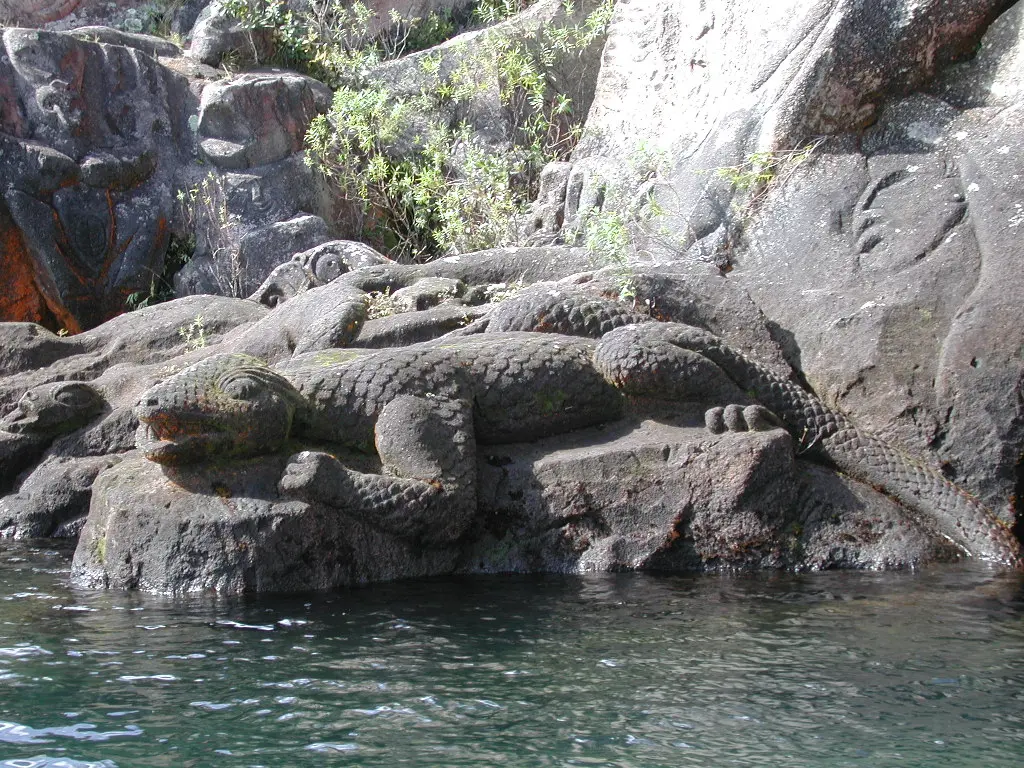
The carving photographed on this page is at Mine Bay on Lake Taupō. Matahi Whakataka-Brightwell and a team of four cut it into the cliff between 1976 and 1980. The main figure is a 14-metre likeness of the ancestor Ngātoro-i-rangi. Smaller tūpuna and kaitiaki surround it, the taniwha here among them. The cliff has no land access; it is reached from the water by boat or kayak from Taupō township.
Marae are private property and wāhi tapu are places of restriction. The Resource Management Act gives the relationship of Māori with their ancestral water and sites the status of a matter of national importance, which is the legal reason a taniwha can stop a road. Basil Keane's Te Ara entry is free to read in English and in te reo Māori, and Justine Kingsbury's 2022 paper is open access under a CC-BY licence.
Sources consulted
- Transit New Zealand; statements by Chris Allen, Regional Projects Manager, and Rima Herbert, Ngāti Naho spokesperson, «Agreement reached at Taniwha site (media release, Mercer to Long Swamp section)» — waikato.transit.govt.nz, Waikato Expressway project site. Read in the Internet Archive capture of 19 November 2004, 2002 archive
- New Zealand Herald staff, «Taniwha halts work on highway» — The New Zealand Herald, 4 November 2002. Full text read in the Internet Archive capture of 5 February 2021, 2002 newspaper archive
- Jan Corbett, «Transit and the taniwha» — The New Zealand Herald, 9 November 2002. Interviews with Remi Herbert (Ngāti Naho Co-operative Society), Dr Ranginui Walker and John Tamihere. Full text read in the Internet Archive capture of 15 April 2021, 2002 newspaper archive
- Basil Keane, «Taniwha (nine-page story, including "What are taniwha?", "Freshwater taniwha" and "Taniwha today")» — Te Ara – the Encyclopedia of New Zealand, Manatū Taonga / Ministry for Culture and Heritage, published 24 September 2007, 2007 web
- Parliament of New Zealand; Parliamentary Counsel Office, «Resource Management Act 1991, sections 6 (matters of national importance), 7 (other matters) and 8 (Treaty of Waitangi)» — New Zealand Legislation, legislation.govt.nz. Text of the reprint as at 2022–2023 read in the Internet Archive, 1991 report
- D. N. King and J. R. Goff, «Benefitting from differences in knowledge, practice and belief: Māori oral traditions and natural hazards science» — Natural Hazards and Earth System Sciences 10: 1927–1940 (open access), 2010 academic
- Justine Kingsbury (University of Waikato), «Taking taniwha seriously» — Asian Journal of Philosophy 1(2), article 49, published 10 November 2022, CC-BY. Read in full in the author's copy at the University of Waikato Research Commons, 2022 academic
- Aaron Leaman, «Consultation key to Huntly expressway project» — Waikato Times / Stuff, 2015. Interview with Raymond (Moko) Kumar, Waikato-Tainui project manager. Read in the Internet Archive, 2015 newspaper archive
- Paddy Ryan, «Eels – Overview, New Zealand eels, and Life cycle and breeding grounds (longfin eel Anguilla dieffenbachii: 1.75 m, heaviest measured 24 kg, males 23 and females 34 years on average)» — Te Ara – the Encyclopedia of New Zealand, published 24 September 2007, 2007 web
- Department of Conservation / Te Papa Atawhai, «Eels / tuna – longfin eel (endemic; over 1 m and up to 2 m, about 20 kg; growth 15–25 mm a year; average lifespan 35–52 years, up to 100 and more; spawns in deep ocean thought to be near Tonga and dies; threat status At Risk – Declining)» — doc.govt.nz, consulted 11 August 2026, 2026 web
- John C. Moorfield, «taniwha (headword and definitions: water spirit, monster, powerful creature; also chief or powerful leader)» — Te Aka Māori Dictionary, maoridictionary.co.nz, consulted 11 August 2026, 2026 web
- NZ Transport Agency Waka Kotahi, «Waikato Expressway (project page: seven sections, final Hamilton section completed July 2022)» — nzta.govt.nz, consulted 11 August 2026, 2026 web
- Matahi Whakataka-Brightwell (carver); photograph by Pseudopanax, 28 September 2010, public domain, «Mine Bay rock carvings, Lake Taupō: carved 1976–1980, a 14-metre figure of Ngātoro-i-rangi ringed by smaller tūpuna and kaitiaki; and the source file for the photograph on this page, "Taniwha rock carving from the side (Lake Taupo)", described as part of the modern Māori rock carvings on Lake Taupō» — Wikimedia Commons file page and the English Wikipedia article on Matahi Brightwell, consulted 11 August 2026, 2026 web
- Elizabeth Binning and Cathy Aronson, «Second home puts taniwha out of the way (Karu Tahi's lair beside SH1 about 1 km south of the Meremere power station; Transit working on stretches away from the lair while talks continue; Ranginui Walker and Vicki Hyde quoted)» — The New Zealand Herald, 8 November 2002, 2002 newspaper archive
- New Zealand Herald staff, «Taniwha road gets all clear (agreement on a steeper embankment beside the lair; "without any impact on the four lanes or motorist safety"; extra cost $15,000 to $20,000)» — The New Zealand Herald, 8 January 2003, 2003 newspaper archive
Reviewed by V. Serrano on 2026-08-11 · How we verify our content
📎 Source: Enigma Atlas
💬 Field testimonies (0)
No testimonies yet. Add the first.
Add your testimony
🔒 Log in to add a testimony