👻 HAUNTED PLACE · EXP. Nº9046
ACTIVE
Larnach Castle
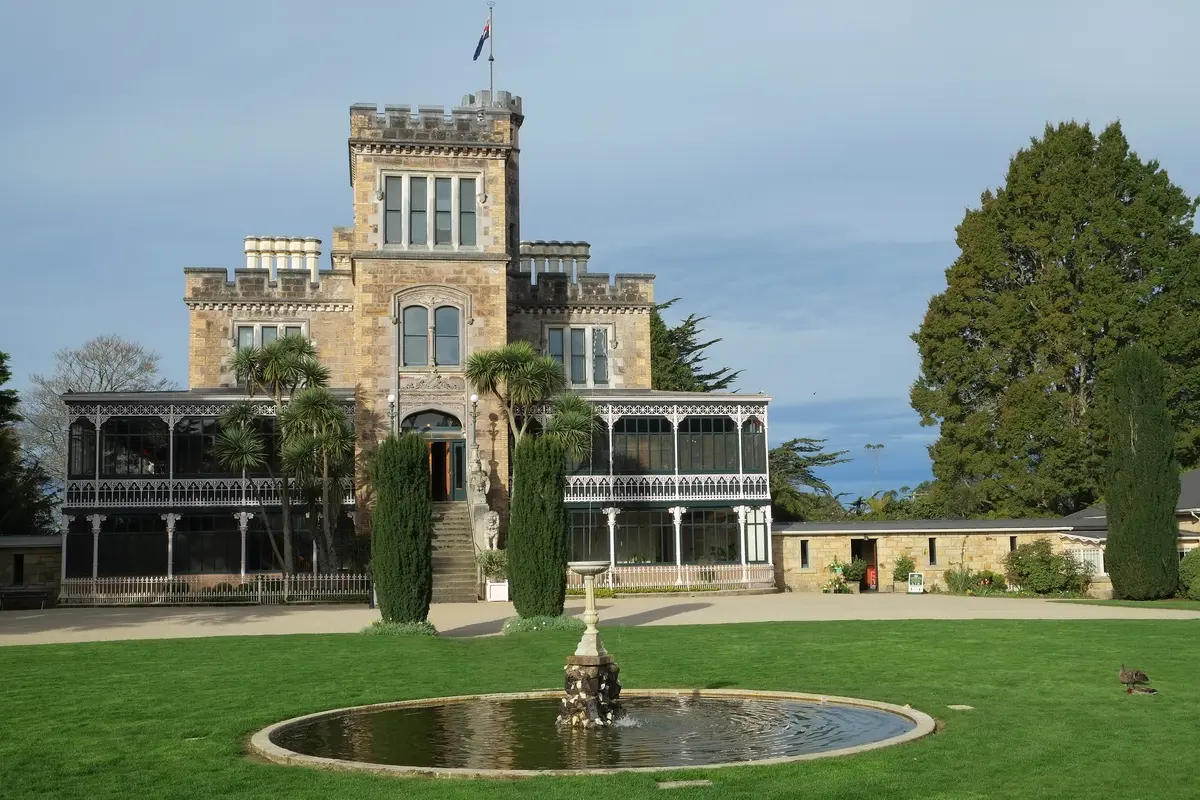
New Zealand's grandest Victorian house stands on a ridge above Otago Harbour, and almost everything the ghost tellings say about it is out by a few hundred kilometres.
Where is Larnach Castle?
- Location
- Dunedin, New Zealand
- Type
- Castle
- Coordinates
- -45.862, 170.627
- Last updated
LOCATION
Why is Larnach Castle said to be haunted?
William Larnach, a banker who became Colonial Treasurer, began building the house his family called The Camp in 1871, with marble from Italy, slate from Wales and glass from Venice. Four deaths made its reputation: his first wife Eliza in 1880, aged 38; his second wife Mary, who was Eliza's half-sister, in 1887 at the same age; his eldest daughter Kate, of typhoid fever, in 1891; and Larnach himself, who shot himself in October 1898 in a locked committee room at Parliament in Wellington. Kate died in Wellington too, at a house on Mulgrave Street, not in the castle. After the family sold up, the Government bought the place in 1906 for a mental hospital, and a plan in 1907 to turn it into an asylum for criminal lunatics drew a widely signed protest petition in Dunedin. The Barker family bought the ruin in 1967 and run it today as castle, garden and accommodation, with daily guided tours; in June 2017 its candlelit midwinter evening of ghost stories, then in its eighth year, was promised by its own storyteller to have no special effects.
What is the history of Larnach Castle?
William James Mudie Larnach arrived in Dunedin in September 1867 to manage the Bank of Otago, and stayed to become one of the richest and most publicly exposed men in the colony. When the bank was absorbed into the National Bank of New Zealand in 1873 he went into business as a merchant in partnership with Walter Guthrie. By then he was already building the house on the Otago Peninsula that his family always called The Camp.
The politics came next: he contested the Peninsula seat in 1875 and lost to Robert Stout by eleven votes, took Dunedin in 1876, and in 1877 moved the vote of no confidence that brought down the Whitaker-Atkinson ministry, which made him Colonial Treasurer and Minister of Public Works under Sir George Grey. He was created C.M.G. in 1879, served as Minister of Mines from October 1887, lost his seat in 1891 and came back for Tuapeka in 1896 by twenty-one votes. That is the career his obituarists summarised the morning after he shot himself.
The house was begun in 1871. According to the owners' own history, about two hundred men spent three years on the shell and European craftsmen another twelve years on the interior: marble from Italy, slate from Wales, floor tiles from England, glass from Venice and France, kauri ceilings and rimu floors. A ballroom of some 3,000 square feet was added in 1885.
The family history is where most retellings go wrong, and the documented version is stranger than the one they tell. Larnach married three times. His first wife, Eliza Jane Guise, bore six children - Donald, Douglas, Kate, Colleen, Alice and Gladys - and died suddenly on 8 November 1880 at her residence in Dunedin, aged 38. His second wife was Mary Cockburn Alleyne, who was Eliza's half-sister; she died at Dunedin on 11 January 1887, also aged 38. His third, married in January 1891 at St Paul's in Wellington, was Constance de Bathe Brandon, eldest daughter of the late A. de Bathe Brandon, M.L.C., and much younger than her husband. When the Christchurch Press published his obituary in October 1898 it stated that he had been married twice. Even the newspapers had lost count.
Kate Emily Larnach, his eldest daughter and by every account his favourite, did not die at the castle. She died on the evening of Friday 24 July 1891 of typhoid fever at Mulgrave Street, in Wellington, in her twenty-fifth year, after about a month's illness attended by Dr Cahill.
Seven years later, on Wednesday 12 October 1898, Larnach chaired the Public Accounts Committee in the morning and struck colleagues as despondent. He was last seen alive at about four o'clock, going into the 'J' committee room upstairs at Parliament Buildings in Wellington. When he did not come home for tea his wife raised the alarm; the government whip, O. H. Mills, M.H.R., searched the building, found the room locked and had the door forced. The body was found at about nine that night, seated, with a bullet wound in the centre of the forehead and a revolver beside him, bought from Tisdale the gunsmith on 23 September. At the inquest the following day the jury found, without retiring, that he had killed himself while temporarily insane. The press attributed the act to serious financial difficulties, and specifically to heavy losses on Colonial Bank shares.
The family sold up. By 1900 the house was a holiday retreat for nuns; in 1906 the Government bought it, and a New Zealand Mail photograph that January captioned it as recently purchased by the Government for a mental hospital. A proposal in 1907 to turn it into an asylum for criminal lunatics drew a widely signed protest petition in Dunedin. It later housed shell-shocked soldiers, stood empty from 1918 to 1927 while it was stripped and vandalised, was restored by Jackson Purdie, sold at auction in 1940 for 1,250 pounds, and billeted more than eighty American soldiers during the Second World War. By 1967, when Barry and Margaret Barker bought it as a family home, it had holes in the roof, water-damaged and graffitied walls, and a ballroom that had been used as a sheep pen.
Timeline: the documented record of Larnach Castle
- September 1867 William James Mudie Larnach arrives in New Zealand to manage the Bank of Otago, which he runs until its absorption into the National Bank of New Zealand in 1873.
- 1871 Work begins on the house the family called The Camp. The owners' history records about two hundred men on the shell for three years and European craftsmen twelve more years on the interior.
- 8 November 1880 Eliza Jane Guise, Larnach's first wife and mother of his six children, dies suddenly at her residence in Dunedin, aged 38, as recorded in the Otago Daily Times death notices.
- 1885 A ballroom of some 3,000 square feet is added to the house. Later guidebooks link it to a daughter's twenty-first birthday; Kate was about eighteen at the time.
- 11 January 1887 Mary Cockburn Alleyne, Larnach's second wife and the half-sister of his first, dies at Dunedin aged 38 - the same age at which Eliza had died seven years earlier.
- January 1891 Larnach marries his third wife, Constance de Bathe Brandon, eldest daughter of the late A. de Bathe Brandon, M.L.C., at St Paul's in Wellington. She is much younger than him.
- 24 July 1891 Kate Emily Larnach, the eldest daughter, dies of typhoid fever at Mulgrave Street in Wellington, in her twenty-fifth year, after about a month's illness attended by Dr Cahill. She does not die at the castle.
- 12 October 1898 Larnach is last seen about 4pm entering the 'J' committee room at Parliament Buildings in Wellington. When he misses tea, the government whip O. H. Mills has the locked door forced; the body is found about 9pm.
- 13 October 1898 At the inquest, Dr Cahill gives evidence of heart disease and mental depression, O. H. Mills of severe headaches, and Dr James of a bullet into the brain and instantaneous death. The jury finds without retiring that he took his own life while temporarily insane.
- January 1906 The New Zealand Mail publishes a photograph of the house captioned as recently purchased by the Government for a mental hospital, confirming the state acquisition.
- 2 August 1907 A petition against the Government's plan to convert the castle into a criminal lunatic asylum is being widely signed in Dunedin, the main objection being the lack of protection if an inmate escaped.
- 1967 Barry and Margaret Barker buy the near-ruined castle as a family home. The roof leaks, the walls are water-damaged and graffitied, and the ballroom has been used as a sheep pen.
- 21 June 2017 Around seventy people attend a sold-out midwinter evening of Victorian ghost stories by candlelight. Storyteller Brian McNeill tells the Otago Daily Times: "There won't be any special effects - at least, none that we've arranged."
Is there a rational explanation for Larnach Castle?
Larnach Castle is a private business, and the usual test applies: what does the owner actually claim? Here the answer is unusually restrained. The daily product, as the castle's tours page described it on 28 September 2026, is a 60-minute guided tour at 9.30 am and 11.30 am about Larnach, the architecture and the restoration. The word "ghost" appeared neither there nor on the What's On page, which that day listed a Christmas dinner-theatre night, a makers' market and school-holiday events.
What the castle does run is a midwinter storytelling evening. Reporting one of them in June 2017, the Otago Daily Times quoted storyteller Brian McNeill: "There won't be any special effects - at least, none that we've arranged." The programme he read from was fiction by named authors - Saki, Dostoyevsky, Lewis Carroll, Algernon Blackwood - and only afterwards did he relate the uncanny goings-on reported by staff over the years. The evening was sold as Victorian ghost stories by candlelight, and by then it had run for seven winters.
The most repeated hook in the popular literature does not survive its own dates. Guidebooks and ghost compendiums say the ballroom was built for Kate's twenty-first birthday and that she died soon afterwards; Charles A. Coulombe's Haunted Castles of the World has her, "for whom he built the ballroom, died shortly after her twenty-first birthday". The ballroom dates from 1885. Kate Emily Larnach died on 24 July 1891 in her twenty-fifth year. About five and a half years separate the two events, and the Wellington papers record typhoid fever, after a month's illness, as the cause of death.
The geography is wrong too. Of the four family deaths the ghost tellings pile into the house, two happened in Wellington, several hundred kilometres away: Kate's, at Mulgrave Street, and Larnach's own, in a locked committee room at Parliament. The notices for Eliza and Mary say only "at her residence, Dunedin" and "at Dunedin"; neither names the house.
The affair story - Constance with her stepson Douglas, given as the motive for the suicide - travels through guidebooks and ghost anthologies and was dramatised in Owen Marshall's 2011 novel The Larnachs, which is fiction. The 1898 inquest heard evidence of heart disease, headaches, depression and mental decline over the preceding weeks, and the Clutha Leader and other papers put the suicide down to financial difficulties, above all heavy losses on Colonial Bank shares. A search of the Papers Past full text through the DigitalNZ interface on 28 September 2026, across the 741 items for "Larnach" dated 1898 and the 303 dated 1899, found no mention of an affair. The same search does find the family quarrel the press did report, which was about property: in 1899 Alice Inder, Colleen Larnach and Donald Larnach sued to set aside the deeds by which the Camp had been assigned, their counsel told the court of "some friction" between the daughters and their stepmother, and in September Mr Justice Williams found for them. Douglas brought his own action that December. Repeating the affair as fact means preferring a novel to a coroner's jury.
Finally, "New Zealand's only castle" is a marketing phrase. The building is a Victorian baronial mansion with no defensive function, and Dunedin had another house going by the name in Larnach's own lifetime: in March 1898 the Otago Witness described "Cargill castle at the cliffs above St Clair" as "a landmark in the surrounding scenery". The owners' own pages call the place "New Zealand's Castle" and do not claim it is the only one. The house is eerie for ordinary reasons - it is large, cold and high, on an exposed ridge above the harbour - and when the storyteller told the ODT that it is "quite an eerie place - especially if it's cold and wet outside", he was talking about the weather.
Can you visit Larnach Castle?
Larnach Castle and Gardens is at 145 Camp Road, Otago Peninsula, Dunedin, about a 20 to 25 minute drive from the Octagon in the city centre. There is no public transport to the door: the owners state plainly that the castle is reachable only by car or tour coach. Two roads climb to it - Portobello Road along the harbour, turning right up Castlewood Road at Company Bay, or Highcliff Road from Anderson's Bay. Both are winding and narrow in places, with pull-over bays. Several Dunedin operators run coach and cruise-and-coach trips, and the city's visitor centre holds the seasonal timetables.
The castle and gardens open 365 days a year. Summer hours are 8:30 to 17:00 (last entry) and winter hours 9:00 to 16:00, switching on the first Monday after the daylight-saving change; the winter 2026 season runs from 6 April to 27 September 2026. The Ballroom Cafe opens 9:30 to 16:30 daily, closing only on Christmas Day.
Prices valid from 1 October 2025 to 30 September 2026: castle and gardens, self-guided, NZ$48 adult (15 and over), NZ$16.50 child aged 5 to 14, free under 5, NZ$112.50 family pass for up to two adults and four children. Gardens and grounds only cost NZ$24, NZ$9.50, free and NZ$57.50 respectively. The daily sixty-minute guided tour, at 9:30 and 11:30, costs NZ$73 adult and NZ$41.50 child and includes entry. Regular visitors and Dunedin locals can convert a ticket into a twelve-month Loyal Local pass.
Accessibility is limited by the building itself. A wheelchair is available free on request and there is accessible parking in the main car park opposite the castle, plus an accessible unisex toilet with a change table in the Ballroom Coverway and an accessible garden route. But the first floor and above are reached by stairs only, by several stairways, and the turret is climbed from the Nursery Floor by narrow, steep concrete steps with a single handrail. The gardens cover about 14 hectares and are rated a Garden of International Significance by the New Zealand Gardens Trust. Accommodation on the estate is offered as Larnach Lodge, Stable Stay and Camp Estate. There is no ghost tour: the storytelling evenings are occasional ticketed events, announced separately.
Sources consulted
- Press Association, «The career of the deceased» — The Press (Christchurch), 1898 newspaper archive
- Otago Daily Times, «Deaths (Eliza Jane Guise Larnach)» — Otago Daily Times, 1880 newspaper archive
- Otago Daily Times, «Death (Mary Cockburn Alleyne)» — Otago Daily Times, 1887 newspaper archive
- Thames Star, «Marriage of the Hon. W. J. M. Larnach» — Thames Star, 1891 newspaper archive
- New Zealand Times, «Death (Kate Emily Larnach)» — New Zealand Times, 1891 newspaper archive
- Feilding Star, «Suicide of the Hon. Mr Larnach» — Feilding Star, 1898 newspaper archive
- Ohinemuri Gazette, «Suicide of Mr Larnach» — Ohinemuri Gazette, 1898 newspaper archive
- Thames Star, «The inquest» — Thames Star, 1898 newspaper archive
- New Zealand Mail, «Larnach's Castle, recently purchased by the Government for a mental hospital» — New Zealand Mail, 1906 newspaper archive
- Larnach Castle & Gardens, «Early history» — larnachcastle.co.nz, 2026 web
- Press Association, «Larnach's Castle (protest petition against a criminal lunatic asylum)» — New Zealand Herald, 1907 newspaper archive
- Larnach Castle & Gardens, «The intervening years and modern history» — larnachcastle.co.nz, 2026 web
- Otago Daily Times, «Ready for a long, spooky night» — Otago Daily Times (reproduced by Larnach Castle & Gardens), 2017 newspaper archive
- Charles A. Coulombe, «Haunted castles of the world» — The Lyons Press, 2005 book
- Larnach Castle & Gardens, «Prices and concessions / Opening times / Getting here / Accessibility» — larnachcastle.co.nz, 2026 web
- Clutha Leader, «Suicide of Mr Larnach — attributes the suicide to serious financial difficulties and heavy losses on Colonial Bank shares» — Clutha Leader, 14 October 1898 (Papers Past), 1898 newspaper archive
- Otago Witness, «Mayors of Dunedin — 'Cargill castle at the cliffs above St Clair is a landmark in the surrounding scenery'» — Otago Witness, 17 March 1898 (Papers Past), 1898 newspaper archive
- West Coast Times, «Mr Larnach's estate — Inder and others v Sievwright and others: action to set aside the deeds assigning the Camp; counsel describes 'some friction' between the daughters and their stepmother» — West Coast Times, 25 July 1899 (Papers Past), 1899 newspaper archive
- Press Association, «Supreme Court — Mr Justice Williams finds for the plaintiffs in Inder and Larnach v Sievwright and others» — Star (Christchurch), 18 September 1899 (Papers Past), 1899 newspaper archive
Reviewed by V. Serrano on 2026-08-11 · How we verify our content
💬 Field testimonies (0)
No testimonies yet. Add the first.
Add your testimony
🔒 Log in to add a testimony