👻 HAUNTED PLACE · EXP. Nº9475
ACTIVE
Napier Prison
Napier Prison opened on Hukarere (Bluff Hill) in June 1862, built for fourteen prisoners, and stayed open for 131 years until the last 56 inmates left for Mangaroa in December 1993.
Where is Napier Prison?
- Location
- Hawke's Bay, New Zealand
- Type
- Prison
- Coordinates
- -39.485, 176.919
- Last updated
LOCATION
Why is Napier Prison said to be haunted?
Four men were hanged inside its walls and three of them were Māori: Kereopa Te Rau in 1872, Haira Te Piri and Makoare Wata in 1889. The fourth, Rowland Herbert Edwards, still lies in the yard under a stone cut with his initials and the date. Te Kooti Arikirangi Te Tūruki was held here in 1866 before being deported without trial to the Chatham Islands, and in 2014 the Crown posthumously pardoned Kereopa Te Rau. Since 2002 the site has been leased and run by Marion and Toro Waaka, who offer visitors a choice between a historical audio tour and a ghost audio tour. The ghost tour is the newer arrival: the operator's own website carried no paranormal content at all until 2008. Heritage New Zealand's detailed listing report for the prison mentions no hauntings whatsoever.
What is the history of Napier Prison?
The hill came before the gaol, and it was not empty ground.
Hukarere — the bluff that settlers renamed Bluff Hill — is part of Mataruahou, and the Heritage New Zealand assessment of the site records that it was "a landmark that was used by tohunga for astronomical purposes" to time customary activities. Tūhinapō, which the same record calls "the most sacred spot in the district", stood on this ground, and ritual offerings were made here. In 1851 the land passed to the Crown in the Ahuriri Block purchase and was set aside as gaol reserve and slaughterhouse reserve. Sacred site, land purchase, gaol: that sequence is the history of Napier Prison in miniature, and it is why the place is still spoken of as tapu.
In 1861 the Hawke's Bay Provincial Government, formed three years earlier, voted 800 pounds for a new gaol to replace a lock-up that no longer served a growing town. The building opened in June 1862, designed to hold fourteen prisoners plus staff, and in the same year was formally declared a place of execution. It stayed open for 131 years and held men, women and children.
It also held the mentally ill, and the reason is recorded plainly. Housing prisoners alongside asylum patients was described at the time as an "abomination", so in 1869 a "West Wing" was opened as a public asylum under the Lunatics Act 1868, with fenced yards separating female prisoners, female patients and male patients. A purpose-built asylum went up at the northern end of the reserve and opened in 1875; it closed on 1 August 1886, when the authorities decided its "existence could no longer be tolerated". Heritage New Zealand notes that almost nothing survives of New Zealand's earliest asylums, which makes the 1869 wing one of only two provincial-government asylums still standing.
The prison's Māori history is not a footnote to its history; it is most of it. Between March and June 1866 the gaol held Hauhau prisoners, among them Te Kooti Arikirangi Te Tūruki, who made several unsuccessful requests to be tried and was instead deported without trial to Rēkohu/Wharekauri, the Chatham Islands, on 5 June — the deportation that would eventually produce his escape, his war, and the Ringatū faith.
Four men were hanged inside the walls, and three of them were Māori.
Kereopa Te Rau, of Ngāti Rangiwewehi and one of the original followers of the Pai Mārire prophet Te Ua Haumēne, was tried at Napier in December 1871 for the killing of the missionary Carl Völkner at Ōpōtiki and hanged on 5 January 1872, the first execution at the gaol. His body was removed by Tareha and buried elsewhere. In 2014, 142 years later, the Crown pardoned him posthumously as part of the Treaty of Waitangi settlement with Ngāti Rangiwewehi: the state that hanged him formally accepted he had not committed the murder.
Rowland Herbert Edwards was hanged at eight in the morning on 15 July 1884 for the murder of his wife and children. He is still in the yard, under a small stone cut with the initials and the date — "R.H.E. July 15 1884" — and he is the only one of the four with a marker.
Haira Te Piri, aged 28, was hanged on 13 May 1889 for the murder of the storekeeper Frank Pook, his wife Jane and their baby Bertie at Mataahu on the East Coast. Before he died he asked to say goodbye to the other Māori prisoners, and they filed into his cell one by one. Makoare Wata, convicted of murder and arson, farewelled three of his children at six in the morning on 28 September 1889 and was hanged at eight. Both were buried in the gaol grounds. Two of the executed men lie in unmarked graves on the site, and their descendants regard those graves as particularly sacred.
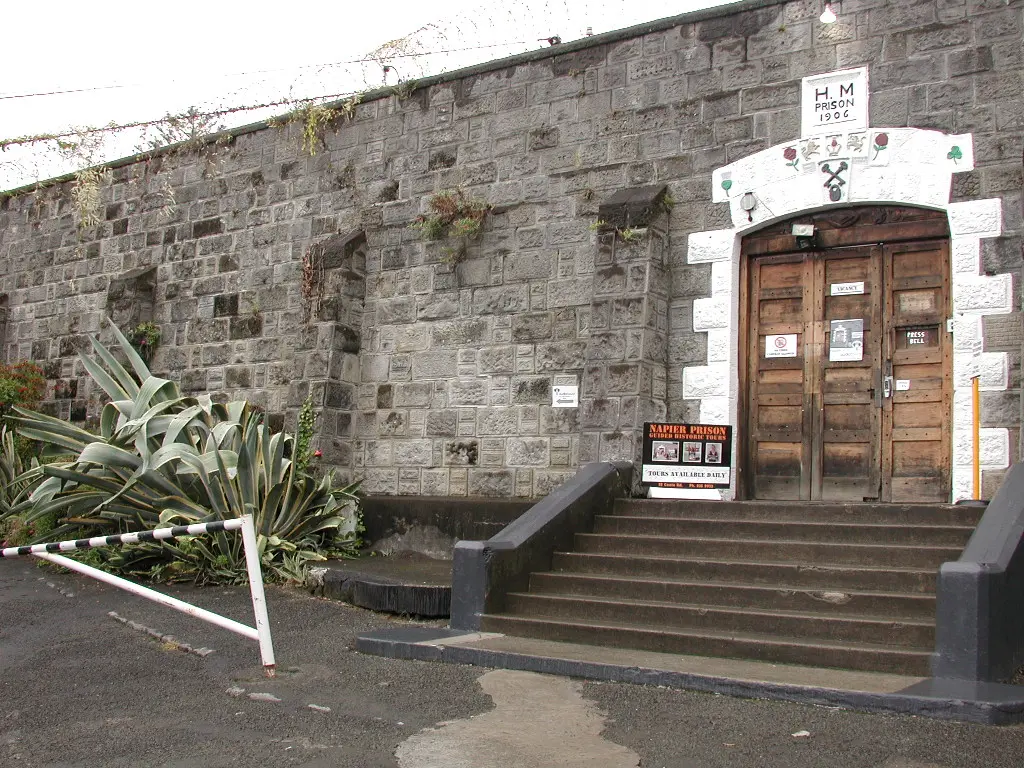
The walls that make the prison photogenic were cut by the men inside it. Prisoners on hard labour quarried and dressed the sandstone from a quarry directly across Coote Road, and the boundary and retaining walls went up in stages from the 1890s into the early 1900s; the arch over the entrance carries the date 1906. The quarry itself did not stay a quarry. In 1973 Napier City Council began converting it into the Centennial Gardens, a waterfall and hanging-garden complex opened on 16 October 1974 — so the pleasant public garden at the foot of the hill is the hole the prisoners dug.
The place aged badly. By 1909 Napier Prison was being described as the worst prison in New Zealand and there were calls to close it; instead, in 1919 its status was reduced to a police gaol holding mostly short-stay prisoners. The 3 February 1931 Hawke's Bay earthquake left deep fissures in the yards and sank foundations, and the corridors have undulated ever since. Repairs cost 170 pounds.
New buildings were added through the 1950s and 1960s, women were held until 1974, and overcrowding was chronic. The government announced a replacement at Mangaroa in 1983; it opened in 1989 and Napier ran on for four more years as a remand facility. In December 1993 the last 56 inmates and 19 staff were transferred out and the gate was locked.
In 2002 Marion and Toro Waaka leased the site from the Crown and opened it as a backpackers hostel and tour operation. The backpackers closed in 2009; the tours did not. In 2021, after an application by Marion Waaka, the whole complex was entered on the New Zealand Heritage List as a Category 1 historic place. The prison that hanged three Māori men and jailed Te Kooti has been in the care of a Māori family for more than twenty years.
Timeline: the documented record of Napier Prison
- 1861 The Hawke's Bay Provincial Government, formed three years earlier, votes 800 pounds for a new gaol at Napier to replace an inadequate lock-up.
- June 1862 The gaol opens on Hukarere (Bluff Hill), designed for fourteen prisoners plus staff, and is declared a place of execution in the same year.
- March-June 1866 The gaol holds Hauhau prisoners including Te Kooti Arikirangi Te Tūruki, who repeatedly asks to be tried and is instead deported without trial to Rēkohu/Wharekauri (Chatham Islands) on 5 June.
- 1869 A 'West Wing' opens as a public asylum under the Lunatics Act 1868, after housing prisoners alongside the mentally ill was condemned as an 'abomination'.
- 5 January 1872 Kereopa Te Rau of Ngāti Rangiwewehi is hanged for the killing of the missionary Carl Völkner - the first execution at the gaol. His body is removed by Tareha and buried elsewhere.
- 15 July 1884 Rowland Herbert Edwards is hanged at 8am and buried in the gaol yard, under a small stone inscribed 'R.H.E. July 15 1884' - the only marked grave on the site.
- 1 August 1886 The separate asylum built in 1875 closes, the authorities having decided its 'existence could no longer be tolerated'.
- 13 May 1889 Haira Te Piri, aged 28, is hanged for the murders of storekeeper Frank Pook, his wife Jane and their baby Bertie at Mataahu. He asks to farewell the other Māori prisoners, who file into his cell one by one.
- 28 September 1889 Makoare Wata farewells three of his children at 6am and is hanged at 8am for murder and arson, the fourth and last execution at Napier. He is buried in the gaol grounds.
- 1909 Napier Prison is described as the worst prison in New Zealand and there are calls for its closure; instead its status is reduced to a police gaol in 1919.
- 3 February 1931 The Hawke's Bay earthquake strikes with a muster of 21 and 11 prisoners working in the quarry. Several are buried by earth and two seriously injured; fellow prisoners dig them out and also rescue a woman buried in Coote Road. One of the injured men later dies in hospital. Repairs cost 170 pounds.
- 16 October 1974 The Centennial Gardens open on the site of the former prison quarry, converted by prisoners and then council gardeners. 1974 is also the last year women are held at Napier Prison.
- December 1993 The last 56 inmates and 19 staff are transferred to Mangaroa Prison and Napier Prison closes after 131 years.
- 2002 Marion and Toro Waaka lease the site from the Crown and open it as a backpackers hostel and prison tour operation. The hostel closes in 2009; the tours continue.
- July 2008 The earliest datable ghost content at the prison: the operator's homepage, archived on 29 September 2008, reports that 'NZ Ghost Hunters' were on site in July 2008 and advertises 'Fright Night Tours' by arrangement. The homepage archived four months earlier contains no ghost material at all.
- 17 August 2011 The Ghost Hunters International episode 'Imprisoned Souls: New Zealand' is broadcast; by that year the operator's own menu lists Ghost Audio, Night Tours, 'Dead Hill' and 'Sick'n'Twisted'.
- June 2014 Kereopa Te Rau is posthumously pardoned as part of the Treaty of Waitangi settlement between the Crown and Ngāti Rangiwewehi - 142 years after he was hanged at Napier.
- 2021 Following an application by Marion Waaka, the whole prison complex is entered on the New Zealand Heritage List as a Category 1 historic place, extending an earlier listing that covered only the wall.
Is there a rational explanation for Napier Prison?
The most useful thing to know about Napier Prison's ghosts is when they arrive, and the operator's own website dates them.
The Internet Archive holds captures of the napierprison.com homepage from 18 November 2003, when it read "Website Coming Soon!". Six distinct versions captured between that date and 23 May 2008 do not contain the word "ghost" once, while "prison" appears in them between three and eighteen times, which shows the count works. The capture of 12 May 2008 sells "Daily guided tours and accommodation", group tours "for only $15pp" and the TV series Redemption Hill, filmed on site, and already calls the place "New Zealand's oldest prison". The capture of 29 September 2008 carries a new notice-board item headed "NZ GHOST HUNTERS": "The group was here in July 2008 investigating paranormal sightings." Beside it is the first paranormal product, "Fright Night Tours by arrangement - minimum 20 people." By the homepage of 14 July 2011 the menu lists Ghost Audio, Night Tours, "Dead Hill" and "Sick'nTwisted".
So the earliest datable ghost content on the operator's site is from July 2008: 146 years after the gaol opened, 15 years after it closed and six years after it began taking visitors. Private experiences before that may have gone unrecorded; in writing, the haunting first appears as a tourism product.
The institutional and newspaper record has been checked for the same thing. Heritage New Zealand's List entry for the former prison, written by Joanna Barnes-Wylie and completed on 20 October 2020, is by a distance the most detailed document on the place, covering the asylum, the executions, the earthquake and the burials; read on 8 October 2026, it does not contain the words ghost, haunt or paranormal, while Rowland Edwards is named in it repeatedly. On Papers Past, queried the same day through the DigitalNZ API, "Napier gaol" with "Edwards" returns 121 newspaper items, and none of the items returned for "Napier gaol" with "ghost" or "haunted" puts either word within 600 characters of the gaol.
The operator labels what it sells: its "Today's Prison" page, as captured by the Internet Archive on 28 February 2024, offers a choice between a historical and a ghost audio tour: "The historical tour is more general facts and the ghost tour is about what people have felt or seen as well as gory stories." The live site answered an automated request on 8 October 2026 with a 403, so the page could not be compared with its current version.
The best-known individual claim is that Rowland Edwards returns on the anniversary of his hanging. A Haunted Auckland article by Mark Wallbank, dated 18 January 2014, reports "the ghost of a murderer on the anniversary of his execution" and names "Roland Edwards" as the best-known former prisoner. Ghost Hunters International filmed at the prison for the episode "Imprisoned Souls", first broadcast on 17 August 2011 according to Wikipedia's episode list. The paranormal sources spell him Roland; the heritage record and his own gravestone give "Rowland Herbert Edwards" and "R.H.E.".
For the physical reports the cause sits in the heritage file. The 1931 earthquake sank the foundations and split the yards, and the corridors have sloped ever since; the operator's 2011 homepage advertised "the undulating corridors" as an attraction and called the building "The only building in Hawkes Bay where you can take a walk down the undulating corridors and see the original path of the devastating 1931 earthquake". A hilltop stone building with warped floors and hard, echoing surfaces produces draughts, temperature gradients and sounds without a visible source, and visitors on the ghost track hear them after being told what people "have felt or seen". The "oldest prison" line is likewise the operator's; Heritage New Zealand's assessor put it more carefully, calling the complex "the most complete example of a purpose-built prison from the provincial government era (1853 – 1876)".
Can you visit Napier Prison?
Napier Prison has been closed to the public since 2024, and the tours described in most guidebooks no longer run.
The site is at 55-57 Coote Road, on Hukarere, the hill above Marine Parade whose official name reverted to Mataruahou under the Ahuriri Hapū claims settlement. Heritage New Zealand Pouhere Taonga lists it as a Category 1 historic place, List No. 181, on Lot 1 DP 22991. The Hawke's Bay Provincial Government built it in 1862; it was in use from June of that year and ran for 131 years until it closed in 1993. Tourism took over from 2002 under a lease held by Toro Waaka, and the tours drew more than 30,000 people a year.
That use ended on a date that is on the record. Toitū Te Whenua Land Information New Zealand, which manages the Crown-landbanked property, served notice to vacate on 18 March 2024, and RNZ reported on 11 April 2024 that the last tour would be on 19 April and that eight staff would lose their jobs. Sonya Wikitera, then LINZ head of Crown property, gave the reason: "The former prison and site present an earthquake risk and the surrounding retaining wall needs strengthening, taking into account the heritage considerations". The LINZ project page for the prison, last updated on 1 May 2024 and read on 9 September 2026, still records the site as "currently closed to public access" while specialist heritage and geotechnical engineers work out what the repairs will cost.
Nothing had changed by the middle of 2026, two years after the gate shut. Hawke's Bay Today reported on 28 June 2026 that the prison "has sat vacant since", and quoted LINZ deputy head of Crown property Matt Bradley on the state of the works: "Consent for this work is in the final stages, and LINZ expects to go out to tender later this year". He added that "We are not actively considering leasing options at this stage". The property is held in the Treaty Settlements Landbank; Mana Ahuriri has a right of first refusal over it under its settlement, and the trust's general manager Parris Greening told the paper that "For now there is no decision before Mana Ahuriri regarding the future ownership of the property". Anyone reading the Heritage New Zealand list entry should note that its own text, written earlier, still describes the prison as "open to the public for tours".
The hill is a burial ground and the list entry says so. Three Māori prisoners were executed there in the late nineteenth century, and two of them, Haira Te Piri and Makoare Wata, remain buried on the site in unmarked graves; Rowland Edwards, hanged in 1884, lies under the solitary headstone in the yard. Heritage New Zealand calls the place "imbued with tapū, particularly to the descendent groups of the three Māori prisoners executed at the prison", and records that "The site's tapu nature is acknowledged through tikanga such as the provision of fresh water upon exit to lift the tapū". The gate is shut and there is nothing at the top of the driveway to see.
Sources consulted
- Heritage New Zealand Pouhere Taonga, «Napier Prison (Former), List No. 181, Category 1 historic place» — New Zealand Heritage List / Rārangi Kōrero, 2020 report
- Napier Prison Tours, «Our History - Napier Prison history timeline» — napierprison.com, archived by the Internet Archive on 28 February 2024, 2024 archive
- Napier Prison Tours, «Today's Prison - tours, prices and the 2021 Heritage New Zealand listing statement» — napierprison.com, archived by the Internet Archive, 2024 archive
- Napier Prison Backpackers and Tours, «Napier Prison Backpackers and Tours homepage (no ghost content; control search)» — napierprison.com, archived by the Internet Archive on 12 May 2008, 2008 archive
- Napier Prison Backpackers and Tours, «Napier Prison Backpackers and Tours homepage ('NZ Ghost Hunters ... here in July 2008'; 'Fright Night Tours')» — napierprison.com, archived by the Internet Archive on 29 September 2008, 2008 archive
- Napier Prison Tours, «Napier Prison Tours homepage (Ghost Audio, Night Tours, 'Dead Hill'; 'the only building in Hawkes Bay ... the original path of the devastating 1931 earthquake')» — napierprison.com, archived by the Internet Archive on 14 July 2011, 2011 archive
- Mark Wallbank, «Napier Prison» — Haunted Auckland / Paranormal NZ, 18 January 2014, 2014 web
- Wikipedia contributors, «Napier Prison» — Wikipedia, 2026 web
- Wikipedia contributors, «1931 Hawke's Bay earthquake» — Wikipedia, 2026 web
- Te Ao Māori News, «Ngāti Rangiwewehi happy with Kereopa Te Rau pardon» — teaonews.co.nz, 23 June 2014, 2014 newspaper archive
- Wikipedia contributors, «Kereopa Te Rau» — Wikipedia, 2026 web
- Pilgrim Films / Syfy, «Ghost Hunters International, series 3 episode 6: 'Imprisoned Souls: New Zealand'» — IMDb entry for the episode, first broadcast 2011, 2011 web
Reviewed by V. Serrano on 2026-08-13 · How we verify our content
💬 Field testimonies (0)
No testimonies yet. Add the first.
Add your testimony
🔒 Log in to add a testimony