👻 HAUNTED PLACE · EXP. Nº9475
ACTIVE
Riccarton House and Bush, Christchurch
Riccarton is a Christchurch suburb, but the place the name came from is still there: a twelve-hectare reserve at 16 Kahu Road holding Pūtaringamotu, a stand of kahikatea forest older than the city, and two buildings of the Deans family.
Where is Riccarton House and Bush, Christchurch?
- Location
- Canterbury, New Zealand
- Type
- House / mansion
- Coordinates
- -43.527, 172.598
- Last updated
LOCATION
Why is Riccarton House and Bush, Christchurch said to be haunted?
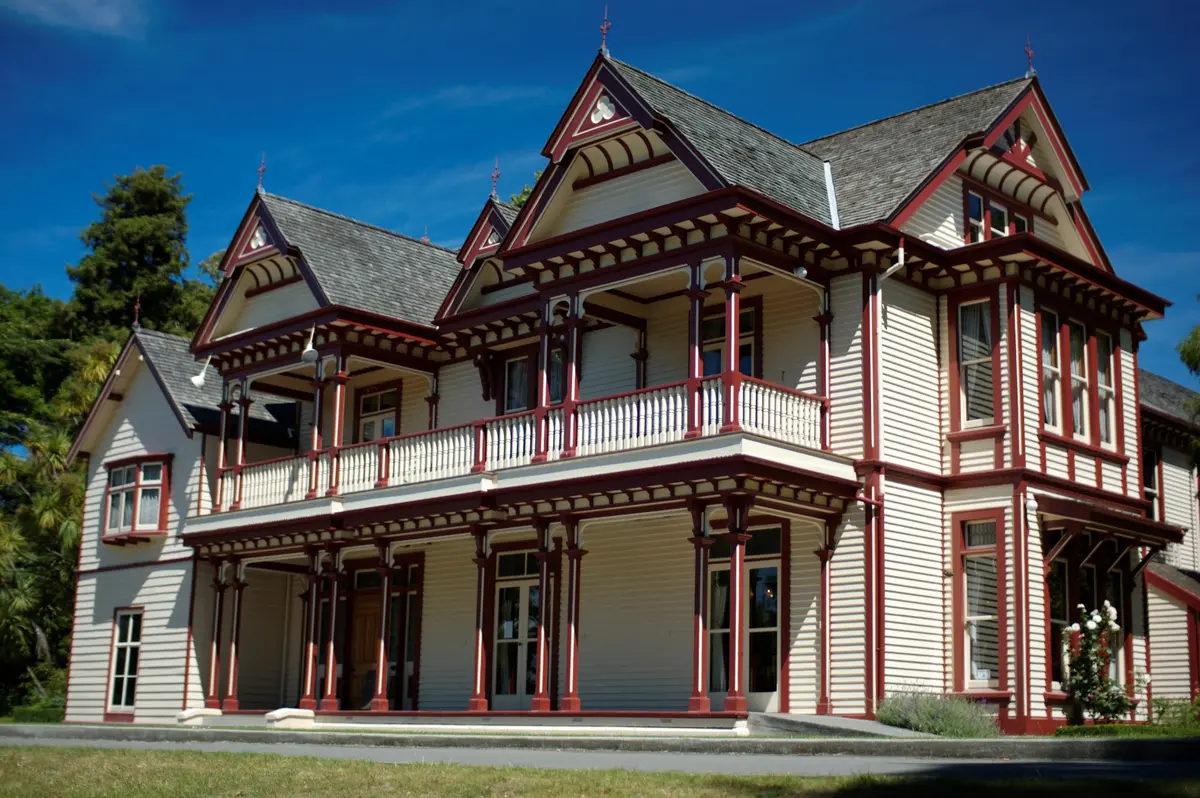
Deans Cottage, finished late in 1843, is the oldest surviving building in Canterbury. Riccarton House, begun for Jane Deans in 1855 and enlarged in 1874 and 1900, is the timber homestead in the photograph. The family story is harder than the tourist version. William Deans drowned in July 1851 when the barque Maria struck rocks off Cape Terawhiti; his brother John died of tuberculosis in the cottage in June 1854, having asked his wife to keep the bush standing. Jane Deans was widowed at thirty-one and outlived him by fifty-seven years, and the family kept the promise in 1914. The house is also said to be haunted by her, on the strength of one account: a nanny who in December 1915 saw an elderly woman in black lean over a newborn's bassinet. We have dated that story, and it is younger than it looks.
What is the history of Riccarton House and Bush, Christchurch?
The name travelled before the place did. Riccarton is a parish in Ayrshire; two Scottish brothers gave it to a farm on the Canterbury Plains; the farm gave it to a Christchurch suburb. What the name originally covered is still on the ground at 16 Kahu Road: a reserve of about twelve hectares holding a remnant of lowland podocarp forest, a cottage finished in 1843 and a homestead begun in 1855.
The forest was Pūtaringamotu long before it was Riccarton Bush. The trust that runs the site today offers two readings of the name — "the place of the echo", for the sound that carried through the surrounding swamp, and "the severed ear", for the way the stand sits cut off from any other bush on the plains. It was a kāinga mahinga kai, a food-gathering place of Ngāi Tūāhuriri: tuna (eels), kanakana (lamprey), kererū, korimako, harakeke and āruhe. Europeans had tried the site before, too: land there was farmed from mid-1840 to mid-1841 and everything built on it burned.
William Deans reached the plains in February 1843, sailing south from Wellington with the carpenter Samuel Manson and with James Robinson Clough, and with the two farming couples who came with him — Samuel and Jean Manson, and John and Mary Gebbie. His brother John arrived in June with stock bought in New South Wales, having lost many animals on a rough passage. The first building was a shed divided into three: the Deans brothers in the middle room, the Mansons and the Gebbies at either end. The story is usually told as two brothers alone on an empty plain. It was at least six adults, and the plain was not empty: in December 1846 the Deans signed a twenty-one-year lease with the Māori chief Te One for land within six miles of the farm.
Late in 1843 Manson built a more substantial house out of kahikatea and mataī pit-sawn from the bush next door. That building is Deans Cottage, and it is the oldest surviving building in Canterbury; Heritage New Zealand listed it as a Category 1 historic place on 2 April 1985.
Then the family was cut down twice in three years. On Sunday 20 July 1851 the barque Maria, 470 tons, Captain Plank, sailed from Lyttelton for Wellington in company with five other vessels. On the Wednesday following, in thick and hazy weather, she crossed a reef and grounded on sunken rocks off the Karori Stream near Cape Terawhiti. Of twenty-two hands and a handful of passengers, two men lived. When the Lyttelton Times reported the wreck on 23 August it named one of the two cabin passengers as "Mr. William Deans, of Riccarton", "a gentleman respected amongst ourselves in no small degree for his kindness, usefulness, and sterling worth". His body had not been recovered when the paper went to press.
John Deans married Jane McIlraith, eldest daughter of James McIlraith of Auchenflower in Ayrshire, in September 1852, and brought her out on the Minerva; they reached Lyttelton in February 1853. Their only child, John Deans II, was born in the cottage in August 1853. On 23 June 1854 John died in that same cottage of tuberculosis, aged thirty-four, after asking his wife to keep the bush standing.
Jane Deans was thirty-one. She stayed fifty-seven more years. The house her husband had sited but never built went up in three pushes: a modest two-storey first stage by James Johnston, the first commercial builder in Christchurch, into which she moved in March 1856; a wing added in 1874 to hold the guests for her son's twenty-first birthday; and, in 1900, an extension by the architect Robert England that more than doubled the building and gave it the veranda and gables it wears today, with oak panelling downstairs cut from a tree grown on the property. Her son John Deans II, chairman of the Christchurch Drainage Board and of the Riccarton Road Board, died of meningitis on 19 June 1902, nine years before her. Jane died at Riccarton on 19 January 1911, aged eighty-seven.
The deathbed promise was kept in 1914. On 2 November the family handed the surviving remnant of Pūtaringamotu to the people of Canterbury, and Parliament passed the Riccarton Bush Act to bind a board of trustees to keep it in its natural state; the bush opened to the public on 24 February 1917. The house and most of the land followed in 1947, bought by Christchurch City Council, which required an amending Act. It is worth setting beside that generosity what had already gone: on Christmas Day 1848 the brothers agreed to let Canterbury Association settlers take timber and firewood from half the bush, and by July 1851 that half had been stripped of standing timber.
Timeline: the documented record of Riccarton House and Bush, Christchurch
- February 1843 William Deans lands on the Canterbury Plains with the carpenter Samuel Manson, James Robinson Clough and the Manson and Gebbie couples, and builds a three-room shed beside Pūtaringamotu. His brother John arrives in June with stock from New South Wales.
- Late 1843 Samuel Manson builds a sturdier house for the Deans brothers from kahikatea and mataī pit-sawn in the bush next door. It survives as Deans Cottage, the oldest building left in Canterbury.
- December 1846 The Deans brothers sign a twenty-one-year lease with the Māori chief Te One for land within six miles of the farm — a detail that survives in the record and is usually left out of the settler version of the story.
- 25 December 1848 The brothers agree to let Canterbury Association settlers take timber and firewood from half of Riccarton Bush. By July 1851 that half has been cleared of standing timber.
- 23 July 1851 The barque Maria, which left Lyttelton on Sunday 20 July, grounds on sunken rocks off the Karori Stream near Cape Terawhiti. Two men survive. The Lyttelton Times of 23 August names one of the cabin passengers as William Deans of Riccarton; his body had not been recovered.
- August 1853 John Deans II is born in Deans Cottage, six months after his mother Jane McIlraith reached Lyttelton on the Minerva.
- 23 June 1854 John Deans dies of tuberculosis in the cottage, aged thirty-four, having asked his wife Jane to keep Riccarton Bush standing in perpetuity.
- March 1856 Jane Deans moves out of the cottage into the first stage of Riccarton House, a modest two-storey timber building put up by James Johnston. Two more stages follow, in 1874 and — designed by Robert England — in 1900.
- 19 June 1902 John Deans II, who had taken over the estate on coming of age and chaired the Christchurch Drainage Board, dies of meningitis at Riccarton. The Press prints a long obituary the following morning.
- 19 January 1911 Jane Deans dies at Riccarton aged eighty-seven, a widow of fifty-seven years. The Star of Christchurch prints her obituary the same evening; The Press leads on it the next morning.
- 2 November 1914 The Deans family formally hands the surviving remnant of Pūtaringamotu to the people of Canterbury. Parliament passes the Riccarton Bush Act, binding a board of trustees to keep it in its natural state; the bush opens to the public on 24 February 1917.
- December 1915 The date given for the only ghost account with names attached: an unnamed nanny sees an elderly woman in black beside the bassinet of the newborn Austen Deans, and the family identifies her as Jane. The oldest printed telling that can be dated is from 2013.
- 1947 Christchurch City Council buys Riccarton House, the cottage and most of the land from the Deans family, a purchase that required an amendment to the 1914 Act. The last triangle of land follows in 1975.
- 2005 TV2 broadcasts an episode of the paranormal series Ghost Hunt filmed at Riccarton House — the earliest broadcast telling of the haunting that can be dated.
- 22 February 2011 Riccarton House closes after the Canterbury earthquakes. Six of its seven chimneys had already been damaged in September 2010 and taken down, which spared it worse in February. It reopens in June 2014 after about NZ$2.3 million of repair and seismic strengthening.
- July 2018 NO Productions Theatre runs scripted after-dark tours written for the venue by Nataliya Oryshchuk; the press release says the ghost of Jane Deans may also make an appearance. The company films Haunted by History about the house in 2020, on a council intangible heritage grant.
- 2025 Pūtaringamotu closes for several months while its failing boardwalk and displaced concrete paths are replaced, reopening with a new walking surface.
Is there a rational explanation for Riccarton House and Bush, Christchurch?
The haunting is one story, not many, and the first job is to separate the story from the way our own earlier file told it.
The story runs like this. In December 1915 a nanny at Riccarton House saw an elderly woman — small, slight, blue-eyed, dressed in black — come into the room where Norna Deans lay with her newborn son, look into the bassinet and leave without a word. The baby was Alister Austen Deans, later a well-known painter and mountaineer, who died in 2011 aged ninety-five. The family, hearing the description, said it matched Jane Deans, who had died on 19 January 1911.
Three things about that account. The witness is unnamed in every version I have been able to read. The identification was not hers: she described, and the family named. And what she described — an elderly woman in black — is the least distinctive sighting imaginable in a house whose matriarch had been in mourning since 1854.
Then there is the age of the telling. The oldest datable printed version I could find is an article by Annette Bulovic on the Canterbury history site Peeling Back History, published on 23 April 2013, roughly ninety-eight years after the night it describes. A page for the 2018 Deans family reunion puts the sighting on 1 December; Bulovic puts it on 2 December, the day Austen Deans was born. I searched Papers Past, the National Library of New Zealand's digitised newspaper archive, which carries The Press into the 1990s. The phrase "ghost of Jane Deans" returns nothing; "Jane Deans" together with "ghost" returns nothing, and both queries were repeated to be sure. The same archive returns 277 hits for "Jane Deans", 4,037 for "Riccarton House" and 48 for "Riccarton" with "ghost" and "Deans". Whatever this account is, it does not appear to have circulated in the New Zealand press while anyone who could have checked it was still alive.
What did circulate is recent and traceable. TV2 broadcast an episode of the paranormal series Ghost Hunt from Riccarton House in 2005. In July 2018 the Christchurch theatre company NO Productions ran scripted after-dark tours of the cottage and the house, written for the venue by Nataliya Oryshchuk and led by two actors playing a Dr Wild and a housemaid called Dorcas; the press release said in as many words that "the ghost of Jane Deans may also make an appearance". In 2020 the same company made a short film about the house, Haunted by History, funded by a Christchurch City Council intangible heritage grant and now held by Christchurch City Libraries. The trust that runs the site does list a Ghost Tours product in its own booking system. Its public website, checked page by page against its sitemap on 13 August 2026, does not mention a ghost anywhere.
The sentence our earlier file carried — that generations of caretakers and visitors had reported being watched upstairs and doors closing unassisted — is attached to no source I could find, and I could not substantiate any part of it. It has been removed rather than reworded. What is left is a single second-hand account, told at ninety-eight years' distance, in a house that was rebuilt around its own core three times and repaired again after two earthquakes.
Can you visit Riccarton House and Bush, Christchurch?
Riccarton House and Bush is open, and has been continuously since June 2014, when it reopened after the Canterbury earthquakes. The address is 16 Kahu Road, Riccarton, Christchurch 8041, about 3.5 km west of the city centre; the heritage listing also gives 19 Ngahere Street.
The grounds and the forest cost nothing. The trust gives the bush as open daily from 6:00 to 20:30 in daylight-saving months and the grounds from 6:00 to 19:00. Pūtaringamotu is 7.8 hectares inside a predator-proof fence built in 2000, with about 900 metres of flat path through it; some of the kahikatea are around six hundred years old. The failing boardwalk and the displaced concrete paths were replaced in 2025, which closed the bush from early June to around September that year, so any description of the walk written before 2025 describes a surface that no longer exists.
The house is ticketed and booking ahead is not optional: the trust does not take walk-ins, and its guides are offsite until 9:00 on weekdays. The tour runs sixty minutes — allow ninety — covers more than twenty restored rooms including Jane Deans's 1856 bedroom, and is capped at fifteen people. Checking the trust's own live booking calendar on 13 August 2026, tours were running at 11:00 every day except Saturday, with an extra 14:00 slot on Sundays. There are adult, senior, student, child, young child and family rates; a New Zealand tour listing put the adult ticket at NZ$20, but that figure is second-hand and should be confirmed at the point of booking.
Two access warnings come from the operator itself: the upper floor is reached by staircase only, and floors are uneven with low lighting in places, as in most heritage houses. Parking, toilets and wheelchair access are available on the site, and the bush paths are flat.
Deans Cottage stands between the house and the bush and is open as a museum. It has been moved twice: once in the mid-twentieth century — Heritage New Zealand dates that shift to 1950 and credits local Rotarians, while the standard family history dates it to 1947 and a traction engine — and again in 1970, to its present position. The Quarters café and restaurant operates inside Riccarton House and takes private functions. The Christchurch Farmers' Market has been held on the lawn in front of the house every Saturday from 9:00 to 12:00 since 2004, with more than sixty stallholders; that is why the house tour skips Saturdays.
The trust also lists a seasonal Ghost Tours product in its booking system. It has been run in the last days of October, in the evening, for ages sixteen and over, and had no dates loaded when this file was written. Nothing on the site is sold as an investigation, and the daytime tour makes no supernatural claim at all.
Sources consulted
- Lyttelton Times, «Loss of the Maria» — Lyttelton Times, 23 August 1851, p. 5, 1851 newspaper archive
- Star (Christchurch), «Obituary — Mrs J. Deans» — Star (Christchurch), issue 10056, 19 January 1911, p. 3, 1911 newspaper archive
- The Press, «Obituary. Mr John Deans» — The Press, Christchurch, 20 June 1902, p. 2, 1902 newspaper archive
- Heritage New Zealand Pouhere Taonga, «Riccarton House and Bush — List entry no. 1868, Category 1 historic place» — New Zealand Heritage List / Rārangi Kōrero, 1992 report
- Heritage New Zealand Pouhere Taonga, «Deans Cottage — List entry no. 3679, Category 1 historic place» — New Zealand Heritage List / Rārangi Kōrero, 1985 report
- National Library of New Zealand Te Puna Mātauranga o Aotearoa, «Papers Past — digitised New Zealand newspapers; searches on Riccarton House, Jane Deans and ghost, with result counts, August 2026» — Papers Past, 2026 archive
- Riccarton Bush Trust, «Pūtaringamotu Riccarton House, Bush and Deans Cottage — official site and live booking system (About, The House, The Bush, Deans Cottage, What's On)» — riccartonhouse.co.nz, 2026 web
- English Wikipedia contributors, «Riccarton House, Deans Cottage, William Deans, John Deans and Ghost Hunt (NZ TV series) — English Wikipedia articles, sourced in the main to Joanna Orwin, Riccarton and the Deans Family: History and Heritage (David Bateman, 2015)» — en.wikipedia.org, 2026 web
- Christchurch City Libraries Ngā Kete Wānanga o Ōtautahi, «Riccarton Bush (Pūtaringamotu), Riccarton House and Deans Cottage» — my.christchurchcitylibraries.com, 2026 web
- Annette Bulovic, «A Riccarton Ghostly Tale» — Peeling Back History, 23 April 2013, 2013 web
- NO Productions Theatre, «Adventure at the Haunted House (press release)» — Scoop, 28 June 2018, 2018 web
- Nataliya Oryshchuk and David Allen, NO Productions Theatre, «Haunted by History: Riccarton House (series 1, episode 2)» — Canterbury Stories, Christchurch City Libraries, 2020 web
- Tohu Whenua, «Pūtaringamotu Riccarton House & Bush» — tohuwhenua.nz, 2026 web
Reviewed by V. Serrano on 2026-08-13 · How we verify our content
💬 Field testimonies (0)
No testimonies yet. Add the first.
Add your testimony
🔒 Log in to add a testimony