👻 HAUNTED PLACE · EXP. Nº9475
ACTIVE
St. James Theatre, Wellington
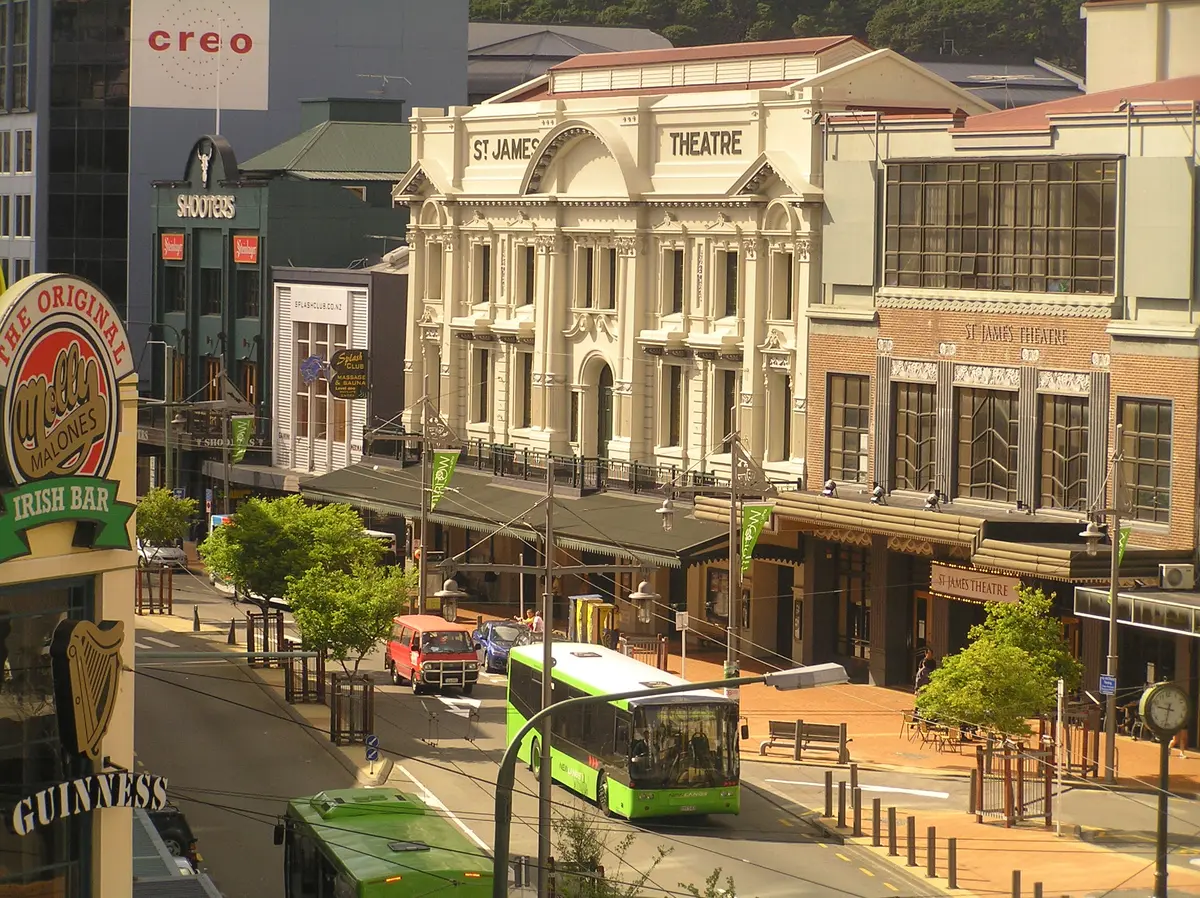
Wellington's St James opened on Boxing Day 1912 as His Majesty's Theatre, built in nine months for the vaudeville firm John Fuller and Sons to a steel-framed design by Henry Eli White, and seating 2,300.
Where is St. James Theatre, Wellington?
- Location
- Wellington, New Zealand
- Type
- Theater
- Coordinates
- -41.293, 174.78
- Last updated
LOCATION
Why is St. James Theatre, Wellington said to be haunted?
Everyone who tells the ghost story tells the same one: Yuri, a Russian dancer who fell from the flies above the stage, or who was pushed there by a fellow performer named Pasha. What he is credited with is small and domestic — switching the house lights back on after the cleaners have gone, swinging doors open, and twice shoving a projectionist out of harm's way. Three other ghosts share the building: a Wailing Woman said to be an actress booed off the stage, a former manager named Stan Andrews, and a boys' choir lost at sea. No recorded death matches any of them. Up to 1945, as far as the digitised Wellington press reaches, no article calls the theatre haunted, and the English Wikipedia article cites for the ghosts a book published in 1998, the year after the ruined house reopened. The owner is the city council, which publishes the stories, and the guided tour sold for the venue promises a ghost story or two.
What is the history of St. James Theatre, Wellington?
A smaller theatre had stood on this stretch of Courtenay Place since the late 1870s. What replaced it in 1912 was, for a while, the largest theatre in New Zealand.
It was built for Messrs John Fuller and Sons, the vaudeville and variety firm whose bills ran to slapstick comedians, balladeers, jugglers, acrobats, tumblers and dancers, and it opened under the name His Majesty's Theatre — or, to Wellingtonians, simply "Fullers". The architect was Henry Eli White (1876–1952), son of a Dunedin building contractor, who had learned bricklaying, plumbing, carpentry, joinery and painting before teaching himself theatre design at art-school night classes. He went on to design more than 130 theatres across Australasia, ending with the State Theatre in Sydney. His own rule for the job had three clauses, and he wrote them down: "…a clear vision line from every seat; perfect acoustics; and a scheme of ventilation that will ventilate."
At the St James he abandoned the deep horseshoe then in fashion and gave the circle and grand circle a shallow curve, which brought a large audience closer to the stage. The frame was steel, fireproofed with concrete and brickwork; Wellington City Council's heritage inventory says that "it is believed that this is the first theatre building to be constructed in this way", and describes it as one of the first fully steel-framed reinforced concrete buildings in Australasia. It took nine months and £32,000, and it seated 2,300.
The opening was fixed for Boxing Day. Two days before, the Dominion announced that "Messrs. Fuller's fine new theatre in Courtenay Place will be one of the principal attractions in the city on the evening of Boxing Day", that the doors would open at 6.45 p.m., and that a few minutes before eight the Mayor, D. McLaren, would formally declare it open. The principal item on the bill was "Sweet Nell of Old Drury", with Nellie Stewart in the lead.
For its first nine months the house ran mainly on silent films; from 1913 to 1930 it was predominantly a vaudeville theatre. In 1926 three floors of offices for John Fuller and Sons were built into the top of the eastern end of the fly tower, to designs by S and A Luttrell of Christchurch — permit issued 8 September 1926, builder William Husband. In 1930 the theatre closed to be rewired for sound and reopened almost immediately under a new name, the St James, with Warner Brothers' The Gold Diggers of Broadway.
Ownership passed to the Kerridge Rank Corporation in 1942, then, as Kerridge Odeon, to the Chase Corporation in 1986. The last film screened on 7 May 1987 — Wanted: Dead or Alive — and the building went dark. What followed was one of New Zealand's largest heritage battles, with the owner seeking demolition consent for a tower and the city, the Historic Places Trust and the public resisting. Wellington City Council bought the theatre in 1993, an $18.5 million restoration plan was set out in 1995, and the restored house reopened in 1997. In 2000 it was strengthened to 100 per cent of the building code of the day.
That was not the end of it. In 2015 the St James was found to be earthquake-prone. Strengthening to a minimum of 67 per cent of the New Building Standard began in April 2019 and the theatre stayed shut for three years; the work, led by Maycroft Construction, came to $42 million all told. It reopened on 23 June 2022 with TEEKS and the New Zealand Symphony Orchestra, and a public open day followed on 2 July.
Timeline: the documented record of St. James Theatre, Wellington
- 24 December 1912 The Dominion announces that Messrs Fuller's new theatre in Courtenay Place will open on Boxing Day night, that the doors will open at 6.45 p.m., that the Mayor D. McLaren will declare it open a few minutes before eight, and that it will seat "no fewer than 2300 people". The opening bill is "Sweet Nell of Old Drury" with Nellie Stewart.
- 8 September 1926 A building permit is issued for three floors of offices for John Fuller and Sons inside the top of the eastern end of the fly tower, designed by S and A Luttrell of Christchurch, built by William Husband.
- 1930 The theatre closes to be rewired for sound and reopens almost immediately as the St James. The change of name can be watched happening in the Evening Post: "St. James Theatre" alongside "Courtenay Place" gives 0 hits in 1926–28, 1 in 1929, 138 in 1930 and 233 in 1931, while "His Majesty's Theatre" with the same phrase runs 27, 53 and 39 in 1928–30 and drops to 0 from 1931.
- 1942 Ownership passes from John Fuller and Sons to the Kerridge Rank Corporation, which hosts touring revues, dance troupes and theatre companies through the 1950s and 1960s.
- 27 June 1985 The building is registered as a Category 1 historic place, entry 3639 on the New Zealand Heritage List, at 77–81 Courtenay Place.
- 7 May 1987 The last film is screened — Wanted: Dead or Alive — and the theatre closes its doors. The English Wikipedia article places "rumours of ghosts haunting upper seat levels" in this period of decline.
- 1993 After years of failed deals and one of New Zealand's largest heritage battles, Wellington City Council buys the theatre. An $18.5 million restoration plan follows in 1995 and the house reopens in 1997.
- 2000 The building is earthquake-strengthened to 100 per cent of the building code then in force. Fifteen years later it will be declared earthquake-prone anyway.
- 2005 The New Zealand television programme Ghost Hunt films at the theatre; the investigators report photographs and "orbs", and the lift malfunctions during filming. Wellington City Council's own two accounts, both published in June 2022, date the episode to 2005 in one and 2006 in the other.
- 2003–2007 The theatre carries a bank's name. Wellington City Council Archives hold 51 programmes and posters whose venue is given as the "Westpac St James Theatre"; the dated ones run from 2003 to 2007. The photograph on this file was taken on 7 November 2007, the year the sponsorship ended.
- 19 December 2011 An editor adds the line "Category:Reportedly haunted locations in New Zealand" to the theatre's Wikipedia article. The edit is 58 bytes, carries no edit summary and adds no source; it is the reason this building appears on lists of haunted places, although the article had described its ghosts, citing a 1998 book, since the day it was created in August 2006.
- 2015 The St James is found to be earthquake-prone. Strengthening to a minimum of 67 per cent of the New Building Standard begins in April 2019 and the theatre stays shut for three years.
- 17 and 23 June 2022 Six days before the theatre reopens from a $42 million closure, its owner, Wellington City Council, publishes "The Ghosts of St James Theatre", a news feature setting out Yuri, the Wailing Woman, Stan Andrews and the boys' choir. The theatre reopens on 23 June with TEEKS and the New Zealand Symphony Orchestra.
- 23 July 2022 A month after the reopening, Lindsay Shelton reports that the council's own statutory notices at the entrance still declare the strengthened building earthquake-prone, and that the strengthening budget had gone from $14.9 million to $31.6 million.
Is there a rational explanation for St. James Theatre, Wellington?
The St James does have a ghost story, it is old, and it belongs to the building. What it does not have is anything resembling a record.
Start with who Yuri is supposed to be. Every published account calls him a Russian dancer or ballet performer who fell — or was pushed — from the flies above the stage: the city council's heritage inventory says "a Russian Ballet performer", the council's own 2022 feature says "a Russian dancer", and the paranormal researcher Mark Wallbank, writing in 2016, gives the same. In several versions he was pushed by another Russian performer named Pasha. And what he is credited with doing is specific and domestic: switching the house lights back on after the cleaners have gone, swinging doors open, and — twice, according to one projectionist — shoving the man out of harm's way, once away from the orchestra pit and once when a beam came down.
None of this can be checked against a death. On 8 October 2026 Papers Past, the National Library's newspaper archive, searched through the DigitalNZ interface, returned eight articles for either of the theatre's names together with "fatal fall", and none of them reports a death at the Wellington theatre: the one real fall, in the Evening Post of 5 October 1939, happened at His Majesty's in Auckland, and the other seven are film notices, a pantomime review and a news digest. Anchoring on the building itself gives 1,307 articles for "His Majesty's Theatre" together with "Courtenay Place" and 2,042 for "St. James Theatre" with the same phrase; the controls run high ("Courtenay Place" 137,345, "Nellie Stewart" 6,094) and a nonsense phrase returns zero, so the corpus and the query both work. Adding "haunted" leaves eleven articles, because the engine also matches "haunt" and "haunts": eight advertisements, two entertainment columns and a 1909 news column from the Wairarapa Daily Times, and none of them applies the word to the theatre. A wider pass over 938 articles that pair either name with "ghost" or "haunted" and "Wellington" finds the two words beside the theatre's name only in film titles and programme notes, such as The Ghost Breakers at the St James in October 1940.
The stories arrive later, and they arrive with the empty building. The English Wikipedia article places "rumours of ghosts haunting upper seat levels" in the 1970s decline, when the house was losing its audiences to newer venues, and the theatre's page on the WellingtonNZ site repeats the sentence almost word for word; for the ghosts themselves the article cites David McGill's Full Circle, a book on the theatre published in 1998, the year after it reopened. The city council's heritage inventory lists one source for its paragraph on the ghosts, a feature by Duncan McKinlay in the Victoria University student magazine Salient, and that link returned a 404 error on 8 October 2026.
The supporting cast is no firmer. Stan Andrews is "a former manager who died in 1965" in the English Wikipedia article, which cites McGill's book for it, and a "deceased American actor" in the council's 2022 feature; the American actor of that name on Wikidata, Stanley Andrews, died in Los Angeles on 23 June 1969. The boys' choir said to have played the St James during the Second World War and been lost at sea leaves no trace in the same archive: on 8 October 2026 "boys' choir" returned 614 articles, and none of them together with "lost at sea". The council itself places the Peter Jackson sighting, which it quotes at length from Britain's Channel 4, in an apartment across the road from the theatre.
And there is a plain commercial interest. The owner is Wellington City Council, which published the ghost stories as a news feature on 17 June 2022, six days before the theatre reopened from a $42 million closure, and the venue operator, Venues Wellington, sells tickets through Ticketmaster for a guided theatre tour that the WellingtonNZ site advertised on 8 October 2026 with the line "There might even be a ghost story or two to keep you on your toes". The council's heritage inventory reports the same stories with "supposedly" and "said to haunt", and its own two 2022 articles date the Ghost Hunt episode to 2005 in one and to 2006 in the other.
Can you visit St. James Theatre, Wellington?
The St James Theatre, at 77–87 Courtenay Place in Te Aro, Wellington, is a working theatre run by Venues Wellington. The venue's page, consulted on 24 September 2026, names the Royal New Zealand Ballet as its resident company, gives the main theatre 1,552 seats and says the box office opens 60 minutes before ticketed events. The 1912 auditorium stands at 77–81 Courtenay Place, the address on its heritage listing. The main entrance and the ticket office are in the adjoining former A. & T. Burt building at 83–87 Courtenay Place; Wellington City Council's heritage inventory records that its spaces took over the function of the original foyers in the restoration that followed the council's purchase of the theatre in 1993.
For performances, the venue page lists eight wheelchair spaces, each with a companion seat, in the ground-floor stalls, and an audio loop with infrared receivers covering all levels of the theatre. Companion tickets are available to eligible patrons, and guide dogs are admitted.
The building can also be seen on the St James Theatre and Opera House guided tour. WellingtonNZ's theatre-tours page gave its length on 24 September 2026 as about two and a half hours, with starts at 10am or 2pm depending on availability. Groups are limited to 15 people. Bookings go through Ticketmaster, where dates are released six weeks in advance. The tour meets in the foyer of the Opera House at least 15 minutes before it begins. According to the same page the tour is not accessible to wheelchair users and needs a good level of mobility on stairs. The page requires closed-toe flat shoes and warns that some seating areas are steep and may not suit people who experience vertigo. Children aged 14 and under must be supervised by a parent or caregiver over 18. Its only reference to ghosts is the line "There might even be a ghost story or two to keep you on your toes".
The theatre is a Category 1 historic place on the New Zealand Heritage List, number 3639, registered on 27 June 1985. It closed in 2019 for earthquake strengthening and reopened on 23 June 2022; the council's press release of the day before announced it as the theatre's first performance in three years.
Sources consulted
- Unsigned, «Entertainments — His Majesty's Theatre» — Dominion, vol. 6, issue 1631, p. 8, 1912 newspaper archive
- Wellington City Council, «St James Theatre, 77–81 Courtenay Place — heritage building inventory report (history based on Chris Cochran, 'St James Theatre: Cultural Heritage Assessment', NZHPT, 1998)» — Wellington Heritage Building Inventory, 2015 report
- Heritage New Zealand Pouhere Taonga, «St James Theatre — List entry 3639, Historic Place Category 1, listed 27 June 1985» — New Zealand Heritage List / Rārangi Kōrero, 1985 archive
- Wellington City Council, «The history of St James Theatre» — Tō Tātou Pōneke — Our Wellington, 2022 archive
- Wellington City Council, «The Ghosts of St James Theatre» — Tō Tātou Pōneke — Our Wellington, 2022 archive
- Wellington City Council (press release), «St James Theatre reopens with 3 shows by Teeks and NZSO» — Wellington.Scoop, 2022 newspaper archive
- Lindsay Shelton, «They spent $31m, and it's quake prone?» — Wellington.Scoop, 2022 newspaper archive
- Mark Wallbank, «St James Theatre, Wellington» — Paranormal New Zealand, 2016 web
- Venues Wellington, «St James Theatre — venue information and St James Theatre & The Opera House Guided Tour» — WellingtonNZ, 2026 archive
- National Library of New Zealand Te Puna Mātauranga o Aotearoa, «Papers Past — Evening Post, Dominion and NZ Truth, full-text search (measurements taken 20 August 2026 and repeated on 8 October 2026 through the DigitalNZ API)» — Papers Past, 2026 archive
- Wellington City Council Archives, «Programmes and posters catalogued under the venue 'Westpac St James Theatre' (51 records)» — Archives Online, 2026 archive
- Wikipedia contributors, «Revision history of the article 'St. James Theatre, Wellington'» — English Wikipedia, 2011 web
- Venues Wellington, «Wellington Historic Theatre Tours: St James Theatre and The Opera House ("There might even be a ghost story or two to keep you on your toes")» — WellingtonNZ, 2026 web
- Wikidata contributors, «Stanley Andrews (Q3496795): American actor, died 23 June 1969 in Los Angeles» — Wikidata, 2026 archive
Reviewed by V. Serrano on 2026-08-20 · How we verify our content
💬 Field testimonies (0)
No testimonies yet. Add the first.
Add your testimony
🔒 Log in to add a testimony