👻 HAUNTED PLACE · EXP. Nº9475
ACTIVE
St Bathans (Vulcan Hotel)
The Vulcan Hotel is a mud-brick pub on the main street of St Bathans, a Central Otago gold town with eight permanent residents, and it is routinely called New Zealand's most haunted building.
Where is St Bathans (Vulcan Hotel)?
- Location
- Otago, New Zealand
- Type
- Village / settlement
- Coordinates
- -44.869, 169.808
- Last updated
LOCATION
Why is St Bathans (Vulcan Hotel) said to be haunted?
The story sold with Room 1 is that a prostitute known as Rose or Rosie was strangled there in the 1880s by a client who robbed her of her gold and threw her body in the lake. Two documents undo it. Heritage New Zealand's registration report records that this building was the Ballarat Hotel, rebuilt in mud brick by Patrick Hanrahan in 1882, and that it took the name Vulcan only in about 1931, when the real Vulcan, a separate pub around the corner, burned down for the last time. And there was no lake to throw anyone into: in the 1880s Kildare Hill was a working hydraulic sluicing claim, kept drained, and the pit filled with water only after the mining stopped. A full-text sweep of New Zealand's digitised newspapers returns 13,492 St Bathans articles and not one murder in either hotel. What the archive does hold is better, and it has names.
What is the history of St Bathans (Vulcan Hotel)?
St Bathans began as Dunstan Creek, a gold camp under the southern spur of the St Bathans Range. The surveyor John Turnbull Thomson renamed it after Abbey St Bathans in the Scottish Borders, where his maternal grandfather was born. The Department of Conservation dates the settlement to 1863, raised to service the goldmines. Heritage New Zealand's registration report puts the boom in scale: in 1872 there were 220 licensed hotels on the Otago goldfields, one for every 200 people, and St Bathans alone had fourteen. Today one is left.
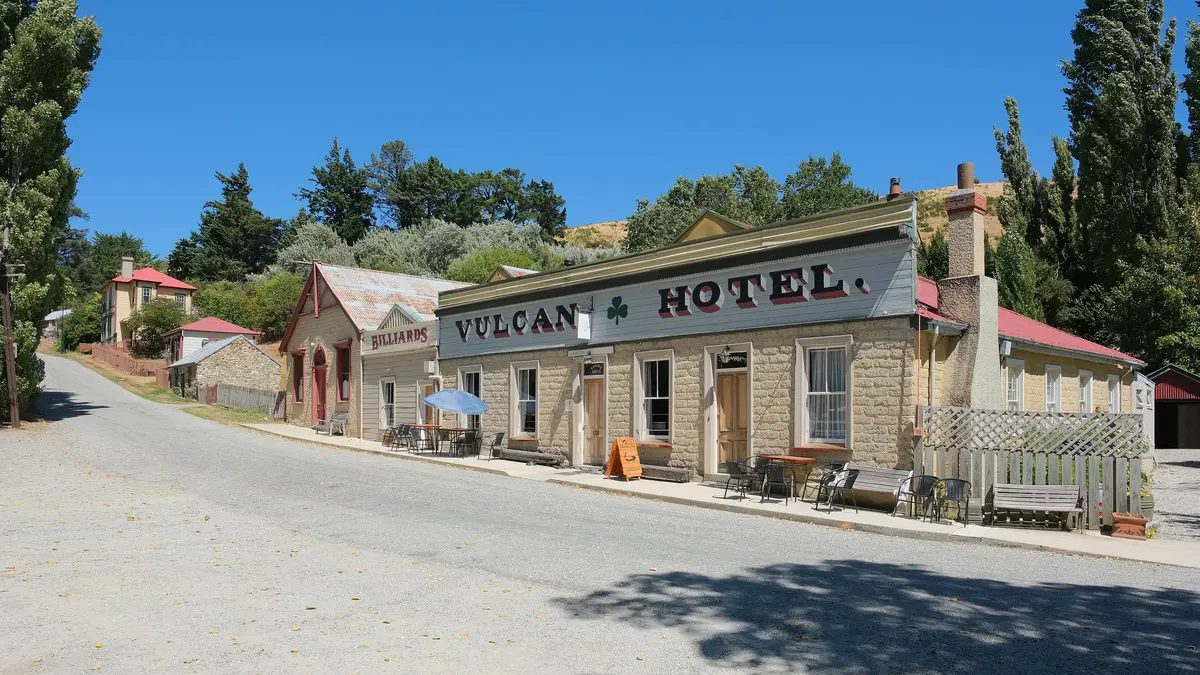
That survivor is the building on Loop Road with VULCAN HOTEL painted across a timber false front. It did not start life under that name, and this is the single fact that undoes almost everything told about its ghost.
Heritage New Zealand's report is explicit: "The first hotel proven to be on the site of the current Vulcan Hotel is the Ballarat Hotel." A newspaper report from July 1868 records that Patrick Hanrahan, an Irish miner who had reached St Bathans with three siblings and their widowed mother in 1863-4, opened his "new house" to replace his earlier Cornwall Arms, which had burnt down after a fire started in a guest's room. The town threw him a complimentary ball and supper in the attached billiard hall: over one hundred people danced until dawn to McGillvery's quadrille band. An 1877 photograph shows two corrugated-iron sheds with false fronts reading "The Billiard Saloon" and "The Ballarat Hotel, P. Hanrahan." Hanrahan rebuilt it in mud brick in 1882, with Thomas Griffiths and John Gallagher as builders — bricks of clay and straw shaped in wooden moulds, air-dried, laid in lime mortar or clay slurry. It is that 1882 fabric, Category 1 on the New Zealand Heritage List since 2010, that visitors sleep in.
Meanwhile there was a real Vulcan Hotel, and it was somewhere else. The hotel's own history page — the version published by earlier owners and archived in March 2023 — names its founder as Samuel Hanger, a blacksmith from Tasmania who sailed to Otago on the Aldinga in November 1862, supplied miners with sluice pipes, and began serving them in a calico tent in 1864. In 1869, "with thirteen hotels in opposition", he opened the Vulcan in a corrugated-iron building with two doors and two windows; the name fits, Vulcan being the Roman god of the forge. He added a billiard annexe across the road in 1874 and died in 1879. His widow Mary sold to John and William Thurlow in 1888.
That Vulcan burned three times. The Star of 2 May 1889 reported the first: the fire "destroyed the drapery stores and stables of W. McConnochie and Thurlow's Vulcan Hotel", the hotel insured for 600 pounds with the Standard. It was rebuilt; when William Thurlow died on 31 January 1902 the Otago Witness printed his portrait and called him "one of the earliest of the Otago Goldfields' pioneers" and "for many years past managing partner of the Vulcan Hotel, St. Bathans". Fire took the building again in 1914, it was rebuilt in red brick, and fire took it a third and final time in 1931. Heritage New Zealand: "In about 1931 the name of the Ballarat Hotel was changed to the Vulcan, after the Vulcan Hotel (around the corner to the north-west of the Ballarat) was destroyed by fire."
The landscape has a parallel story. In 1873 John Ewing formed the St Bathans Channel Company to work the Kildare Hill claim, cut a tailings channel and introduced hydraulic elevating; the claim became the deepest hydraulic elevating operation in the world, turning a 120-metre hill into a 68-metre hole. Ewing's work stopped in 1902 for want of fall in the tailings channel and he was bankrupt by 1905; the Scandinavian Water Race Company took the claim and worked it until it was abandoned for fear of undermining the town itself. Drainage off the surrounding hills did the rest. DOC records that "by 1936... there was a lake", its bottom "some 40 metres below the town's main street", coloured by the minerals it dissolved. The published end date for the mining varies by source between 1932 and 1934.
The town emptied with the gold. Where the main street once held some forty businesses, a straggle of buildings remains. In 1987 residents formed a company, Vulcan Hotel Ltd, to buy the pub and keep it local. In 1998, facing a call to sell, the shareholders voted to keep it and upgrade the showers instead; the hotel then had three bedrooms and slept seven. Jude and Mike Kavanagh ran it for nineteen years and put it on the market in 2018.
One more thing lies under St Bathans, and it is not a ghost. The beds along the Manuherikia River near the village hold the St Bathans Fauna, the first substantial pre-Quaternary land vertebrate fauna found in New Zealand, laid down 19 to 16 million years ago in a shallow lake. In 2006 Trevor Worthy, Alan Tennyson and colleagues described in PNAS a mouse-sized land mammal from those sediments — an animal that should not exist in a country with no native land mammals but bats. Their title calls it a Mesozoic ghost lineage.
Timeline: the documented record of St Bathans (Vulcan Hotel)
- July 1868 Patrick Hanrahan opens the Ballarat Hotel on the site of today's Vulcan, replacing his Cornwall Arms, which had burnt down after a fire started in a guest's room. The town gives him a complimentary ball and supper: over a hundred people dance until dawn to McGillvery's quadrille band.
- 1869 Samuel Hanger, a Tasmanian blacksmith who had been serving miners from a calico tent since 1864, opens the original Vulcan Hotel - a corrugated-iron building with two doors and two windows, around the corner to the north-west, 'with thirteen hotels in opposition'. This, and not the Ballarat, is the Vulcan of the ghost story's dates.
- 14 September 1871 The Otago Witness reports that St Bathans had 'a marriage, a birth, a death and a funeral' in one day. The dead woman was the wife of Claus Gerkins, manager of the public channel; she had spent the previous night 'assisting at the sad preparations for the funeral of the child of Mr P. Hanrahan of the Ballarat Hotel', was confined prematurely at about ten the next morning and died that afternoon as the funeral procession went to the cemetery. The infant survived.
- 1873 John Ewing forms the St Bathans Channel Company to work the Kildare Hill claim, cuts a tailings channel and introduces hydraulic elevating. The claim becomes the deepest hydraulic elevating operation in the world and turns a 120-metre hill into a 68-metre pit - kept drained, because that is how the gold is won.
- 1882 Hanrahan rebuilds the Ballarat Hotel in mud brick, with Thomas Griffiths and John Gallagher as builders. This is the fabric that stands today and that Heritage New Zealand listed as a Category 1 historic place in 2010.
- 22-23 July 1885 A documented death in the building. The Otago Witness reports that James Callaghan, a miner living at St Bathans, was cantering near Cambrians on the afternoon of Wednesday 22 July when his horse stumbled; he fell on his head, fractured his skull 'in a shocking manner' and was carried to the Ballarat Hotel. Doctors Hyde of Ophir and Whitton of Naseby attended, but he 'remained insensible and speechless' and died about twenty hours later. Some 300 people followed him to the Catholic cemetery. He was from near Adare, County Limerick.
- 1-2 May 1889 Fire destroys 'the drapery stores and stables of W. McConnochie and Thurlow's Vulcan Hotel', reported the Star. The hotel was insured for 600 pounds with the Standard; McConnochie was expected to lose about 4,000 pounds over his insurance. It is the first of the three fires that end the original Vulcan.
- 31 January 1902 William Thurlow, 'familiarly known as Uncle', dies at St Bathans. The Otago Witness prints his portrait and calls him one of the earliest of the Otago goldfields' pioneers and 'for many years past managing partner of the Vulcan Hotel, St. Bathans'.
- about 1931 The original Vulcan Hotel burns for the third and last time, and its licence and its name are transferred to the empty Ballarat Hotel building. From this date, and only from this date, the mud-brick pub of 1882 is called the Vulcan Hotel.
- 20 August 2010 Heritage New Zealand registers the Vulcan Hotel as a Category 1 historic place (List No. 2259). Its report dates the ghost itself: 'In the 1990s and early 2000s the Vulcan gained some notoriety for its resident ghost. Articles appeared in the Otago Daily Times and the Hotel featured in the 2005 television series Ghost Hunt, and the resulting book.'
- 9 December 2018 The Otago Daily Times interviews Jude Kavanagh, nineteen years the licensee, as she and her husband put the pub up for sale. Her version has no murder in it: 'the ghost is the Rose of St Bathans, a young woman who died in one of the rooms of the hotel more than 100 years ago'. She adds: 'I'm not a great believer in ghosts, but I've seen shadows.' The article gives the village a permanent population of eight.
- 12 February 2022 The hotel's own website publishes the full lurid version - Rosie the singer and prostitute, strangled and robbed of her gold in the early 1880s, her body thrown into the lake - credits it to the paranormal researcher Mark Wallbank, and closes with 'Spend a night in Room 1... If you dare!'. By 2026 the current owners have cut it back to 'a disagreement with a miner' whose details 'have faded with time'.
Is there a rational explanation for St Bathans (Vulcan Hotel)?
The legend has a fixed shape. In the version the hotel itself published in February 2022, an itinerant prostitute called Rosie, a gifted singer who worked the dance halls, rented a room at the Vulcan in the early 1880s, "invited the wrong client back to her room and she was strangled and robbed of her gold... Her body was thrown into the lake and her killer has never been caught." The page ends: "Spend a night in Room 1... If you dare!" That version is credited on the page to the paranormal researcher Mark Wallbank, who had published essentially the same account on his own site in November 2015.
Three things in it cannot be true at once.
First, the building. In the early 1880s this pub was the Ballarat Hotel; Heritage New Zealand's report states that the name Vulcan moved onto it only in about 1931. The Vulcan that existed in the 1880s was Samuel Hanger's, around the corner to the north-west, and it burned down in 1889, 1914 and 1931. A woman who rented a room at the Vulcan in the 1880s rented it in Samuel Hanger's old building, run after his death by his widow Mary; the building whose Room 1 is let today was then Patrick Hanrahan's Ballarat Hotel.
Second, the lake. Rosie's body is thrown into the Blue Lake, but in the 1880s there was no lake to throw it into. Kildare Hill was an active hydraulic sluicing claim, worked by John Ewing's St Bathans Channel Company from 1873 and by the Scandinavian Water Race Company after 1905; the pit was kept drained to be worked, and it only filled once the work was abandoned in the 1930s.
Third, the archive. New Zealand digitised its old newspapers and made them free, so this is checkable. Searched on 13 August 2026 through the National Library's Papers Past collection, and again on 8 October 2026 through the DigitalNZ API with identical results, "St Bathans" returns 13,492 articles and "Dunstan Creek" 1,418; the two hotels are there too, 114 articles for "Vulcan Hotel" with "St Bathans" and 102 for "Ballarat Hotel" with "St Bathans". The corpus answers. Against those controls: "Vulcan Hotel" with "ghost" returns 0, with "haunted" 0; "strangled" with "Vulcan Hotel" returns 0; "murdered at St Bathans" returns 0; "Rose of St Bathans" returns 0. The five hits for "St Bathans" with "charged with murder" are killings at Green Island, Tuapeka Mouth, Nenthorn and Dunedin that merely share a page with the words. The two hits for "Ballarat Hotel", "St Bathans" and "inquest" are a licensing hearing about a death at Clark's Junction and a stabbing at Gore. The sampled coverage of these Otago titles runs from the 1860s into the 1920s — precisely the window the legend claims. A repeat of every count returned the same figures.
Someone else did this work first. Under Wallbank's own article, a commenter signing as Dave Smith wrote on 21 December 2020: "Stayed the night there once and experienced nothing. There is nobody in any of the local graveyards, nor are there any newspaper articles or court news accounts that back up in any way, shape or form the story of the prostitute Rose." He then posted links to the two real deaths he had found instead, and both check out.
The earliest datable print appearances of the story are recent. Heritage New Zealand, writing its registration report in 2010, treats the ghost as a modern development: "In the 1990s and early 2000s the Vulcan gained some notoriety for its 'resident ghost.' Articles appeared in the Otago Daily Times and the Hotel featured in the 2005 television series 'Ghost Hunt', and the resulting book." That is a gap of roughly a century between the murder the story dates to the 1880s and the story's first traceable circulation.
And the detail is unstable, which is what a folk tale does and a record does not. On 9 December 2018 the Otago Daily Times interviewed Jude Kavanagh, who had by then run the pub for nineteen years. Her version has no prostitute, no strangling, no gold and no lake: "the ghost is the 'Rose of St Bathans', a young woman who died in one of the rooms of the hotel more than 100 years ago." She was candid about what she had and had not seen: "I'm not a great believer in ghosts, but I've seen shadows, and you never feel as if you're on your own." She also described the mechanism plainly - "A lot of guests ask to be put in her room" - and the phenomena reported by people who asked for it: being "gently pressed in their bed", hearing "chains drag along the floor". By 2026 the hotel's current owners had sanded the story back down again: Rosie's "life was cut tragically short after a disagreement with a miner", and "the details have faded with time". The page is headed "Meet Rosie" and its button reads "Share a Room with Rosie".
That is the last piece: the incentive is printed on the hotel's own page. Four rooms are let above a bar, and one of them is the famous one. Around it stands a mud-brick building put up in 1882 with no cavity and no insulation, in a village of eight permanent residents where the pub shuts at half past seven and the winter frosts have reached -22C. Old adobe and old timber tick as they cool; a house with nobody else awake in it sounds like a house with somebody in it. None of that is proof that nothing happens in Room 1. It is a reminder that the murder said to have caused it left no body, no inquest, no charge and no line of newsprint, in a country that kept the newsprint.
Can you visit St Bathans (Vulcan Hotel)?
The Vulcan Hotel stands on the west side of Loop Road, the street at the centre of St Bathans, and gives its own address as 1670 St Bathans Loop Road, Saint Bathans, Central Otago. Heritage New Zealand entered it on the List on 20 August 2010 as a Category 1 historic place (List No. 2259), and its registration report describes a single-storey mud-brick building with a timber false front bearing the hotel's name. The hotel is trading: on 24 September 2026 its website gave opening hours of 11am to 7.30pm seven days a week, closed on Good Friday, with meals in the dining room or the garden bar, the telephone +64 3 447 3629 and the e-mail [email protected].
There are four guest rooms with shared bathrooms along the hallway. The website lists Rooms 1 and 2 as rooms and Rooms 3 and 4 as bunk rooms, with linen, towels and heating provided, and places them upstairs; the Heritage New Zealand report puts the accommodation wing, with four bedrooms, through a doorway to the right of the bar, and records that in 1998 the hotel had three bedrooms sleeping seven guests. The hotel's Meet Rosie page says that most of the ghost stories centre on Room One and that some guests book it for that reason. Bookings are taken by telephone or through the contact form. The hotel's 2026 accommodation policy, linked from every page of the site, allows free cancellation up to seven days before arrival and charges a pet fee of NZ$25 a night; dogs are allowed in the bar and kept out of the dining room. No room rates were published on the site on 24 September 2026.
The Department of Conservation places St Bathans 60 km north-east of Alexandra off State Highway 85, the road from Alexandra to Ranfurly, and describes it as a popular side trip from the Otago Central Rail Trail; the St Bathans community site gives it as 40 km north-west of Ranfurly. The publican Jude Kavanagh told the Otago Daily Times in 2018 that the village had six feet of snow in 2013, that she remembered a frost of -22C, and that the coldest that year had been -12C.
The Blue Lake lies across the road from the hotel. It fills the working of the Kildare Hill claim, where, in the community's account, hydraulic elevating turned a 120-metre hill into a 68-metre hole before mining was abandoned in 1932 for fear of undermining the town; DOC gives the lake bottom as "some 40 metres below the town's main street". A 2 km track with history plaques goes round it, and the community site calls it a summer swimming spot and a winter ice-swimming location. The mud-brick St Bathans Hall, built in 1892-93 by the local publican, is described by DOC as the oldest continually used mud-brick hall in New Zealand; it is a Category II historic place, one of 21 sites in the Otago Goldfields Park, and opens to the public from Labour Weekend to Easter every year. DOC dates the post office to 1909, the third built on its site. The Otago Daily Times gave the permanent population as eight in 2018, with about fifteen holiday homes, and the Heritage New Zealand report of 2010 as about a dozen.
Sources consulted
- Heritage New Zealand Pouhere Taonga, «Vulcan Hotel, St Bathans - List No. 2259, Category 1 historic place (registration report)» — New Zealand Heritage List / Rarangi Korero, 2010 report
- Correspondent, «ST. BATHANS. [a marriage, a birth, a death and a funeral in one day]» — Otago Witness, 1871 newspaper archive
- Correspondent, «ST. BATHANS. Fatal accident [death of James Callaghan at the Ballarat Hotel]» — Otago Witness, 1885 newspaper archive
- Press Association, «The Fire at St Bathans [Thurlow's Vulcan Hotel and McConnochie's drapery destroyed]» — Star (Christchurch), 1889 newspaper archive
- Otago Witness, «THE LATE MR WM. THURLOW, familiarly known as 'Uncle', who died at St. Bathans on January 31, 1902» — Otago Witness, 1902 newspaper archive
- Mark Wallbank, «The Vulcan Hotel, St Bathans (with reader comment by 'Dave Smith', 21 December 2020)» — Haunted Auckland / Paranormal New Zealand, 2015 web
- Pam Jones, «Historic Vulcan Hotel up for sale» — Otago Daily Times, 2018 newspaper archive
- Vulcan Hotel, St Bathans, «Vulcan Hotel History (former official website, archived 21 March 2023)» — vulcanhotel.kiwi via the Internet Archive, 2023 archive
- Vulcan Hotel, St Bathans, «Ghost Stories - Rose (former official website, archived 30 November 2022)» — vulcanhotel.kiwi via the Internet Archive, 2022 archive
- Vulcan Hotel, St Bathans, «Meet Rosie, About, Accommodation and Activities (current official website, consulted 13 August 2026)» — vulcanhotel.nz, 2026 web
- Department of Conservation Te Papa Atawhai, «St Bathans area: Places to go in Otago» — doc.govt.nz, 2026 web
- St Bathans Community, «The History of St Bathans - the Blue Lake and Kildare Hill» — stbathans.nz, 2026 web
- Trevor H. Worthy, Alan J. D. Tennyson and colleagues, «Miocene mammal reveals a Mesozoic ghost lineage on insular New Zealand, southwest Pacific» — Proceedings of the National Academy of Sciences 103(51), 19419-19423, 2006 academic
- National Library of New Zealand Te Puna Matauranga o Aotearoa, «Papers Past - full-text search of digitised New Zealand newspapers (Otago titles), searched 13 August 2026 and again 8 October 2026 via the DigitalNZ API» — paperspast.natlib.govt.nz, 2026 archive
- Vulcan Hotel, St Bathans, «Accommodation, Rooms 1 & 2, Rooms 3 & 4, Book Now and Contact — current official website, with the linked 2026 accommodation policy (cancellation and dogs)» — vulcanhotel.nz (consulted 24 September 2026), 2026 web
Reviewed by V. Serrano on 2026-08-13 · How we verify our content
💬 Field testimonies (0)
No testimonies yet. Add the first.
Add your testimony
🔒 Log in to add a testimony