📜 LEGEND · EXP. Nº3657
ACTIVE
Baba Yaga and Vasilisa the Beautiful
Baba Yaga and Vasilisa the Beautiful is a legend from RU — a folk story passed down over generations. This file collects its origins, its meaning and how it has been retold.
Where does the legend of Baba Yaga and Vasilisa the Beautiful come from?
- Location
- RU
- Kind of legend
- Folk tale
- Coordinates
- 56.0, 38.0
- Testimonies
- 0
- Last updated
LOCATION
What is the legend of Baba Yaga and Vasilisa the Beautiful?
Afanasyev printed "Vasilisa the Beautiful" in the fourth fascicle of his Russian Folk Tales in 1858, as tale no. 44 — no. 104 in modern editions. A merchant's wife dies when her daughter is eight and leaves her a doll "together with my parental blessing": feed it, and ask its advice. The stepmother puts out the household fire and sends Vasilisa into the forest to beg a light from Baba Yaga. Three horsemen pass her on the road — white, red and black, the witch's own bright day, red sun and dark night. In Afanasyev's text the hut stands on nothing remarkable; it is the gate that is monstrous, with human legs for gateposts, hands for bolts and a toothed mouth for a lock, under a fence of bones topped with skulls whose eyes light the clearing. The doll, not Vasilisa, does the impossible work of sorting wheat from nigella and poppy seed from earth. Asked how she manages it, Vasilisa answers "my mother's blessing helps me", and that is what gets her thrown out — with a burning skull on a stick, which reduces the stepmother and stepsisters to coal. The tale does not end there: the last third takes her to the city, to a loom, and to the Tsar.
What is the history of Baba Yaga and Vasilisa the Beautiful?
Afanasyev printed "Vasilisa the Beautiful" in the fourth fascicle of his Narodnye russkie skazki (Russian Folk Tales), as tale no. 44 — that is how W. R. S. Ralston cited it in 1873, and it is the number the tale carried before the modern academic editions renumbered it 104. The eight fascicles were issued in Moscow by the publisher Kozma Soldatenkov between 1855 and 1863; the fourth is dated 1858, with a second printing in 1860. Afanasyev was an archivist rather than a field collector: most of his corpus reached him already written down, from the manuscript holdings of the Russian Geographical Society and from the papers of the lexicographer Vladimir Dal.
The Russian text runs to roughly 2,500 words, and it repays being read rather than remembered, because the version that circulates is not quite it. A merchant, twelve years married, has one daughter. When the mother dies Vasilisa is eight years old, and from under the bedclothes the dying woman takes out a doll: "together with my parental blessing I leave you this doll; keep it always by you and show it to no one, and when some grief befalls you, give it food and ask its advice." The father remarries, the stepmother moves the household to the edge of a deep forest, the candles are put out one autumn night, and Vasilisa is pushed out of the door to go and beg fire from Baba Yaga.
Three horsemen overtake her on the road: one white on a white horse, and it begins to grow light; one red on a red horse, and the sun rises; one black on a black horse who reaches the gate and vanishes, and night falls. What she finds in the clearing is the passage our own entry had lost. "A fence around the hut made of human bones; on the fence stick up human skulls, with eyes in them; instead of gateposts — human legs; instead of bolts — hands; instead of a lock — a mouth with sharp teeth." The hut itself is simply an izba standing on a clearing. In this tale it does not stand on chicken legs and it does not turn.
Baba Yaga comes out of the forest riding in a mortar, driving with the pestle and sweeping away her trail with a broom. She sets two tasks: clean a quarter-measure of wheat of its chernushka — nigella, a black seed, glossed as a herbaceous plant in the Wikisource footnote — and then clean a measure of poppy of the earth someone has mixed into it, grain by grain. Vasilisa does neither. She feeds the doll, the doll says "morning is wiser than evening", and in the morning the work is done and the doll is picking the last black grains out of the wheat, leaving her only the cooking. When Baba Yaga inspects it she calls out "my faithful servants, friends of my heart" and three pairs of hands appear, seize the wheat and carry it off to be ground; the next night they come back to press the oil from the poppy.
Then the two of them question each other, and this is the hinge of the tale. Vasilisa asks about the three horsemen and is told: "That is my bright day", "that is my red sun", "that is my dark night — all of them my faithful servants." She remembers the three pairs of hands and says nothing, and Baba Yaga approves: "It is well that you ask only about what you saw outside the yard and not inside it. I do not like my dirty linen washed in public, and I eat the too curious." Then it is Baba Yaga's turn. How does she get the work done? "My mother's blessing helps me," Vasilisa answers — and that answer is what expels her: "So that is it! Get away from me, blessed daughter. I have no use for the blessed." She is dragged out of the room and pushed through the gate, and Baba Yaga lifts one skull with burning eyes off the fence, sticks it on a stick and hands it over: "here is fire for your stepmother's daughters; that is what they sent you here for."
The skull's eyes burn the stepmother and the two stepsisters to coal by morning, and Vasilisa alone is untouched. The tale does not end there, and roughly the last third of the Russian text is what happens next: she buries the skull in the ground, locks the house, walks to the city and lodges with a childless old woman; she asks for flax, spins thread as fine as a hair, has a loom made, weaves linen so fine it will pass through the eye of a needle; the old woman carries it to the Tsar as a gift, no seamstress can be found to cut it, Vasilisa sews a dozen shirts, the Tsar sends for the woman who made them, sees her and marries her. Her father comes home and stays with her, she takes the old woman into her household, and the doll she carried in her pocket to the end of her life.
Timeline: the documented record of Baba Yaga and Vasilisa the Beautiful
- 1858 The fourth fascicle of Afanasyev's Narodnye russkie skazki appears in Moscow from the publisher Kozma Soldatenkov, carrying "Vasilisa the Beautiful" as tale no. 44; a second printing of that fascicle follows in 1860. Ralston cites the tale by that number in 1873. Modern academic editions renumber it 104.
- 1873 W. R. S. Ralston publishes "Vasilissa the Fair" in Russian Folk-Tales, citing "Afanasief, iv. No. 44". He translates the gate of human legs, arms and teeth faithfully and gives the hut no chicken legs — while using "fowl's legs" four times elsewhere in the same book for other tales. He then breaks off at the burning of the stepmother and prints the rest as a bracketed epitome, explaining in a footnote that what follows "is inferior in dramatic interest".
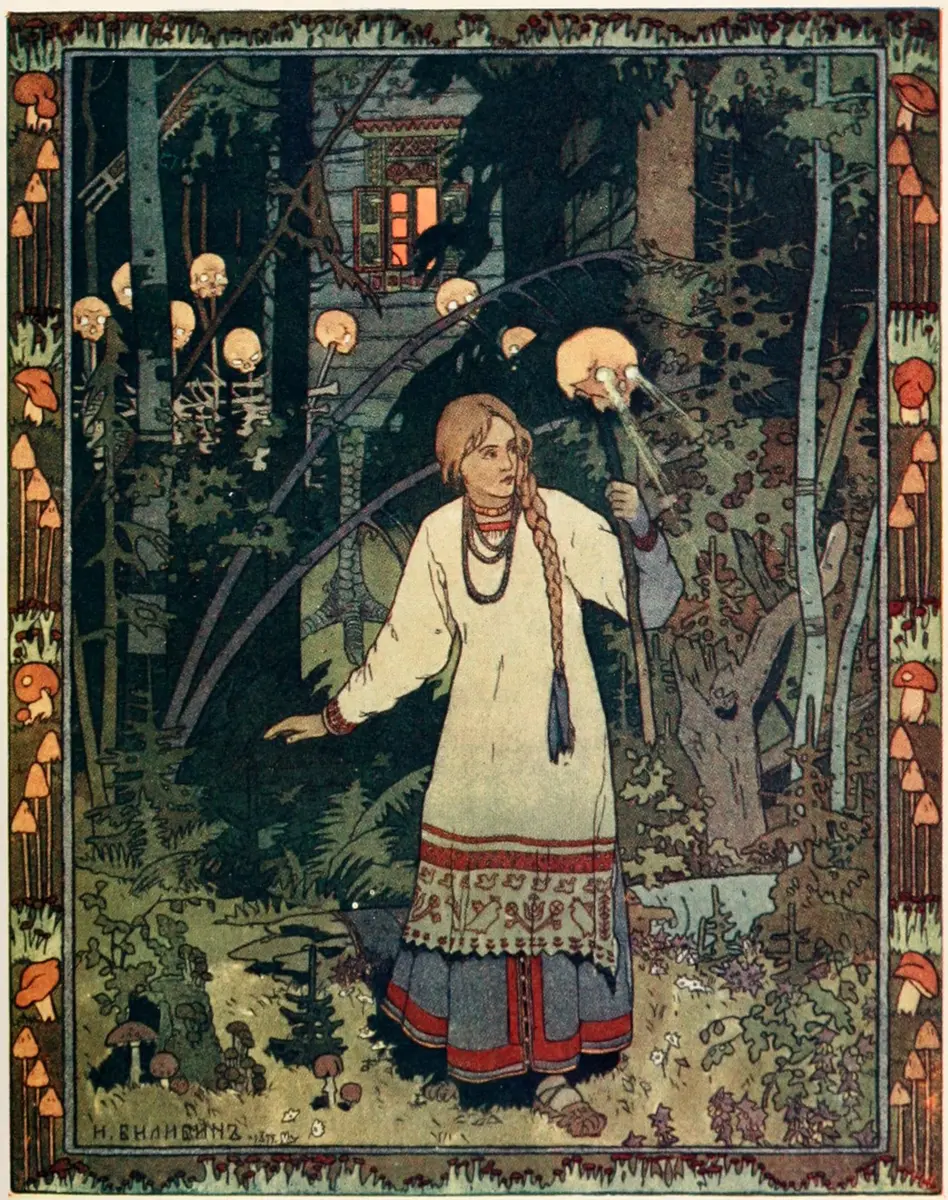
- 1900 (drawings 1899–1900) The Expedition for Preparing State Papers in St Petersburg publishes Ivan Bilibin's illustrated Vasilisa Prekrasnaya; a chromolithographic issue of 32.5 by 25.5 cm follows in 1902. The best known plate of the cycle is the one on this page: Vasilisa in the night forest with the skull on a stick.
- 1912 Post Wheeler, then secretary of the American embassy at St Petersburg, publishes Russian Wonder Tales with twelve Bilibin plates used "by special permission". His "Wassilissa the Beautiful" is the first English version to say that the hut "stood on its hens' legs", three times over, and it drops the arms that served as bolts. This is the wording that reached later retellings, and the plate facing his page 50 is the image this page carries.
- 16 August 2026 This entry is rewritten against the Russian text and the two English translations. A search of tale no. 104 for the chicken-leg formula returns zero, against fourteen other Afanasyev tales carrying it in the same index and pass. The claim was removed, the human legs, arms and toothed mouth of the gate restored, the tasks returned to the doll that actually performs them, and the last third of the story — the linen, the Tsar and the marriage — restored.
Is there a rational explanation for Baba Yaga and Vasilisa the Beautiful?
There is nothing supernatural here to adjudicate: this is a wonder tale, and it says so in its first four words. What can be checked is the text, and the checks are cheap and they came out badly for the version this page used to carry.
The hut on chicken legs is not in this tale. Searching the Russian text of no. 104 for the roots kur'ikh / kurinykh nozhkakh returns zero. That zero is controlled: the same search index, run over the same collection in the same pass, returns fourteen other Afanasyev tales that do contain the formula — twelve with kur'ikh nozhkakh, among them "Gusi-lebedi", "Tereshechka", "Pyoryshko Finista" and the tale actually titled "Baba Yaga", and two more with kurinykh nozhkakh. So Afanasyev has the chicken-legged hut in abundance; he simply does not put it in this story, where the legs at Baba Yaga's gate are human.
The same result falls out of the two English versions, and it dates the error. Ralston translated the tale closely in 1873 and kept the fence intact — "instead of uprights at the gates were men's legs; instead of bolts were arms" — while using the phrase "fowl's legs" four times elsewhere in the very same volume for other Baba Yaga stories: the distinction was deliberate. Post Wheeler's translation of 1912 is where the chicken legs enter: "the wretched little hut stood on its hens' legs", three times. Wheeler also quietly loses the arms that served as bolts, demotes the human legs to "the bones of human feet" used as hinges, and turns the toothed mouth into "jaw-bones". Our own text inherited Wheeler's hens' legs and then added something that is in neither translator: that the hut turns.
The missing ending has an author too, and he explained himself in print. Ralston stopped his translation at the moment the stepmother and stepsisters are burnt, and set the remainder in brackets and small type with this note: "I break off the narrative at this point, because what follows is inferior in dramatic interest, and I am afraid of diminishing the reader's admiration for one of the best folk-tales I know." That is a signed, dated decision from 1873 to amputate the last third of the story, and the short summaries in English have ended at the ashes ever since. Ours did too.
One more correction, and it runs the other way. The claim that the doll stands for a mother's blessing is not a gloss added by later storytellers: the blessing is stated twice inside Afanasyev's text, once by the dying mother who bequeaths the doll "together with my parental blessing" and once by Vasilisa herself, whose answer "my mother's blessing helps me" is the line that gets her thrown out of the house. Attributing it vaguely to "storytellers across Russia" made a plot point sound like folk wisdom and removed the only place a reader could go to check it. The doll had already drawn commentary by 1873, when Ralston devoted several pages to it, noting that it is called a kukla in the original and comparing it with a Little Russian variant in which the dead mother comes out of her grave to advise her daughter.
Can you visit Baba Yaga and Vasilisa the Beautiful?
There is nothing to visit, and that is not a limitation of this entry but a statement made by the source. Afanasyev's text opens "v nekotorom tsarstve" — "in a certain kingdom" — the standard opening formula of the Russian skazka, whose whole function is to decline to say where. No province, no river, no town and no forest is named anywhere in the 2,500 words. Any point on a map attached to this tale is an editorial guess, including the one this page has carried.
What can be visited is the text, and all of it is free. The Russian original of no. 104 is transcribed in full on Russian Wikisource from the modern academic edition, with the footnote identifying chernushka. Ralston's 1873 translation, "Vasilissa the Fair", is in Russian Folk-Tales at pages 150 to 158, scanned at the Internet Archive; read it with the bracketed epitome at the end, which is where the second half of the story went. Post Wheeler's 1912 translation, "Wassilissa the Beautiful", is at pages 27 to 54 of Russian Wonder Tales, also at the Internet Archive, and it is the book from which the illustration on this page is taken.
That illustration is by Ivan Bilibin, from the cycle he drew for Vasilisa Prekrasnaya in 1899–1900 and which the Expedition for Preparing State Papers in St Petersburg published as an illustrated booklet, first in 1900 and again in 1902 in chromolithography at 32.5 by 25.5 cm. It shows Vasilisa in the night forest holding the skull on its stick, its eyes throwing beams, with the skull-topped poles around her and the lit window of the hut behind. Wheeler's 1912 volume reproduces twelve of these plates and states on its list of illustrations that they come from the Expedition series and are "used by special permission"; this one faces his page 50. The originals are widely held in Russian public collections and the plates are long out of copyright.
Sources consulted
- А. Н. Афанасьев, «Василиса Прекрасная (№ 104)» — Народные русские сказки; first printed in fascicle IV (1858, 2nd printing 1860). Full Russian text (c. 2,500 words) consulted in the Russian Wikisource transcription of the modern academic edition, with the editorial footnote identifying chernushka, 1858 book
- W. R. S. Ralston, «Vasilissa the Fair, in Russian Folk-Tales, pp. 150–158» — Smith, Elder & Co., London. Cites its source as "Afanasief, iv. No. 44". Contains the translator's footnote explaining why he breaks off the narrative, and uses "fowl's legs" four times elsewhere in the volume for other Baba Yaga tales. Full scan consulted at the Internet Archive, 1873 book
- Post Wheeler, «Wassilissa the Beautiful, in Russian Wonder Tales, pp. 27–54» — The Century Co., New York. With a foreword on the Russian skazki and twelve plates by I. A. Bilibin, stated in the list of illustrations to come from the Expedition for Preparing State Papers series and used "by special permission". Full scan consulted at the Internet Archive, 1912 book
- Ivan Bilibin, «Russian Wonder Tales 081 — Bilibin plate of Vasilisa with the skull» — Wikimedia Commons file record for the plate used on this page: drawing dated 1899, sourced to the Internet Archive scan of Wheeler 1912, uploaded 27 June 2018, public domain (PD-Russia-expired). Bilibin's illustrated Vasilisa Prekrasnaya was published by the Expedition for Preparing State Papers, St Petersburg, first in 1900, with a chromolithographic issue of 32.5 by 25.5 cm in 1902, 1899 archive
- Russian Wikipedia contributors, «Народные русские сказки (сборник Афанасьева)» — Consulted for the publication history of the collection: eight fascicles issued 1855–1863 by Kozma Soldatenkov, with fascicle IV dated 1858 and reprinted 1860, and for the posthumous four-volume second edition of 1873 prepared by Afanasyev himself, 2026 web
Reviewed by V. Serrano on 2026-08-16 · How we verify our content
📎 Source: Enigma Atlas
💬 Field testimonies (0)
No testimonies yet. Add the first.
Add your testimony
🔒 Log in to add a testimony